- 1. What is a vector?
- 2. How do you add two arrows?
- 3. Breaking a vector into parts
- 4. Adding vectors with numbers
- 5. Velocity and acceleration in a plane
- 6. Motion in a plane with constant acceleration
- 7. How does a thrown ball move?
- 8. How high, how long, how far?
- 9. Why is steady circling still accelerating?
- Review
5 of 9·NCERT §3.7 · §3.7.1·pp. 34–37·6 min
Velocity and acceleration in a plane
The big ideaIn a plane, velocity is the rate of change of the position vector and always points along the path; acceleration is the rate of change of velocity and can point any way.
In simple words
Watch a bike going round a bend. At each moment it is heading straight along the road just where it is, like an arrow touching the curve. To turn, something has to push it sideways. So the "going" arrow lies along the road, but the "change" arrow can point off to the side.
Position and displacement
Set up x- and y-axes with origin O. A particle at point P with coordinates \( (x, y) \) has position vector
\[ \mathbf{r} = x\,\hat i + y\,\hat j \]Its components are simply its coordinates. Suppose it moves along a curved path and is at P at time \( t \) and at P′, with coordinates \( (x', y') \), at time \( t' \). The displacement is the change in position vector, an arrow from P to P′:
\[ \Delta\mathbf{r} = \mathbf{r}' - \mathbf{r} = (x' - x)\,\hat i + (y' - y)\,\hat j = \Delta x\,\hat i + \Delta y\,\hat j \]A long-exposure photograph shows a whole path at once. Each car's lights draw its trajectory; at every instant the car was somewhere on that streak, and its position vector from any chosen origin pointed there.
 one car's path, traced by its lightsvelocity: along the streak, at every point
Velocity
The average velocity over the interval \( \Delta t = t' - t \) is the displacement divided by the time:
\[ \mathbf{v}_{\text{avg}} = \frac{\Delta\mathbf{r}}{\Delta t} = \frac{\Delta x}{\Delta t}\,\hat i + \frac{\Delta y}{\Delta t}\,\hat j \]Dividing a vector by a positive number keeps its direction, so the average velocity points the same way as \( \Delta\mathbf{r} \): along the straight chord from P to P′, cutting across the curve.
The instantaneous velocity (or just velocity) is what the average velocity becomes when the time interval is made smaller and smaller, towards zero:
\[ \mathbf{v} = \lim_{\Delta t \to 0}\frac{\Delta\mathbf{r}}{\Delta t} = \frac{d\mathbf{r}}{dt} \]Picture what happens as \( \Delta t \) gets smaller. P′ slides back along the curve towards P, and the chord PP′ swings round. In the limit the chord just touches the curve at P: it becomes the tangent. So the velocity at any point is along the tangent to the path, in the direction of motion.
Try it: guess first, then shrink the time step and watch the chord turn into the tangent.
You can see the tangent rule with your own eyes in a workshop. Bits of hot metal torn off a spinning grinding wheel keep the velocity they had at the moment they left the rim, so each spark flies off along the tangent, in a straight line.
 each spark flies off along the tangentwheel meets the pipe here
In components,
\[ \mathbf{v} = v_x\,\hat i + v_y\,\hat j, \qquad v_x = \frac{dx}{dt}, \quad v_y = \frac{dy}{dt} \]If \( x \) and \( y \) are known as functions of time, differentiate each to get \( v_x \) and \( v_y \). The speed and direction are then
\[ v = \sqrt{v_x^2 + v_y^2}, \qquad \tan\theta = \frac{v_y}{v_x} \]where θ is the angle of the velocity with the x-axis, so \( v_x = v\cos\theta \) and \( v_y = v\sin\theta \).
Acceleration
The average acceleration is how much the velocity vector changed, divided by the time it took, and the instantaneous acceleration is its limit:
\[ \mathbf{a}_{\text{avg}} = \frac{\Delta\mathbf{v}}{\Delta t}, \qquad \mathbf{a} = \lim_{\Delta t \to 0}\frac{\Delta\mathbf{v}}{\Delta t} = \frac{d\mathbf{v}}{dt} \] \[ \begin{gathered} \mathbf{a} = a_x\,\hat i + a_y\,\hat j \\ a_x = \frac{dv_x}{dt} = \frac{d^2x}{dt^2}, \quad a_y = \frac{dv_y}{dt} = \frac{d^2y}{dt^2} \end{gathered} \]To find the direction of \( \Delta\mathbf{v} \), draw the velocity at P and the velocity at P′ tail to tail; \( \Delta\mathbf{v} = \mathbf{v}' - \mathbf{v} \) is the arrow from the head of the first to the head of the second (the triangle law). The average acceleration points along this \( \Delta\mathbf{v} \). As \( \Delta t \) shrinks, the direction of \( \Delta\mathbf{v} \) changes, and in the limit it gives the direction of the instantaneous acceleration.
On a curved path the velocity keeps turning, so \( \Delta\mathbf{v} \) has a sideways part, pointing towards the inside of the bend. That is why acceleration, unlike velocity, need not lie along the path.
Don't mix these up
- In one dimension, velocity and acceleration always lie along the same line (same or opposite direction).
- In two or three dimensions, the angle between \( \mathbf{v} \) and \( \mathbf{a} \) can be anything from 0° to 180°.
- Velocity is always tangent to the path. Acceleration is not, unless the path is straight.
- A body moving at constant speed on a curve is still accelerating, because the direction of its velocity changes.
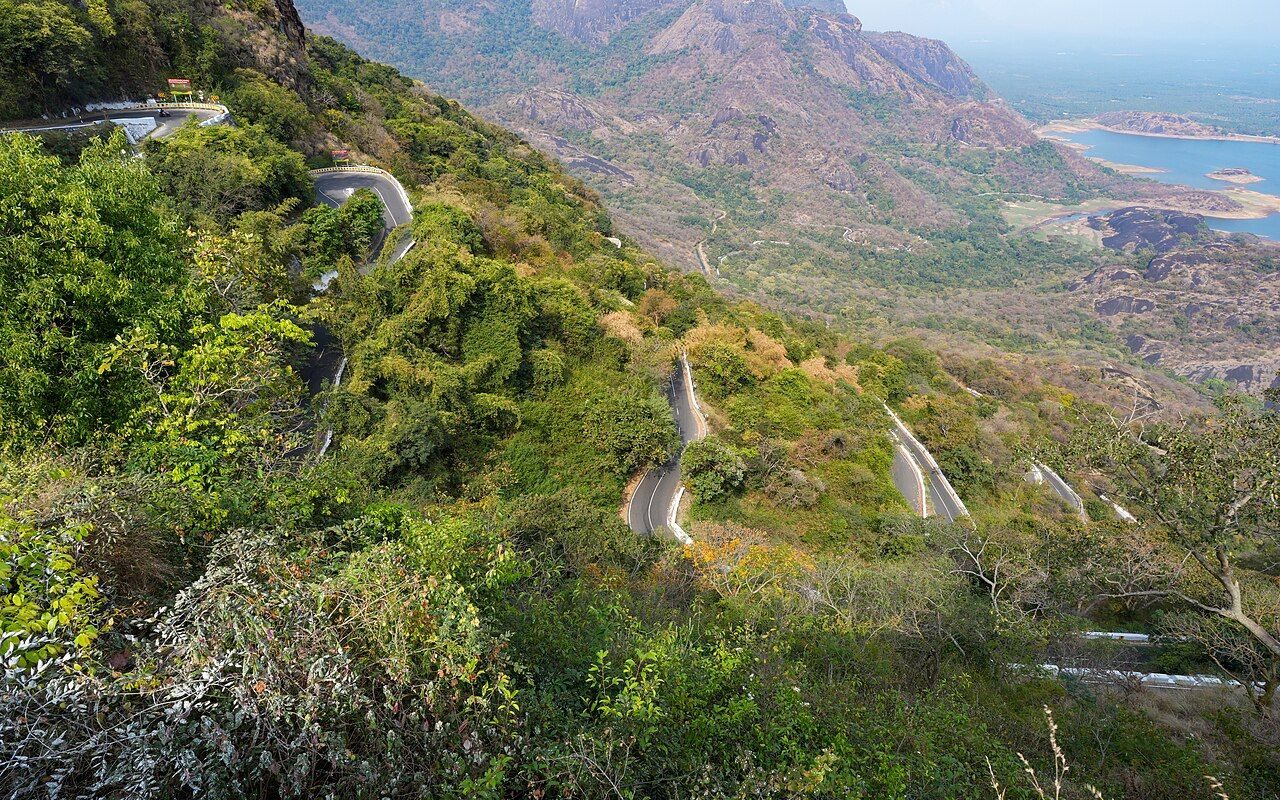 hairpin bend: the velocity turns right roundAliyar reservoir
Worked example
A particle's position is \( \mathbf{r} = 2t\,\hat i + 3t^2\,\hat j \) metres, with \( t \) in seconds. Find its velocity and acceleration, and the speed and direction of motion at \( t = 1 \) s.
- Differentiate each component: \( \mathbf{v} = \dfrac{d\mathbf{r}}{dt} = 2\,\hat i + 6t\,\hat j \) m s−1.
- Differentiate again: \( \mathbf{a} = \dfrac{d\mathbf{v}}{dt} = 6\,\hat j \) m s−2. It is constant and points along +y.
- At \( t = 1 \) s: \( \mathbf{v} = 2\hat i + 6\hat j \). Speed \( = \sqrt{4 + 36} = \sqrt{40} \approx \) 6.3 m s−1.
- Direction: \( \tan\theta = 6/2 = 3 \), so θ ≈ 72° above the x-axis. Notice that \( \mathbf{v} \) (at 72°) and \( \mathbf{a} \) (at 90°) are not along the same line.
Try it
A drone flies with \( x = 4t \) and \( y = 3t \) (metres, seconds). Find its speed and acceleration. What shape is its path?
Answer
Just remember
Notation and names: no physics hides in these, they are the way everyone writes it. Use the hooks.
- Δ means "later minus earlier": \( \Delta\mathbf r = \mathbf r' - \mathbf r \), \( \Delta\mathbf v = \mathbf v' - \mathbf v \)
- Like a bank passbook: change = closing balance minus opening balance. Get the order wrong and the arrow points backwards.
- A dot on top means d/dt: \( \dot x = dx/dt = v_x \), \( \ddot x = d^2x/dt^2 = a_x \)
- Newton's own notation, still common in physics books. "One dot, one d/dt; two dots, two." Differentiate each component separately; \( \hat i \) and \( \hat j \) never change, so they just ride along.
- Tangent comes from Latin tangere, "to touch"
- Same root as tangible, "touchable". The tangent touches the path at one point, and the velocity lies along it.
- Position vector
- r = x î + y ĵ, the arrow from the origin to the particle.
- Average velocity
- Displacement divided by the time taken; along the chord.
- Instantaneous velocity
- dr/dt, the velocity at one moment; along the tangent.
- Tangent
- A straight line that just touches a curve at one point.
- Instantaneous acceleration
- dv/dt, the rate at which the velocity vector changes.
Words to know
At a point on a curved path, the instantaneous velocity points
- along the position vector
- along the tangent to the path
- along the acceleration
- towards the origin
If \( \mathbf{r} = 3t\,\hat i + 2t^2\,\hat j \) m, what is the acceleration?
- 3î + 4t ĵ m s⁻²
- 4ĵ m s⁻²
- 3î m s⁻²
- Zero
For motion in a plane, the angle between velocity and acceleration
- is always 0° or 180°
- is always 90°
- can be anything from 0° to 180°
Deep dive · optional
Where is it going, and where is it being pushed?
Why velocity hugs the path while acceleration points into the bend, how to split an acceleration into a part that changes speed and a part that turns, and Hamilton's trick of drawing all the velocities from one point. The exam doesn't need this; it makes the page stick.
The roots: a change has a direction too
- Why does velocity always lie along the path?Over a short time the body moves from P to a nearby P′, so its average velocity points along the chord PP′. Shrink the time and P′ crowds in on P; the chord turns into the tangent. A body cannot be going anywhere except along its own path.
- Then why can acceleration point off the path?Acceleration is about the change in velocity, \( \Delta\mathbf v = \mathbf v' - \mathbf v \), not about the velocity itself. On a bend the later velocity has turned towards the inside, so the arrow joining the two heads has a part pointing into the bend.
- What does each part of the acceleration do?Split \( \mathbf a \) into a part along the velocity, the tangential part, and a part across it, the normal part. The along part makes the body speed up or slow down. The across part only turns it, without changing its speed, like pushing sideways on a moving trolley.
- How do we know the across part cannot change the speed?A small sideways change \( \delta \) added to a velocity of size \( v \) gives a new size \( \sqrt{v^2 + \delta^2} \), which differs from \( v \) only by an amount of size \( \delta^2 \), far smaller than \( \delta \) itself. Pile up many tiny sideways nudges and the speed stays the same while the direction swings round.
- And the bedrock?Velocity is a vector, so changing its direction is a change just as real as changing its size, and changes of vectors are found head to tail.
So there are three pure cases. Acceleration always along the velocity: a straight path, speeding up or slowing down (the last chapter). Acceleration always across the velocity: constant speed on a curve, as in uniform circular motion. Anything in between: the speed and the direction both change, as for a thrown ball, which slows while it climbs and turns all the time. The sharper the bend at a given speed, the bigger the across part has to be; for a circle of radius R it is \( v^2/R \), the subject of the last page of this chapter.
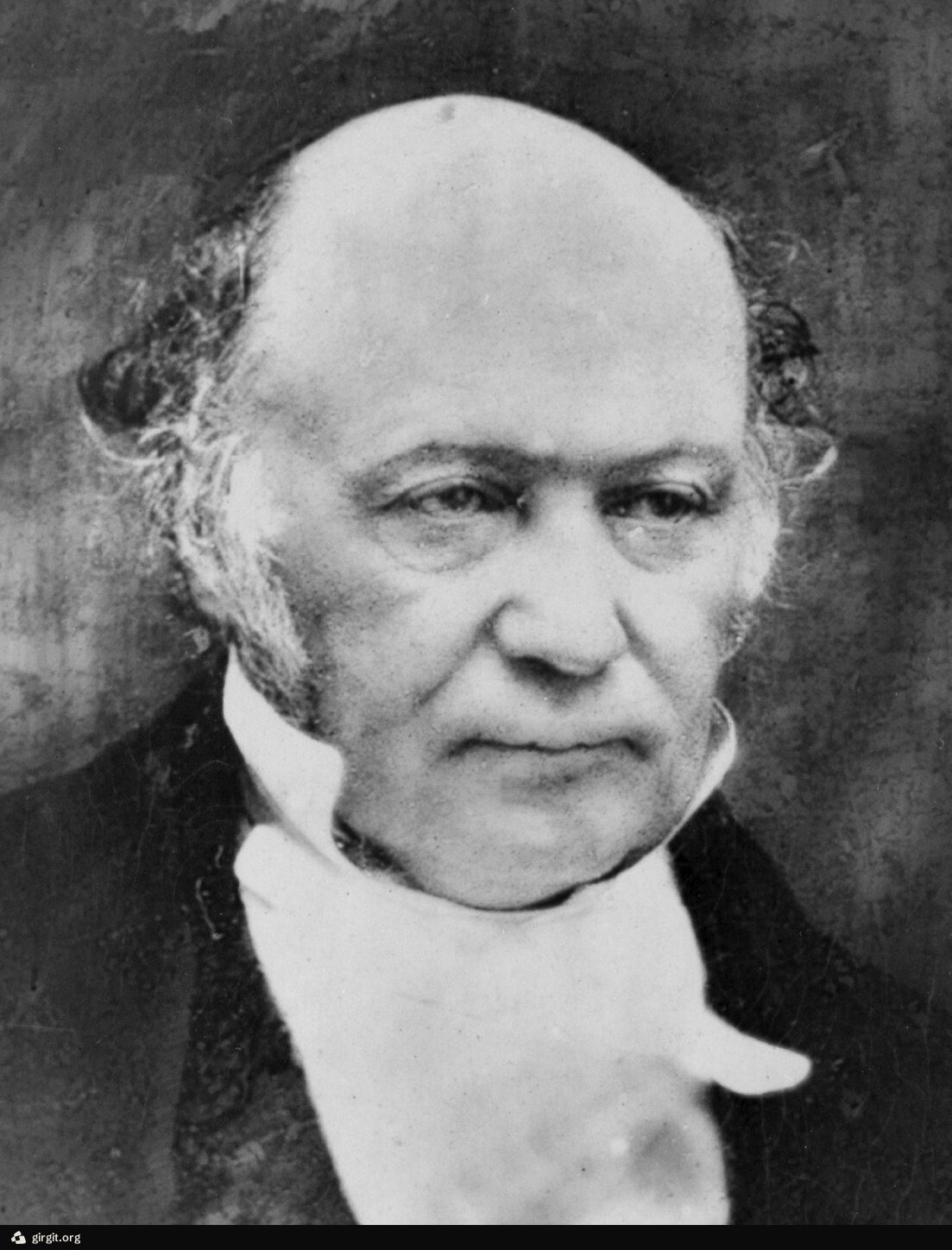
Now Hamilton's idea. Draw every velocity of a motion as an arrow starting from one fixed point O. As time goes on, the tip of the arrow moves and traces a curve, the hodograph (Greek hodos, way, and graphein, to draw). The tip moves at \( d\mathbf v/dt \), which is the acceleration. In other words, acceleration is to the hodograph exactly what velocity is to the path: \( \mathbf v \) is the velocity of the point on the path, and \( \mathbf a \) is the velocity of the point on the hodograph. A thrown ball's hodograph is a vertical straight line, because only \( v_y \) changes and it changes at a steady g. Uniform circular motion has a circle for its hodograph.
The story
See it
Guess first, then slide time and watch the tips. Try the circle and the planet after the ball.
Solve it
Solve it
A car drives round a hairpin bend on a ghat road at a steady 18 km/h (5 m/s). It enters heading north and leaves heading south, 6 s later. Its speed never changed. Did it accelerate? If so, find its average acceleration.
Hint
Answer
Solve it
A particle moves with \( \mathbf r = 2t\,\hat i + t^2\,\hat j \) (metres, seconds). At t = 1 s, how much of its acceleration goes into changing its speed, and how much into turning it? At t = 0?
Hint
Answer
Solve it
Think with the hodograph. What motion has a hodograph that is (a) a single point? (b) a straight line through O? (c) a circle centred on O?
Answer
Solve it
Estimate. A small angle grinder has a wheel 115 mm across that spins at about 11,000 turns a minute. How fast does a spark leave the rim, in km/h?
Answer
Connect it
Connect it
- Instantaneous velocity, Chapter 2. The same limit on a line, where the chord and the tangent lie along the axis: instantaneous velocity.
- Projectiles, this chapter. A constant acceleration means the hodograph is a straight line, and the path a parabola: how does a thrown ball move?
- Circular motion, this chapter. All across, none along: why is steady circling still accelerating?
- Gravitation, Chapter 7. A planet speeds up near the sun and slows far away, yet its hodograph is a circle: Kepler's laws.
- Maths, limits and derivatives. The tangent as the limit of chords is the derivative itself: what is a derivative?
- Daily life. On a ghat bus you feel the across part as a sideways lean on every bend, and the along part as a forward lurch when the driver brakes.
Still confused?
If the velocity is along the tangent, why doesn't a car on a bend shoot off along it?
It would, if nothing pushed it sideways: that is what the sparks do. On the road, friction between the tyres and the road gives the across part of the acceleration, which keeps turning the velocity to follow the bend. On ice there is little friction, and cars do slide off along the tangent.
Can the velocity be zero while the acceleration is not?
Yes. A ball thrown straight up has zero velocity for an instant at the top, while its acceleration is still g downward. On its hodograph, the tip is passing through O at that moment, still moving.
Does the average velocity point along the path?
No, along the chord, the straight line from start to finish of the interval. Only when the interval shrinks to nothing does the chord become the tangent and lie along the path.
Sources
- Wikipedia, "Hodograph": Hamilton's paper, Proceedings of the Royal Irish Academy 3 (1847) 344–353; Maxwell, Matter and Motion.
- Wikipedia, "Laplace–Runge–Lenz vector": the velocity of a body under an inverse-square force moves on a circle (Hamilton).
- Wikipedia, "Feynman's Lost Lecture": the lecture of 13 March 1964 and the 1996 book by D. L. and J. R. Goodstein.
- Library of Congress, portrait of Sir William Rowan Hamilton.

Picture and video credits
Show 3 picture and video credits
- light-trails-curving-highway.jpg: Joe Parks, CC BY 2.0
- grinding-sparks-kolkata.jpg: Biswarup Ganguly, CC BY-SA 3.0
- valparai-ghat-hairpin-bends.jpg: Timothy A. Gonsalves, CC BY-SA 4.0


