Classification of Elements and Periodicity in PropertiesFull experience
- 1. Why sort the elements?
- 2. Mendeleev's periodic table
- 3. The modern periodic table
- 4. How do you name element 120?
- 5. Why the table has the shape it has
- 6. The s, p, d and f blocks
- 7. Metals, non-metals and metalloids
- 8. How big is an atom?
- 9. How hard is it to pull an electron off?
- 10. Which atoms want extra electrons?
- 11. Valence, and the odd ones at the top
- 12. Where are the most reactive elements?
- Review
10 of 12·NCERT §3.7.1·pp. 85–92·6 min
Which atoms want extra electrons?
The big ideaAtoms at the top right of the table, just before the noble gases, release the most energy when they gain an electron and pull shared electrons hardest, while those at the bottom left care least.
In simple words
Some atoms are one tiny bit short of a full set, like a cricket team with ten players. Give them one more and they are happy, and they let out energy. Atoms with a full set do not want any more at all. And when two atoms share bits, the greedier one pulls the shared bits closer to itself. The greediest atoms sit at the top right of the chart.
Electron gain enthalpy
Give a neutral gaseous atom one extra electron and it becomes a negative ion. The enthalpy change for this is the electron gain enthalpy, \( \Delta_{eg} H \). It measures how easily an atom takes on an electron to form an anion.
\[ \ce{X(g) + e- -> X-(g)} \qquad \Delta_{eg} H \]- For many elements energy is released (the process is exothermic), so \( \Delta_{eg} H \) is negative.
- For some, energy must be supplied (endothermic), so \( \Delta_{eg} H \) is positive.
A more negative value means a stronger wish to gain an electron.
| Group 1 | \( \Delta_{eg} H \) | Group 16 | \( \Delta_{eg} H \) | Group 17 | \( \Delta_{eg} H \) | Group 18 | \( \Delta_{eg} H \) |
|---|---|---|---|---|---|---|---|
| H | −73 | He | +48 | ||||
| Li | −60 | O | −141 | F | −328 | Ne | +116 |
| Na | −53 | S | −200 | Cl | −349 | Ar | +96 |
| K | −48 | Se | −195 | Br | −325 | Kr | +96 |
| Rb | −47 | Te | −190 | I | −295 | Xe | +77 |
| Cs | −46 | Po | −174 | At | −270 | Rn | +68 |
All values in kJ mol−1. What the table shows:
- Halogens have very negative values: one extra electron gives them a stable noble gas configuration.
- Noble gases have large positive values: their shell is full, so the added electron must go into the next shell, giving a very unstable arrangement.
- The most negative values lie at the upper right of the table, just before the noble gases.
Try it: here is every element from hydrogen to barium. Guess first, then walk along the curve and watch where the new electron has to go.
Try it: give one extra electron to chlorine, then neon, then two to oxygen. Does each release energy or cost it?
Trends, and the fluorine surprise
Electron gain enthalpy varies less regularly than ionization enthalpy, but as a rule:
- Across a period it becomes more negative. Effective nuclear charge rises and atoms get smaller, so an added electron sits closer to the positive nucleus.
- Down a group it becomes less negative. Atoms get bigger and the added electron is farther from the nucleus.
The exception: O and F are less negative than S and Cl, the elements below them. Fluorine is −328 but chlorine is −349. O and F are tiny, and the added electron goes into the crowded n = 2 shell, where it is strongly repelled by the electrons already there. In S and Cl the electron enters the roomier n = 3 shell, with much less repulsion.
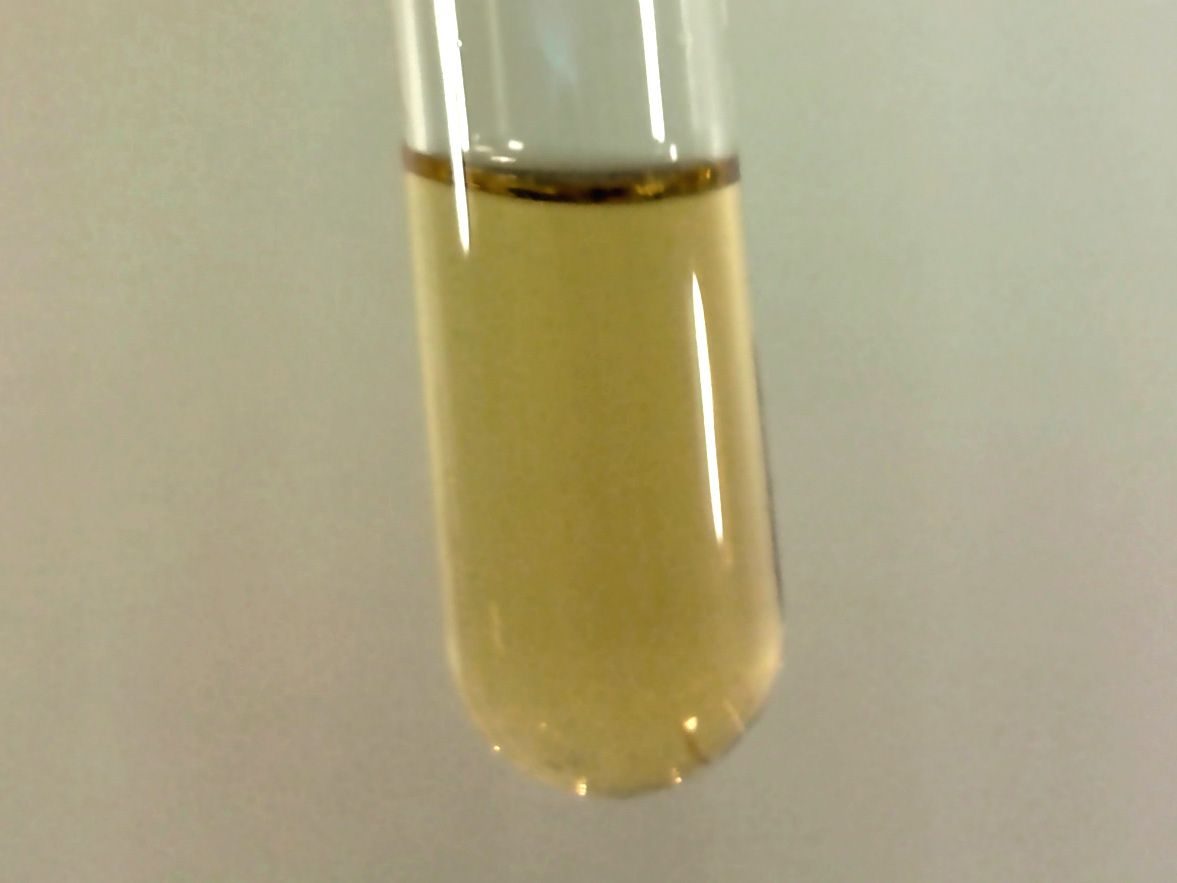 F₂ liquid: ΔegH −328
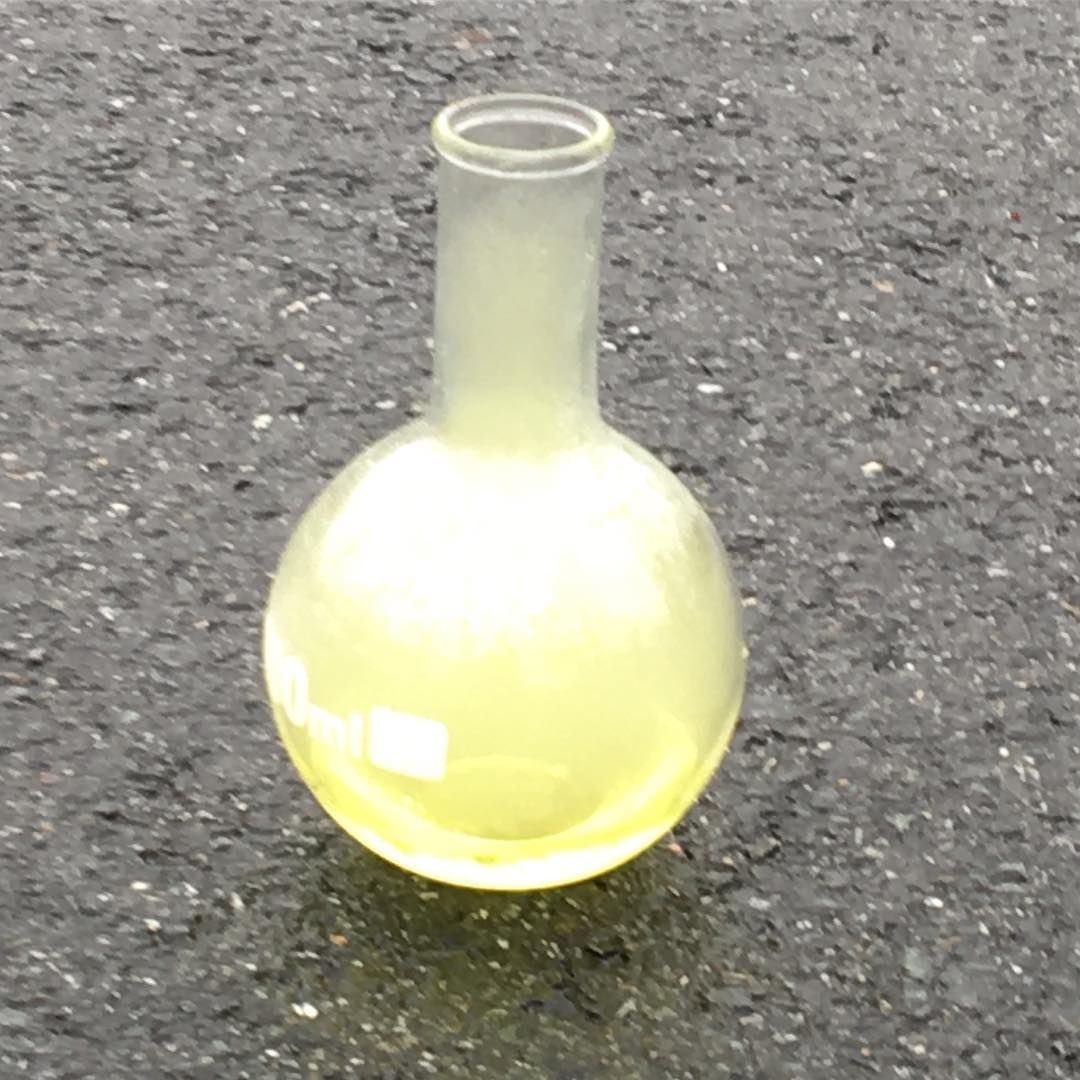 Cl₂ gas: ΔegH −349
Try it: drag down the halogens and see where the trend breaks.
Order of electron gain enthalpy (most negative first)
- Halogens: Cl > F > Br > I (−349, −328, −325, −295).
- Group 16: S > Se > Te > Po > O.
- Chlorine has the most negative electron gain enthalpy of all elements.
A note on electron affinity. Many books use electron affinity, \( A_e \), which is the negative of the enthalpy change above: if energy is released, \( A_e \) is positive. That is the opposite of the usual thermodynamic sign. Electron affinity is defined at absolute zero; at any other temperature T the two are linked by
\[ \Delta_{eg} H = -A_e - \tfrac{5}{2} RT \]where \( R \) is the gas constant and \( T \) the temperature in kelvin.
Worked example: most and least negative
Which of O, S, F and Cl gives out the most energy when it gains an electron, and which gives out the least?
- Across a period it becomes more negative, so F is more negative than O, and Cl more than S.
- Normally values get less negative down a group, but the small n = 2 atoms O and F are exceptions: S beats O and Cl beats F.
- Most negative: Cl. Least negative: O.
Electronegativity
Electronegativity is a qualitative measure of how strongly an atom in a compound pulls shared electrons towards itself. It cannot be measured directly, the way the two enthalpies above can; it is a number assigned on a scale.
Several scales exist: the Pauling scale, the Mulliken-Jaffe scale and the Allred-Rochow scale. The most widely used is Pauling's. The American scientist Linus Pauling set fluorine, the element thought to attract electrons most strongly, at 4.0, and placed the others relative to it.
Textbook check · §3.7.1Pauling's scale is from 1932, not 1922
- The textbook says
- Linus Pauling, an American scientist, developed his electronegativity scale in 1922.
- What we know now
- Pauling proposed electronegativity and his scale in 1932, in the fourth paper of his series "The Nature of the Chemical Bond" (Journal of the American Chemical Society, volume 54, pages 3570 to 3582). In 1922 he had only just finished his first degree, in chemical engineering. The values most books print today are A.L. Allred's 1961 revision, which is why fluorine is often given as 3.98 rather than 4.0.Source: Pauling, J. Am. Chem. Soc. 54, 3570 (1932); Electronegativity, Wikipedia
- In the exam
- The year is rarely asked. If it is, 1932 is correct; use NCERT's values (F = 4.0) in numerical questions.
| Period 2 | Li | Be | B | C | N | O | F |
|---|---|---|---|---|---|---|---|
| Pauling value | 1.0 | 1.5 | 2.0 | 2.5 | 3.0 | 3.5 | 4.0 |
| Period 3 | Na | Mg | Al | Si | P | S | Cl |
| Pauling value | 0.9 | 1.2 | 1.5 | 1.8 | 2.1 | 2.5 | 3.0 |
| Group 1 | Li | Na | K | Rb | Cs |
|---|---|---|---|---|---|
| Pauling value | 1.0 | 0.9 | 0.8 | 0.8 | 0.7 |
| Group 17 | F | Cl | Br | I | At |
| Pauling value | 4.0 | 3.0 | 2.8 | 2.5 | 2.2 |
An element's electronegativity is not fixed: it shifts a little with the atom it is bonded to. Even so, it helps predict what kind of bond two atoms will form, which you will use in the next chapter.
Try it: drag across period 2 and watch the shared pair slide towards the stronger puller.
Electronegativity trends and metallic character
- Across a period it increases (Li 1.0 to F 4.0). Atoms get smaller, so the nucleus pulls the bonding electrons harder.
- Down a group it decreases (F 4.0 to At 2.2). Atoms get bigger, and the pull weakens. The trend is just like ionization enthalpy.
Non-metals tend to gain electrons, so electronegativity goes with non-metallic character and against metallic character. As electronegativity rises across a period, elements become more non-metallic; as it falls down a group, they become more metallic.
All the trends in one place
- Across a period (left to right): atomic radius ↓, ionization enthalpy ↑, electron gain enthalpy more negative, electronegativity ↑, non-metallic character ↑.
- Down a group: atomic radius ↑, ionization enthalpy ↓, electron gain enthalpy less negative, electronegativity ↓, metallic character ↑.
Try it. Arrange in increasing electronegativity: Cl, Mg, Cs, O, Si.
Answer
Don't mix these up
- Electron gain enthalpy is for a lone gaseous atom and is measured. Electronegativity is about an atom in a bond and is assigned on a scale.
- Fluorine has the highest electronegativity; chlorine has the most negative electron gain enthalpy.
- Noble gases have positive electron gain enthalpies.
Just remember
The signs are a convention and the scale's zero was a choice; the orders below have reasons (on this page), but in the exam you need them instantly. Hooks:
- Sign: ΔegH is negative when energy is released; electron affinity Ae is positive for the same thing
- ΔegH is the atom's own hisaab (account): energy going out of it is a minus. Ae is the world's aamdani (income): the energy we receive is a plus. Same event, two account books.
- Most negative electron gain enthalpy: Cl > F > Br > I (−349, −328, −325, −295)
- Normal order down the group, except the top two swap: chhota fluorine is too small and crowded to win, so chlorine is champion.
- Positive ΔegH: the noble gases (and, by estimate, Be, Mg and N)
- A full shell (or a full s pair, or a half-filled p set) is a "house full" board: the newcomer has to sit in the next row, and that costs energy.
- Pauling values: F 4.0, O 3.5, N 3.0, Cl 3.0
- "F-O-N-Cl" sounds like "phone call": 4, then half off, then half off again, then hold at 3. Fluorine, highest of all.
- Lowest: caesium (and francium), 0.7
- Bottom left of the table, the opposite corner from fluorine. From lithium 1.0 the alkali metals slide down to 0.7.
- Electron gain enthalpy
- Enthalpy change when a gaseous atom gains an electron; negative if energy is released.
- Exothermic, endothermic
- Gives out heat; takes in heat.
- Electron affinity
- The same process with the opposite sign: positive when energy is released.
- Electronegativity
- How strongly an atom in a bond pulls shared electrons to itself.
- Pauling scale
- The common electronegativity scale, with fluorine set at 4.0.
Words to know
Why do noble gases have positive electron gain enthalpies?
- They are very large atoms
- The extra electron has to go into a new, higher shell
- They lose electrons easily
Fluorine's electron gain enthalpy (−328) is less negative than chlorine's (−349) because
- fluorine is less electronegative
- the added electron suffers more repulsion in fluorine's small 2p subshell
- fluorine needs two electrons to fill its shell
Which statement about electronegativity is correct?
- It is measured directly, in kJ mol⁻¹
- It increases down a group
- It increases across a period as atoms get smaller
Deep dive · optional
Fluorine is the greediest atom, so why does chlorine grab a spare electron harder?
What really decides whether an atom welcomes an extra electron, why "greed in a bond" is a different question, and how two chemists measured it in two completely different ways and got the same answer. Not needed for the exam; it is here so the fluorine surprise makes sense.
The roots: pull minus crowding
- Why does chlorine give out energy when it takes an electron?The newcomer joins chlorine's 3p subshell. The other outer electrons, being in the same shell, hide the nucleus from it only partly, so it still feels a strong net pull, and it settles into a lower energy than it had outside. The energy it loses comes out.
- Why do neon and argon need energy put in?Their outer shell is full. The next free place is in a new shell, farther out, behind a complete set of electrons that cancels almost all of the nucleus's charge. The newcomer feels almost no pull but still feels everyone's push, so energy has to be supplied. The same thing, more weakly, happens to beryllium and magnesium (the next free place is an empty p subshell above a full s pair) and to nitrogen (it must pair up in a half-filled set).
- Fluorine's nucleus pulls harder and is closer. Why does it release less than chlorine?Because fluorine is tiny. Its seven outer electrons are packed into the small n = 2 shell, and an eighth electron squeezed in among them gets pushed very hard. Going from chlorine to fluorine, the extra pull grows, but the crowding grows even more. Chlorine's roomier 3p shell gives the best balance: the most negative value of all.
- Then why is fluorine, not chlorine, the most electronegative?Electronegativity is a different question. It is not about a free electron arriving; it is about a pair shared in a bond, sitting between two nuclei. What matters is how hard the atom holds electrons near it at bonding distance, and that includes how hard it holds its own. Fluorine's grip on its own electrons (ionisation enthalpy 1681 kJ mol−1) is far stronger than chlorine's (1251). The small difference in electron gain enthalpy is swamped.
- The bedrockCoulomb's law, again: the pull of the nucleus against the push of the other electrons, both weaker with distance. Electron gain enthalpy weighs them for one extra electron; electronegativity weighs them for a shared pair.
Robert Mulliken turned point 4 into arithmetic. An atom's greed for electrons, he said, is the average of how hard it holds its own (the first ionisation energy) and how much it gains by taking one more (the electron affinity). For fluorine that average is (1681 + 328) ÷ 2 ≈ 1004 kJ mol−1; for chlorine only (1251 + 349) ÷ 2 = 800. Fluorine wins comfortably, even though chlorine takes a spare electron more eagerly. Mulliken's average links this page to the last one: electronegativity is ionisation enthalpy and electron gain enthalpy, rolled into one number.
The story
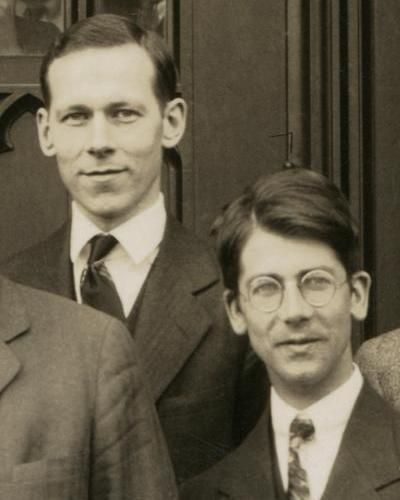 MullikenHund
See it
Mulliken's idea, element by element. Guess first: neon is the interesting case. Then tap points in the cloud: every dot puts an element's Mulliken average (from single atoms) against Pauling's value (from bonds).
Solve it
Solve it: be Pauling
Bond energies: H–Br 3.79 eV, H–H 4.52 eV, Br–Br 2.00 eV. Pauling's rule says the extra strength of the unlike bond, in eV, equals \( (\chi_A - \chi_B)^2 \). Find bromine's electronegativity, taking hydrogen as 2.20.
Hint
Answer
Solve it: be Mulliken
Use first ionisation enthalpies (F 1681, Cl 1251 kJ mol−1) and electron gain enthalpies (F −328, Cl −349 kJ mol−1). Which is more electronegative by Mulliken's rule, and by how much? Convert both to Pauling's scale with \( \chi \approx 0.187\,(IE + A_e)/\text{eV} + 0.17 \) (1 eV per atom = 96.5 kJ mol−1).
Answer
Solve it: spot the error
A student writes: "Fluorine is the most electronegative element, so it must have the most negative electron gain enthalpy." Explain what is wrong in two sentences.
Answer
Solve it: the 5/2 RT term
NCERT links the two quantities by \( \Delta_{eg}H = -A_e - \tfrac{5}{2}RT \). Chlorine's electron affinity is 348.6 kJ mol−1. Find its electron gain enthalpy at 298 K. Is the correction worth worrying about?
Answer
Connect it
Connect it
- Ionisation enthalpy, previous page. Mulliken's average makes electronegativity half ionisation enthalpy: see the saw-tooth on How hard is it to pull an electron off?
- Why nitrogen refuses an electron, Chapter 2. A half-filled p set is unusually steady (Hund's rule and exchange): Electronic configuration. The 2p and 3p shells that make fluorine crowded and chlorine roomy are drawn on Shapes and energies of orbitals.
- Polar bonds, Chapter 4. The difference in electronegativity sets how lopsided a bond is and how big its dipole: Polarity and dipole moment.
- Salt, Chapter 4. Sodium gives up an electron (496 kJ mol−1), chlorine takes it back (−349), and the attraction of the ions in the crystal pays the rest: Ionic bond and lattice enthalpy.
- Your non-stick tawa. Teflon is carbon chains wrapped in fluorine. The C–F bond, made strong and polar by fluorine's electronegativity, is about 481 kJ mol−1, one of the strongest single bonds in chemistry, which is why food does not react with or stick to it.
Still confused?
Why does NCERT give fluorine 4.0 when other books say 3.98?
Pauling's own numbers (rounded, with F = 4.0 and H = 2.1) are what NCERT prints. In 1961 A.L. Allred recalculated them from better bond-energy data, giving F = 3.98 and H = 2.20. Both are on the same Pauling scale; use NCERT's in the exam.
Can electron affinity be negative?
Yes. When energy has to be put in, as for the noble gases, Ae is negative and ΔegH positive. Such anions fall apart almost at once, so their values cannot be measured directly; the numbers in tables (He +48, Ne +116 kJ mol−1 for ΔegH) are estimates.
Is adding a second electron ever helpful, as in O2−?
Never on its own: the second electron is pushed away by an ion that is already negative, so it always costs energy. Oxide ions exist in solids like MgO only because the strong attraction between O2− and its positive neighbours in the crystal pays that cost and more.
Sources
- Electron affinity (data page), Wikipedia: measured and estimated values used here (F 328.16, Cl 348.58, N −6.8 kJ/mol; noble-gas estimates from Bratsch and Lagowski, 1986)
- Molar ionization energies of the elements, Wikipedia (CRC data): F 1681, Cl 1251 kJ/mol
- Electronegativity, Wikipedia: Pauling 1932 and the bond-energy rule, the H–Br example, H set at 0 then 2.1, Allred 1961; Mulliken 1934 and the conversion 0.187(IE + EA) + 0.17
- L. Pauling, "The Nature of the Chemical Bond. IV. The Energy of Single Bonds and the Relative Electronegativity of Atoms", J. Am. Chem. Soc. 54, 3570 (1932)
- Electronegativities of the elements (data page), Wikipedia: revised Pauling values used in the widget
- Linus Pauling, Wikipedia: no high-school diploma, the 1958 petition (11,021 scientists, fifty countries), Peace Prize announced 10 October 1963, two unshared Nobel Prizes
- Nobel Prize in Chemistry 1954 (nobelprize.org): Pauling's citation and 1966: Mulliken, "for his fundamental work concerning chemical bonds and the electronic structure of molecules by the molecular orbital method"
- Fluorine, Wikipedia: the "fluorine martyrs", Moissan's isolation in 1886, Nobel Prize 1906 two months before his death
- Molecular orbital theory, Wikipedia: first called the Hund–Mulliken theory
- Bond dissociation energy, Wikipedia: C–F in CH3F 481 kJ/mol, "rationalizes inertness of Teflon"
Picture and video credits
Show 3 picture and video credits
- liquid-fluorine-in-a-tube.jpg: Fulvio314, CC BY-SA 3.0
- chlorine-gas-in-a-flask.jpg: Larenmclane, CC BY-SA 4.0
- mulliken-and-hund-1929.jpg: GFHund, CC BY 3.0


