Classification of Elements and Periodicity in PropertiesFull experience
- 1. Why sort the elements?
- 2. Mendeleev's periodic table
- 3. The modern periodic table
- 4. How do you name element 120?
- 5. Why the table has the shape it has
- 6. The s, p, d and f blocks
- 7. Metals, non-metals and metalloids
- 8. How big is an atom?
- 9. How hard is it to pull an electron off?
- 10. Which atoms want extra electrons?
- 11. Valence, and the odd ones at the top
- 12. Where are the most reactive elements?
- Review
9 of 12·NCERT §3.7.1·pp. 85–92·6 min
How hard is it to pull an electron off?
The big ideaIonization enthalpy, the energy needed to pull an electron off an atom, rises across a period and falls down a group, with small dips at boron and oxygen that come from how electrons sit in their orbitals.
In simple words
Every atom holds on to its outside bits. Some hold them loosely, like a child holding a balloon string with two fingers. Others grip tight. The energy needed to pull one bit away tells you how tight the grip is. Atoms on the left of the chart let go easily; atoms on the right, and the quiet ones at the very end, hold on very hard.
What is ionization enthalpy?
Ionization enthalpy is a measure of how readily an element loses an electron. The first ionization enthalpy, \( \Delta_i H \), is the energy needed to remove the most loosely held electron from an isolated gaseous atom in its ground state (its lowest-energy arrangement):
\[ \ce{X(g) -> X+(g) + e-} \qquad \Delta_i H_1 \]The unit is kJ mol−1 (energy per mole of atoms). "Gaseous" and "isolated" matter: in a solid or liquid, neighbours would change the answer.
The second ionization enthalpy is the energy to remove the next electron from the cation:
\[ \ce{X+(g) -> X^2+(g) + e-} \qquad \Delta_i H_2 \]- Energy is always needed, so ionization enthalpies are always positive.
- \( \Delta_i H_2 > \Delta_i H_1 \): pulling a negative electron off an already positive ion is harder. Likewise \( \Delta_i H_3 > \Delta_i H_2 \), and so on.
- "Ionization enthalpy" on its own means the first one.
For sodium, \( \Delta_i H_1 = 496 \) kJ mol−1 but \( \Delta_i H_2 \approx 4562 \) kJ mol−1, more than nine times larger, because the second electron must come out of the full, tightly held neon-like core. That huge jump is why sodium is always \(\ce{Na+}\), never \(\ce{Na^2+}\).
Try it: pull magnesium's electrons off one at a time and watch where the cost jumps.
The shape of the graph
Plot first ionization enthalpy against atomic number from Z = 1 to 60 and you see a saw-tooth that repeats:
- Peaks at the noble gases (He, Ne, Ar, Kr, Xe): closed shells, very stable, very hard to disturb.
- Troughs at the alkali metals (Li, Na, K, Rb, Cs): one lonely outer electron, easily lost. Their low ionization enthalpy is why they are so reactive.
- Between each trough and the next peak, the values climb, with small dips along the way.
The two ends of the curve, side by side: helium, the hardest atom of all to ionise, and caesium, the easiest one you can keep in a jar.
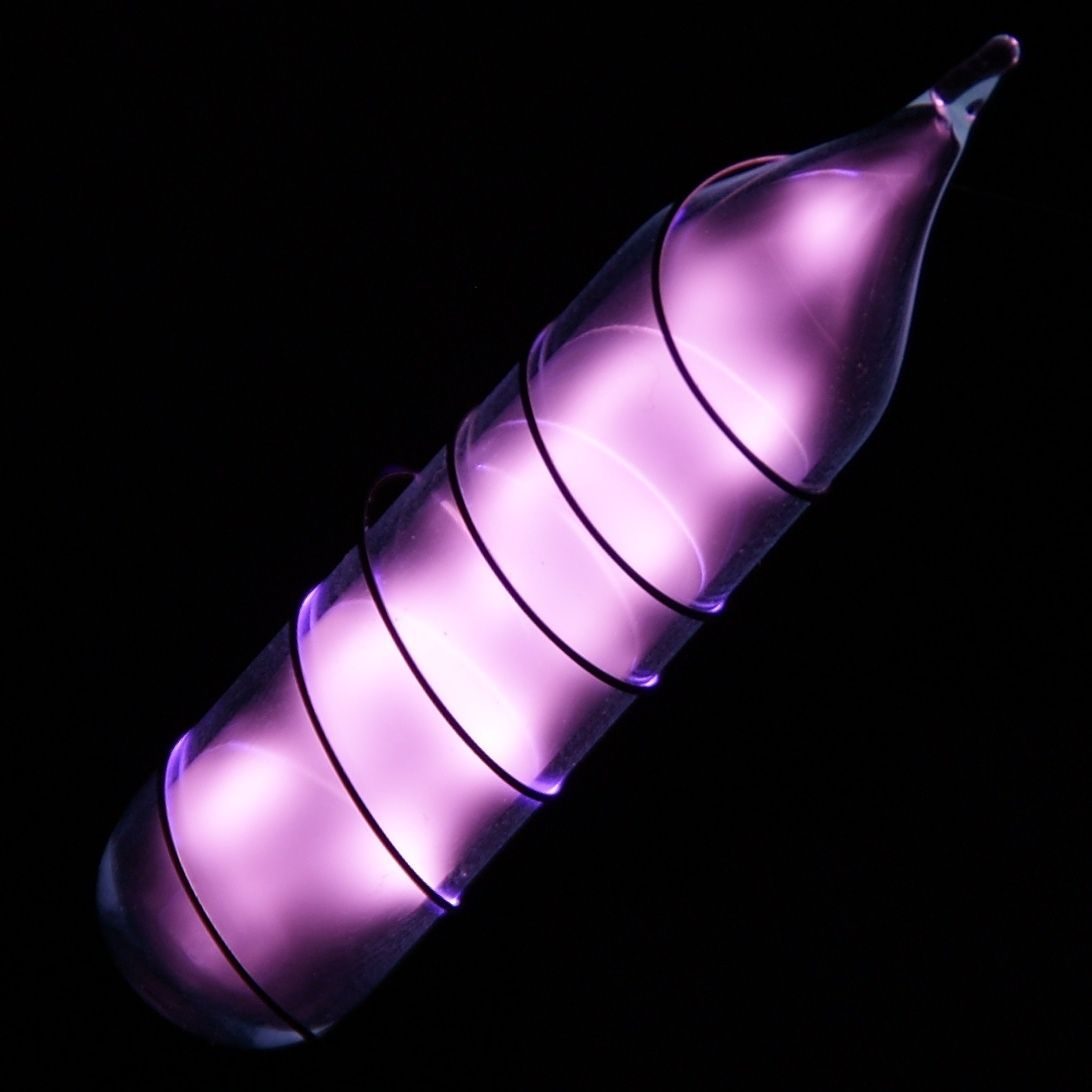 He: 2372 kJ/mol
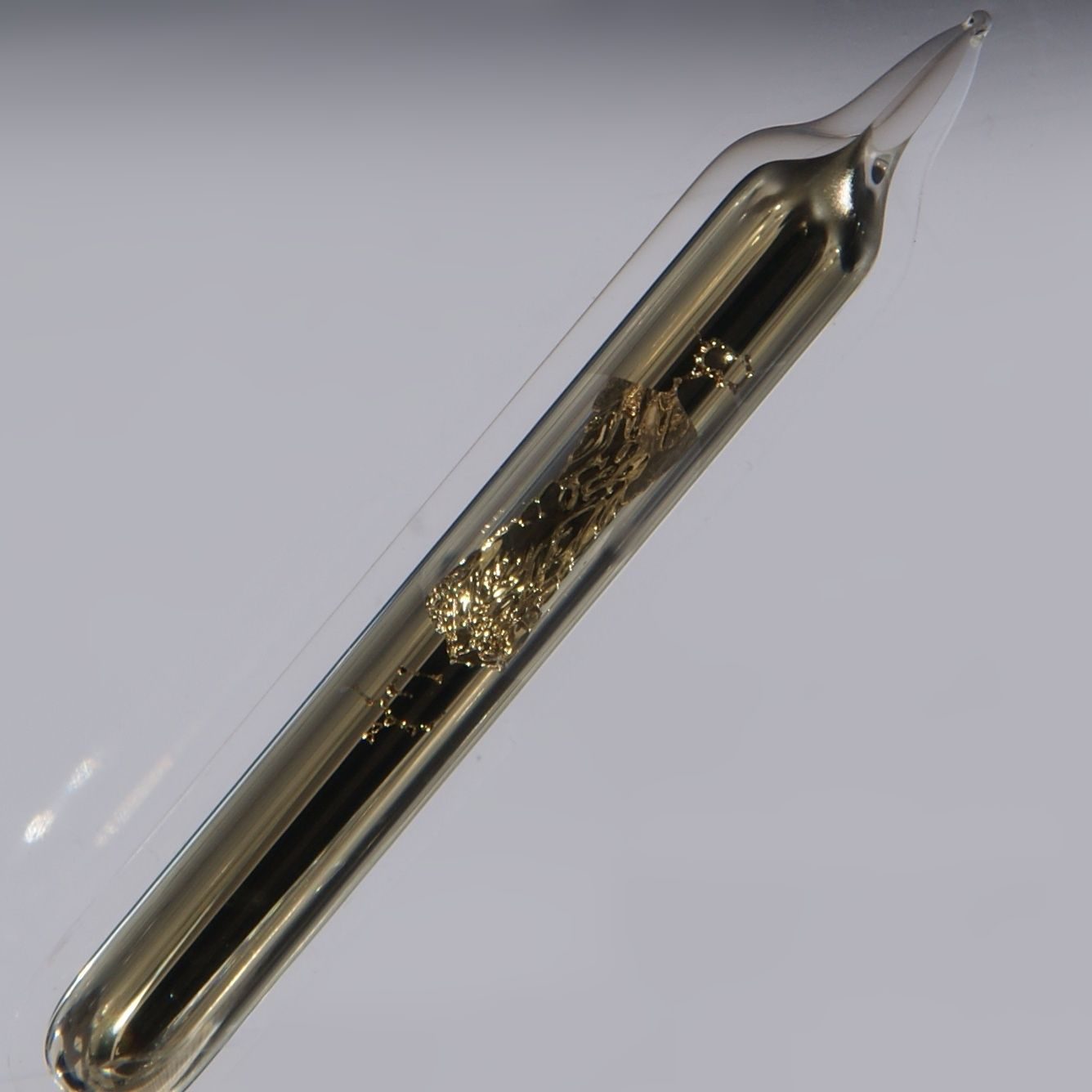 Cs: 376 kJ/molsealed glass
| Period 2 | Li | Be | B | C | N | O | F | Ne |
|---|---|---|---|---|---|---|---|---|
| \( \Delta_i H_1 \) / kJ mol−1 | 520 | 899 | 801 | 1086 | 1402 | 1314 | 1681 | 2080 |
| Group 1 | Li | Na | K | Rb | Cs |
|---|---|---|---|---|---|
| \( \Delta_i H_1 \) / kJ mol−1 | 520 | 496 | 419 | 403 | 376 |
Try it: here is the real curve from hydrogen to barium, every point a measured value. Guess first, then walk along it and read why each step goes up or down.
Try it: see the whole table as a skyline, each element as tall as its ionization enthalpy.
Why the trends? Pull against shielding
Two forces decide how tightly an electron is held: (i) the attraction of the nucleus and (ii) the repulsion from other electrons. Inner electrons stand between the nucleus and the valence electron, so the valence electron feels less than the full nuclear charge. This is shielding or screening, and the charge actually felt is the effective nuclear charge.
In lithium, the 2s electron is shielded by the two 1s electrons, so it feels much less than the full +3. Shielding works best when the inner shells are completely filled, as in the alkali metals: one ns electron outside a noble gas core.
- Across a period, \( \Delta_i H \) increases. Electrons are added to the same shell. Shielding by the inner core hardly changes, but the nuclear charge keeps rising. Pull wins over shielding, so the outer electrons are held more tightly.
- Down a group, \( \Delta_i H \) decreases. The outer electron is in a shell farther out, with more inner shells shielding it. The extra shielding and distance win over the extra nuclear charge, so less energy is needed.
So size and ionization enthalpy go hand in hand: smaller atom, harder to ionise.
The two dips: Be > B and N > O
Boron is lower than beryllium (801 vs 899), even though boron has more protons.
- Be is 1s22s2: the electron removed is a 2s electron.
- B is 1s22s22p1: the electron removed is a 2p electron.
- In the same shell, an s electron penetrates closer to the nucleus than a p electron and is held more strongly. The 2p electron of boron is better shielded by the inner electrons, so it is easier to remove.
Oxygen is lower than nitrogen (1314 vs 1402).
- N is 2p3: by Hund's rule, the three p electrons sit in three different orbitals, one each.
- O is 2p4: the fourth p electron must share an orbital with another. Two electrons in one orbital repel each other more.
- So that paired electron of oxygen is easier to remove. Taking it away leaves oxygen with three unpaired 2p electrons, the same steady arrangement nitrogen has.
So the true order for period 2 is Li < B < Be < C < O < N < F < Ne. NEET asks this often.
Try it: drag across period 2 and watch which electron leaves each atom.
Worked example: guessing a missing value
The first ionization enthalpies of P and Cl are 1012 and 1251 kJ mol−1. Is sulphur's value closer to 1000 or 1130?
- S lies between P and Cl, so a smooth trend would suggest about 1130.
- But P is 3p3 (all unpaired) and S is 3p4 (one pair). This is the same situation as N and O.
- The paired electron in S is easier to remove, so S should be lower than P.
- Answer: closer to 1000 kJ mol−1 (the measured value is 1000).
Try it. Mg is 738 and Si is 786 kJ mol−1. Will Al be nearer 580 or 760?
Answer
Don't mix these up
- B < Be because of s vs p (penetration). O < N because of paired electrons (repulsion). Two different reasons.
- Ionization enthalpy is for a gaseous atom. Ease of losing electrons in water is a different measure.
- Successive values always rise: \( \Delta_i H_1 < \Delta_i H_2 < \Delta_i H_3 \).
Just remember
The reasons for these are on this page; the facts themselves you simply have to carry into the exam. Hooks:
- The two dips in period 2: Be > B and N > O
- The two losers spell "BO": B and O each lose to the element just before them. Two different reasons: B = first p electron (p gets less close than s), O = first pair. The same pair of dips comes back one row down: Al < Mg and S < P.
- Period 2 order: Li < B < Be < C < O < N < F < Ne
- Write the plain order Li Be B C N O F Ne, then swap the two "BO" pairs: Be/B and N/O.
- Highest of all: helium, 2372 kJ mol−1. Lowest stable: caesium, 376 kJ mol−1
- Top right holds tight, bottom left lets go. "He holds, Cs lets go": the smallest noble gas against the biggest stable alkali metal.
- Unit: kJ mol−1, always positive; 1 eV per atom = 96.5 kJ mol−1
- "About a hundred": multiply eV by roughly 100 to get kJ per mole. Sodium: 5.14 eV, so 496 kJ mol−1.
- Sodium's jump: 496 then 4562 kJ mol−1; magnesium's: 738, 1451, then 7733
- The big jump always comes right after the last valence electron: count the valence electrons (one for Na, two for Mg), then hit the wall.
- Ionization enthalpy
- Energy to remove an electron from an isolated gaseous atom; in kJ mol⁻¹.
- Ground state
- The lowest-energy arrangement of an atom's electrons.
- Second ionization enthalpy
- Energy to remove an electron from the 1+ ion; always larger than the first.
- Penetration
- How close an electron gets to the nucleus on average; s > p > d in the same shell.
- Hund's rule
- Electrons occupy separate orbitals of a subshell singly before pairing up.
Words to know
Which element has the lowest first ionization enthalpy?
- Li
- Na
- K
- Mg
Why is the second ionization enthalpy of an element always larger than its first?
- The nucleus gains a proton
- The electron is being removed from a positive ion
- The second electron always comes from an inner shell
Nitrogen's first ionization enthalpy is higher than oxygen's. Which explanation is right?
- Nitrogen has a larger nuclear charge
- Oxygen loses an s electron and nitrogen a p electron
- In oxygen two 2p electrons share one orbital and repel each other
Deep dive · optional
Why is the curve a saw-tooth, and how do we know?
Where every rise, drop and dip on the ionisation curve comes from, how the numbers are measured, and how a 1914 experiment got its own reading wrong. Not needed for the exam; it is here so the dips stop being two facts to cram.
The roots: one pull, many pushes
- Why does it cost anything to take an electron away?Because the electron is negative and the nucleus is positive, and opposite charges attract. A bound electron sits low in energy, like a ball at the bottom of a well. To free it you must lift it all the way out, and that lift is the ionisation enthalpy.
- Why does the cost rise across a period?Each step adds one proton to the nucleus and one electron to the same shell. Electrons in the same shell are at about the same distance, so each one hides only a small part of the nucleus from the others. The pull felt by an outer electron, the effective nuclear charge, climbs steadily: about 1.3 for lithium's 2s electron and about 5.8 for neon's 2p, by the standard 1963 calculation of Clementi and Raimondi. A bigger pull also drags the shell inwards, so the electron sits deeper in its well.
- Then why does it fall down a group?The next shell is much farther out, and a full inner shell sits between it and the nucleus, cancelling nearly all the extra protons. Potassium's 4s electron feels a pull of only about 3.5, and it is so far away that the attraction at its distance is weaker than for sodium's 3s electron. Distance wins.
- Why does boron dip below beryllium?Beryllium loses a 2s electron, boron a 2p electron. A 2s cloud has a small inner bump that dips inside the 1s pair and gets close to the nucleus; a 2p cloud is zero at the nucleus and stays outside. So the 2p electron is better shielded and feels less pull, and that loss is bigger than boron's one extra proton.
- Why does oxygen dip below nitrogen?Nitrogen's three 2p electrons sit one in each orbital. Oxygen's fourth 2p electron must share an orbital with another. Two electrons in the same orbital are crowded into the same region of space, so they repel each other strongly. Taking one away relieves that push, and it leaves oxygen with nitrogen's steady half-filled set. It costs less.
- The bedrockCoulomb's law: opposite charges attract, like charges repel, and both weaken with distance. Every rise and dip on the curve is the nucleus's pull fighting the other electrons' push.
The same two dips come back in every period, because every period repeats the same filling: an s pair, then the first p electron (a dip: Al below Mg, Ga below Zn), then three single p electrons, then the first pair (a dip: S below P). Across the d-block the curve stays almost flat, because the new electrons go into an inner d subshell and the outer s electron hardly notices.
The biggest features are the cliffs in the successive ionisation enthalpies. Sodium gives up one electron for 496 kJ mol−1; the second costs 4562, more than nine times as much, because it must come out of the full shell below, much closer in and hardly shielded. Nobody has to tell you that sodium's electrons sit in shells of 2, 8 and 1: you can read it straight off the measured numbers, as the widget below shows.
The story
 Gustav HertzJames Franck
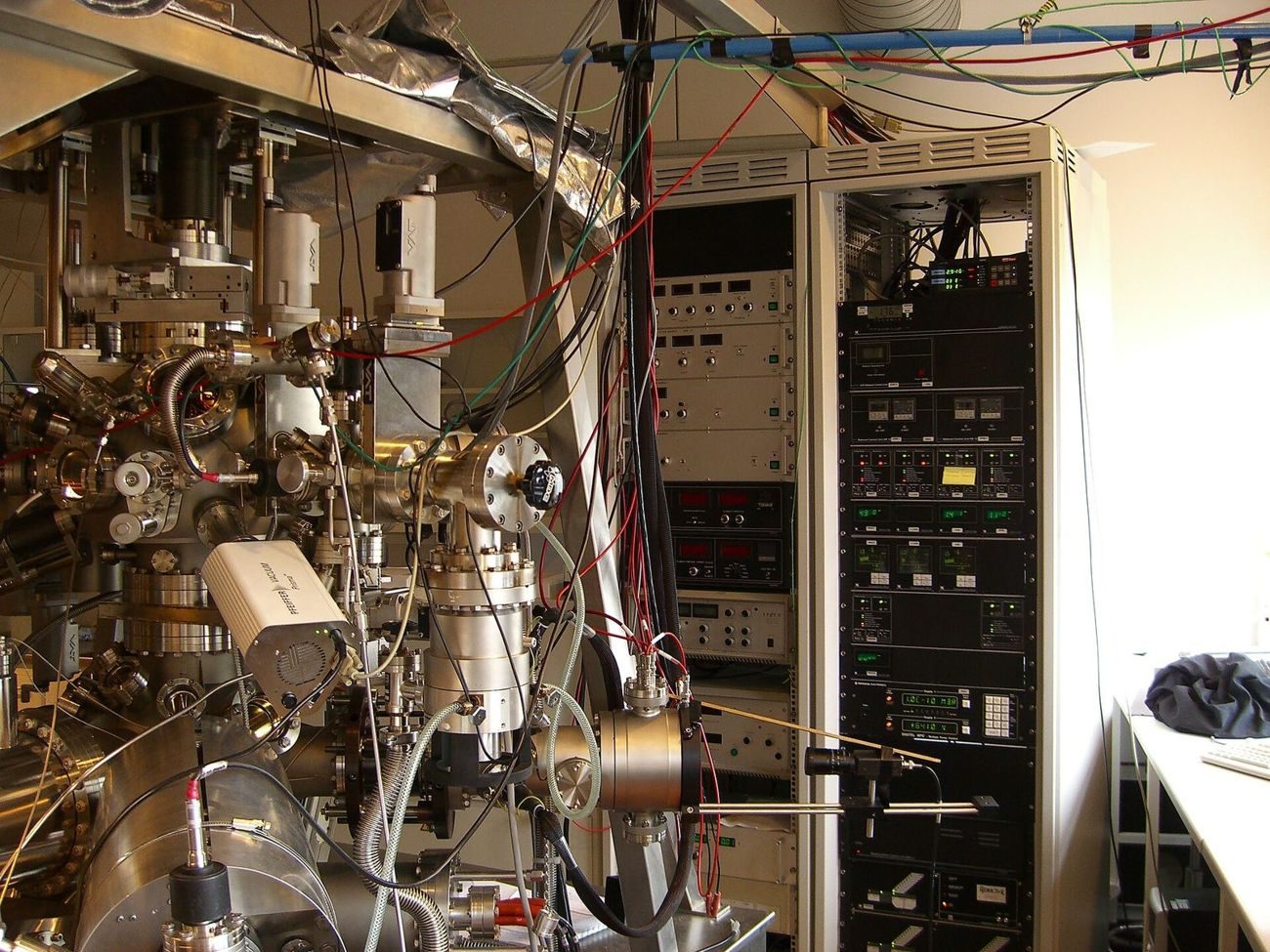 steel vacuum chamberscontrol electronics
See it
Strip an atom one electron at a time and look at the bars. Guess first. Then press Every element: all twenty atoms from hydrogen to calcium, lined up by how many electrons each particle still has, hit their cliffs in exactly the same two places.
And here is a modern Franck–Hertz tube, filled with neon instead of mercury so you can see the light. As the voltage rises, the electrons gain energy, give it up to neon atoms in one lump every 18.7 volts or so, and a new glowing layer appears each time. The glow is excitation; neon's ionisation energy, 21.6 eV, is higher still.
Solve it
Solve it: spot the error
Franck and Hertz took 4.9 eV to be mercury's ionisation energy. Convert 4.9 eV per atom into kJ mol−1 and compare it with the measured first ionisation enthalpy of mercury, 1007 kJ mol−1. What wavelength of light would a mercury atom give out when it drops back after taking 4.9 eV?
Hint
Answer
Solve it: read the jumps
A period 3 element has these first five ionisation enthalpies, in kJ mol−1: 786, 1577, 3232, 4356, 16 091. Which element is it, and what is the formula of its chloride?
Answer
Solve it: predict, then check
Zinc is [Ar]3d104s2, with a first ionisation enthalpy of 906 kJ mol−1. Gallium comes next, with one more proton. Will gallium be higher or lower, and by a lot or a little?
Answer
Solve it: think harder
Sodium's first ionisation enthalpy is 496 kJ mol−1. What is the longest wavelength of light that could ionise a lone sodium atom? Yet visible light, about 400 to 500 nm, knocks electrons out of sodium metal (its work function is 2.3 eV). How can both be true?
Hint
Answer
Connect it
Connect it
- Penetration, Chapter 2. The inner bump of an s cloud, the reason boron dips, is drawn and measured on Shapes and energies of orbitals; its deep-dive widget compares how much of a 4s and a 3d cloud sits near the nucleus.
- Hund's rule and half-filled sets, Chapter 2. Why nitrogen's three unpaired 2p electrons are so steady is the same trade that makes chromium 3d54s1: see Electronic configuration and its "Count the swaps" widget.
- Hydrogen's ionisation energy, Chapter 2. Hydrogen's 1312 kJ mol−1 is Bohr's 13.6 eV, the jump from n = 1 to n = ∞: the limit of the Lyman series. See How Bohr explained the spectrum.
- Work function, Chapter 2. The solid-metal cousin of ionisation enthalpy: Light comes in packets.
- Size, this chapter. Smaller atom, harder to ionise: compare this curve with How big is an atom?, and see why the alkali metals at the bottom of the curve are the most reactive metals on Where are the most reactive elements?
- Why salt is Na+Cl−, Chapter 4. Making Na2+ would cost another 4562 kJ mol−1, far more than any bond pays back. See Ionic bond and lattice enthalpy; the d-block's own ionisation story is in Class 12, d- and f-block.
Still confused?
Oxygen has more protons than nitrogen. How can it hold its electron less tightly?
The extra proton does pull harder on every electron. But the electron oxygen loses is the one sharing an orbital, and the push from its partner, very close by, outweighs the gain from one more proton. Take that paired electron away and the rest of oxygen's electrons are, as expected, held more tightly than nitrogen's: oxygen's second ionisation enthalpy (3388) is higher than nitrogen's (2856).
Is francium the easiest atom to ionise?
No, though most people guess it. Francium's measured first ionisation enthalpy is about 393 kJ mol−1, a little higher than caesium's 376. In such heavy atoms the inner electrons move so fast that relativity matters: the s orbitals shrink and hold their electrons slightly tighter. Caesium is the easiest; that is why the trend "down a group, lower" is stated for the elements NCERT lists.
Is ionisation enthalpy the same as ionisation energy?
Almost. Ionisation energy is the cost at absolute zero; the enthalpy is at room temperature, where the freed electron also carries a little heat energy. The difference is \( \tfrac{5}{2}RT \), about 6 kJ mol−1 at 298 K: less than one per cent for most atoms. Tables, including NCERT's, quote the measured energies.
Sources
- Molar ionization energies of the elements (Wikipedia, from the CRC Handbook): every first and successive value used here, including Hg 1007 and Fr 393 kJ/mol
- Ionization energy (Wikipedia): the Be/B and N/O dips explained by 2p penetration and paired-electron repulsion; relativistic effects in heavy atoms
- Effective nuclear charge (Wikipedia): Clementi and Raimondi's 1963 values (Li 2s 1.279, Ne 2p 5.758, K 4s 3.495)
- Franck–Hertz experiment (Wikipedia): 24 April 1914, the 4.9 V dips, the ionisation misreading and Bohr's 1915 reading, the neon version's 18.7 V steps, Nobel Prize for 1925
- Gustav Ludwig Hertz (Wikipedia): nephew of Heinrich Hertz
- Nobel Prize in Physics 1981 (nobelprize.org): Kai Siegbahn, "for his contribution to the development of high-resolution electron spectroscopy" and 1924 (Manne Siegbahn)
- Kai Siegbahn (Wikipedia): Uppsala from 1954, ESCA, now called XPS
- Photoemission spectroscopy (Wikipedia): measuring binding energies from the kinetic energy of ejected electrons
Picture and video credits
Show 5 picture and video credits
- helium-glowing-in-a-vial.jpg: Jurii, CC BY 3.0
- caesium-metal-in-ampoule.jpg: Jurii, CC BY 3.0
- franck-greets-hertz-1962.jpg: Willy Pragher, CC BY 4.0
- x-ray-photoelectron-spectrometer.jpg: Stian Martinsen, CC BY-SA 4.0
- franck-hertz-neon-glowing-layers.mp4: BalticLabor, CC BY 4.0


