Structure of AtomFull experience
- 1. What is an atom made of?
- 2. Why did a few alpha particles bounce back?
- 3. Atomic number, mass number, isotopes and isobars
- 4. Why should Rutherford's atom collapse? And what is light?
- 5. Light comes in packets
- 6. Why does each element glow in its own colours?
- 7. Bohr's model of the hydrogen atom
- 8. How Bohr explained the hydrogen spectrum, and where he failed
- 9. Is an electron a particle or a wave?
- 10. Orbitals and quantum numbers
- 11. What does an orbital look like, and which is lowest?
- 12. How do electrons fill an atom?
- Review
9 of 12·NCERT §2.5 · §2.5.1 · §2.5.2·pp. 49–53·6 min
Is an electron a particle or a wave?
The big ideaEvery moving particle is also a wave (λ = h/mv), and for an electron we can never know its exact position and exact speed at the same time.
In simple words
If light can act like tiny balls, maybe tiny balls can act like light. They do: a stream of electrons spreads and makes patterns, the way waves do. And there is a strange limit. To see something as small as an electron, you have to hit it with light, and that hit shoves it. So the more exactly you find where it is, the less you know about how fast it is going. You can never draw its path like a line.
Bohr's model had gaps, so a better model was needed. Two ideas made it possible: the dual behaviour of matter and the Heisenberg uncertainty principle.
de Broglie: matter waves (1924)
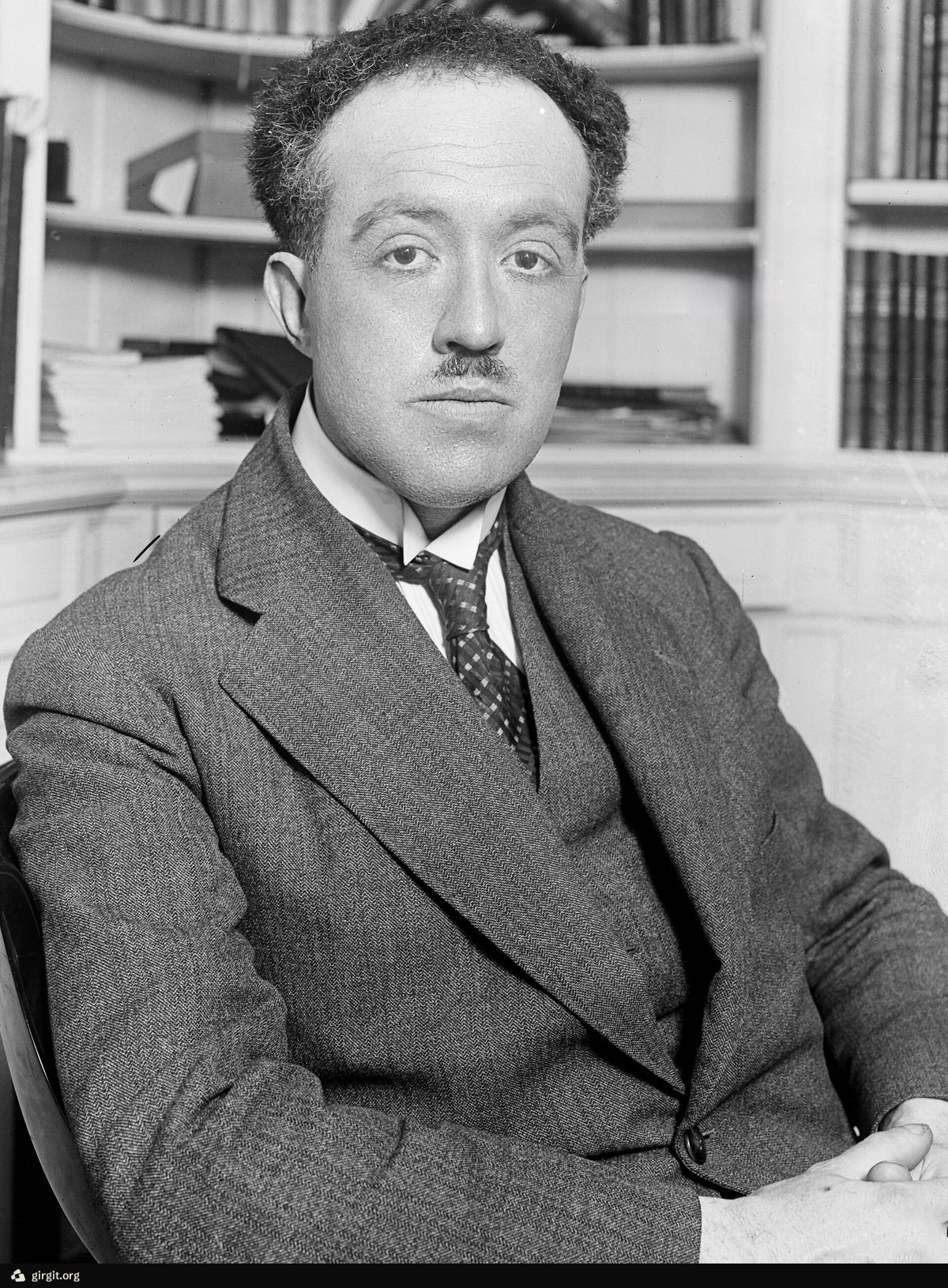
The French physicist Louis de Broglie argued: radiation behaves as both wave and particle, so matter should too. A photon has a momentum and a wavelength; an electron should have both as well. He linked the wavelength \( \lambda \) of a particle to its momentum \( p \):
\[ \lambda = \frac{h}{mv} = \frac{h}{p} \]where \( m \) is the particle's mass, \( v \) its velocity and \( p = mv \). This is the de Broglie relation.
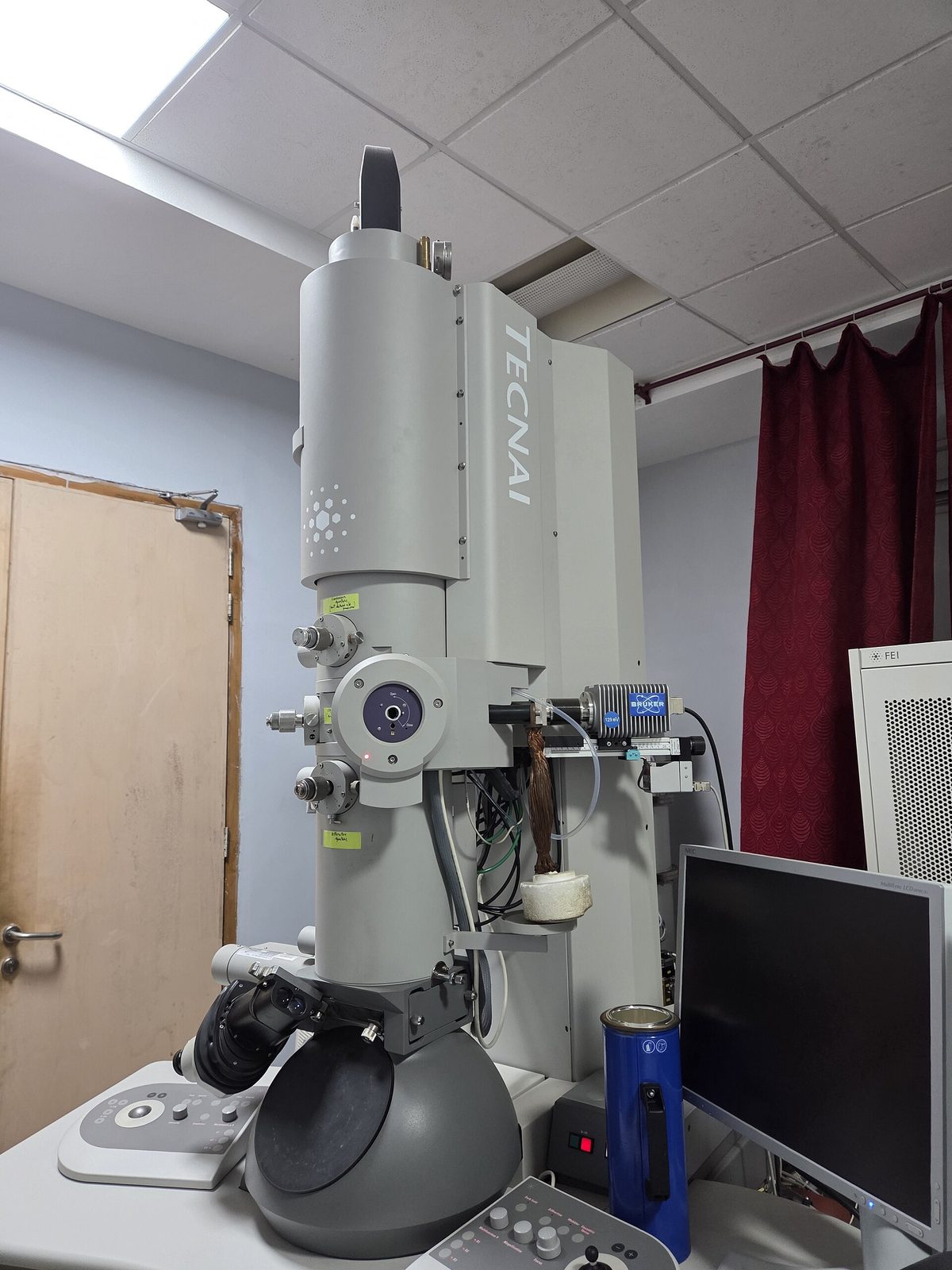
It was confirmed when a beam of electrons was found to diffract, something only waves do. The electron microscope works with electron waves in place of the light waves of an ordinary microscope; it magnifies about 15 million times.
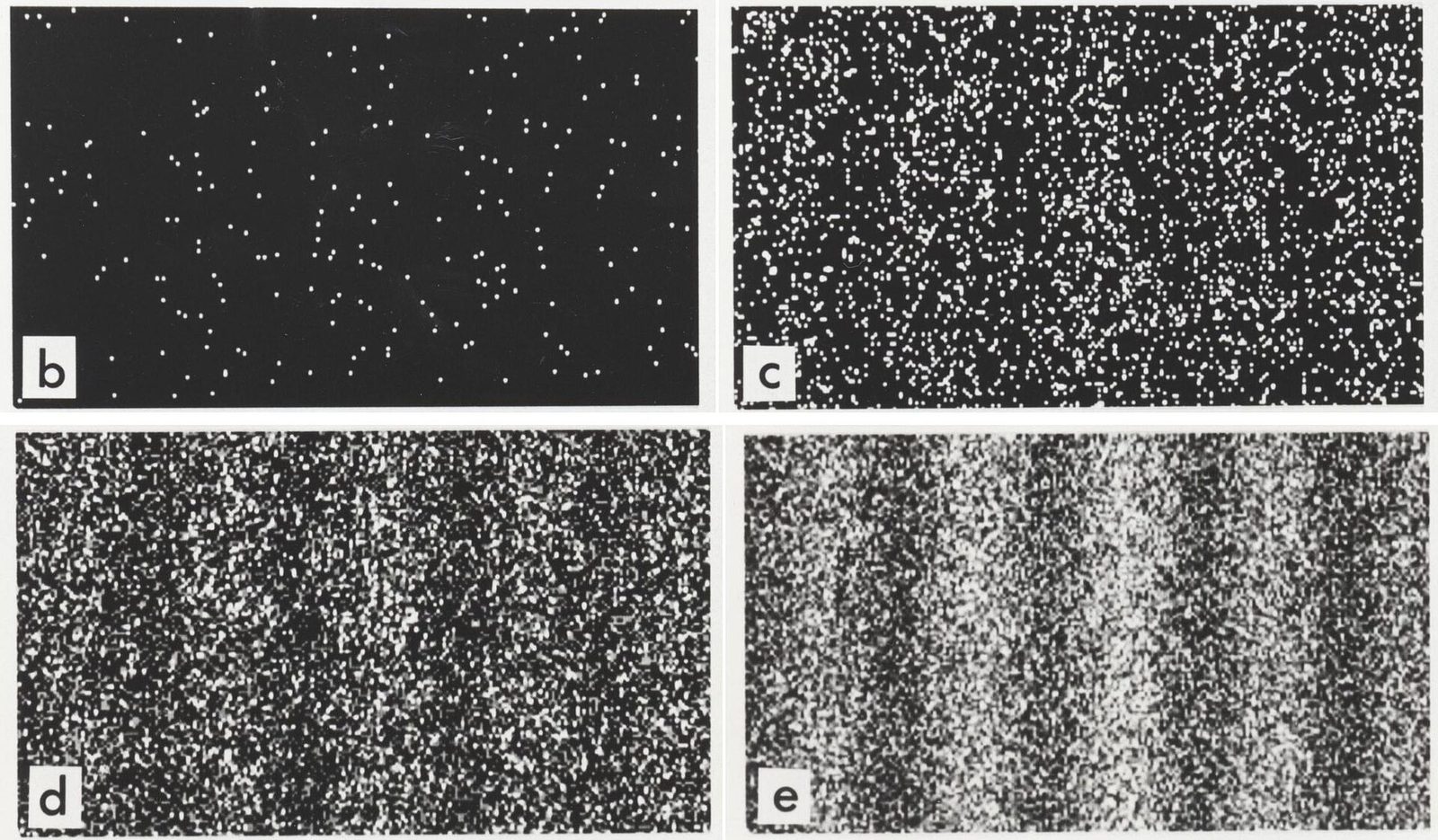
Watch the wave nature appear: electrons fired one at a time still build a wave pattern.
 electron gunmagnetic lensessample goes inviewing chamber
Every moving object has a wavelength, but for everyday objects it is far too small to detect, because their mass is huge. For electrons, with tiny mass, it can be measured.
Worked example 1: a cricket ball and an electron
- Cricket ball, 0.16 kg at 40 m s−1: \( \lambda = \dfrac{6.626 \times 10^{-34}\ \mathrm{J\,s}}{0.16\ \mathrm{kg} \times 40\ \mathrm{m\,s^{-1}}} = 1.0 \times 10^{-34} \) m. Far smaller than a nucleus: no wave effect could ever be seen.
- Electron, \( 9.11 \times 10^{-31} \) kg at \( 2.0 \times 10^{6} \) m s−1: \( \lambda = \dfrac{6.626 \times 10^{-34}}{9.11 \times 10^{-31} \times 2.0 \times 10^{6}} = 3.6 \times 10^{-10} \) m = 364 pm. That is about the size of an atom, so the wave nature matters inside atoms.
(Units: 1 J = 1 kg m2 s−2, so J s ÷ (kg m s−1) = m.)
Try it: put an electron, a proton and a cricket ball on the same ruler of lengths.
Try it. A proton and an electron move at the same speed. Which has the longer de Broglie wavelength?
Answer
Heisenberg's uncertainty principle (1927)
Werner Heisenberg showed a direct result of this dual behaviour: we cannot know, at one and the same moment, precisely where an electron is and precisely what its momentum (or velocity) is.
\[ \Delta x \times \Delta p_x \ge \frac{h}{4\pi} \qquad\text{or}\qquad \Delta x \times \Delta(m v_x) \ge \frac{h}{4\pi} \qquad\text{or}\qquad \Delta x \times \Delta v_x \ge \frac{h}{4\pi m} \]\( \Delta x \) is how unsure we are of the position, and \( \Delta p_x \) (or \( \Delta v_x \)) the uncertainty in momentum (or velocity). Make one small and the other must become large.
Another way to see it: you cannot measure how thick a page is with a ruler marked only in centimetres; you need marks finer than the page. Locating an electron needs "light" of wavelength smaller than the electron, and such light has photons of high momentum that change the electron's velocity in the collision.
Try it: shine shorter and shorter light on an electron to see where it is.
What it means
- A trajectory (a path) needs the exact position and velocity at each moment. For an electron we cannot have both, so an electron has no definite path.
- The effect matters only for microscopic objects. For a milligram-sized or heavier object the uncertainties are far too small to matter.
- So exact statements about an electron's position and momentum must be replaced by probabilities. This is the heart of the quantum mechanical model.
Worked example 2: pinning down an electron
An electron is located to within 50 pm, about the size of an atom. What is the least uncertainty in its velocity?
\[ \Delta v \ge \frac{h}{4\pi m \Delta x} = \frac{6.626 \times 10^{-34}}{4 \times 3.1416 \times 9.11 \times 10^{-31} \times 50 \times 10^{-12}} = 1.2 \times 10^{6}\ \mathrm{m\,s^{-1}} \]That is as large as the speed of the electron itself in Bohr's first orbit (about \( 2.2 \times 10^{6} \) m s−1). A neat circular orbit makes no sense.
Worked example 3: the same rule for a cricket ball
A 0.16 kg ball's speed is known to within 0.01 m s−1. The least uncertainty in its position:
\[ \Delta x \ge \frac{6.626 \times 10^{-34}}{4 \times 3.1416 \times 0.16 \times 0.01} = 3.3 \times 10^{-32}\ \mathrm{m} \]Unimaginably small. For big objects the principle sets no practical limit.
Try it: the same rule for three very different masses.
Why Bohr's model had to fail
Bohr treated the electron as a charged particle on a fixed circular orbit. That ignores its wave character, and a fixed orbit needs exact position and velocity together, which breaks the uncertainty principle. So there was no point extending Bohr's model to other atoms. A new approach, quantum mechanics, was needed.
Try it: look at the electron again and again, and see what builds up.
Not in the current textbook, but NEET has asked it: the uncertainty principle also links energy and time, \( \Delta E \times \Delta t \ge h/4\pi \). And in \( \lambda = h/mv \), \( v \) is the speed of the particle itself (sometimes called the group velocity of its wave).
Don't mix these up
- de Broglie: \( \lambda = h/mv \), one particle's wavelength. Heisenberg: \( \Delta x \Delta p \ge h/4\pi \), a limit on what we can know.
- The limit is \( h/4\pi \), not \( h/2\pi \) (which is Bohr's angular momentum unit).
- The uncertainty is not because our instruments are poor; it is how nature works at that scale.
Just remember
These are a constant, a convention and two dates. Nothing to derive; use the hooks.
- \( h = 6.626 \times 10^{-34} \) J s
- "Six-six-two-six, minus thirty-four": say it like a phone number, as on the Planck page. You will use it in every sum on this page.
- Uncertainty limit: \( h/4\pi \), not \( h/2\pi \)
- "Four for fuzzy": the uncertainty principle takes the 4. Bohr's angular momentum takes the 2 (\( nh/2\pi \)).
- For an electron, \( h/4\pi m_e = 5.79 \times 10^{-5} \) m2 s−1
- Saves time in NEET sums: \( \Delta x \cdot \Delta v \ge 5.79 \times 10^{-5} \). "5.79" is almost 5.8, and the power is −5.
- de Broglie 1924, Heisenberg 1927
- Wave first, limit after: "de Broglie before", three years ahead.
- Electron microscope: about 15 million times
- "1.5 crore" times. A light microscope stops at about 2000 times, because light waves are too long to show anything finer.
- Dual behaviour of matter
- Particles such as electrons also behave as waves.
- Momentum, p
- Mass × velocity.
- de Broglie wavelength
- λ = h/mv for a moving particle.
- Uncertainty principle
- Δx · Δp ≥ h/4π: exact position and momentum cannot both be known.
- Trajectory
- The exact path of an object over time.
- Electron microscope
- A microscope that uses electron waves instead of light.
Words to know
Why do we never notice the wave nature of a moving car?
- Only small particles have a wavelength
- Its mass is so large that its wavelength is far too small to detect
- It moves too slowly
If the uncertainty in an electron's position is made 10 times smaller, the least uncertainty in its velocity
- also becomes 10 times smaller
- becomes 10 times larger
- stays the same
Which idea most directly rules out Bohr's fixed orbits?
- Planck's E = hν
- Heisenberg's uncertainty principle
- Rydberg's formula
Deep dive · optional
Why can't an electron be in one place with one speed?
The uncertainty principle is not about clumsy measuring. It comes straight out of the electron being a wave, and it even sets the size of every atom. The exam needs only the formula; this is the reason behind it.
The roots: a wave can't be in one place
- Why can't we know exactly where an electron is and exactly how fast it moves?Because the electron is a wave, and for any wave "where it is" and "what its wavelength is" cannot both be sharp.
- Why can't a wave with one exact wavelength be in one place?One exact wavelength means the same crest, trough, crest repeated with no end. A wave like that is spread evenly over all of space: it is everywhere, so it is nowhere in particular.
- Then how do you make a wave that sits in one small place?Add many waves of slightly different wavelengths. Where their crests line up they build each other up; everywhere else they get out of step and cancel. The result is a short bump. The more wavelengths you mix in, the narrower the bump can be.
- Why does that make the momentum uncertain?De Broglie's rule, \( p = h/\lambda \), turns every wavelength into a momentum. A bump made from a spread of wavelengths is a spread of momenta. Narrow bump, wide spread of momenta; wide bump, narrow spread. The best possible mix gives exactly \( \Delta x \cdot \Delta p = h/4\pi \), and any other mix gives more.
- The bedrockTwo things you can check for yourself: waves add (two ripples on a pond pass through each other and add up), and electrons diffract, so \( \lambda = h/p \) is real.
Music shows the same trade. A long, steady note has a clear pitch. A very short tap, like a clap, has no single pitch at all: it is a mix of many. A sound cannot be both very short and of one exact pitch. For electrons, "short" is position and "pitch" is momentum.
Heisenberg's own picture, light knocking the electron as you look at it (the Rive piece above), is a good way to feel the limit, but it is not the cause. Even if nobody looks, the electron's wave cannot be both narrow and of one wavelength.
This has a big consequence. Squeeze an electron into a smaller space and its momentum spread, and so its least possible kinetic energy, goes up. The nucleus pulls the electron in, but the closer it is held, the more energy it must have just from being confined. The two balance at a size of a few tens of picometres. That is why atoms are the size they are, and why an electron does not simply fall into the nucleus, the problem that sank Rutherford's model.
The story
See it
 200 electrons6,00040,000140,000
Now build an electron's wave yourself. Change how widely the momenta are spread and watch the bump get narrower or wider. Then scramble the mix: you can make \( \Delta x \cdot \Delta p \) bigger, but never smaller than \( h/4\pi \).
Solve it
Solve it: the 1927 numbers
Davisson and Germer used electrons pushed through 54 V. (a) Find their de Broglie wavelength. (b) The rows of nickel atoms on their crystal face are 0.215 nm apart, and the strong reflected beam came out at 50°. Rows spaced \( d \) apart send waves out strongly where \( d \sin\theta = \lambda \). Do the two agree?
Hint
Answer
(b) \( 0.215 \times \sin 50^\circ = 0.215 \times 0.766 = 0.165 \) nm. Agreement within about 1%: the electrons behaved exactly like waves of de Broglie's wavelength.
Solve it: what would happen if…
An electron is squeezed into a space \( \Delta x \) across. Its least momentum spread is \( \Delta p \approx h/(4\pi \Delta x) \), and its least kinetic energy roughly \( (\Delta p)^2/2m \). (a) Find this energy for \( \Delta x = 100 \) pm, about an atom. (b) What happens to it if the electron is squeezed 100 times closer, to 1 pm? (c) The nucleus's pull is worth about 14 eV at 100 pm and about 1400 eV at 1 pm. Which wins in each case?
Answer
(b) Energy goes as \( 1/(\Delta x)^2 \): 100 times closer means 10,000 times more, about 10,000 eV.
(c) At 100 pm the pull (14 eV) easily beats the confinement cost (1 eV), so the electron can be held. At 1 pm the cost (10,000 eV) beats the pull (1400 eV): the electron cannot be held that tightly. Somewhere in between, at a few tens of picometres, they balance. That is the size of an atom, and it is why electrons never collapse into the nucleus.
Solve it: estimate
What is your own de Broglie wavelength when you walk to school (say 60 kg at 1.5 m s−1)? Could any experiment ever see you diffract through a doorway?
Answer
Connect it
Connect it
- Light did it first, Class 12 Physics. The stripes in the electron film are the same pattern light makes in Young's double-slit experiment; physics derives matter waves again in de Broglie's matter waves and electron waves.
- Orbitals next. Because an electron has no path, the next page describes it by a wave function and a probability cloud: orbitals and quantum numbers.
- Seeing cells. Ribosomes and the inner folds of mitochondria were first seen with electron microscopes; see Cell: the unit of life.
- Waves in a box, Class 11 Physics. A guitar string allows only certain wavelengths because its ends are fixed: standing waves on strings. An electron held by an atom is a wave held in a "box" too, which is the deep reason its energies come in steps.
- Labs in India. Electron microscopes like the one above are standard equipment at IITs, IISc and medical research centres, used to study everything from viruses to new battery materials.
Still confused?
Is the uncertainty just because our instruments are not good enough yet?
No. Better instruments cannot beat it, because it is not a measuring error. An electron's wave simply does not have a sharp position and a sharp wavelength at the same time. The limit belongs to the electron, not to the ruler.
So is the electron a particle or a wave?
Neither word fits on its own. It travels and spreads like a wave (it goes through both slits and makes stripes), and it is detected like a particle (one dot, in one place, every time). "Dual nature" means we need both pictures to describe what it does.
If my wavelength is tiny, does the uncertainty principle apply to me?
It applies to everything, but for a big mass the limit is absurdly small. For a cricket ball the position blur is about \( 10^{-32} \) m, far smaller than a nucleus. Only for tiny masses like the electron does the limit reach the size of an atom.
Sources
- A. Aspect and J. Villain, "The birth of wave mechanics (1923–1926)", Comptes Rendus Physique 18, 583 (2017)
- History of de Broglie's thesis defence and Langevin's report, Uspekhi Fizicheskikh Nauk (1988)
- Davisson–Germer experiment (Wikipedia): the 1925 accident, the 54 V beam and the 50° peak
- The Nobel Prize in Physics 1937 (Davisson and G.P. Thomson); 1929 (de Broglie); 1906 (J.J. Thomson)
- A. Tonomura et al., "Demonstration of single-electron buildup of an interference pattern", American Journal of Physics 57, 117 (1989); picture: Wikimedia Commons, with Dr Tonomura's permission
- R. Bach, D. Pope, S.-H. Liou and H. Batelaan, "Controlled double-slit electron diffraction", New Journal of Physics 15, 033018 (2013)
- W. Heisenberg, "Über den anschaulichen Inhalt der quantentheoretischen Kinematik und Mechanik", Zeitschrift für Physik 43, 172 (1927)
- NIST, CODATA values of h, mₑ and e

Picture and video credits
Show 3 picture and video credits
- electron-double-slit-buildup.mp4: Roger Bach, Damian Pope, Sy-Hwang Liou and Herman Batelaan (New J. Phys. 15, 033018, 2013), CC BY 3.0
- transmission-electron-microscope-india.jpg: Gannu03, CC BY-SA 4.0
- tonomura-electron-double-slit-buildup.jpg: Dr. Tonomura and Belsazar, CC BY-SA 3.0


