Structure of AtomFull experience
- 1. What is an atom made of?
- 2. Why did a few alpha particles bounce back?
- 3. Atomic number, mass number, isotopes and isobars
- 4. Why should Rutherford's atom collapse? And what is light?
- 5. Light comes in packets
- 6. Why does each element glow in its own colours?
- 7. Bohr's model of the hydrogen atom
- 8. How Bohr explained the hydrogen spectrum, and where he failed
- 9. Is an electron a particle or a wave?
- 10. Orbitals and quantum numbers
- 11. What does an orbital look like, and which is lowest?
- 12. How do electrons fill an atom?
- Review
3 of 12·NCERT §2.2.3 · §2.2.4·pp. 35–36·4 min
Atomic number, mass number, isotopes and isobars
The big ideaThe number of protons (Z) decides which element an atom is; protons plus neutrons (A) decide its mass.
In simple words
Every atom has a centre with plus bits and no-charge bits. Count the plus bits and you know which element it is: one means hydrogen, six means carbon, always. Add up both kinds of bits in the centre and you know how heavy the atom is. Two atoms of the same element can have a different number of no-charge bits. They behave the same in chemistry, but one is a little heavier.
Atomic number and mass number
The nucleus is positive because of its protons. The number of protons is the atomic number, \( Z \). A neutral atom has as many electrons as protons, so the charges cancel.
\[ Z = \text{number of protons} = \text{number of electrons in a neutral atom} \]Hydrogen has 1 proton (Z = 1) and sodium has 11 (Z = 11), so a neutral sodium atom has 11 electrons.
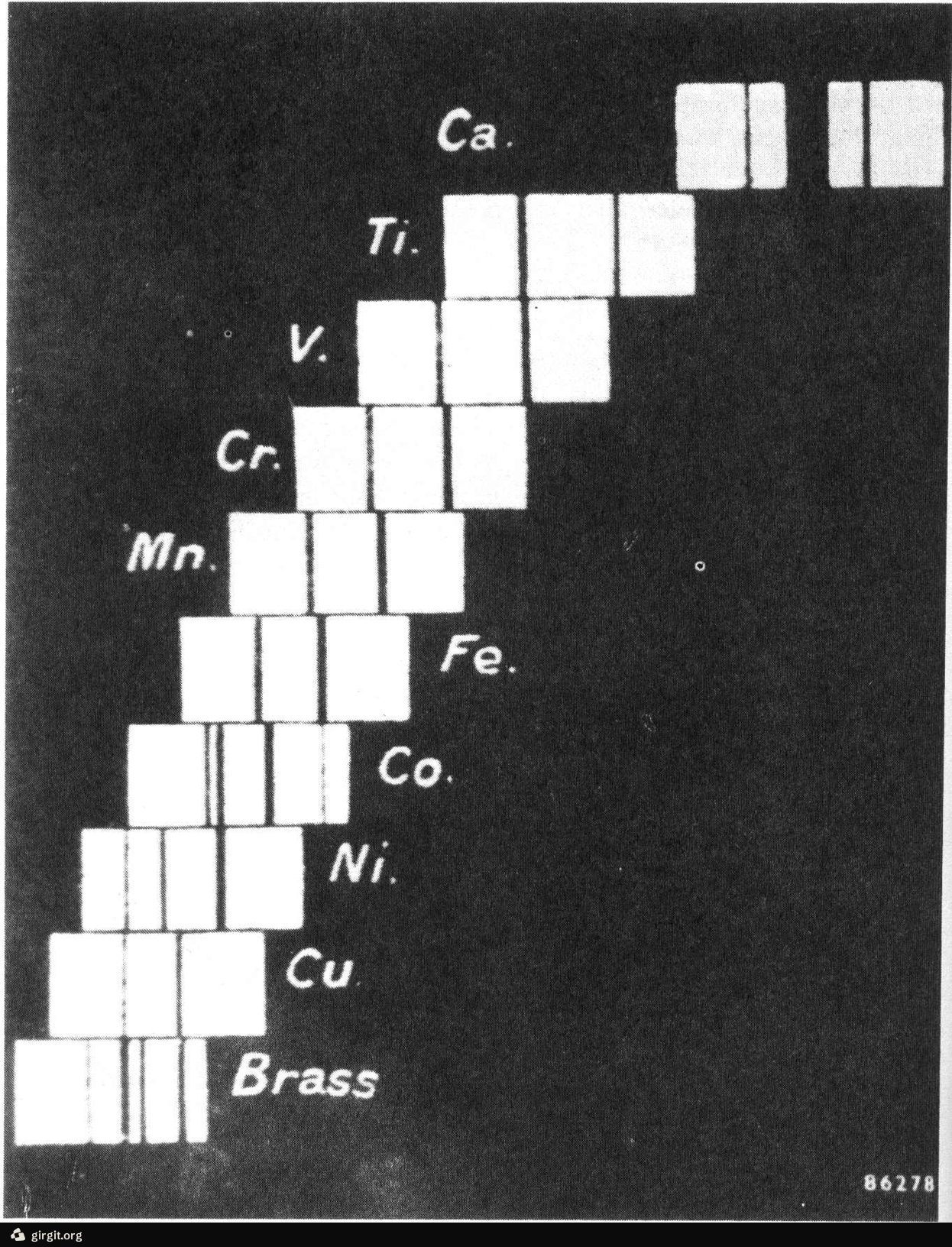 Ca, Z = 20gap: Sc, Z = 21Fe, Z = 26Co, Z = 27Ni, Z = 28
The mass of the nucleus comes from its protons and neutrons. Together these are called nucleons. Count all the nucleons and you get the mass number, \( A \):
\[ A = Z + n \qquad\text{so}\qquad n = A - Z \]where \( n \) is the number of neutrons. An atom is written with A as a raised number and Z as a lowered number, both on the left of the symbol: \( {}^{A}_{Z}\mathrm{X} \). For example \( {}^{23}_{11}\mathrm{Na} \) has 11 protons, 11 electrons and 23 − 11 = 12 neutrons.
Worked example 1: an ion
How many protons, neutrons and electrons are in \( {}^{56}_{26}\mathrm{Fe^{3+}} \)?
- Protons = Z = 26.
- Neutrons = A − Z = 56 − 26 = 30. (This is true for atoms and ions alike.)
- Charge +3 means 3 electrons have been lost: electrons = 26 − 3 = 23.
Worked example 2: name the species
A particle has 8 protons, 8 neutrons and 10 electrons. What is it?
- 8 protons, so Z = 8: oxygen.
- A = 8 + 8 = 16.
- Two more electrons than protons, so the charge is −2. It is the oxide ion, \( {}^{16}_{8}\mathrm{O^{2-}} \).
Before you write the symbol
- First decide: neutral atom, cation (positive ion, more protons than electrons) or anion (negative ion, more electrons than protons)?
- Only a neutral atom has electrons = protons = Z.
- Neutrons are always A − Z, whatever the charge.
Try it: build atoms and ions from their particles, and watch the symbol change.
Isotopes and isobars
Isotopes are atoms with the same atomic number but different mass numbers. Same protons, different neutrons. Hydrogen has three:
| Isotope | Symbol | Protons | Neutrons | How common |
|---|---|---|---|---|
| Protium | \( {}^{1}_{1}\mathrm{H} \) | 1 | 0 | 99.985% |
| Deuterium | \( {}^{2}_{1}\mathrm{D} \) | 1 | 1 | 0.015% |
| Tritium | \( {}^{3}_{1}\mathrm{T} \) | 1 | 2 | Only traces on earth |
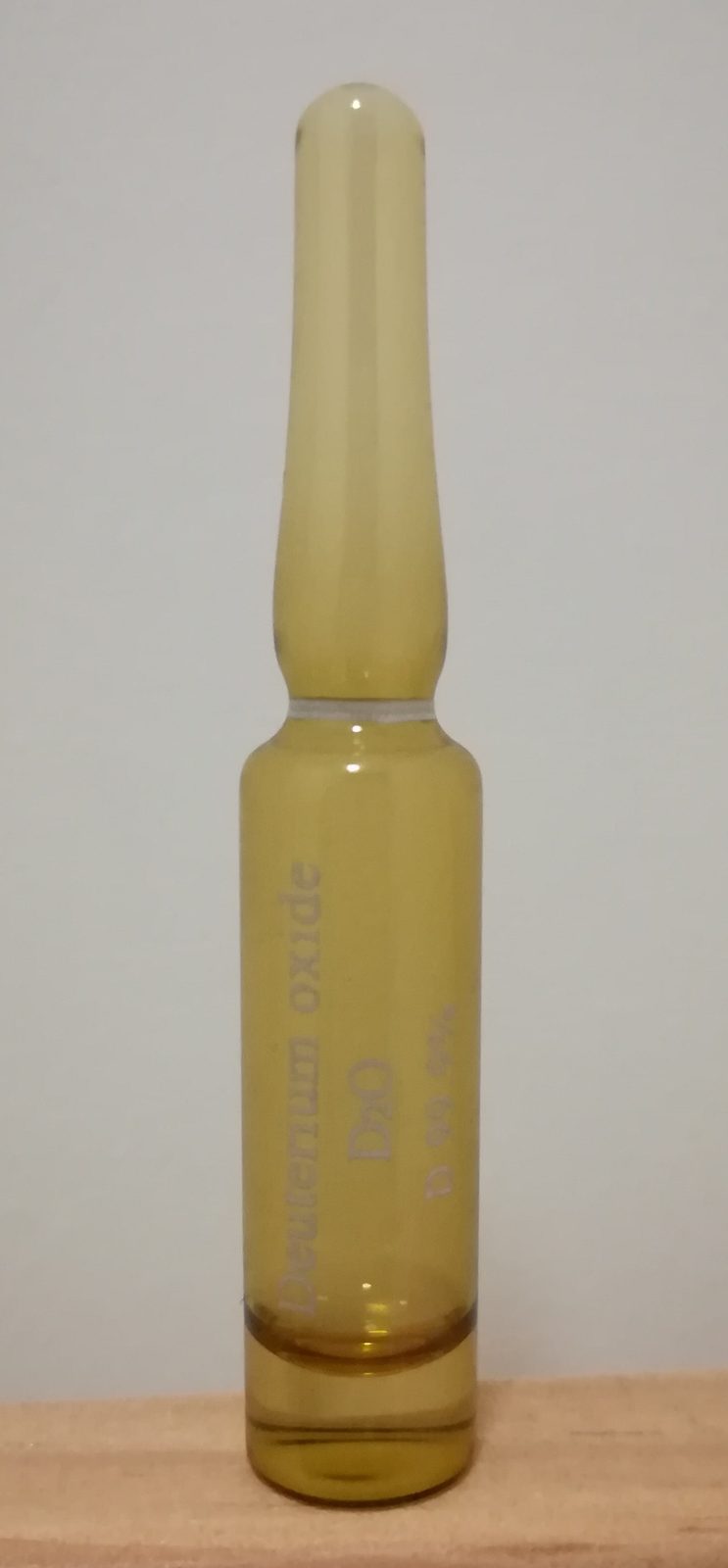
Carbon has isotopes with 6, 7 and 8 neutrons (\( {}^{12}_{6}\mathrm{C}, {}^{13}_{6}\mathrm{C}, {}^{14}_{6}\mathrm{C} \)) and chlorine has isotopes with 18 and 20 neutrons (\( {}^{35}_{17}\mathrm{Cl}, {}^{37}_{17}\mathrm{Cl} \)).
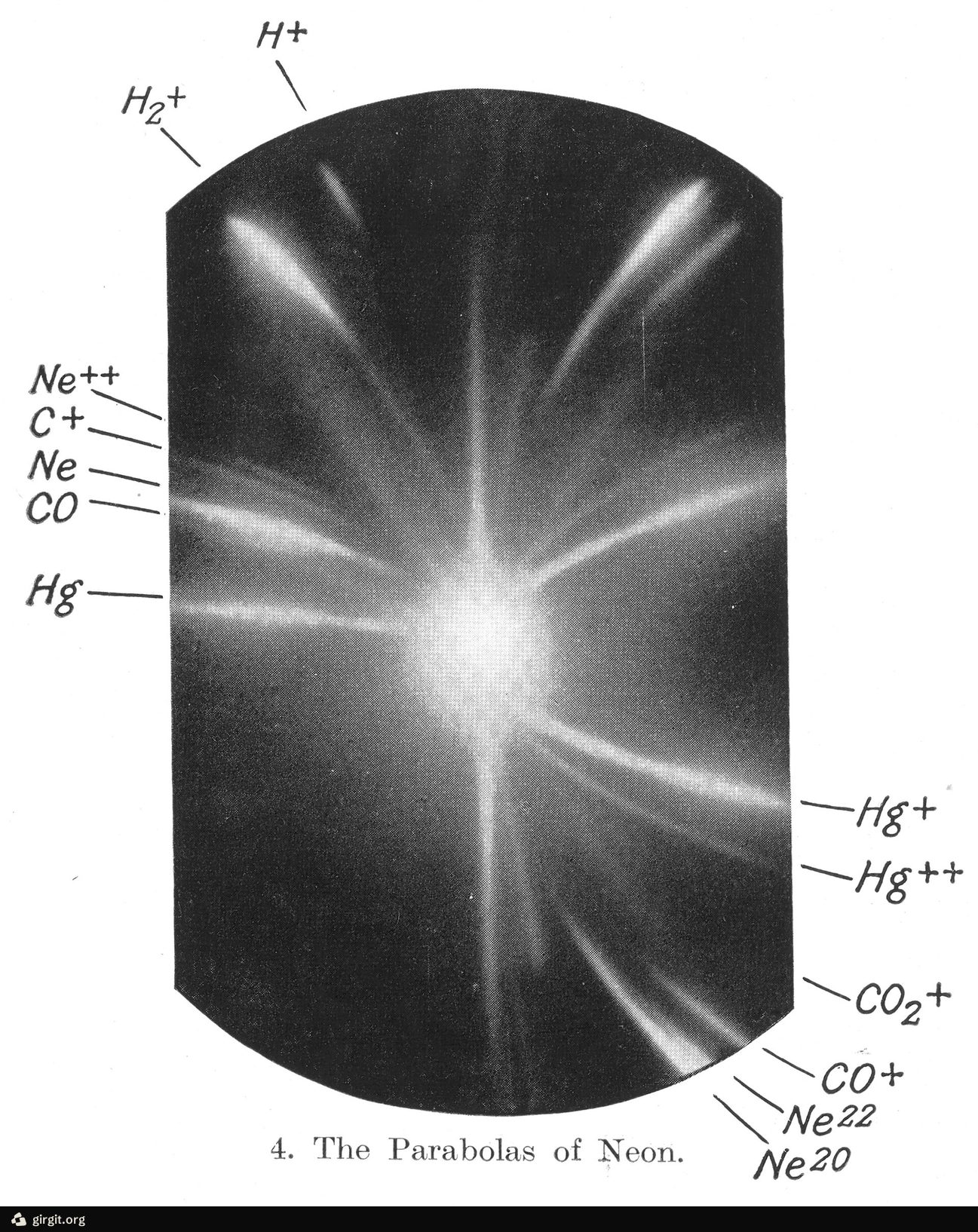 each curve: one kind of ionneon-20 and neon-22
Why isotopes react alike: chemistry is decided by electrons, and the number of electrons is fixed by the number of protons. Neutrons hardly affect chemical properties. So all isotopes of an element show the same chemical behaviour.
Isobars are the opposite: atoms with the same mass number but different atomic numbers, so they are different elements. Example: \( {}^{14}_{6}\mathrm{C} \) and \( {}^{14}_{7}\mathrm{N} \).
Don't mix these up
- Isotopes: same Z (same number of protons). Isobars: same A (same "bar" on the weighing scale).
- Nucleons are protons + neutrons. Electrons are not nucleons.
Try it. How many protons, neutrons and electrons are there in \( {}^{40}_{20}\mathrm{Ca^{2+}} \)? Which neutral atom has the same number of electrons?
Answer
Just remember
Conventions and names: these are agreed ways of writing, not facts of nature. Hooks help.
- In \( {}^{A}_{Z}\mathrm{X} \), A on top, Z below
- A is above; Z sits on the zameen (the ground). The big number (mass) goes up, the small number (protons) goes down.
- Isotope = same Z
- The word itself: Greek isos (same) + topos (place). Same place in the periodic table, so same element, same Z.
- Protium, deuterium, tritium: 1, 2, 3 nucleons
- Greek counting: protos first, deuteros second, tritos third. Hydrogen is 99.985% protium.
- Symbols D and T
- The only isotopes with their own letters. D for deuterium, T for tritium; heavy water is D2O.
- Chlorine-35 and chlorine-37: 18 and 20 neutrons
- Both have 17 protons; take 17 from 35 and from 37. Natural chlorine is about three parts Cl-35 to one part Cl-37, which is why its atomic mass is about 35.5.
- Atomic number, Z
- Number of protons in the nucleus.
- Mass number, A
- Protons + neutrons.
- Nucleons
- The particles in the nucleus: protons and neutrons.
- Isotopes
- Same Z, different A: same element, different neutrons.
- Isobars
- Same A, different Z: different elements.
- Cation / anion
- A positive / negative ion.
Words to know
Chlorine-35 and chlorine-37 differ in their number of
- protons
- neutrons
- electrons
Which pair are isobars?
- \( {}^{1}_{1}\mathrm{H} \) and \( {}^{2}_{1}\mathrm{H} \)
- \( {}^{40}_{18}\mathrm{Ar} \) and \( {}^{40}_{20}\mathrm{Ca} \)
- \( {}^{12}_{6}\mathrm{C} \) and \( {}^{16}_{8}\mathrm{O} \)
A species has 17 protons, 18 neutrons and 18 electrons. It is
- an argon atom
- a chloride ion, ³⁵Cl−
- a Cl+ ion
Deep dive · optional
What really makes an element itself?
Why the proton count, and not the mass, is an element's identity; how a 26-year-old counted protons with X-rays; and why the atomic mass in your periodic table is a number no atom has. The exam needs none of this, but it explains the rules above.
The roots: why Z and not mass
- Why does the number of protons decide which element an atom is?Because an element is defined by how it behaves in chemistry, and chemistry is done by electrons: sharing them, giving them, taking them.
- Why does the proton count fix the electrons?A neutral atom holds exactly as many electrons as it has protons, Z. An atom with too few or too many is an ion, and in ordinary matter ions always pair up with opposite charges. So Z protons means Z electrons, arranged in the same way every time.
- Then why don't neutrons matter for chemistry?A neutron has no charge. Adding one changes how heavy the nucleus is but not how strongly it pulls on the electrons. The electrons cannot tell. That is why isotopes react alike, and why the differences that do appear (heavy water boils at 101.4 °C instead of 100 °C) are small effects of mass alone.
- Why did ordering elements by mass go wrong?Mass counts protons plus neutrons, and the neutron count varies. Argon (39.95 u) is heavier than potassium (39.10 u) but comes first; cobalt is heavier than nickel; tellurium heavier than iodine. Mendeleev had to swap such pairs by hand, trusting chemistry over mass. Ordered by Z, every pair falls into place.
- How could anyone count protons before seeing inside an atom?Moseley found that each element's X-rays climb in frequency by one even step from one element to the next: the square root of the frequency goes up in a straight line with Z. A straight line with equal steps means Z is a real count, the charge of the nucleus, not just a position in a list.
- The bedrockOpposite charges attract, and ordinary matter is neutral overall. Everything on this page follows from those two facts.
So an element is "the set of all atoms with Z protons". Mass number, neutron count and atomic mass are properties of particular atoms or of particular mixtures of them. The atomic mass printed in your periodic table is the second kind: a weighted average over the isotopes found in nature. For chlorine it is 35.45 u, and not one chlorine atom has that mass.
The story
See it
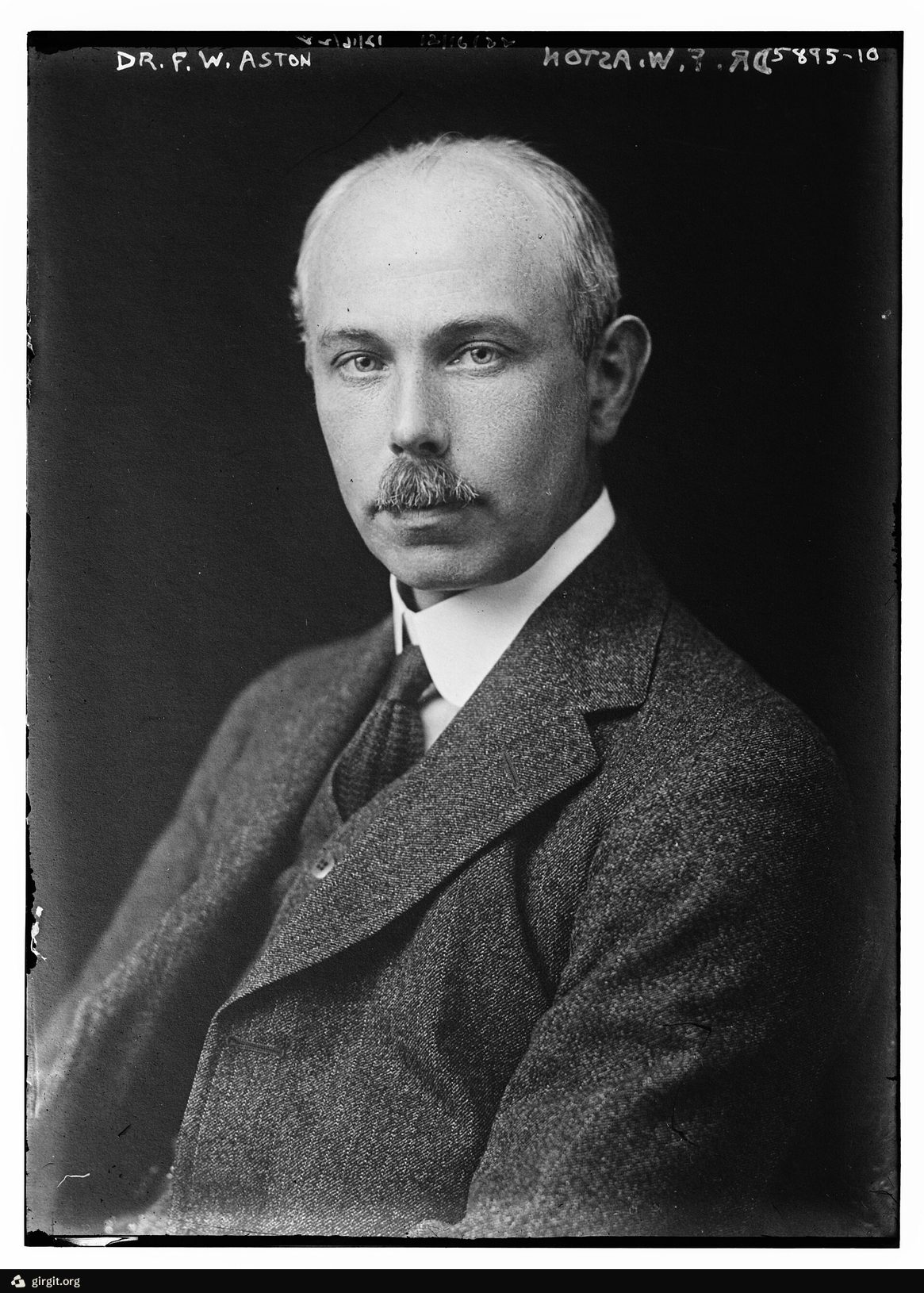
Aston's idea is simple: give ions the same speed, bend them with a magnet, and heavier ions swing wider. Watch chlorine split into two, then change the mixture in the sentence and see the average move while the atoms stay where they are.
Solve it
Solve it
Copper has two isotopes, \( ^{63}\mathrm{Cu} \) (62.930 u) and \( ^{65}\mathrm{Cu} \) (64.928 u). Its atomic mass is 63.546 u. What percentage of copper atoms are copper-63?
Hint
Answer
Solve it: predict, then check
Moseley's rule says the X-ray frequency of an element's main line grows as \( (Z - 1)^2 \). Copper (Z = 29) gives this line at 0.154 nm. Predict the wavelength for iron (Z = 26).
Answer
Solve it: estimate
Heavy water, D2O, has deuterium (2.014 u) where ordinary water has hydrogen (1.008 u). If heavy water molecules pack as closely as ordinary ones, how dense should it be? (Oxygen-16: 15.995 u.)
Answer
Solve it: spot the error
"Carbon-14 and nitrogen-14 have the same mass number, so they behave the same way in chemistry." What is wrong?
Answer
Connect it
Connect it
- Atomic mass, Chapter 1. The "average atomic mass" you calculated there is exactly the weighted average the mass spectrometer measures. See Atomic and molecular mass.
- The modern periodic law, Chapter 3. Moseley's discovery is why the periodic table is ordered by atomic number. See The modern periodic table.
- Sorting by \( q/m \), concept 1. A mass spectrometer is Thomson's cathode ray tube turned into a weighing machine. See What is an atom made of?
- Nuclei, Class 12 Physics. Why some isotopes are stable and others radioactive. See Atomic mass and isotopes.
- India's reactors. Many of India's nuclear power reactors use heavy water to slow down neutrons, which lets them run on natural uranium, and India's Heavy Water Board is among the world's largest producers of it. An isotope you cannot tell from water by looking is a pillar of the country's power programme.
Still confused?
If isotopes have the same chemistry, how can anyone separate them?
By mass, not by chemistry. Heavier molecules move, diffuse and evaporate a little more slowly, and a magnet bends heavier ions less. Each step separates only a little, so it is repeated many times. That is why heavy water and enriched uranium are expensive.
Why are atomic masses not whole numbers when mass numbers are?
Two reasons. Mostly, because natural elements are mixtures of isotopes, so the table shows an average (chlorine, 35.45). And even a single isotope is not exactly a whole number of u, because protons and neutrons are not exactly 1 u each and some mass is lost as binding energy when the nucleus forms. Carbon-12 is exactly 12 u only because the unit is defined that way.
Can an element change into another?
Only if the nucleus changes, which chemistry never does. Radioactive decay can: when carbon-14 gives off a beta particle, one neutron becomes a proton, Z goes from 6 to 7, and the atom is now nitrogen-14, its isobar.
Sources
- APS News, "August 10, 1915: Henry G.J. Moseley killed in action"
- University of Manchester, "Gallipoli 100 years on: Manchester pays tribute to genius lost to war"
- Accademia Nazionale delle Scienze detta dei XL, Rendiconti (2019), study of Moseley's death
- H.G.J. Moseley, "The High-Frequency Spectra of the Elements", Philosophical Magazine 26, 1024 (1913) and 27, 703 (1914)
- Chemistry World, "Transmutations and isotopes" (Soddy and Margaret Todd)
- The Nobel Prize in Chemistry 1922: Francis W. Aston
- Encyclopedia.com, "Aston, Francis William" (neon 20 and 22, 212 isotopes, whole-number rule)
- "Heavy water", Wikipedia (density, boiling point, reactors, India's Heavy Water Board)
- IUPAC Commission on Isotopic Abundances and Atomic Weights (isotope masses and abundances)
Picture and video credits
Show 1 picture and video credits
- heavy-water-sample.jpg: Leiem, CC BY-SA 4.0
