Structure of AtomFull experience
- 1. What is an atom made of?
- 2. Why did a few alpha particles bounce back?
- 3. Atomic number, mass number, isotopes and isobars
- 4. Why should Rutherford's atom collapse? And what is light?
- 5. Light comes in packets
- 6. Why does each element glow in its own colours?
- 7. Bohr's model of the hydrogen atom
- 8. How Bohr explained the hydrogen spectrum, and where he failed
- 9. Is an electron a particle or a wave?
- 10. Orbitals and quantum numbers
- 11. What does an orbital look like, and which is lowest?
- 12. How do electrons fill an atom?
- Review
2 of 12·NCERT §2.2 · §2.2.1 · §2.2.2·pp. 32–35·6 min
Why did a few alpha particles bounce back?
The big ideaAlmost all of an atom's mass and all its positive charge sit in a tiny nucleus at the centre; the rest of the atom is nearly empty space.
In simple words
Once we knew atoms hold plus and minus bits, the question was how they are arranged. One idea said the plus part is spread out like a soft pudding with the minus bits stuck in it. To test it, a scientist fired very fast tiny bullets at a sheet of gold thinner than a hair. Most went straight through. But a very few bounced right back, as if they had hit a small hard rock. So the plus part must be packed into a tiny centre.
What an atomic model had to explain
An atomic model is a picture of how the particles inside an atom are arranged. After the sub-atomic particles were found, a good model had to explain:
- why the atom is stable and does not fall apart;
- why elements differ in their physical and chemical properties;
- how atoms join to make different molecules;
- where the light that atoms absorb and give out comes from.
Many models were tried. NCERT discusses two: Thomson's and Rutherford's.
Thomson's model (1898)
J.J. Thomson pictured the atom as a sphere of radius about \( 10^{-10} \) m with its positive charge spread evenly through it. The electrons sit inside it, placed so that the whole arrangement is as stable as possible. It is called the plum pudding, raisin pudding or watermelon model: a watermelon of positive charge with electrons as the seeds. In this model the mass is also spread evenly over the whole atom.
It explained why an atom is neutral overall, but later experiments proved it wrong. Thomson still won the 1906 Nobel Prize in Physics for his work on how gases conduct electricity.
New rays: X-rays and radioactivity
In 1895 Wilhelm Röntgen found that electrons hitting a material in a cathode ray tube give off rays that make fluorescent materials outside the tube glow. Not knowing what they were, he called them X-rays. They are produced best when electrons hit a dense metal anode (the target), are not bent by electric or magnetic fields, pass easily through matter (so they show the inside of objects), and are electromagnetic waves of very short wavelength, about 0.1 nm.
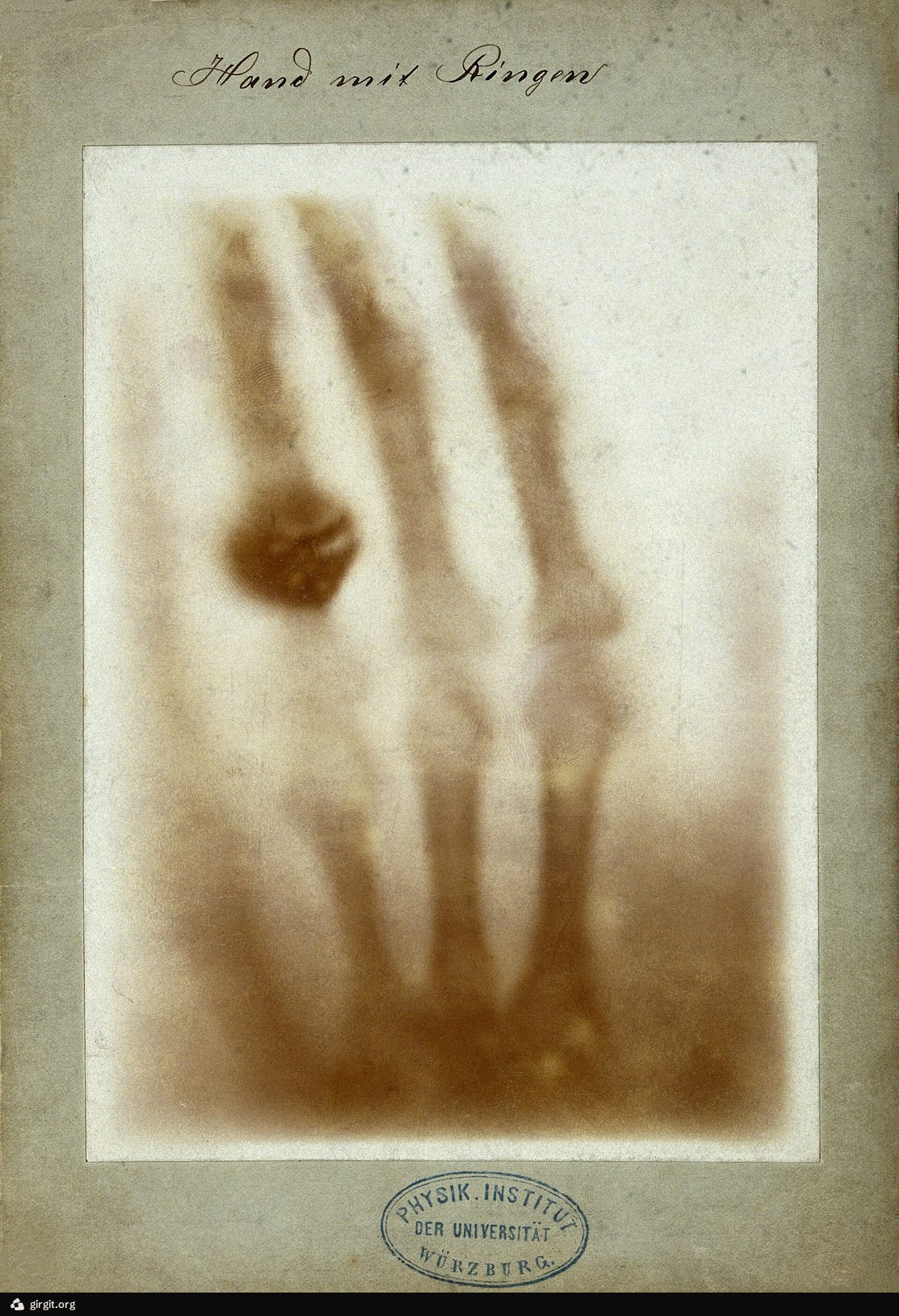 ringfinger bones
Henri Becquerel found that some elements give off radiation all by themselves: radioactivity. Marie Curie, Pierre Curie, Rutherford and Frederick Soddy built up the field. Three kinds of rays come out:
| Ray | What it is | Penetrating power |
|---|---|---|
| α (alpha) | Particles with charge +2 and mass 4 u: helium nuclei (add two electrons and you get helium gas) | Least (taken as 1) |
| β (beta) | Negative particles, like electrons | About 100 times α |
| γ (gamma) | Neutral, high-energy radiation like X-rays; not particles | About 1000 times α |
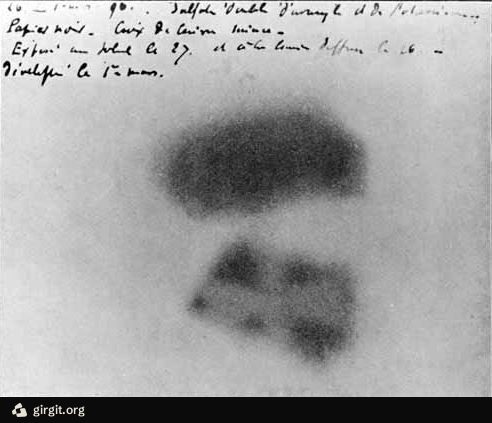 Becquerel's notesfogged under uraniumshadow of a copper cross
Rutherford's gold foil experiment
Ernest Rutherford with Hans Geiger and Ernest Marsden aimed a beam of fast alpha particles from a radioactive source at a very thin gold foil, about 100 nm thick. A circular zinc sulphide screen around the foil gave a tiny flash wherever an alpha particle hit.
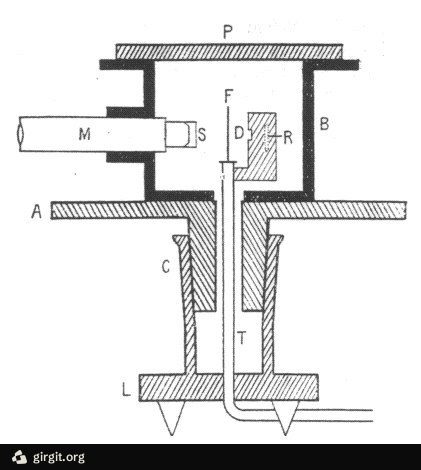 alpha sourcefoilscreenmicroscopeturntable
Try it: before reading what happened, fire alphas at both models of the atom.
If Thomson were right, each gold atom's mass would be spread thinly, and the heavy, fast alpha particles would push straight through, bending only slightly. What actually happened:
- Most alpha particles went straight through, not deflected at all.
- A small fraction were deflected by small angles.
- A very few, about 1 in 20,000, bounced back by nearly 180°.
Rutherford said it was as surprising as firing a shell at tissue paper and having it come back at you. His conclusions:
- Most of the atom is empty space, since most particles were not disturbed.
- The few large deflections need a huge repulsive force, so the positive charge is packed into a very small volume, not spread out as Thomson thought.
- The nucleus is tiny compared with the atom: the atom's radius is about \( 10^{-10} \) m and the nucleus's about \( 10^{-15} \) m, a hundred thousand times smaller.
Rutherford's nuclear model
The nuclear model of the atom
- All the positive charge and almost all the mass are packed into a very small central region, the nucleus.
- Electrons move round the nucleus at high speed in circular paths called orbits, like planets round the sun.
- Electrostatic attraction between the nucleus and the electrons holds them together.
Because it looks like the solar system, it is also called the planetary model. We will see in concept 4 why this picture, taken strictly, cannot work.
Guess first. If the gold foil were made twice as thick, would more or fewer alpha particles bounce back?
Answer
Don't mix these up
- Thomson: positive charge and mass spread out. Rutherford: positive charge and mass concentrated in the nucleus.
- The few back-scattered particles prove the nucleus is small and positive. The many undeflected ones prove the atom is mostly empty.
- γ-rays are not particles and carry no charge; α-particles are helium nuclei, He2+.
Just remember
Names, dates and measured numbers: nothing deeper fixes them, so use the hooks.
- Thomson's model (1898): plum pudding, raisin pudding or watermelon
- Cut a tarbooz: the red flesh is the spread-out positive charge, the black seeds are the electrons.
- X-rays: Röntgen, 1895. Radioactivity: Becquerel, 1896
- The news of X-rays in early 1896 is what sent Becquerel looking for rays from glowing salts, so X comes first, one year ahead.
- Penetrating power α : β : γ = 1 : 100 : 1000
- Count the zeros: α none, β two, γ three. Alpha is stopped by a sheet of paper, gamma needs thick lead.
- α-particle = helium nucleus, He2+: charge +2, mass 4 u
- "2 and 4": two protons, four nucleons, like the 2 in He's place in the periodic table and the 4 in its mass.
- About 1 in 20,000 alphas bounced back
- One person in a packed cricket stadium of twenty thousand.
- Atom about \( 10^{-10} \) m, nucleus about \( 10^{-15} \) m
- The smaller thing gets the bigger number after the minus: 15 beats 10 by five, so the atom is \( 10^{5} \) times wider.
- Plum pudding model
- Thomson's atom: electrons set in a uniform sphere of positive charge.
- X-rays
- Very short-wavelength electromagnetic rays made when electrons hit a metal target.
- Radioactivity
- Elements giving off α, β or γ radiation on their own.
- α-particle
- A helium nucleus: charge +2, mass 4 u.
- Nucleus
- The tiny, dense, positive centre of an atom.
- Orbit
- In Rutherford's model, the circular path of an electron round the nucleus.
Words to know
Which observation made Rutherford reject Thomson's model?
- Most α-particles passed straight through
- About 1 in 20,000 α-particles bounced back by nearly 180°
- The zinc sulphide screen flashed when hit
The radius of an atom is about 10−10 m and of its nucleus about 10−15 m. How many times wider is the atom?
- 10−5 times
- 105 times
- 1025 times
Which radiation is not deflected by an electric field?
- α-rays
- β-rays
- γ-rays
Deep dive · optional
How did a bounce prove the nucleus is tiny?
Why a pudding of charge can never turn an alpha particle round, how far the alpha actually gets, and the people counting flashes in the dark. Not needed for the exam; it makes the gold foil result feel inevitable.
The roots: why only a tiny nucleus can do it
- Why could Thomson's atom never send an alpha particle back?To turn round, the alpha must lose all its energy of motion, about 7.7 MeV for the alphas Rutherford used. Spread through a whole gold atom, the positive charge can take away at most about 0.0034 MeV. That is more than two thousand times too little.
- Why is spread-out charge so weak?The electric push between two charges grows as they get closer, as \( 1/r^2 \). If the charge is spread through a ball \( 10^{-10} \) m wide, the alpha can never get close to all of it at once: by the time it is inside, some of the charge is behind it, pulling the other way. At the very centre the pushes cancel.
- Why does a concentrated charge work?If all the charge sits at one point, the energy needed to come closer, \( U = 1.44 \times 2Z / r \) MeV (with \( r \) in femtometres, 1 fm = \( 10^{-15} \) m), grows without limit as \( r \) shrinks. The alpha climbs this hill until \( U \) equals its energy, stops, and rolls back.
- How close does it get?Set \( U = K \): \( d = 2.88\,Z/K \) fm. For gold (\( Z = 79 \)) and \( K = 7.7 \) MeV, \( d \approx 30 \) fm, about \( 3 \times 10^{-14} \) m.
- So what does the bounce tell us?The alpha turned back without hitting anything, so the whole positive charge must fit inside a sphere smaller than about 30 fm. The atom is about 100,000 fm across. The nucleus is at least thousands of times smaller than the atom (today we know gold's is about 7 fm in radius).
- The bedrockTwo rules you already trust: like charges repel more strongly the closer they are (Coulomb's law), and energy is never lost, only changed from one form to another.
Notice what the experiment really measured. Rutherford never saw a nucleus. He counted where flashes appeared and compared the counts with a prediction. A point charge predicts that the number of alphas scattered through an angle \( \theta \) falls off steeply, as \( 1/\sin^4(\theta/2) \); a pudding predicts almost nothing beyond a few degrees. When Geiger and Marsden counted at every angle in 1913, the point-charge prediction fitted. That is how a picture of something far too small to see is earned: by a number that matches.
And why did most alphas sail straight through? An alpha particle is about 7300 times heavier than an electron. Electrons are in the way, but pushing through them is like a cricket ball flying through a cloud of mosquitoes. Only the nucleus, about 50 times heavier than the alpha for gold, can stop it.
The story
See it
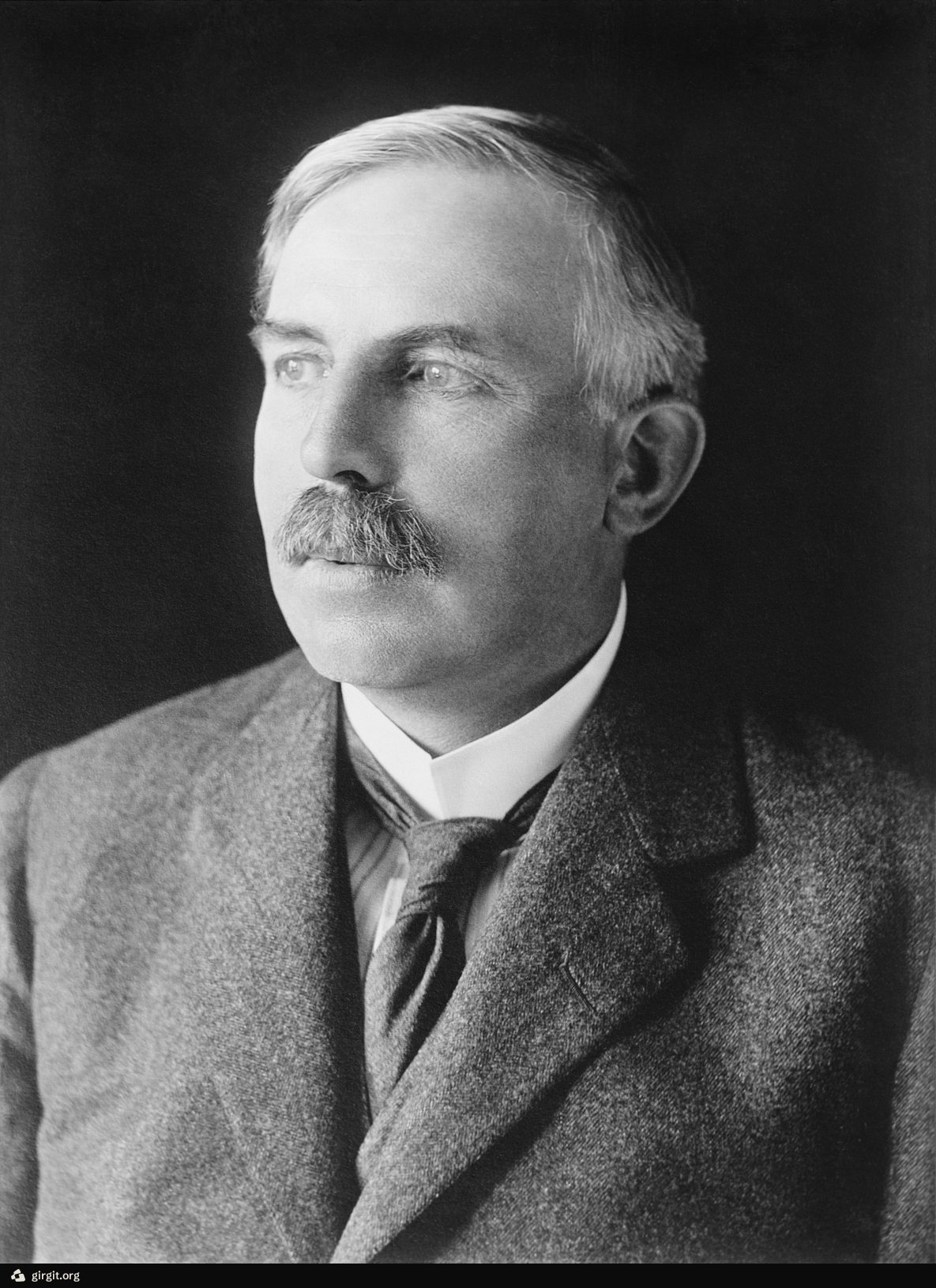
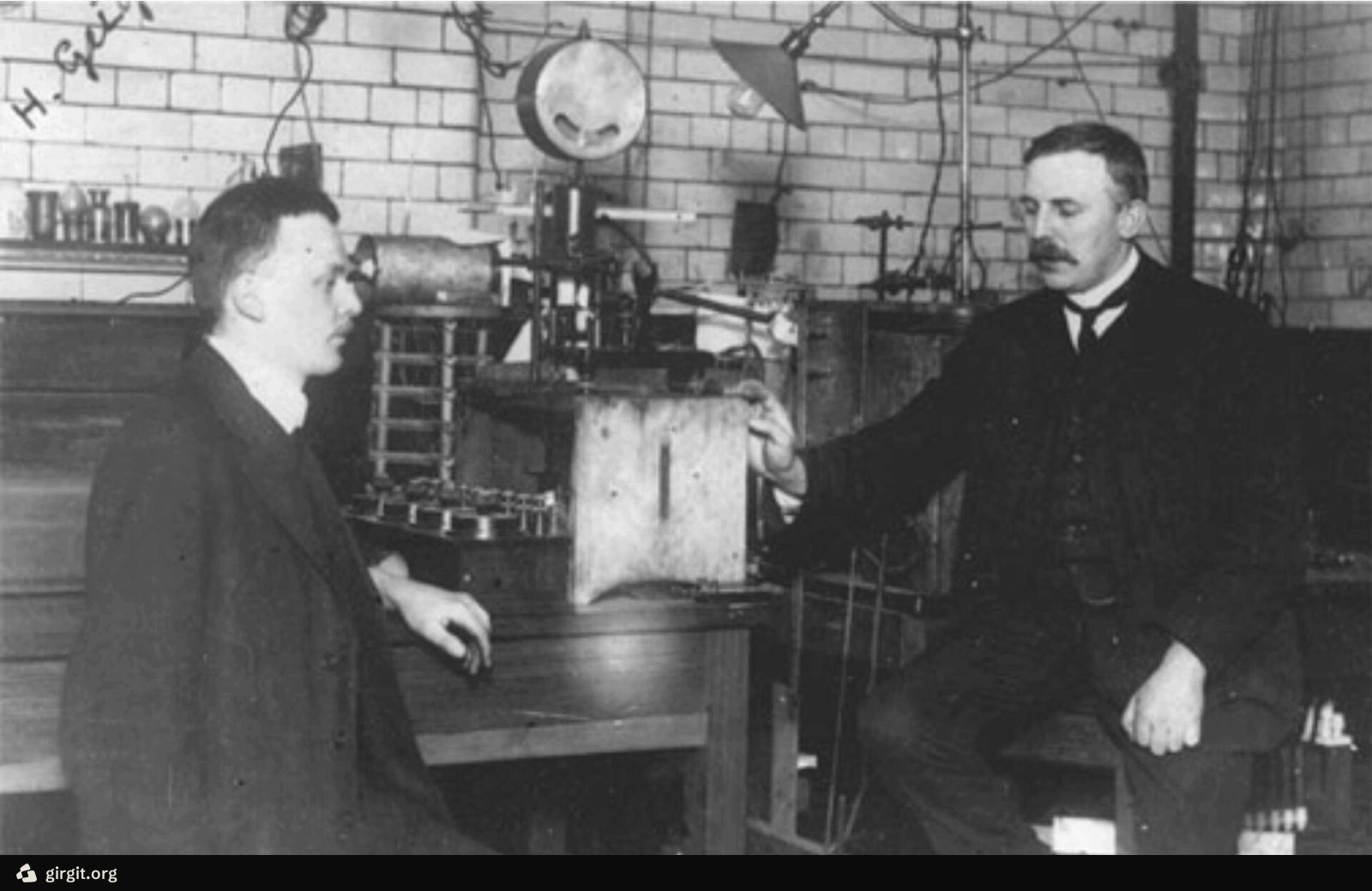 GeigerRutherford
Now fire the alpha yourself. Start with Thomson's atom, then switch to Rutherford's nucleus. Drag the energy and the element in the sentence; press Every energy to see how close every alpha gets.
Solve it
Solve it
Polonium-210 gives alphas of 5.3 MeV. How close does one get, head-on, to (a) a gold nucleus, (b) an aluminium nucleus (\( Z = 13 \))? Nuclear radii are about 7.0 fm for gold and 3.6 fm for aluminium. In which case does the alpha come near to touching?
Hint
Answer
Solve it: estimate
A gold nucleus has mass 197 u (\( 3.3 \times 10^{-25} \) kg) and radius about 7 fm. Estimate its density. How heavy would one teaspoon (5 mL) of such matter be?
Answer
Solve it: spot the error
A student says: "Most alphas went straight through, so the gold foil must be full of holes, like a fishing net." What is wrong?
Answer
Solve it: predict
Rutherford's theory says the number of large-angle bounces from one atom grows as \( Z^2 \). Roughly how many times more often does a gold atom send an alpha back than an aluminium atom?
Answer
Connect it
Connect it
- Closest approach, Class 12 Physics. The same energy sum, with the impact parameter added, is a JEE favourite. See Impact parameter and closest approach and Alpha-particle scattering.
- Coulomb's law. The whole argument rests on the \( 1/r^2 \) push. See Coulomb's law.
- How big is a nucleus? Radius \( \approx 1.2\,A^{1/3} \) fm, so every nucleus has about the same density. See Size of the nucleus.
- Next in this chapter. A tiny positive nucleus with electrons circling it should collapse in a fraction of a second. See Why should Rutherford's atom collapse?
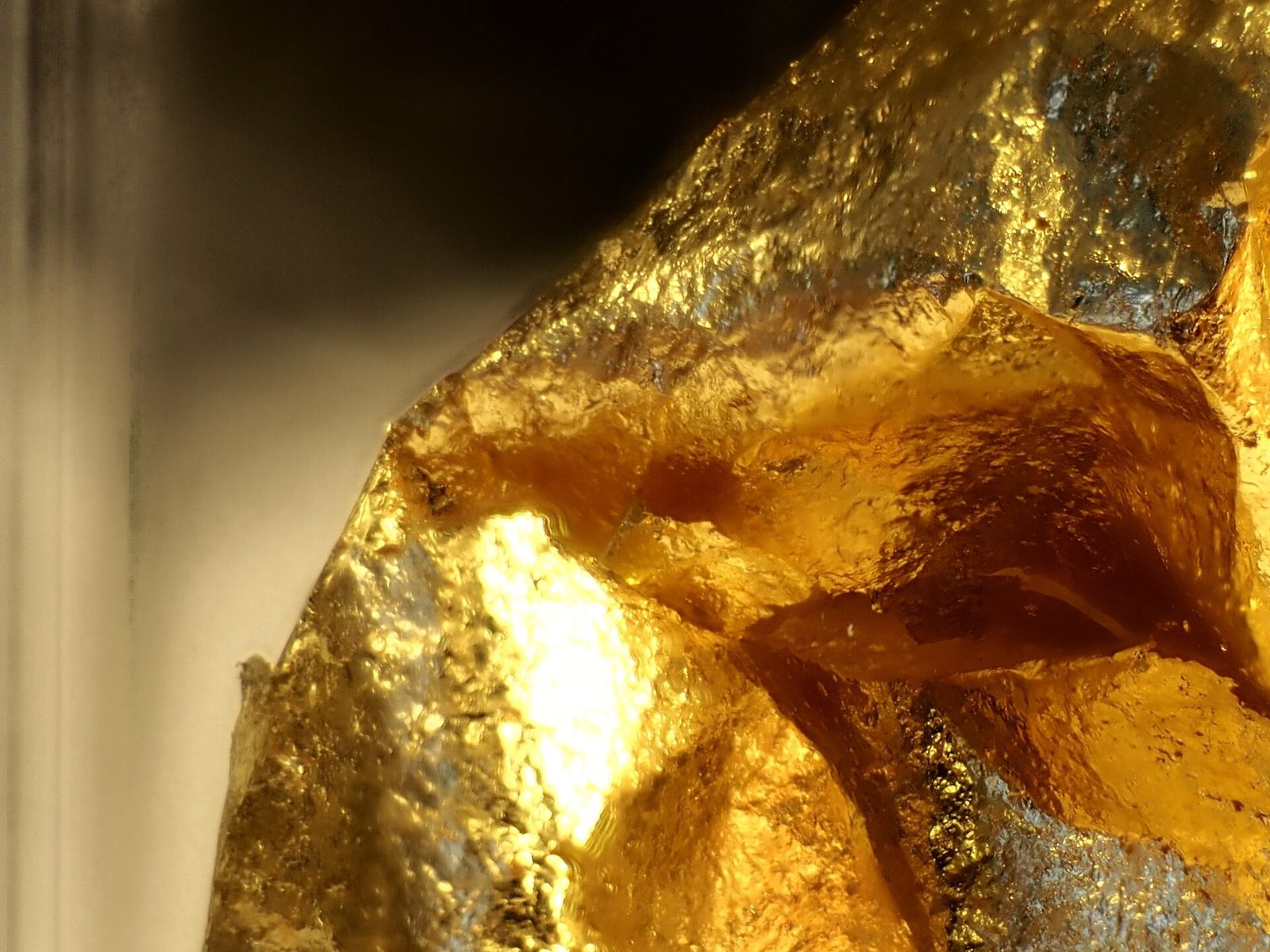
- In your home. Many smoke alarms hold a speck of americium-241, an alpha source like the one in the cloud chamber clip. The alphas knock electrons off air molecules and a tiny current flows; smoke soaks up those charged molecules, the current drops, and the alarm sounds. Gold and silver beaten into leaf, like the varq on mithai, are the same craft as Rutherford's foil.
Still confused?
Why gold?
Two reasons. Gold can be hammered thinner than almost any other metal, so the alphas meet only a few hundred layers of atoms and most single bounces are clean. And gold's nucleus carries a big charge (+79), so it pushes hard and bends alphas a lot, which makes the rare bounces easier to count.
If the nucleus pushes alphas away, why do most of them go straight?
Because the push matters only very close to the nucleus. An alpha passing an atom at a typical distance, thousands of nucleus-widths away, feels a nucleus whose charge is almost cancelled by the atom's own electrons. Only the very few aimed within a few tens of femtometres of a nucleus get a big kick.
Did Rutherford's model survive?
Half of it. The tiny, heavy, positive nucleus is still exactly right. The electrons circling like planets did not survive: concept 4 shows why such an atom would collapse, and Bohr and then quantum mechanics replaced the orbits.
Sources
- American Institute of Physics, "Rutherford's Nuclear World: Alpha Particles and the Atom" (Marsden's age, the 1938 quotation, the 1911 paper)
- H. Geiger and E. Marsden, "On a Diffuse Reflection of the α-Particles", Proc. R. Soc. A 82, 495 (1909)
- ChemTeam, "Rutherford's Experiment, 1906 to 1911" (timeline, dark room, microscope, 1 in 8000)
- E. Rutherford, "The Development of the Theory of Atomic Structure", in J. Needham and W. Pagel (eds.), Background to Modern Science, Cambridge University Press, 1938, pp. 68–69
- E. Rutherford, "The Scattering of α and β Particles by Matter and the Structure of the Atom", Philosophical Magazine 21, 669 (1911)
- H. Geiger and E. Marsden, "The Laws of Deflexion of α Particles through Large Angles", Philosophical Magazine 25, 604 (1913)
- APS News, "March 1, 1896: Henri Becquerel discovers radioactivity"
- The Nobel Prize in Chemistry 1908: Ernest Rutherford
- NIST, CODATA constants (alpha-particle and electron masses)
Picture and video credits
Show 2 picture and video credits
- cloud-chamber-alpha-tracks.mp4: Bilovitskiy, CC BY 4.0
- gold-leaf-close-up.jpg: Tim Denholm, CC BY 4.0
