Structure of AtomFull experience
- 1. What is an atom made of?
- 2. Why did a few alpha particles bounce back?
- 3. Atomic number, mass number, isotopes and isobars
- 4. Why should Rutherford's atom collapse? And what is light?
- 5. Light comes in packets
- 6. Why does each element glow in its own colours?
- 7. Bohr's model of the hydrogen atom
- 8. How Bohr explained the hydrogen spectrum, and where he failed
- 9. Is an electron a particle or a wave?
- 10. Orbitals and quantum numbers
- 11. What does an orbital look like, and which is lowest?
- 12. How do electrons fill an atom?
- Review
5 of 12·NCERT §2.3.2·pp. 39–44·7 min
Light comes in packets
The big ideaLight energy is not a smooth flow but comes in packets called quanta (photons), each with energy E = hν.
In simple words
Think of light as a rain of tiny packets of energy. Blue light packets carry more energy than red ones. A metal holds on to its electrons with a certain grip. A packet that is too weak cannot knock an electron out, however many of them you send. A strong enough packet knocks one out at once. A brighter light just means more packets, so more electrons fly out.
The wave picture explains diffraction (a wave bending round an obstacle) and interference (two waves adding up or cancelling). But 19th-century physics, called classical physics, could not explain four things:
- the radiation given off by hot bodies (black-body radiation);
- electrons thrown out of a metal when light falls on it (the photoelectric effect);
- how the heat capacity of solids changes with temperature;
- the line spectra of atoms, especially hydrogen.
All four point the same way: a system can take in or give out energy only in definite amounts, not any amount at all.
Black-body radiation
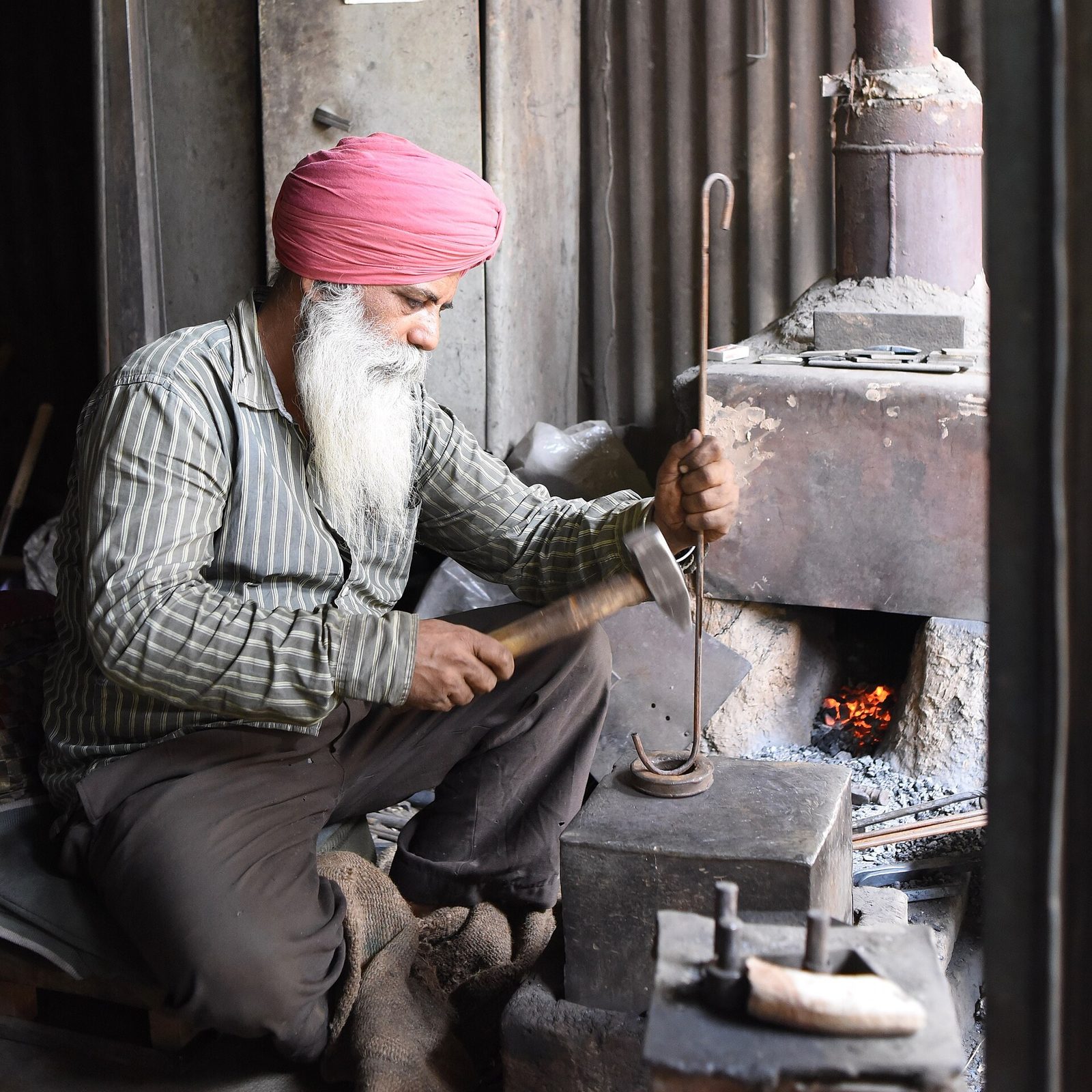
Heat an iron rod in a furnace. It glows dull red, then brighter red, then white, then bluish at very high temperature. So a hot body gives out many wavelengths, and which wavelength is brightest depends on the temperature: hotter means shorter wavelengths.
Ordinary objects reflect, absorb and transmit parts of the light falling on them. An ideal body that absorbs and emits all frequencies perfectly is a black body; its radiation is black-body radiation. Carbon black comes close, and so does a closed box with one tiny hole (light that gets in bounces about until absorbed). It sits at the same temperature as its surroundings (thermal equilibrium), and what it gives out is set by its temperature alone.
At a given temperature the intensity rises with wavelength, reaches a peak, then falls. As the temperature goes up, the peak moves to shorter wavelengths. The wave theory could not predict this curve.
Try it: heat the body and follow the peak of its glow.
Planck's quantum theory (1900)
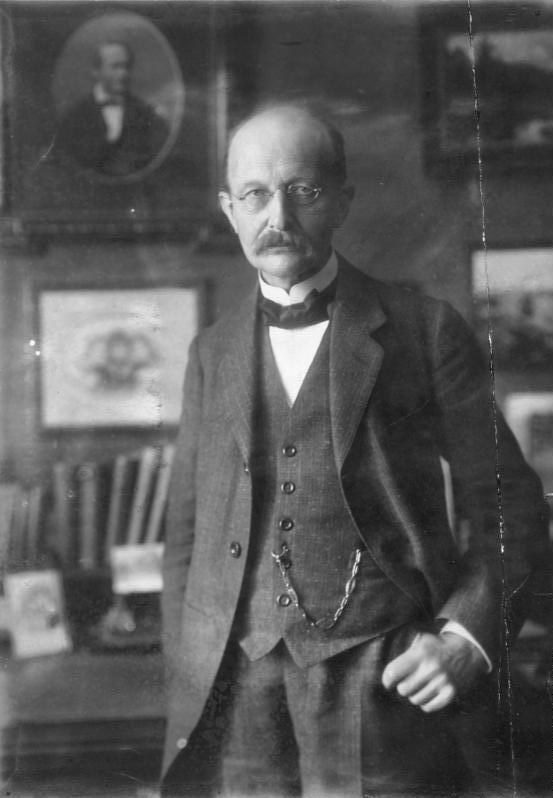
Max Planck explained the curve by assuming that the atoms in the walls of a black body (the "oscillators") can absorb or emit energy only in small, separate bundles. He called the smallest bundle a quantum (plural quanta). Its energy is proportional to the frequency:
\[ E = h\nu \]where \( h = 6.626 \times 10^{-34} \) J s is Planck's constant and \( \nu \) is the frequency. A body can hold energy \( 0, h\nu, 2h\nu, 3h\nu \ldots nh\nu \), but nothing in between. Planck won the 1918 Nobel Prize for this idea.
Since \( c = \nu\lambda \), we can also write \( E = \dfrac{hc}{\lambda} \): shorter wavelength, more energy per photon. Violet photons carry more energy than red ones.
Worked example 1: one photon and one mole
Find the energy of one photon, and of one mole of photons, of green light with λ = 500 nm.
- \( E = \dfrac{hc}{\lambda} = \dfrac{(6.626 \times 10^{-34})(3.0 \times 10^{8})}{500 \times 10^{-9}} = 3.98 \times 10^{-19} \) J per photon.
- One mole: \( 3.98 \times 10^{-19} \times 6.022 \times 10^{23} = 2.39 \times 10^{5} \) J = 239 kJ mol−1.
Worked example 2: photons from a lamp
A 10 W LED lamp gives out orange light of 600 nm. How many photons does it emit each second?
- 10 W means 10 J of light energy each second.
- One photon: \( E = \dfrac{1.988 \times 10^{-25}\ \mathrm{J\,m}}{600 \times 10^{-9}\ \mathrm{m}} = 3.31 \times 10^{-19} \) J.
- Photons per second \( = \dfrac{10}{3.31 \times 10^{-19}} = 3.0 \times 10^{19} \).
The photoelectric effect
In 1887 Heinrich Hertz found that certain metals, such as potassium, rubidium and caesium, give out electrons when light shines on them. This is the photoelectric effect, and the electrons are photoelectrons. The results:
Try it: before the results below, shine different colours on different metals.
- Electrons come out at once: no time lag after the light falls.
- The number of electrons is proportional to the intensity (brightness) of the light.
- Each metal has a minimum frequency, the threshold frequency \( \nu_0 \). Below it, no electrons come out, however bright the light.
- Above \( \nu_0 \), the kinetic energy of the electrons rises with the frequency, not with the brightness.
Classical physics said a brighter beam should eject faster electrons, and any colour should work if bright enough. It does not: red light of any brightness can shine on potassium for hours and free nothing, while even faint light above potassium's threshold (5.0 × 10¹⁴ Hz) frees electrons at once.
Textbook check · §2.3.2Potassium's threshold: the book's two numbers disagree
- The textbook says
- Potassium's threshold frequency is \( 5.0 \times 10^{14} \) Hz, so yellow light ejects electrons. Its own table gives potassium's work function as 2.25 eV.
- What we know now
- 2.25 eV means \( \nu_0 = W_0/h = (2.25 \times 1.602 \times 10^{-19}) / (6.626 \times 10^{-34}) \approx 5.4 \times 10^{14} \) Hz, which is green light (about 550 nm), not \( 5.0 \times 10^{14} \) Hz. Measured work functions of potassium are close to 2.3 eV, so the table is the better number.Check it yourself with \( \nu_0 = W_0/h \); work function values: Work function (table of elements), Wikipedia
- In the exam
- Use whichever number the question gives you. If it asks for potassium's threshold from NCERT, write \( 5.0 \times 10^{14} \) Hz.
Einstein's explanation (1905)
Albert Einstein used Planck's idea. Light is a stream of particles, photons, each of energy \( h\nu \). One photon hits one electron and hands over all its energy instantly, so there is no delay. The least energy needed to pull an electron out is the work function, \( W_0 = h\nu_0 \). Whatever is left over becomes the electron's kinetic energy:
\[ h\nu = h\nu_0 + \tfrac{1}{2}m_e v^2 \qquad\text{so}\qquad \tfrac{1}{2}m_e v^2 = h\nu - h\nu_0 = h(\nu - \nu_0) \]Here \( m_e \) is the electron's mass and \( v \) its speed. A brighter beam has more photons, so more electrons come out, each with the same energy. Einstein won the 1921 Nobel Prize for this.
| Metal | Li | Na | K | Mg | Cu | Ag |
|---|---|---|---|---|---|---|
| W0 / eV | 2.42 | 2.3 | 2.25 | 3.7 | 4.8 | 4.3 |
(1 eV = 1.602 × 10⁻¹⁹ J. A handy shortcut: \( hc \approx 1240 \) eV nm, so a photon's energy in eV is about 1240 ÷ λ in nm.)
Worked example 3: violet light on sodium
Violet light of 400 nm falls on sodium (W0 = 2.3 eV). Find the kinetic energy and speed of the fastest electrons, and the longest wavelength that still works.
- Photon energy: \( 1240 / 400 = 3.10 \) eV.
- Kinetic energy: \( 3.10 - 2.3 = 0.80 \) eV \( = 0.80 \times 1.602 \times 10^{-19} = 1.28 \times 10^{-19} \) J.
- Speed: \( v = \sqrt{\dfrac{2 \times 1.28 \times 10^{-19}}{9.109 \times 10^{-31}}} = 5.3 \times 10^{5} \) m s−1.
- Threshold wavelength: \( \lambda_0 = 1240 / 2.3 = 539 \) nm (green). Any longer wavelength, such as red light, ejects nothing.
Guess first. You double the brightness of the violet lamp in example 3. What happens to the speed of the fastest electrons?
Answer
Light is both a wave and a particle
The particle picture explains black-body radiation and the photoelectric effect; the wave picture explains interference and diffraction. The only way out is to accept that light has dual behaviour. It behaves like particles when it interacts with matter and like a wave when it travels. We will see that electrons share this wave-particle duality.
Don't mix these up
- Intensity (brightness) controls how many electrons; frequency controls how fast they are.
- Work function is an energy (\( W_0 = h\nu_0 \)); threshold frequency is a frequency. Below \( \nu_0 \), no electrons at all.
Just remember
Constants and names are measured or agreed, not derived. Learn them with these hooks.
- Planck's constant \( h = 6.626 \times 10^{-34} \) J s
- "Six-six-two-six, minus thirty-four": say it like a phone number, 66-26, then the power 34.
- \( hc \approx 1240 \) eV nm, so photon energy in eV \( \approx 1240 / \lambda \) (nm)
- "12:40, lunch time". Green light, 500 nm: 1240/500 ≈ 2.5 eV.
- Order of the four classical failures: black body, photoelectric effect, heat capacity of solids, line spectra
- "Big Problems Hit Late": Black body, Photoelectric, Heat capacity, Line spectra.
- Nobel Prizes: Planck 1918, Einstein 1921
- "P before E, three years apart", as in "PE" period: Planck first, then Einstein.
- Easy metals for the photoelectric effect: K, Rb, Cs (and Na)
- The big alkali metals hold their outer electron loosely, so they have the smallest work functions. "KiRan's Camera": photocells were made with them.
- Black body
- An ideal body that absorbs and emits all frequencies perfectly.
- Quantum
- The smallest packet of energy that can be emitted or absorbed as radiation.
- Planck's constant, h
- 6.626 × 10⁻³⁴ J s.
- Photon
- A quantum of light, energy hν.
- Threshold frequency, ν0
- Lowest frequency that ejects electrons from a metal.
- Work function, W0
- Least energy to remove an electron from a metal, hν0.
- Dual behaviour
- Showing both wave and particle properties.
Words to know
Light of a frequency below a metal's threshold falls on it. If you make the light ten times brighter,
- electrons start to come out slowly
- still no electrons come out
- electrons come out ten times faster
Which photon carries the most energy?
- A radio-wave photon
- A red photon
- An ultraviolet photon
- An infrared photon
Electrons leave a metal with 1.0 eV of kinetic energy when 3.5 eV photons fall on it. The work function is
- 4.5 eV
- 2.5 eV
- 3.5 eV
Deep dive · optional
Why doesn't a hot iron glow ultraviolet?
The counting argument that broke classical physics, how one assumption about packets fixed it, and the people who did not quite believe their own results. Not needed for the exam; it is the reason \( E = h\nu \) is not just a formula to learn.
The roots: ways to shine, and the price of a packet
- Why does a hot body's glow rise to a peak and then fall away at short wavelengths?Because short waves are "frozen out": light can only be given out in whole packets of \( h\nu \), and for short waves one packet costs more energy than the heat can usually spare.
- What did the old theory predict instead?Think of the light inside a hot box as standing waves, like the vibrations of a veena string but in three dimensions. Many more short waves fit in the box than long ones: the number of ways grows as \( \nu^2 \). Classical physics also said heat is shared out fairly, an average of \( kT \) to every way of moving (\( k \) is Boltzmann's constant, \( T \) the temperature). Infinitely many short-wave ways, each with \( kT \), means infinite energy in the ultraviolet. Real hot things are not like that.
- How do packets fix it?If a wave of frequency \( \nu \) can hold only \( 0, h\nu, 2h\nu \ldots \), then a wave whose single packet costs far more than \( kT \) almost always holds nothing. Its average share drops from \( kT \) to \( \dfrac{h\nu}{e^{h\nu/kT} - 1} \), which is nearly zero when \( h\nu \gg kT \). The many short-wave ways are there, but they are empty.
- Why does the chance fall so steeply?In anything hot, the chance of a share of energy \( E \) falls as \( e^{-E/kT} \): every extra \( kT \) makes it about 2.7 times less likely. At 1500 K, \( kT \) is 0.13 eV, while a packet of green light costs about 2.5 eV, nearly 20 times \( kT \). The chance is about \( e^{-20} \), two in a billion. That is why most of the glow of hot iron is infrared.
- The bedrockHeat is energy shared out at random, about \( kT \) per way of moving, and light can only be handed over in packets of \( h\nu \). Compare the packet with the share and you know whether a colour will shine.
The same comparison explains the photoelectric effect. There the "share" is not heat but the energy one photon brings to one electron. If \( h\nu \) is less than the work function, no number of photons helps, because an electron cannot save up energy from many photons; each one either gets enough from a single photon or gets nothing worth having. In both stories the rule is the same: energy moves between light and matter one packet at a time.
A neat check of the whole idea: the glow's peak sits where a packet costs about 2.8 \( kT \). Double the temperature and the peak frequency doubles. Drawn against wavelength, the glow of the Sun's surface (about 5800 K) peaks in the visible, near 500 nm; a red-hot iron at about 1000 K peaks far out in the infrared, so we see only the faint red edge of its glow.
The story
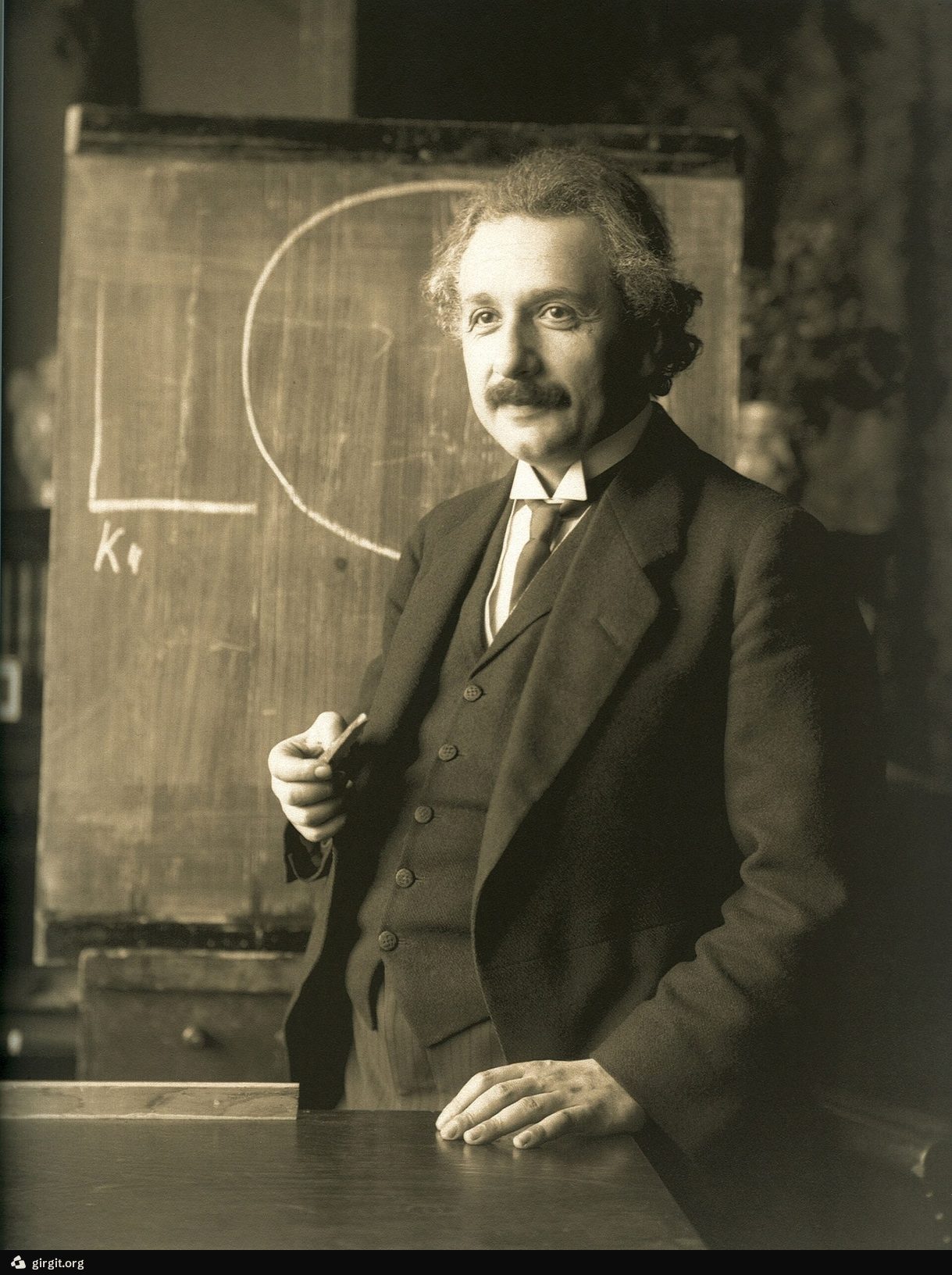
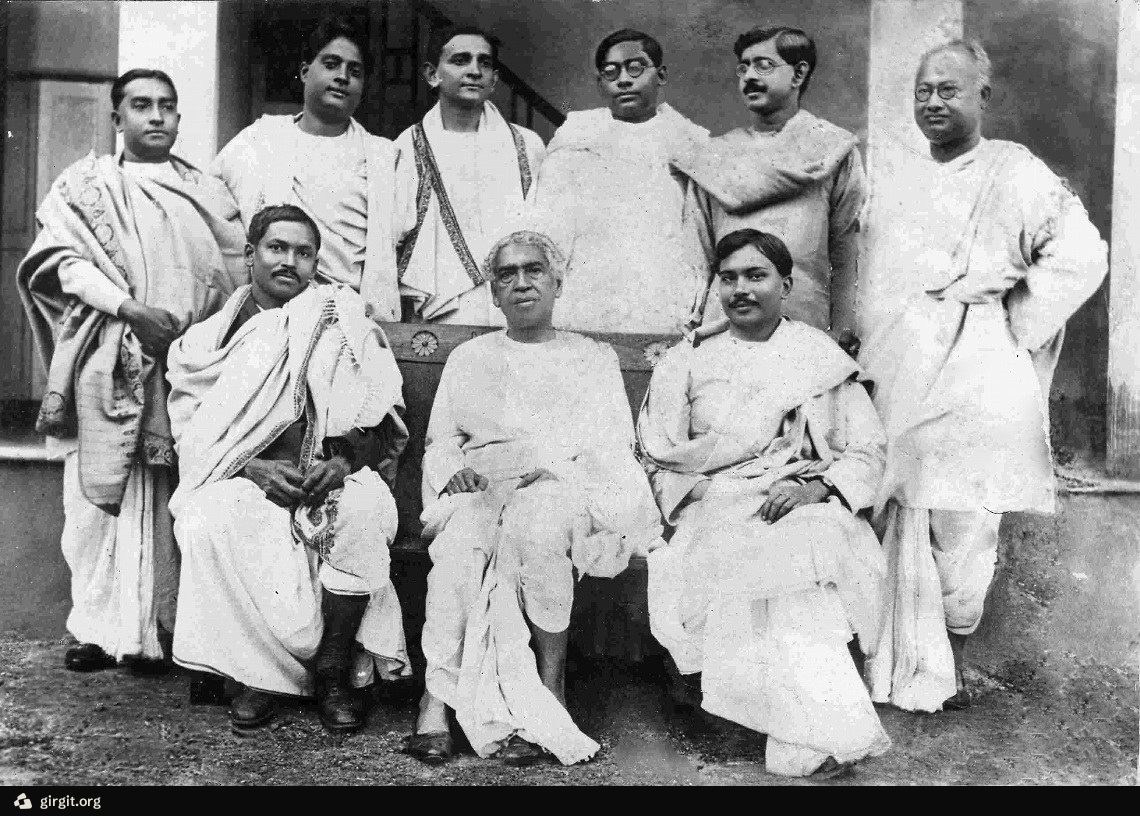 S.N. BoseMeghnad SahaJ.C. Bose
See it
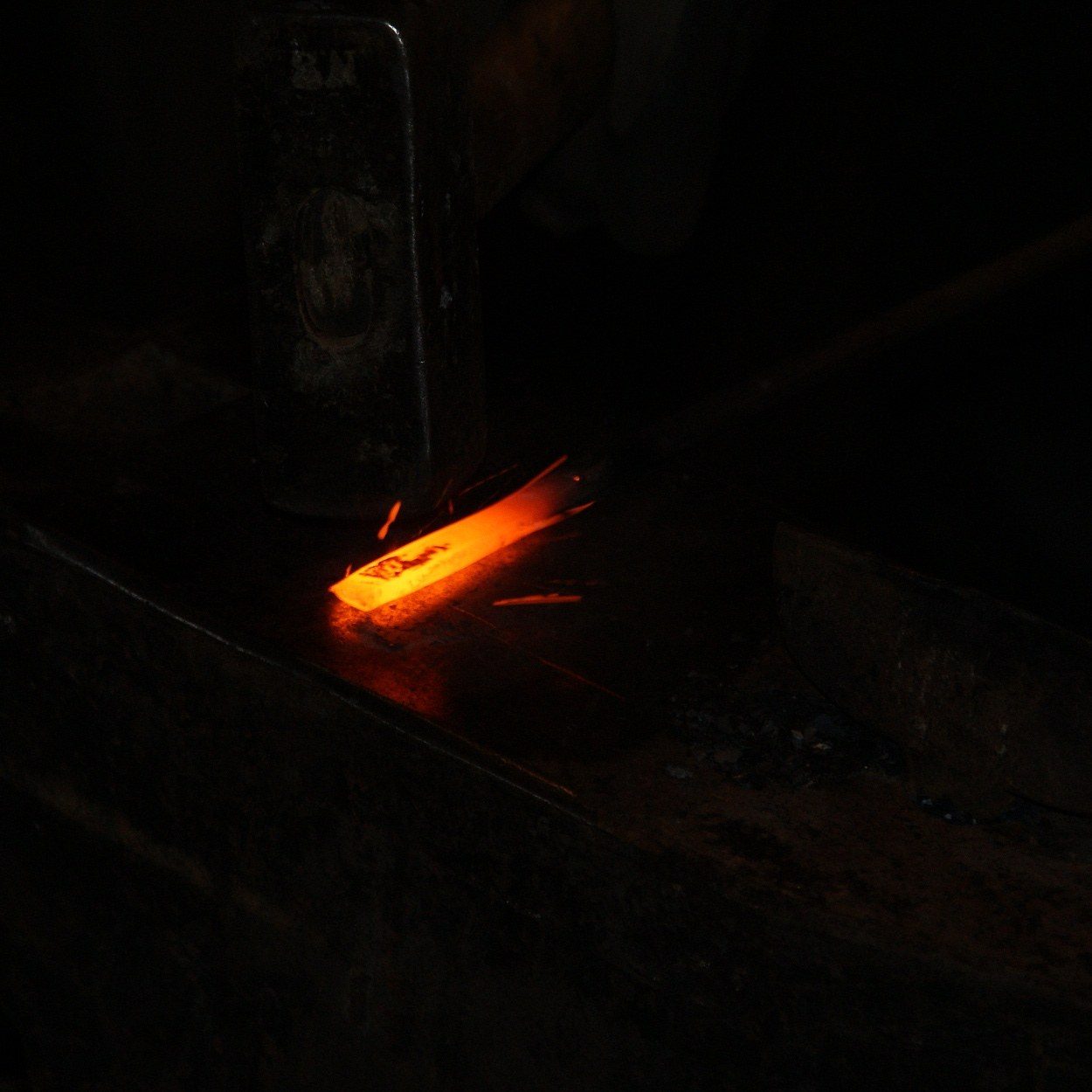 yellow-orange: hottestred: cooler
 glowing coalsanvil
Now take the glow apart. The blue curve counts the ways a hot box can hold light of each frequency; the amber curve is the average share each way actually gets; their product, teal, is the glow. Drag the white cursor along the frequencies, change the temperature, and watch the staircase below: one wave's allowed energies.
Solve it
Solve it: be Millikan
Light of three frequencies falls on a clean metal. The fastest photoelectrons have these kinetic energies: \( 6.0 \times 10^{14} \) Hz → 0.18 eV; \( 8.0 \times 10^{14} \) Hz → 1.01 eV; \( 10.0 \times 10^{14} \) Hz → 1.84 eV. Find Planck's constant from the data, the work function, and the threshold frequency. Which metal from the table could it be?
Hint
Answer
Solve it: estimate
A tawa on the stove reaches about 250 °C (523 K) and does not glow. An iron bar in a forge at about 900 °C (1173 K) glows red. Compare how many times \( kT \) a packet of red light (about 2 eV) costs at each temperature, and so roughly how much more likely the forge is to give one out per wave.
Answer
Solve it: predict, then check
Ultraviolet light of 300 nm, very bright, falls on copper (\( W_0 = 4.8 \) eV). Do electrons come out?
Answer
Connect it
Connect it
- Black-body radiation, Class 11 Physics. Wien's law and the colours of stars, from the physics side. See Blackbody radiation.
- Photons, Class 12 Physics. Stopping potential, the full photoelectric equation and the photon's momentum. See Einstein's photoelectric equation and The photon.
- Photosynthesis, Class 11 Biology. A leaf works one photon at a time too: each red photon absorbed by chlorophyll lifts one electron. See The light reaction.
- Solar cells and LEDs, Class 12 Physics. A solar panel is a photon-to-electron machine with a threshold set by its material, a cousin of the photoelectric effect. See LEDs and solar cells.
- Next page. Packets of light with exact energies are the key to why atoms glow in sharp colours: Atomic spectra.
Still confused?
Is a black body actually black?
Only when it is cold. "Black" means it absorbs every colour that falls on it; it says nothing about what it gives out. Hot, a black body glows brightly: the Sun is a good example of a near black body. The small hole in a closed hot oven is another: it looks black at room temperature and glows when the oven is red hot.
Does more energy in the beam mean more energy per electron?
No. A brighter beam has more photons, each with the same \( h\nu \). One electron takes one photon, so a brighter beam frees more electrons, each with the same energy. To give each electron more, you must raise the frequency.
Is all energy quantised, then?
Energy exchanged with light comes in \( h\nu \) packets, and energies inside atoms and molecules come in steps (page 7 onwards). For everyday objects the steps are so tiny compared with \( kT \) that energy looks smooth: that is why classical physics worked so well for so long. The third failure in the list above, the heat capacity of solids, was explained by Einstein in 1907 the same way: at low temperature the vibrations of the atoms are frozen out, just like the ultraviolet waves.
Sources
- H. Kragh, "Max Planck: the reluctant revolutionary", Physics World (2000): dates of 1900, "an act of desperation", the 1931 letter
- Ultraviolet catastrophe, Wikipedia (Ehrenfest 1911, equipartition, modes ∝ ν²)
- A. Einstein, "Über einen die Erzeugung und Verwandlung des Lichtes betreffenden heuristischen Gesichtspunkt", Annalen der Physik 17, 132 (1905)
- Photoelectric effect, Wikipedia (Millikan's tests and "quite unthinkable")
- The Nobel Prize in Physics 1921 (prize motivation)
- APS News, Millikan's Nobel Prize for the charge and the 1916 determination of h
- Satyendra Nath Bose, Wikipedia (Dhaka 1924, Philosophical Magazine, Einstein's translation, Dirac's "boson")
- Work function, Wikipedia (values for K, Na, Cu)
Picture and video credits
Show 3 picture and video credits
- max-planck-1901.jpg: Unknown photographer (German Federal Archive, Bild 183-R0116-504), CC BY-SA 3.0 de
- red-hot-iron-on-anvil.jpg: Hi-Res Images of Chemical Elements, CC BY 3.0
- blacksmith-punjab-iron-rod.jpg: Gurdeepdali, CC BY-SA 4.0


