Structure of AtomFull experience
- 1. What is an atom made of?
- 2. Why did a few alpha particles bounce back?
- 3. Atomic number, mass number, isotopes and isobars
- 4. Why should Rutherford's atom collapse? And what is light?
- 5. Light comes in packets
- 6. Why does each element glow in its own colours?
- 7. Bohr's model of the hydrogen atom
- 8. How Bohr explained the hydrogen spectrum, and where he failed
- 9. Is an electron a particle or a wave?
- 10. Orbitals and quantum numbers
- 11. What does an orbital look like, and which is lowest?
- 12. How do electrons fill an atom?
- Review
7 of 12·NCERT §2.4·pp. 46–48·6 min
Bohr's model of the hydrogen atom
The big ideaBohr said the electron can circle only in certain fixed orbits, each with a fixed energy, and gives out or takes in light only when it jumps between them.
In simple words
Bohr made a new rule for the electron in hydrogen: it may only run on a few set tracks round the centre, like the lanes of a running track. On a track it loses no energy, so it never falls in. To move out to a farther track it must take in an exact amount of energy. When it drops back to a nearer track it gives that exact amount out as light.
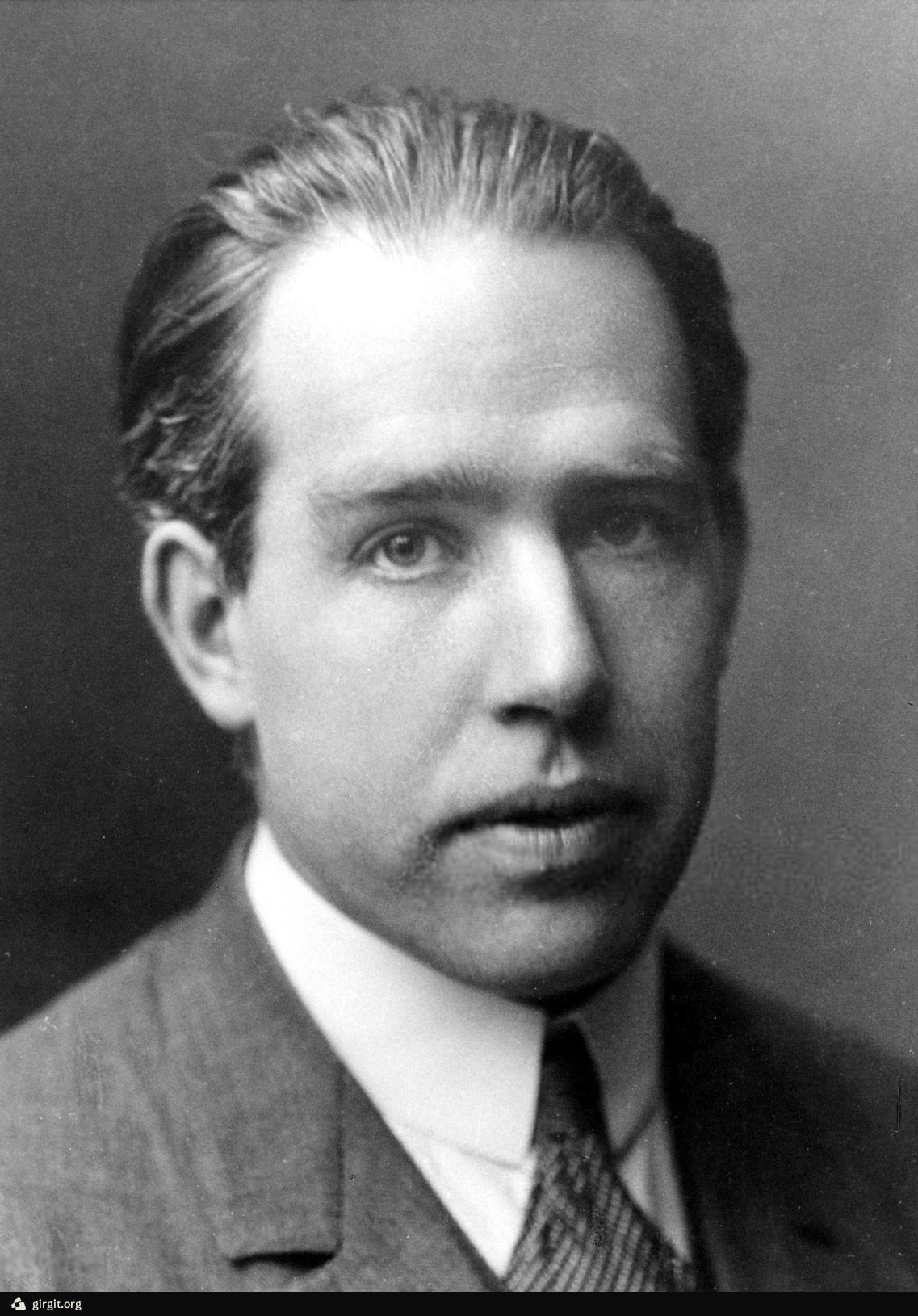
In 1913 Niels Bohr gave the first model that could put numbers to the hydrogen atom and its spectrum. He borrowed Planck's idea that energy comes in fixed amounts. His model is not modern quantum mechanics, but it still explains a lot.
Bohr's postulates
- The electron can travel only on certain circles round the nucleus, each with a set radius and a set energy. Such a circle is an orbit, also called a stationary state or allowed energy state; the circles are nested one inside another.
- While in an orbit, the electron's energy does not change with time. It moves to a higher orbit only by absorbing the right amount of energy, and to a lower orbit by emitting energy. The change happens in a jump, not gradually.
- The frequency of the light absorbed or emitted in a jump between two states with energy difference \( \Delta E \) is given by Bohr's frequency rule: \[ \nu = \frac{\Delta E}{h} = \frac{E_2 - E_1}{h} \] where \( E_1 \) is the energy of the lower state and \( E_2 \) of the higher one.
- The angular momentum of the electron is quantised: it can only be a whole-number multiple of \( h/2\pi \). \[ m_e v r = n \cdot \frac{h}{2\pi}, \qquad n = 1, 2, 3, \ldots \] where \( m_e \) is the electron's mass, \( v \) its speed and \( r \) the orbit's radius.
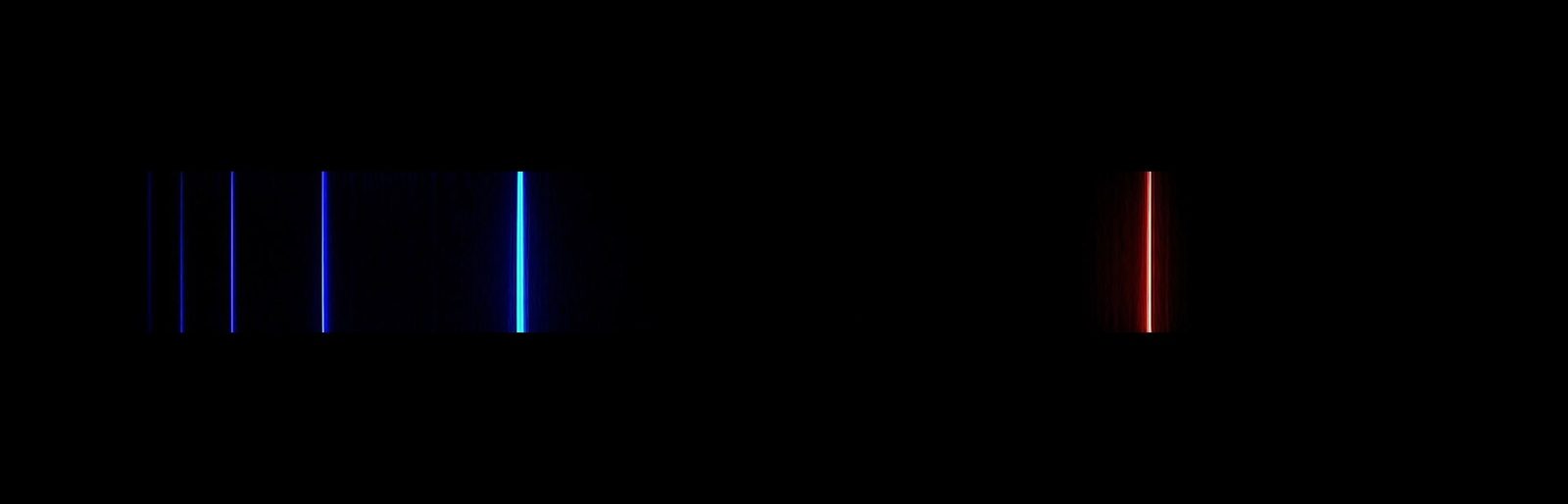 410 nm434 nm486 nm656 nm
What is angular momentum? Linear momentum is mass × velocity. For something turning in a circle, angular momentum is moment of inertia \( I \) × angular velocity \( \omega \). For an electron, \( I = m_e r^2 \) and \( \omega = v/r \), so angular momentum \( = m_e r^2 \times v/r = m_e v r \).
Because only certain orbits are allowed, Maxwell's rule (that a circling charge must radiate) is simply set aside inside the atom. Radiation happens only during a jump.
Radius and energy of the orbits
The derivation is for higher classes, but the results are simple. The whole number \( n = 1, 2, 3 \ldots \) labelling each orbit is the principal quantum number.
For the hydrogen atom
- Radius: \( r_n = n^2 a_0 \), with \( a_0 = 52.9 \) pm. The first orbit, the Bohr orbit, has radius 52.9 pm; normally the electron is here.
- Energy: \( E_n = -R_H \left( \dfrac{1}{n^2} \right) \), with \( R_H = 2.18 \times 10^{-18} \) J (the Rydberg constant in energy units).
- Ground state (n = 1): \( E_1 = -2.18 \times 10^{-18} \) J. For n = 2: \( E_2 = -0.545 \times 10^{-18} \) J.
Try it: move the electron out, orbit by orbit, and read the radius and energy.
As \( n \) grows, the orbit gets bigger (as \( n^2 \)) and the energy rises towards zero. A drawing of these levels is an energy level diagram.
Why is the energy negative?
We give zero energy to an electron that is free and at rest, infinitely far from the nucleus (\( n = \infty \)). An electron held by the nucleus has less energy than that, so its energy is negative: energy was given out when the nucleus captured it. The closer it is (smaller \( n \)), the more negative its energy, and the more tightly it is held. The most negative value, at \( n = 1 \), is the most stable state, the ground state. An atom with its electron removed to \( n = \infty \) is an ionised hydrogen atom.
Worked example 1: the third orbit of hydrogen
- Radius: \( r_3 = 3^2 \times 52.9 = 476 \) pm, nine times the first orbit.
- Energy: \( E_3 = -\dfrac{2.18 \times 10^{-18}}{3^2} = -2.42 \times 10^{-19} \) J.
Worked example 2: ionisation energy of hydrogen
How much energy removes the electron from 1 mol of hydrogen atoms in the ground state?
- Per atom: from \( E_1 = -2.18 \times 10^{-18} \) J to \( E_\infty = 0 \), so \( 2.18 \times 10^{-18} \) J.
- Per mole: \( 2.18 \times 10^{-18} \times 6.022 \times 10^{23} = 1.31 \times 10^{6} \) J = 1312 kJ mol−1.
Ions with one electron
Bohr's theory also works for hydrogen-like species: ions with only one electron, such as He+, Li2+ and Be3+. With \( Z \) the atomic number:
\[ E_n = -2.18 \times 10^{-18} \left( \frac{Z^2}{n^2} \right)\ \mathrm{J} \qquad\qquad r_n = \frac{52.9\ n^2}{Z}\ \mathrm{pm} \]A bigger nuclear charge makes the energy more negative and the orbit smaller: the electron is held more tightly. The electron's speed, too, rises with Z and falls as n rises.
Worked example 3: Be3+, second orbit
Be has Z = 4. For n = 2:
- \( E_2 = -2.18 \times 10^{-18} \times \dfrac{4^2}{2^2} = -2.18 \times 10^{-18} \times 4 = -8.72 \times 10^{-18} \) J.
- \( r_2 = \dfrac{52.9 \times 2^2}{4} = 52.9 \) pm, the same size as hydrogen's first orbit.
Try it. What is the energy of the electron in He+ when n = 2? Compare it with hydrogen's ground state.
Answer
Don't mix these up
- Radius goes as \( n^2/Z \); energy goes as \( Z^2/n^2 \) (with a minus sign).
- "Higher energy" for a bound electron means less negative: \( -0.545 \times 10^{-18} \) J is higher than \( -2.18 \times 10^{-18} \) J.
- These formulas work only for one-electron species: H, He+, Li2+, Be3+. Not for He or Li atoms.
Just remember
The formulas \( r_n \propto n^2/Z \) and \( E_n \propto -Z^2/n^2 \) have reasons (see the deep dive). These numbers are measured constants: learn them.
- Bohr radius \( a_0 = 52.9 \) pm
- "A pack of cards, nearly": 52 cards and a bit, 52.9. Then \( r_n = 52.9\,n^2/Z \) pm.
- \( R_H = 2.18 \times 10^{-18} \) J per atom
- "Two eighteens": 2.18 × 10⁻¹⁸. The same energy is 13.6 eV, or 1312 kJ mol−1 for a mole of atoms: "13.6 and 1312 both start with 13".
- Angular momentum comes in steps of \( h/2\pi \)
- \( m_e v r = nh/2\pi \): "n slices of h-by-2-pie". It is a postulate in Bohr's model; the deep dive shows where it really comes from.
- Energy zero is the free electron at rest (n = ∞)
- A convention, like sea level for heights. Every bound electron is "below sea level", so its energy is negative.
- Stationary state
- An allowed orbit, in which the electron's energy stays fixed.
- Bohr's frequency rule
- ν = ΔE/h for a jump between two states.
- Angular momentum
- mevr for an electron in a circle; quantised as nh/2π.
- Principal quantum number, n
- The whole number that labels each orbit.
- Ground state
- The lowest-energy state, n = 1.
- Hydrogen-like species
- An ion with just one electron, such as He+.
Words to know
What is the radius of the second orbit of a hydrogen atom?
- 105.8 pm
- 211.6 pm
- 13.2 pm
An electron in hydrogen has energy −2.18 × 10⁻¹⁸/16 J. Which orbit is it in?
- n = 16
- n = 4
- n = 2
Compared with hydrogen's first orbit, the first orbit of Li2+ is
- three times larger
- one third the size
- one ninth the size
Deep dive · optional
Where do Bohr's numbers come from?
Why only some orbits are allowed, how 52.9 pm and \( -2.18 \times 10^{-18} \) J fall out of two simple laws, and how a 27-year-old got there. The exam needs only the results; this shows they are not magic.
The roots: a wave that must join itself
- Why can the electron sit only on certain orbits?Because, Bohr said, its angular momentum must be a whole number of \( h/2\pi \): \( m_e v r = n h/2\pi \). In 1913 this was a bold guess, chosen because it gave the right hydrogen lines.
- Why that rule, of all rules?Eleven years later Louis de Broglie found a reason. An electron also behaves as a wave, with wavelength \( \lambda = h/m_e v \). A wave running round a circle comes back to where it started. If a whole number of wavelengths fits, \( 2\pi r = n\lambda \), the wave meets itself in step and survives. Put \( \lambda = h/m_e v \) in, and out comes \( m_e v r = nh/2\pi \): Bohr's rule.
- Why must the wave meet itself in step?If it does not, the second time round its crests land on the first lap's troughs, the third time somewhere else, and after many laps everything cancels to nothing. Only the whole-number orbits keep a steady wave. A guitar string is the same: only whole numbers of half-waves fit between its fixed ends, which is why it plays one note and its overtones.
- Why does that give \( r = n^2 \times 52.9 \) pm?Two things must both be true. The pull of the nucleus must supply the force that keeps the electron turning: \( \dfrac{m_e v^2}{r} = \dfrac{k e^2}{r^2} \). And the wave must fit: \( m_e v r = \dfrac{nh}{2\pi} \). Two equations, two unknowns (\( v \) and \( r \)): solve them and \( r \) comes out proportional to \( n^2 \).
- The bedrockCoulomb's law, Newton's law for circular motion, and one wave rule. Everything else on this page follows.
Follow the algebra (optional)
- From the wave rule, \( v = \dfrac{nh}{2\pi m_e r} \). Put it into the force rule \( m_e v^2 r = k e^2 \): \[ m_e \left( \frac{nh}{2\pi m_e r} \right)^2 r = k e^2 \quad\Rightarrow\quad r_n = n^2\, \frac{h^2}{4\pi^2 m_e k e^2} \]
- With \( h = 6.626 \times 10^{-34} \) J s, \( m_e = 9.109 \times 10^{-31} \) kg, \( e = 1.602 \times 10^{-19} \) C and \( k = 8.99 \times 10^{9} \) N m2 C−2: \( \dfrac{h^2}{4\pi^2 m_e k e^2} = 5.29 \times 10^{-11} \) m = 52.9 pm.
- Energy: the force rule gives kinetic energy \( \tfrac12 m_e v^2 = \dfrac{k e^2}{2r} \); the potential energy of two opposite charges is \( -\dfrac{k e^2}{r} \). Add them: \[ E_n = -\frac{k e^2}{2 r_n} = -\frac{2.18 \times 10^{-18}}{n^2}\ \mathrm{J} \]
- For a nucleus of charge \( Ze \), every \( e^2 \) becomes \( Ze^2 \): so \( r \propto n^2/Z \) and \( E \propto -Z^2/n^2 \), exactly the formulas above.
Notice what the result says. The energy is fixed by the size of the orbit, \( E = -ke^2/2r \), so a ladder of allowed sizes is automatically a ladder of allowed energies. And since the sizes go as \( n^2 \), the energies go as \( 1/n^2 \): exactly the \( R/n^2 \) ladder hiding in Rydberg's formula on the last page. That match, with the right value of \( R \) coming out of \( h \), \( m_e \) and \( e \), is what convinced people.
The story
See it
Now wrap the electron's wave round an orbit yourself. Drag the electron in or out (or change the radius in the sentence). The picture draws three laps of the wave: watch them fall exactly on top of each other only at certain radii. Then press Every radius to see why those radii go as \( n^2 \).
Solve it
Solve it
Use \( m_e v r = h/2\pi \) to find the speed of the electron in hydrogen's first orbit. How many times does it go round in one second?
Answer
Solve it
For the ground state of hydrogen, \( E_1 = -2.18 \times 10^{-18} \) J. Find the electron's kinetic energy and its potential energy. (This is a favourite NEET question.)
Hint
Answer
Solve it: what would happen if…
A muon is a particle just like an electron but about 207 times heavier. Replace hydrogen's electron by a muon. How big is the first orbit, and how much energy does the ground state have? What kind of light would its jumps give out?
Hint
Answer
Connect it
Connect it
- The spectrum it explains. The \( R/n^2 \) ladder was already hiding in Rydberg's formula: Why does each element glow in its own colours? Next, the jumps themselves: How Bohr explained the hydrogen spectrum.
- The wave rule. \( \lambda = h/mv \) gets its own page: Is an electron a particle or a wave?
- Physics, Class 11. The force rule is ordinary circular motion (Circular motion); angular momentum \( mvr \) is in Torque and angular momentum; whole numbers of waves on a string are in Standing waves on strings.
- Physics, Class 12. The same derivation, in physics language: Bohr radius and energy.
- Ionisation enthalpy, next chapter. Hydrogen's 1312 kJ mol−1 is the first entry in every ionisation enthalpy table: Ionisation enthalpy.
Still confused?
Does the electron really go round in a circle?
No. Two pages on, you will see that an electron has no definite path at all; the modern picture is a cloud of probability, the orbital. What survives from Bohr is remarkable, though: his energies \( -2.18 \times 10^{-18}/n^2 \) J are exactly right for hydrogen, and 52.9 pm turns out to be (very nearly) the most likely distance of the electron from the nucleus in the ground state.
If the energy is negative, how can the kinetic energy be positive?
Total energy is kinetic plus potential. Kinetic energy is always positive. The potential energy of an electron near a proton is negative and twice as big, so the total comes out negative. "Negative total energy" just means "bound": you would have to add energy to pull the electron away.
Why doesn't the circling electron radiate, as Maxwell says it should?
In Bohr's model there is no reason: it is a rule he laid down because atoms clearly do not collapse. The wave picture gives the first real hint. A wave that fits the orbit exactly is a standing wave: nothing about the electron's spread-out charge changes with time, so there is nothing to send out waves. Light is given out only during a jump, when the pattern changes.
Sources
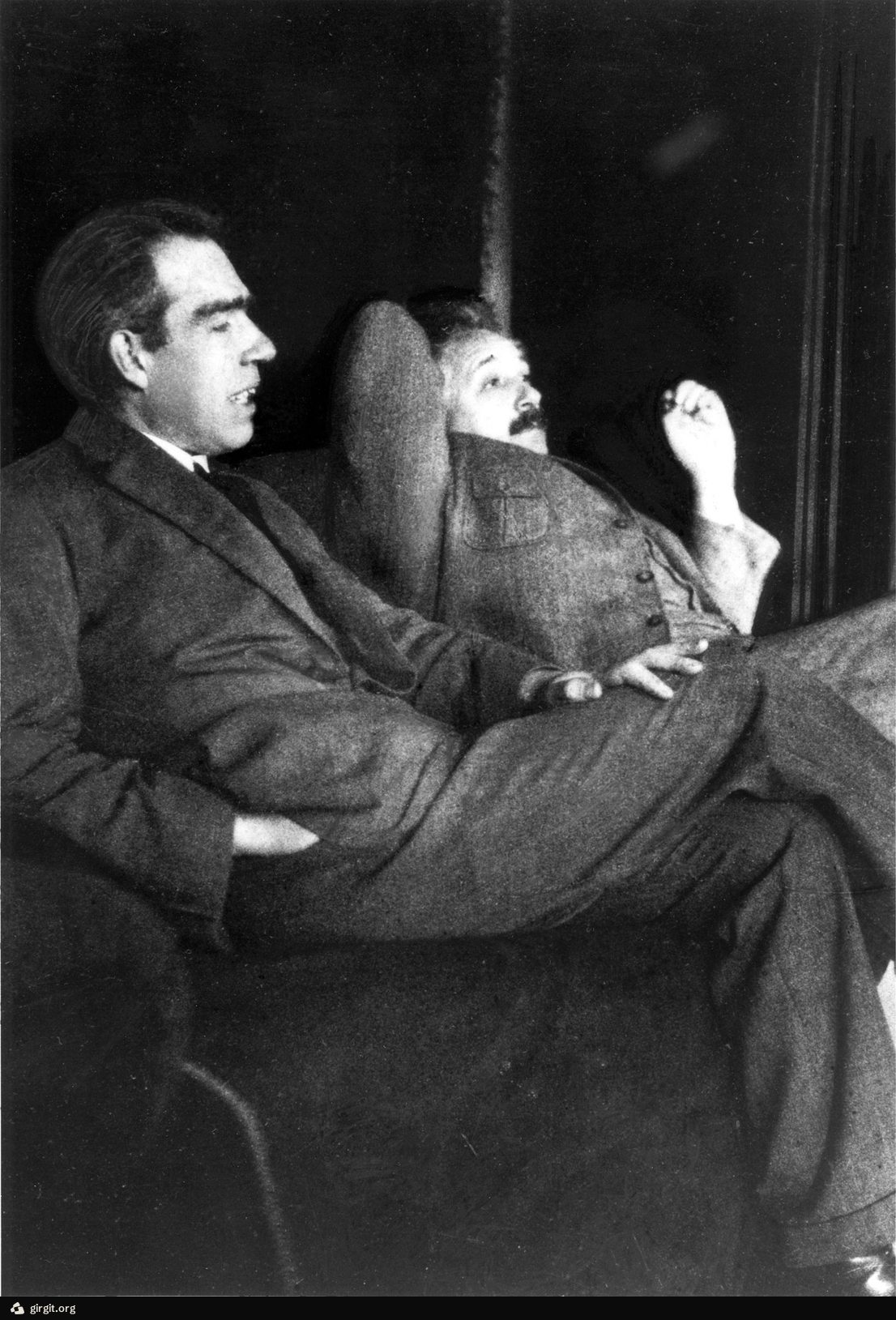
- Niels Bohr (Wikipedia): Manchester 1912, the 1913 trilogy (July, September, November), the Nobel Prize 1922 and its citation
- Bohr model (Wikipedia): "On the constitution of atoms and molecules", Hansen and the Balmer formula (February 1913), 52.9 pm, de Broglie's standing-wave reading (1924)
- Muon (Wikipedia): mass 206.77 times the electron's and Muonic hydrogen (Wikipedia): smaller orbit, the proton radius
- Bohr radius (Wikipedia): 52.9 pm, close to the most probable electron distance in the ground state
- NIST, CODATA values of the fundamental constants (h, mₑ, e, Bohr radius)
Picture and video credits
Show 2 picture and video credits
- hydrogen-visible-spectrum-photo.jpg: Jan Homann, CC BY-SA 3.0
- niels-bohr-institute-copenhagen.jpg: Leif Jørgensen, CC BY-SA 4.0

