Classification of Elements and Periodicity in PropertiesFull experience
- 1. Why sort the elements?
- 2. Mendeleev's periodic table
- 3. The modern periodic table
- 4. How do you name element 120?
- 5. Why the table has the shape it has
- 6. The s, p, d and f blocks
- 7. Metals, non-metals and metalloids
- 8. How big is an atom?
- 9. How hard is it to pull an electron off?
- 10. Which atoms want extra electrons?
- 11. Valence, and the odd ones at the top
- 12. Where are the most reactive elements?
- Review
3 of 12·NCERT §3.3·p. 78·4 min
The modern periodic table
The big ideaMoseley showed that atomic number, not atomic mass, is the true order of the elements, and today's long-form periodic table has 7 periods and 18 groups built on that order.
In simple words
Lining people up by weight goes wrong sometimes, because two people can be nearly the same weight. Lining them up by their roll number never goes wrong. A man found that every building block has its own roll number, which is how many tiny plus bits sit in its middle. Once the chart was ordered by that number, all the odd cases fixed themselves.
Moseley and the atomic number
When Mendeleev made his table, nobody knew what was inside an atom. In 1913 the English physicist Henry Moseley studied the X-rays that each element gives off when struck by fast electrons. Each element has its own characteristic X-ray spectrum. He found a simple rule:
- A graph of \( \sqrt{\nu} \) against atomic number \( Z \) is a straight line. Here \( \nu \) (the Greek letter nu) is the frequency of the X-rays.
- A graph of \( \sqrt{\nu} \) against atomic mass is not a straight line.
So the atomic number is the more fundamental property. It equals the nuclear charge (the number of protons), which also equals the number of electrons in a neutral atom.
Try it: guess first, then plot Moseley's X-rays against mass and against atomic number.
The modern periodic law
- The physical and chemical properties of the elements are periodic functions of their atomic numbers.
Ordering by atomic number puts tellurium (Z = 52) before iodine (Z = 53) naturally, the very pair Mendeleev had to swap by hand.
The law brought out family likenesses among all 94 elements found in nature. That count includes neptunium and plutonium, which, like actinium and protactinium, occur in traces in pitchblende, a uranium ore. It also guided the making of short-lived artificial elements.
Why do properties repeat?
Because electronic configurations repeat. As Z increases by one, one more electron is added. Every so often the outer arrangement of electrons becomes the same as an earlier element's, one shell further out, and so the properties come back. The periodic law is really a result of the periodic variation in electronic configuration. You will see this in detail two concepts from now.
The long form of the periodic table
Many shapes of periodic table have been drawn. Some stress valence and reactions, others stress electron arrangements. For decades lecture halls hung a short form with only eight main columns, squeezing two kinds of element into each one.
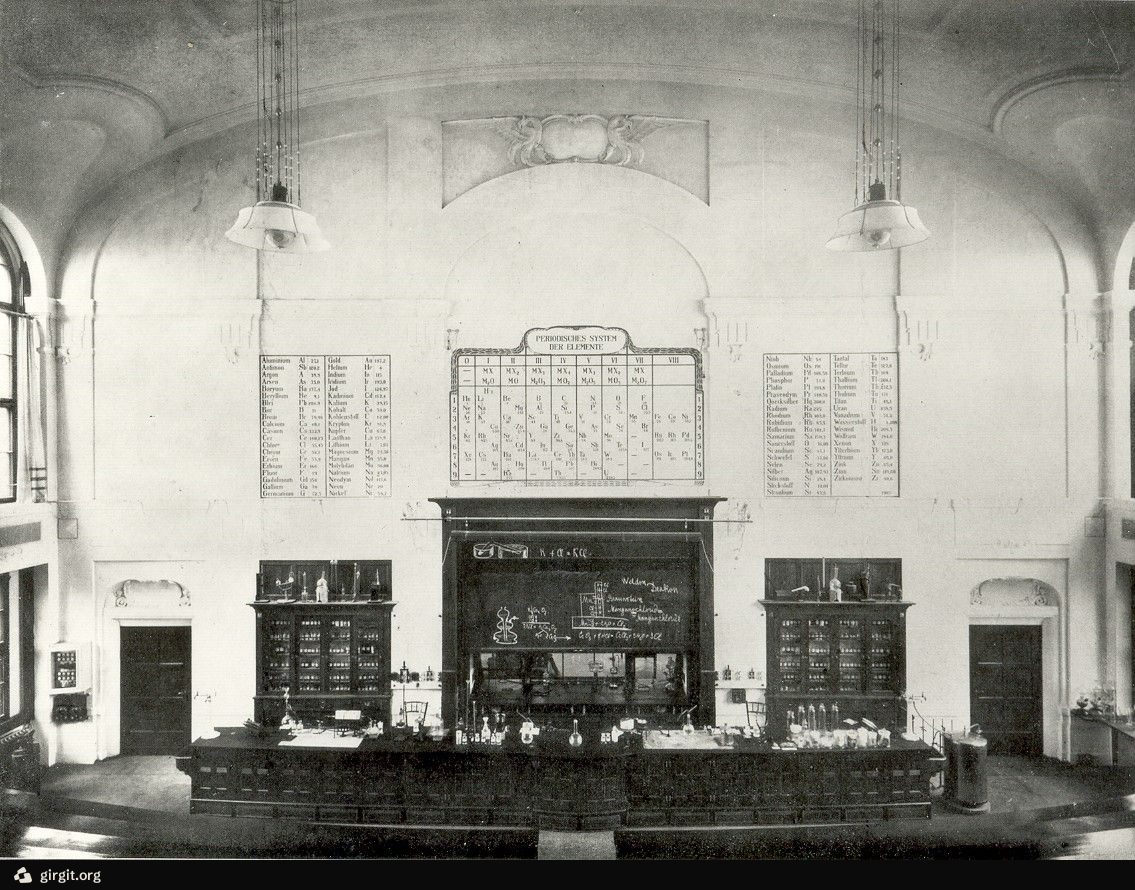 Short form: groups 0 to VIIIElements and atomic weights
The most convenient and widely used today is the long form. Picture it like this:
- A wide grid of 18 columns and 7 rows.
- Row 1 is just two boxes, at the far left (hydrogen) and far right (helium), with a big empty space between.
- Rows 2 and 3 have two boxes on the left and six on the right, with a gap in the middle.
- From row 4 down, the middle is filled in by ten extra columns.
- Two separate rows of 14 elements, the lanthanoids and actinoids, sit in a panel below the main table so it does not become too wide.
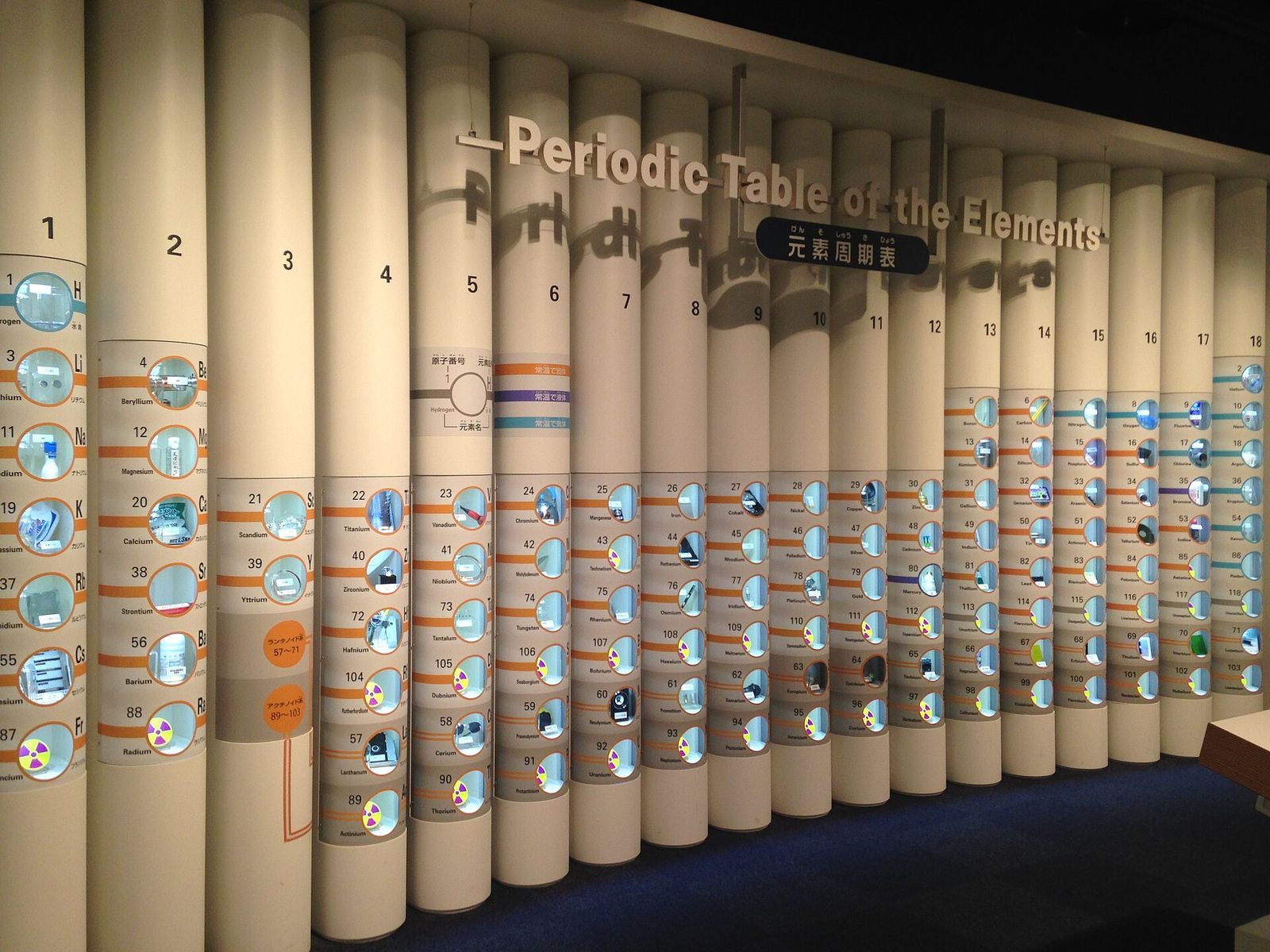 Group 1H: period 1Group 18f-block strips
The horizontal rows are called periods (Mendeleev called them series). The vertical columns are groups or families: elements in a group have similar outer electronic configurations.
IUPAC (the International Union of Pure and Applied Chemistry) numbers the groups 1 to 18, replacing the older labels IA to VIIA, VIII, IB to VIIB and 0.
Seven periods
- The period number equals the highest principal quantum number \( n \) (the outermost shell) of the elements in it.
- Number of elements in periods 1 to 7: 2, 8, 8, 18, 18, 32, and period 7 also 32 now that it is complete up to element 118.
- The 14 lanthanoids (period 6) and 14 actinoids (period 7) are the ones placed in the bottom panel.
Textbook check · §3.3Period 7 is no longer incomplete
- The textbook says
- The seventh period is incomplete. (Its own §3.4 then lists every element up to 118 with an official name.)
- What we know now
- On 30 December 2015 IUPAC confirmed the discoveries of elements 113, 115, 117 and 118 and announced that "the 7th period of the periodic table of elements is complete". Their names were approved in November 2016. Period 7 now holds 32 elements, the same as period 6.Source: IUPAC, Discovery and assignment of elements with atomic numbers 113, 115, 117 and 118 (2015)
- In the exam
- If a question asks how many elements period 7 has, write 32. If it quotes NCERT's line that the seventh period is incomplete, recognise it as the older statement.
The American chemist Glenn T. Seaborg discovered plutonium in 1940 and then the transuranium elements up to 102. His work led to moving the actinoids into their own row below the lanthanoids. He won the Nobel Prize in Chemistry in 1951, and element 106, seaborgium (Sg), is named after him.
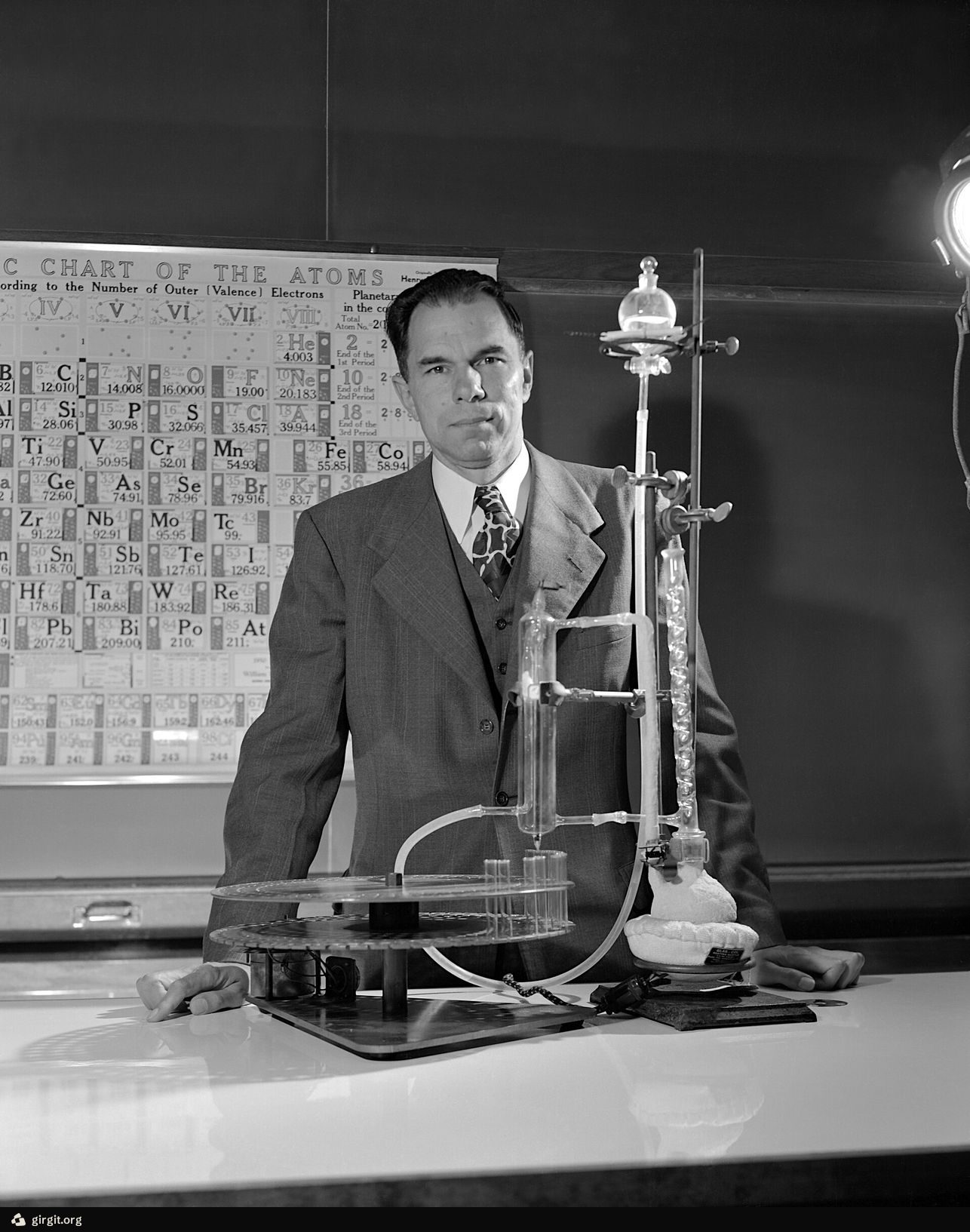 Actinoids in their own rowTc (43)Ion-exchange column
Don't mix these up
- Period = horizontal row = same outermost shell \( n \). Group = vertical column = same outer configuration, similar properties.
- Mendeleev's law: atomic weight. Modern law: atomic number. Moseley's straight line was \( \sqrt{\nu} \) against Z.
Just remember
These are conventions and dates. Nothing deeper decides them, so use the hooks.
- Period = horizontal row; group = vertical column
- A school period runs along the timetable row, left to right. A group of friends stands one behind the other in a queue, a column.
- Old group labels → IUPAC 1 to 18
- IA, IIA are 1 and 2. For the right-hand side, add 10: IIIA → 13, IVA → 14, VA → 15, VIA → 16, VIIA → 17, and group 0 (the noble gases) → 18. Everything in between (the B groups and VIII) is 3 to 12.
- Mendeleev: atomic mass (1869). Moseley: atomic number (1913)
- "Mendeleev weighed, Moseley counted." Mass and Mendeleev both start with M; Moseley gave the elements their roll numbers.
- 94 elements occur in nature
- Up to plutonium, Z = 94. Neptunium and plutonium are the last two, found only as traces in pitchblende (uranium ore): "Pu is the last one nature puts in the pot."
- Lanthanoids Ce to Lu (58 to 71), period 6; actinoids Th to Lr (90 to 103), period 7
- Each strip holds 14, one for each electron the 4f or 5f set can take. Each starts just after its namesake: Lanthanum (57) and Actinium (89) stay in the main table.
- Glenn Seaborg: actinoids moved below the table; Nobel Prize 1951; seaborgium, Sg, 106
- "Seaborg sent the actinoids down to the seabed of the table."
- Atomic number (Z)
- Number of protons in the nucleus; the true order of the table.
- Modern periodic law
- Properties repeat as a function of atomic number.
- Period
- A horizontal row; its number is the outermost shell n.
- Group (family)
- A vertical column, numbered 1 to 18 by IUPAC.
- Long form
- The 18-column periodic table used today.
- IUPAC
- The international body that sets chemical names and rules.
Words to know
Moseley got a straight line when he plotted the square root of X-ray frequency against
- atomic mass
- atomic number
- period number
An element is in period 4. What does that tell you for sure?
- It has 4 valence electrons
- Its outermost electrons are in the shell with n = 4
- It has properties similar to every other period 4 element
Deep dive · optional
How do you know an element is missing?
Why Moseley's X-rays turned the periodic table from a list into a count, how that count showed exactly which elements were still missing, and who filled the last gaps. Not needed for the exam; it is here so "atomic number, not mass" stops being a slogan.
The roots: a ladder with equal rungs
- How could Moseley say an element was missing between molybdenum and ruthenium?Because his X-ray frequencies climbed in equal steps, one step per element. Between molybdenum (42) and ruthenium (44) the step was twice as big. A ladder with one rung twice as tall has a rung missing.
- Why one equal step per element?The X-ray line he measured (called K-alpha) is made when an electron drops into the innermost shell, n = 1. Its energy grows as the square of the charge that electron feels, so \( \sqrt{\nu} \) grows in proportion to that charge. Add one proton and the charge goes up by one unit: one more equal step.
- Why does that electron feel the nucleus almost bare?It sits closest in. All the other electrons are further out, and a shell of charge outside you pulls you equally in every direction, so its pulls cancel. Only the one other electron left in the innermost shell shields it, by about one unit. So it feels \( Z - 1 \), and \( \sqrt{\nu} \propto (Z - 1) \).
- Why can't atomic mass show a missing element?Mass counts protons plus neutrons, and the number of neutrons wanders. The step from one element to the next is sometimes 1 u, sometimes 4 u, and three times it even goes backwards (Ar/K, Co/Ni, Te/I). A jump of 3 u could be a missing element, or just a neutron-rich neighbour. Mass has no rungs.
- The bedrockCharge comes in whole units, and the energy of an electron near a nucleus grows as the square of the charge it feels (Bohr's \( Z^2/n^2 \), from Coulomb's law). Whole units make equal rungs; equal rungs make a count.
Once the order became a count, questions that chemists had argued over for decades could be settled in a few months. How many elements lie between hydrogen and uranium? Exactly 92. How many rare earths are there? From lanthanum (57) to lutetium (71), exactly 15, no more and no less. Which ones are still unknown? Moseley's own measurements, which reached gold, showed four empty rungs: 43, 61, 72 and 75, and no other gaps between aluminium (13) and gold (79). Above gold, 85 and 87 were missing too.
The story
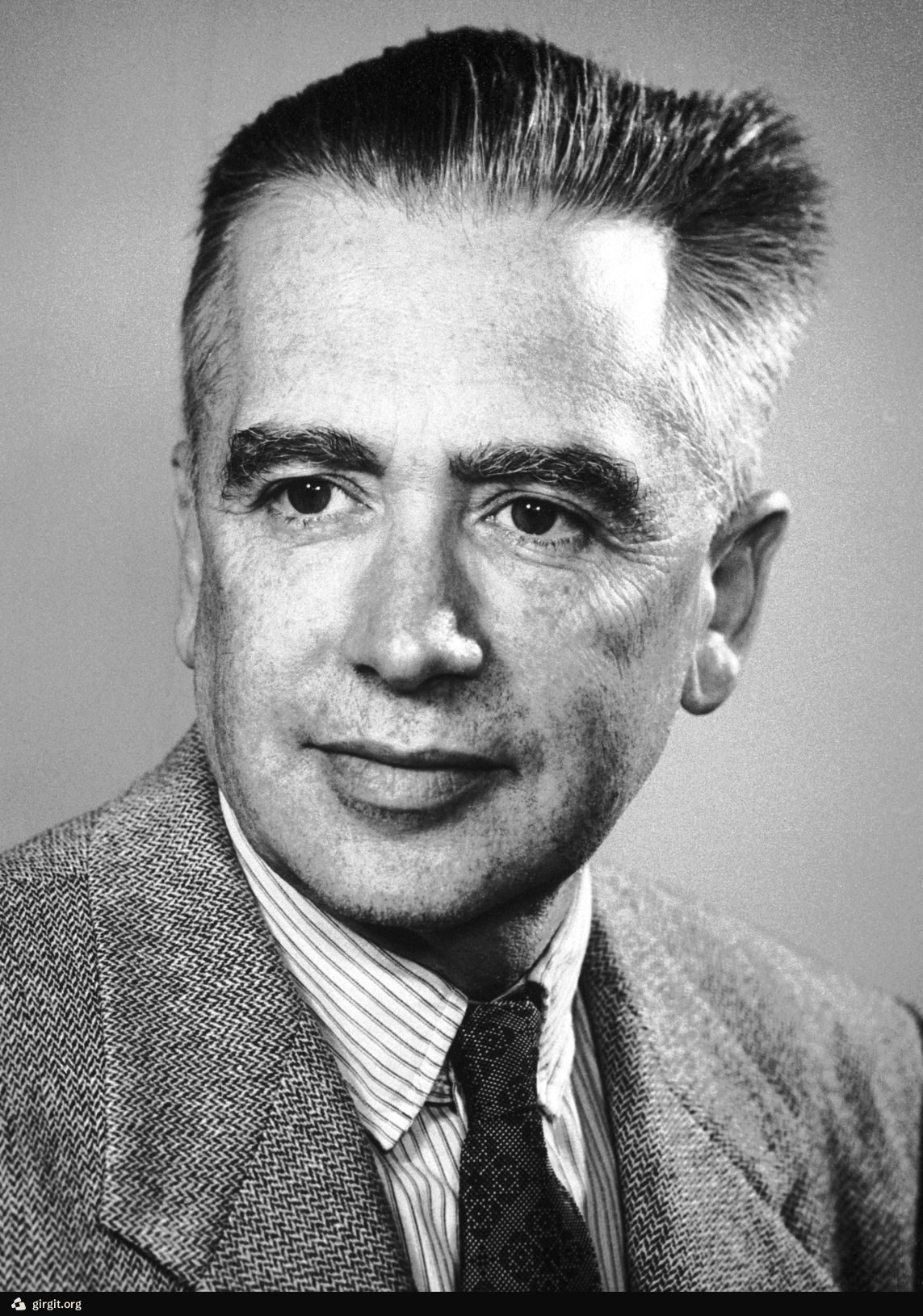
Two more gaps, 72 and 75, were filled from rocks, both by X-rays. Hafnium (1923) has its own story on the electronic configuration page. Rhenium (1925) had in fact been found in 1908 by a Japanese chemist, who put it in the wrong gap; that story is on the next page.
See it
Travel in time and line the known elements up two ways. By mass, one missing element pushes everything after it into the wrong family. By atomic number, a missing element is simply an empty box. Scrub the year back to 1914 and switch between the two orders.
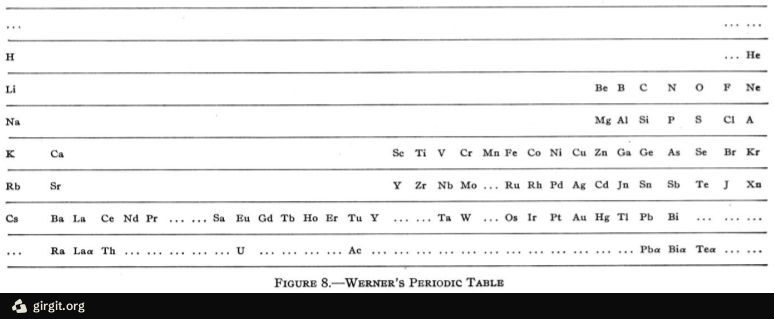
The long form itself is older than Moseley. Alfred Werner's table of 1905 already gave the transition metals and the rare earths their own columns, which made it very wide. Notice the empty place after molybdenum: Werner knew something was missing there, but not that it was element 43.
 Gap: element 43
Solve it
Solve it: predict, then check
Molybdenum (Z = 42) gives its K-alpha X-ray at 0.0709 nm. Using \( \nu \propto (Z - 1)^2 \), predict the wavelength for element 43, which nobody had seen in 1914, and for ruthenium (44).
Hint
Answer
Solve it: what would happen if…
It is 1914. Element 43 is unknown. You line up every known element strictly by atomic mass and give them roll numbers 1, 2, 3 in that order. Which family does ruthenium end up in, and what happens to the elements after it?
Answer
Solve it: think harder
A chemist in 1913 announces a new element with atomic mass 42.5 u, between calcium and scandium. Using only Moseley's idea, explain why there cannot be a new element between them, whatever its mass.
Answer
Connect it
Connect it
- Moseley himself, Chapter 2. His experiment, his straight line and his death at Gallipoli are on Atomic number, isotopes and isobars.
- Why the energy goes as Z², Chapter 2. Bohr's energy levels for one electron and a charge Z: How Bohr explained the spectrum. Moseley's K-alpha line is the same sum with \( Z - 1 \) for Z.
- Mendeleev's gaps, one page back. His eka-manganese is technetium, the gap at 43. See Mendeleev's periodic table.
- Shielding, later in this chapter. "The other electrons cancel out from outside" is the same idea that explains why atoms shrink across a period: see How big is an atom?
- The f-block strip. Why the lanthanoids and actinoids come in rows of 14: The s, p, d and f blocks, and in Class 12, The lanthanoids.
- Hospitals. Technetium, the element nobody could find, is now made on purpose every day: its short-lived form technetium-99m is the most used medical radioisotope in the world, in tens of millions of scans a year (bones, heart, thyroid, kidneys).
Still confused?
If atomic number is the order, why does the table still print atomic masses?
Because chemists weigh things. To turn grams into moles you need the average mass of the atoms, so the mass stays in every box. It just no longer decides where the box goes. For the three reversed pairs, the box order follows Z and the masses simply read "out of order".
Why are the lanthanoids and actinoids pulled out and put below?
Only to save width. Put them back in their places and the table becomes 32 columns wide, like Werner's 1905 table above. Both shapes are the same table; the 18-column one fits on a page.
Which elements belong under yttrium: lanthanum and actinium, or lutetium and lawrencium?
Chemists still argue about this. NCERT puts lanthanum and actinium in group 3, with the strips starting at cerium and thorium. Many chemists prefer lutetium and lawrencium in group 3; an IUPAC project reported in 2021 that it is a matter of convention but suggested the lutetium form as a compromise. For the exam, follow NCERT's table.
Sources
- Henry Moseley (Wikipedia): gaps at 43, 61, 72, 75; exactly 15 lanthanides; no other gaps between Al and Au; didymium; element 61 predicted
- Promethium (Wikipedia): Brauner 1902, Moseley 1914, false claims 1926, Marinsky, Glendenin and Coryell 1945, announced 1947, Grace Mary Coryell and the name
- Technetium (Wikipedia): Segrè and Perrier 1937, the molybdenum foil from Lawrence's cyclotron, the name (1947), technetium-99m in medicine
- History of the periodic table (Wikipedia): Werner 1905, the gaps left in 1936 (43, 61, 85, 87), francium 1939 by Marguerite Perey, Seaborg's actinide concept
- Periodic table (Wikipedia): 18-column and 32-column forms; Bassett, Thomsen and Werner
- Technetium-99m (Wikipedia): tens of millions of procedures a year, the most used medical radioisotope
- Group 3 element (Wikipedia): the lanthanum/lutetium question and the 2021 IUPAC report
- X-ray Data Booklet, Table 1-2 (Lawrence Berkeley National Laboratory): K-alpha energies of Mo, Tc and Ru
- IUPAC (2015): the seventh period is complete
- Timeline of chemical element discoveries (Wikipedia): the years used in the widget
Picture and video credits
Show 1 picture and video credits
- periodic-table-nagoya-science-museum.jpg: そらみみ, CC BY-SA 4.0
