- 1. How do we measure an angle?
- 2. What is a radian?
- 3. Changing degrees into radians and back
- 4. Sine and cosine for any angle
- 5. Tan, cot, sec and cosec
- 6. Which functions are positive where?
- 7. Domain and range of the six functions
- 8. What the graphs look like, and why they repeat
- 9. Sine and cosine of a sum or difference
- 10. Angles like π − x, and tan of a sum
- 11. Double and triple angles
- 12. Turning sums into products and back
- Review
9 of 12·NCERT §3.4·6 min
Sine and cosine of a sum or difference
The big idea\( \cos(x + y) = \cos x \cos y - \sin x \sin y \), proved by measuring one distance on the unit circle in two ways, and every other sum and difference formula follows from it.
In simple words
If you know the sine and cosine of two angles, you can find the sine and cosine of the two angles put together, without a calculator. But you cannot just add the answers. Turning by one angle and then another is not like adding two prices. There is a fixed recipe that mixes all four numbers, and once you have one recipe, the rest come from it.
First, a quick check of your instinct.
What an identity is
A trigonometric identity is an equation that is true for every value of the angles for which both sides are defined. You already have three: \( \sin^2 x + \cos^2 x = 1 \), \( \sin(-x) = -\sin x \) and \( \cos(-x) = \cos x \). Now we build the most important new one.
Proving \( \cos(x + y) \)
Take the unit circle with centre O. Mark four points on it:
- \( P_4 = (1, 0) \), the starting point;
- \( P_1 = (\cos x, \sin x) \), after turning \( x \) from \( P_4 \);
- \( P_2 = (\cos(x + y), \sin(x + y)) \), after turning a further \( y \) from \( P_1 \);
- \( P_3 = (\cos(-y), \sin(-y)) = (\cos y, -\sin y) \), after turning \( y \) clockwise from \( P_4 \).
The angle from \( P_3 \) to \( P_1 \) at O is \( y + x \), and the angle from \( P_4 \) to \( P_2 \) is also \( x + y \). So triangles \( P_1 O P_3 \) and \( P_2 O P_4 \) have two sides equal to 1 (radii) and the same angle between them. They are congruent (SAS), so the chords match: \( P_1P_3 = P_2P_4 \). Now find both lengths with the distance formula.
Try it: drag the points and watch the two chords stay equal, whatever x and y are.
- \( P_1P_3^2 = (\cos x - \cos y)^2 + (\sin x + \sin y)^2 \). Expand: \( \cos^2 x + \cos^2 y - 2\cos x \cos y + \sin^2 x + \sin^2 y + 2\sin x \sin y \). The squares pair up into \( 1 + 1 \), giving \( 2 - 2(\cos x \cos y - \sin x \sin y) \).
- \( P_2P_4^2 = (1 - \cos(x + y))^2 + (0 - \sin(x + y))^2 = 1 - 2\cos(x + y) + \cos^2(x + y) + \sin^2(x + y) = 2 - 2\cos(x + y) \).
- Set them equal: \( 2 - 2(\cos x \cos y - \sin x \sin y) = 2 - 2\cos(x + y) \).
Everything else follows
- Replace \( y \) by \( -y \), using \( \cos(-y) = \cos y \) and \( \sin(-y) = -\sin y \): \[ \cos(x - y) = \cos x \cos y + \sin x \sin y \]
- Put \( \tfrac{\pi}{2} \) for \( x \) and \( x \) for \( y \) in that: \( \cos\left(\tfrac{\pi}{2} - x\right) = 0 \cdot \cos x + 1 \cdot \sin x \), so \[ \cos\left(\tfrac{\pi}{2} - x\right) = \sin x \]
- Apply that to the angle \( \tfrac{\pi}{2} - x \): \( \sin\left(\tfrac{\pi}{2} - x\right) = \cos\left(\tfrac{\pi}{2} - \left(\tfrac{\pi}{2} - x\right)\right) = \cos x \). \[ \sin\left(\tfrac{\pi}{2} - x\right) = \cos x \]
- Sine of a sum. \( \sin(x + y) = \cos\left(\left(\tfrac{\pi}{2} - x\right) - y\right) = \cos\left(\tfrac{\pi}{2} - x\right)\cos y + \sin\left(\tfrac{\pi}{2} - x\right)\sin y \), so \[ \sin(x + y) = \sin x \cos y + \cos x \sin y \]
- Replace \( y \) by \( -y \) once more: \[ \sin(x - y) = \sin x \cos y - \cos x \sin y \]
Worked example
- \( \cos 75^\circ = \cos(45^\circ + 30^\circ) = \tfrac{1}{\sqrt{2}} \cdot \tfrac{\sqrt{3}}{2} - \tfrac{1}{\sqrt{2}} \cdot \tfrac{1}{2} = \dfrac{\sqrt{3} - 1}{2\sqrt{2}} \).
- \( \sin 105^\circ = \sin(60^\circ + 45^\circ) = \tfrac{\sqrt{3}}{2} \cdot \tfrac{1}{\sqrt{2}} + \tfrac{1}{2} \cdot \tfrac{1}{\sqrt{2}} = \dfrac{\sqrt{3} + 1}{2\sqrt{2}} \).
- \( \sin 50^\circ \cos 20^\circ - \cos 50^\circ \sin 20^\circ = \sin(50^\circ - 20^\circ) = \sin 30^\circ = \tfrac{1}{2} \). Spot the pattern and run the formula backwards.
Worked example
\( \sin x = \tfrac{4}{5} \) with \( x \) in the first quadrant, and \( \cos y = -\tfrac{5}{13} \) with \( y \) in the second quadrant. Find \( \sin(x + y) \) and \( \cos(x + y) \).
- \( \cos x = +\sqrt{1 - \tfrac{16}{25}} = \tfrac{3}{5} \) (first quadrant). \( \sin y = +\sqrt{1 - \tfrac{25}{169}} = \tfrac{12}{13} \) (sine is positive in the second quadrant).
- \( \sin(x + y) = \tfrac{4}{5}\left(-\tfrac{5}{13}\right) + \tfrac{3}{5} \cdot \tfrac{12}{13} = \tfrac{-20 + 36}{65} = \tfrac{16}{65} \).
- \( \cos(x + y) = \tfrac{3}{5}\left(-\tfrac{5}{13}\right) - \tfrac{4}{5} \cdot \tfrac{12}{13} = \tfrac{-15 - 48}{65} = -\tfrac{63}{65} \).
- Check: \( 16^2 + 63^2 = 256 + 3969 = 4225 = 65^2 \). Good.
Don't mix these up
- \( \sin(x + y) \ne \sin x + \sin y \). Try \( 30^\circ + 60^\circ \): \( \sin 90^\circ = 1 \), but \( \tfrac{1}{2} + \tfrac{\sqrt{3}}{2} \approx 1.37 \).
- The cosine formulas have the opposite sign: \( \cos(x + y) \) has a minus, \( \cos(x - y) \) has a plus. The sine formulas keep the same sign.
- Sine formulas mix (sin cos, cos sin); cosine formulas pair like with like (cos cos, sin sin).
Try it. (a) Find \( \sin 15^\circ \) using \( 60^\circ - 45^\circ \). (b) Simplify \( \cos 2x \cos x + \sin 2x \sin x \). (c) Show that \( \cos\left(\tfrac{\pi}{3} - x\right) - \sin\left(\tfrac{\pi}{6} + x\right) = 0 \).
Answer
Just remember
The proof is above and the deep dive gives a second one, but the signs and pairings are the part people mix up under pressure. Hooks first, then a two-second check.
- \( \sin(x \pm y) = \sin x \cos y \pm \cos x \sin y \)
- "Sine is friendly: it mixes (sin cos, then cos sin) and keeps your sign." Say it as a chant: sin-cos, cos-sin, same sign.
- \( \cos(x \pm y) = \cos x \cos y \mp \sin x \sin y \)
- "Cosine is fussy: it pairs like with like (cos cos, sin sin) and flips your sign." Chant: cos-cos, sin-sin, sign flips. Check with \( x = y = 45^\circ \): \( \cos 90^\circ = 0 \), and only \( \tfrac{1}{2} - \tfrac{1}{2} \) gives 0, so \( \cos(x + y) \) must have the minus.
- \( \cos\left(\tfrac{\pi}{2} - x\right) = \sin x \)
- The name says it: "co-sine" is short for the Latin complementi sinus, "the sine of the complement". The cosine of an angle is the sine of what is left of \( 90^\circ \). Rebuild: reflect P in the line \( y = x \) (the picture above).
- Trigonometric identity
- An equation true for all angles where both sides make sense.
- \( \cos(x \pm y) \)
- \( \cos x \cos y \mp \sin x \sin y \): the sign flips.
- \( \sin(x \pm y) \)
- \( \sin x \cos y \pm \cos x \sin y \): the sign stays.
- Complementary angles
- \( x \) and \( \tfrac{\pi}{2} - x \); the sine of one is the cosine of the other.
- Congruent triangles
- Same shape and size; here they show two chords are equal.
Words to know
Which is the correct expansion of \( \cos(x - y) \)?
- \( \cos x \cos y - \sin x \sin y \)
- \( \cos x \cos y + \sin x \sin y \)
- \( \sin x \cos y - \cos x \sin y \)
What is \( \sin 40^\circ \cos 50^\circ + \cos 40^\circ \sin 50^\circ \)?
- \( \sin 40^\circ + \sin 50^\circ \)
- 1
- \( \sin 10^\circ \)
Why are triangles \( P_1OP_3 \) and \( P_2OP_4 \) congruent in the proof?
- Two sides are radii of length 1 and the angles between them are both \( x + y \)
- Both are right-angled triangles
- The four points have the same coordinates
Deep dive · optional
One turn after another: why the sum formula is true
A proof of both sum formulas at once by turning the plane, a picture proof with areas, and how Ptolemy used the same idea 1,900 years ago to build the first great trigonometric table. The exam only asks you to use the formulas; this is why they hold.
Turning by x + y is turning by y, then by x
- Why isn't \( \cos(x + y) \) just \( \cos x + \cos y \)?Because cosine is a coordinate on a circle of radius 1, and coordinates on a circle can't simply add: \( \cos 30^\circ + \cos 30^\circ \approx 1.73 \), which is off the circle altogether.
- Then how do two angles combine?As two turns. The point at angle \( x + y \) is the point at angle \( y \), turned a further \( x \) about O.
- What does a turn by \( x \) do?It moves the whole plane rigidly, keeping lengths and right angles. The direction \( (1, 0) \) goes to \( (\cos x, \sin x) \), and the direction \( (0, 1) \), a quarter turn ahead of it, goes to the point a quarter turn ahead of that: \( (-\sin x, \cos x) \).
- And where does the point at angle \( y \) go?It was "\( \cos y \) steps along \( (1, 0) \), then \( \sin y \) steps along \( (0, 1) \)". A rigid turn keeps that recipe, using the turned directions: \( \cos y \) steps along \( (\cos x, \sin x) \), then \( \sin y \) steps along \( (-\sin x, \cos x) \). Add up the across parts and the up parts: \[ \begin{aligned} \text{across} &= \cos x\cos y - \sin x\sin y \\ \text{up} &= \sin x\cos y + \cos x\sin y \end{aligned} \]
- So what is the bedrock?The definition (the point at angle \( x + y \) is \( (\cos(x + y), \sin(x + y)) \)) and the fact that turning a picture does not stretch or bend it. Read off the two coordinates and both formulas appear together.
This proof has one big advantage over triangle pictures: nothing in it needs the angles to be acute. Every step works for any \( x \) and \( y \), negative, obtuse or bigger than a full turn. The chord proof in the main text has the same strength, because it only uses distances on the unit circle.
A picture proof with areas. For acute angles there is a lovely second proof. Stand a line of length 1 straight up from a base, and from its top draw two slanting lines making angles \( x \) and \( y \) with it. The base pieces are \( \tan x \) and \( \tan y \); the slanting sides are \( \sec x \) and \( \sec y \). Work out the area of the whole triangle twice:
\[ \begin{aligned} \text{area} &= \tfrac{1}{2}(\tan x + \tan y) \times 1 \\ &= \tfrac{1}{2}\sec x \sec y \,\sin(x + y). \end{aligned} \]The left side is half base times height; the right side is "half of two sides times the sine of the angle between them". Multiply both sides by \( 2\cos x \cos y \) and out comes \( \sin(x + y) = \sin x\cos y + \cos x\sin y \).
The story
See it
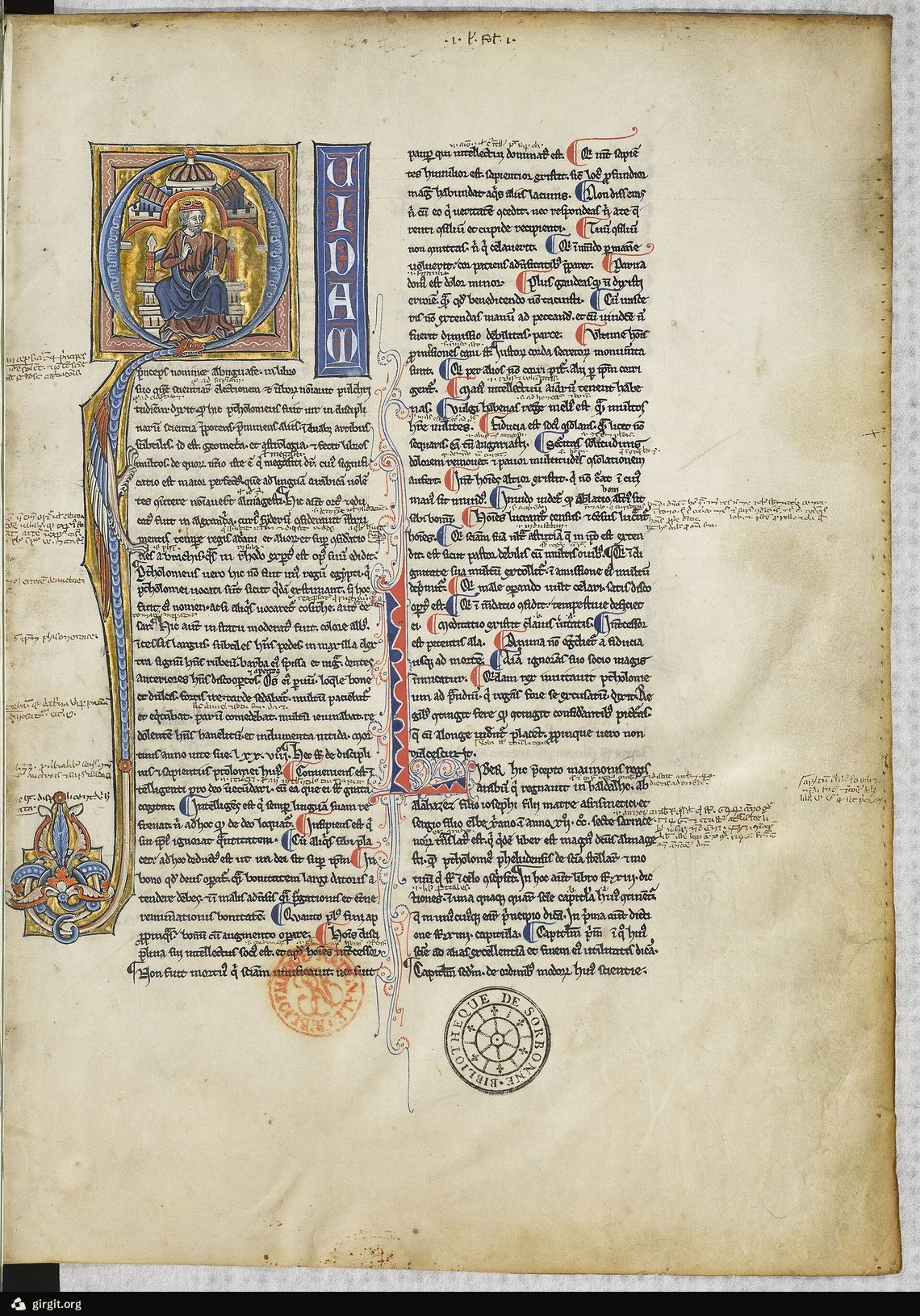 Ptolemy, painted as a kingLatin text of the Almagest
Now the turning proof as something you can move. Q is the point at angle \( y \). Turn the whole picture by \( x \): Q lands on P. Walk to P along the turned axes, \( \cos y \) along the amber one, then \( \sin y \) along the teal one, and split each step into its across and up parts. The four parts are the four terms.
Drag \( x \) or \( y \) past \( 90^\circ \). Some bars flip to the other side of the axis, because a part has turned negative, but the bars still add to exactly the coordinates of P. That is the formula holding for every angle, with no special cases.
Solve it
Solve it
Turn the point \( (3, 4) \) anticlockwise about the origin through \( 30^\circ \). Where does it land?
Hint
Answer
Prove it
Show that \( \sin(x + y)\sin(x - y) = \sin^2 x - \sin^2 y \). (A favourite JEE first step.)
Hint
Answer
Spot the gap
A student proves \( \sin(x + y) \) with the area picture above and writes "true for all \( x \) and \( y \)". What has not been proved?
Answer
Connect it
Connect it
- Double angles, next pages. Put \( y = x \) and the sum formulas become \( \sin 2x \) and \( \cos 2x \): see double and triple angles. The allied angles \( \pi \pm x \) are the sum formula with one angle fixed: allied angles.
- Complex numbers, Class 11. Multiply \( (\cos x + i\sin x)(\cos y + i\sin y) \) and collect: the real part is \( \cos x\cos y - \sin x\sin y \), the imaginary part \( \sin x\cos y + \cos x\sin y \). Multiplying such numbers adds their angles. See multiplying complex numbers.
- Matrices, Class 12. The turn by \( x \) is a 2 by 2 matrix with columns \( (\cos x, \sin x) \) and \( (-\sin x, \cos x) \); multiplying the matrices for \( x \) and \( y \) gives the matrix for \( x + y \), and its entries are these formulas. See multiplying matrices.
- Vectors on a slope, Physics Class 11. Splitting a weight into "along the ramp" and "into the ramp" is exactly walking along turned axes: resolution of vectors.
- The range of a mixed wave. Read backwards, the sum formula turns \( 3\sin x + 4\cos x \) into \( 5\sin(x + \alpha) \): see the deep dive on domain and range.
Sources
- Ptolemy's table of chords, Wikipedia (Almagest Book I; steps of ½° to 180°; radius 60; chord = 120 sin(θ/2); pentagon and hexagon chords; Ptolemy's theorem for sums and differences).
- Ptolemy's theorem, Wikipedia (link to the compound-angle formulas; Hipparchus's earlier chord tables).
- Almagest, Wikipedia (written about 150; the name from Arabic al-majisti).
- Ptolemy, Wikipedia (medieval mix-ups with the Ptolemaic kings).
- Bhāskara II, Wikipedia (Siddhanta Shiromani, 1150, formulas for sin(a + b) and sin(a − b)).
- Sine and cosine, Wikipedia (etymology: cosine from complementi sinus, Gunter 1620).
Picture and video credits