- 1. How do we measure an angle?
- 2. What is a radian?
- 3. Changing degrees into radians and back
- 4. Sine and cosine for any angle
- 5. Tan, cot, sec and cosec
- 6. Which functions are positive where?
- 7. Domain and range of the six functions
- 8. What the graphs look like, and why they repeat
- 9. Sine and cosine of a sum or difference
- 10. Angles like π − x, and tan of a sum
- 11. Double and triple angles
- 12. Turning sums into products and back
- Review
6 of 12·NCERT §3.3.1·5 min
Which functions are positive where?
The big ideaThe sign of each trigonometric function depends only on which quadrant the point P lands in, and that is what lets you pick the right sign after a square root.
In simple words
Graph paper has four corners round the centre. In the top right, right and up are both plus. In the top left, going left makes one number minus. Bottom left, both are minus. Bottom right, going down makes the other one minus. Cosine follows left and right. Sine follows up and down. Once you know the corner, you know which answers are plus and which are minus.
Negative angles: a mirror
Let \( P(a, b) \) be the point for angle \( x \) and \( Q \) the point for \( -x \). Turning the same distance clockwise instead of anticlockwise gives the mirror image of P in the \( x \)-axis, so \( Q = (a, -b) \). Therefore
\[ \cos(-x) = \cos x, \qquad \sin(-x) = -\sin x \]Dividing, \( \tan(-x) = -\tan x \). For example, \( \sin\left(-\tfrac{\pi}{6}\right) = -\tfrac{1}{2} \) and \( \cos\left(-\tfrac{\pi}{3}\right) = \tfrac{1}{2} \).
Sine and cosine stay between −1 and 1
Every point of the unit circle has both coordinates between \( -1 \) and \( 1 \). So for every real \( x \),
\[ -1 \le \cos x \le 1, \qquad -1 \le \sin x \le 1 \]The four quadrants
Which quadrant P lands in decides the signs of \( a = \cos x \) and \( b = \sin x \):
- First quadrant, \( 0 \lt x \lt \tfrac{\pi}{2} \): \( a \gt 0 \), \( b \gt 0 \).
- Second quadrant, \( \tfrac{\pi}{2} \lt x \lt \pi \): \( a \lt 0 \), \( b \gt 0 \).
- Third quadrant, \( \pi \lt x \lt \tfrac{3\pi}{2} \): \( a \lt 0 \), \( b \lt 0 \).
- Fourth quadrant, \( \tfrac{3\pi}{2} \lt x \lt 2\pi \): \( a \gt 0 \), \( b \lt 0 \).
So \( \sin x \) is positive for \( 0 \lt x \lt \pi \) and negative for \( \pi \lt x \lt 2\pi \). \( \cos x \) is positive in the first and fourth quadrants and negative in the second and third. The other four follow: a reciprocal keeps the sign, and \( \tan = \tfrac{\sin}{\cos} \) is positive when the two agree.
| I | II | III | IV | |
|---|---|---|---|---|
| \( \sin x \) | + | + | − | − |
| \( \cos x \) | + | − | − | + |
| \( \tan x \) | + | − | + | − |
| \( \operatorname{cosec} x \) | + | + | − | − |
| \( \sec x \) | + | − | − | + |
| \( \cot x \) | + | − | + | − |
Try it: drag P through all four quadrants and watch the lit column change.
Finding the other five from one
Given one function and the quadrant, the method is always the same: use an identity to get a square, take the square root, then use the quadrant to choose the sign.
Worked example
\( \sin x = -\tfrac{5}{13} \) and \( x \) is in the fourth quadrant. Find the other five.
- \( \operatorname{cosec} x = -\tfrac{13}{5} \) straight away.
- \( \cos^2 x = 1 - \sin^2 x = 1 - \tfrac{25}{169} = \tfrac{144}{169} \), so \( \cos x = \pm\tfrac{12}{13} \).
- In the fourth quadrant cosine is positive: \( \cos x = \tfrac{12}{13} \), and \( \sec x = \tfrac{13}{12} \).
- \( \tan x = \dfrac{\sin x}{\cos x} = \dfrac{-5/13}{12/13} = -\tfrac{5}{12} \), and \( \cot x = -\tfrac{12}{5} \).
Worked example
\( \tan x = \tfrac{3}{4} \) and \( x \) is in the third quadrant. Find the other five.
- \( \cot x = \tfrac{4}{3} \).
- \( \sec^2 x = 1 + \tan^2 x = 1 + \tfrac{9}{16} = \tfrac{25}{16} \), so \( \sec x = \pm\tfrac{5}{4} \).
- In the third quadrant cosine, and so secant, is negative: \( \sec x = -\tfrac{5}{4} \) and \( \cos x = -\tfrac{4}{5} \).
- \( \sin x = \tan x \cos x = \tfrac{3}{4} \times \left(-\tfrac{4}{5}\right) = -\tfrac{3}{5} \), and \( \operatorname{cosec} x = -\tfrac{5}{3} \).
Check: \( \sin x \) and \( \cos x \) are both negative, as they should be in the third quadrant, and \( \tfrac{9}{25} + \tfrac{16}{25} = 1 \).
Don't mix these up
- A square root gives two signs. Never just take the positive one: the quadrant decides.
- \( \cos(-x) = \cos x \) but \( \sin(-x) = -\sin x \). Only sine (and cosec, tan, cot) flips sign.
- Tan is positive in the third quadrant, because there both sine and cosine are negative.
Try it. (a) \( \cos x = -\tfrac{8}{17} \), \( x \) in the second quadrant. Find \( \sin x \) and \( \tan x \). (b) In which quadrant are \( \sin x \lt 0 \) and \( \tan x \gt 0 \) together? (c) Find \( \tan\left(-\tfrac{\pi}{4}\right) \).
Answer
Just remember
The signs have a reason (they are coordinates), but in an exam you want them in one second. Learn the hook, and keep the five-second rebuild as your check.
- Positive in I: all · II: sin, cosec · III: tan, cot · IV: cos, sec
- Go anticlockwise from quadrant I and say "After School To College" (or "Add Sugar To Coffee"): All, then Sin, then Tan, then Cos. Each reciprocal shares its partner's sign. Rebuild in five seconds: cos is \( x \), so it is + on the right; sin is \( y \), so it is + on top; tan is \( y \div x \), so it is + where the two agree (I and III).
- \( \cos(-x) = \cos x \), \( \sin(-x) = -\sin x \)
- "Cos is constant under a sign change; sin switches." Rebuild: \( -x \) is the mirror image in the \( x \)-axis, which keeps \( x \) (cos) and flips \( y \) (sin).
- Quadrant
- One of the four quarters of the plane cut out by the axes, numbered I to IV anticlockwise.
- \( \cos(-x) = \cos x \)
- Cosine does not change when the angle changes sign.
- \( \sin(-x) = -\sin x \)
- Sine changes sign when the angle does.
- Sign table
- Which of the six functions are positive in each quadrant.
Words to know
\( x \) is in the second quadrant and \( \sin x = \tfrac{3}{5} \). What is \( \cos x \)?
- \( \tfrac{4}{5} \)
- \( -\tfrac{4}{5} \)
- \( \tfrac{2}{5} \)
Which function is positive in the fourth quadrant?
- \( \sin x \)
- \( \tan x \)
- \( \sec x \)
What is \( \cos\left(-\tfrac{\pi}{6}\right) + \sin\left(-\tfrac{\pi}{6}\right) \)?
- \( \tfrac{\sqrt{3} - 1}{2} \)
- \( \tfrac{\sqrt{3} + 1}{2} \)
- \( \tfrac{-\sqrt{3} - 1}{2} \)
Deep dive · optional
When did a sine first go negative?
Why a sine is a signed number and not just a length, why a flip of the angle flips only the sine, and the book that made radius 1 the rule. Not examined; it makes the sign rule something you can see rather than recite.
The roots: a sine is a coordinate, not a length
- Why is \( \sin x \) negative in quadrants III and IV?Because it is the \( y \)-coordinate of P, and there P is below the \( x \)-axis.
- Why not just use the length MP, which is always positive?Then P and its mirror image below the axis would get the same sine, and the formulas would break. The sum formula on page 9 says \( \sin(180^\circ + 30^\circ) = \sin 180^\circ \cos 30^\circ + \cos 180^\circ \sin 30^\circ = 0 - \tfrac{1}{2} \). The algebra itself demands a negative sine; a signed coordinate is the only choice that keeps every formula true for every angle.
- Why is tan positive in III, where both coordinates are negative?\( \tan x = \tfrac{y}{x} \), and a negative divided by a negative is positive. Geometrically, OP in quadrant III lies on the same straight line as a point in quadrant I, so it has the same slope.
- Why does \( \cos(-x) = \cos x \) but \( \sin(-x) = -\sin x \)?Turning by \( x \) clockwise gives the mirror image, in the \( x \)-axis, of turning by \( x \) anticlockwise. A mirror in the \( x \)-axis keeps every \( x \)-coordinate and flips every \( y \)-coordinate.
- Bedrock?The coordinate plane: right and up are positive, left and down are negative, the same as on a number line.
So the sign table is not a list of facts. It is one picture, the four quadrants, read in three ways: across (cos), up (sin), and up-over-across (tan). Functions with \( f(-x) = f(x) \) are called even (cos, sec); those with \( f(-x) = -f(x) \) are odd (sin, tan, cosec, cot). Their graphs show it: the cosine graph is symmetric about the \( y \)-axis, and the sine graph looks the same after a half turn about the origin.
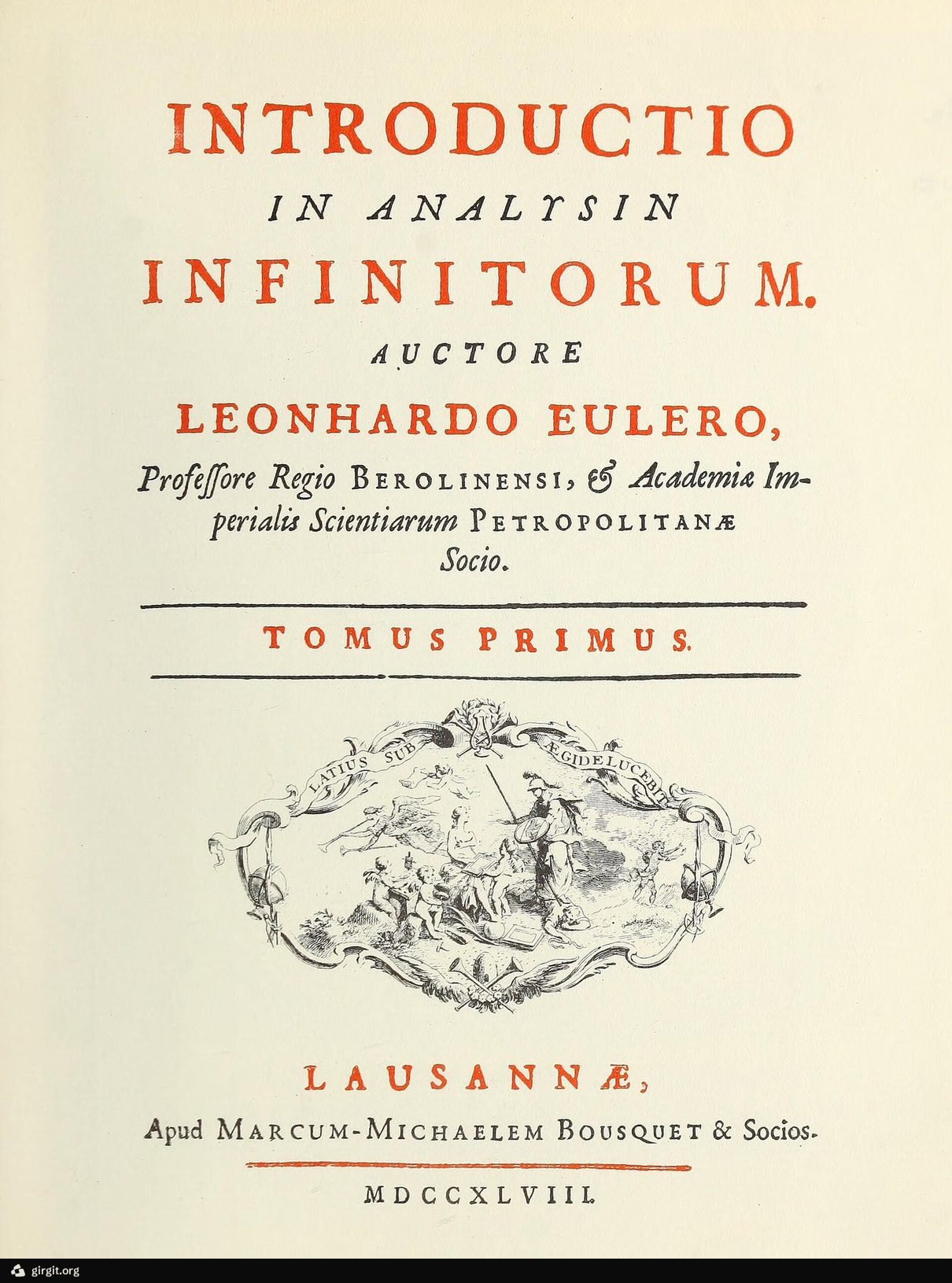
The story: the book that set the radius to 1
See it: the sign of a product
JEE likes questions like "is \( \sin 200^\circ \cos 300^\circ \tan 100^\circ \) positive?" You never need the values, only where each point sits. Guess first, then change the angles and the functions. Turn on the sweep to see the sign for every first angle at once: the colour changes only where the first point crosses an axis.
Solve it
Solve it
Without a calculator, decide the sign of \( \sin 1 \cdot \cos 2 \cdot \tan 3 \). The angles are in radians.
Hint
Answer
Solve it
\( \sin x \cos x \lt 0 \) and \( \cos x \tan x \gt 0 \). In which quadrant is \( x \)?
Answer
Spot the error
"\( 300^\circ = 360^\circ - 60^\circ \), and adding 360° changes nothing, so \( \sin 300^\circ = \sin(-60^\circ) = \sin 60^\circ = \tfrac{\sqrt{3}}{2} \)." Where does it go wrong?
Answer
Connect it
Connect it
- Allied angles, page 10. Every rule like \( \cos(\pi - x) = -\cos x \) takes its sign from this table: page 10.
- Quadrants, Ch 9. The same four quadrants and signs of coordinates: coordinate geometry recap.
- Even and odd, Class 12. An odd function like \( \sin x \) has \( \int_{-a}^{a} \sin x \, dx = 0 \): the parts above and below cancel. even and odd integrals.
- Inverse trig, Class 12. \( \sin^{-1} \) gives answers only in \( [-\tfrac{\pi}{2}, \tfrac{\pi}{2}] \), quadrants I and IV, where sine takes every sign once: why restrict the domain.
- Physics: a thrown ball. Its vertical velocity \( u\sin\theta - gt \) changes sign at the top, the same "signed, not a length" idea: projectile motion.
Still confused?
The triangle in quadrant II has positive sides. How can its cosine be negative?
The triangle only gives the size: \( |\cos x| = \tfrac{\text{adjacent}}{\text{hypotenuse}} \). The sign comes from the direction: the adjacent side runs to the left of O, so the \( x \)-coordinate is negative. Size from the triangle, sign from the quadrant: that is the whole method.
Is tan odd or even?
Odd: \( \tan(-x) = \tfrac{\sin(-x)}{\cos(-x)} = \tfrac{-\sin x}{\cos x} = -\tan x \). An odd function divided by an even one is odd. Likewise cot and cosec are odd, and sec, being \( \tfrac{1}{\cos} \), is even.
Sources
- L. Euler, Introductio in analysin infinitorum (1748), vol. 1, ch. 8, §§126–128 (radius always 1; values at quarter turns; sines and cosines between +1 and −1; rules for π/2 + z and so on), English translation by Ian Bruce.
- D. Richeson, "An amazing paragraph from Euler's Introductio" (Struik's translation; before Euler, sine and cosine were lengths in a circle whose radius need not be 1).
- History of trigonometry (the Introductio established the analytic treatment in Europe; Euler's abbreviations sin., cos., tang., cot., sec., cosec.), Wikipedia.
- Ptolemy's table of chords (circle of radius 60), Wikipedia.
- Title page of the Introductio, volume 1 (1748), Wikimedia Commons.

Picture and video credits