- 1. How do we measure an angle?
- 2. What is a radian?
- 3. Changing degrees into radians and back
- 4. Sine and cosine for any angle
- 5. Tan, cot, sec and cosec
- 6. Which functions are positive where?
- 7. Domain and range of the six functions
- 8. What the graphs look like, and why they repeat
- 9. Sine and cosine of a sum or difference
- 10. Angles like π − x, and tan of a sum
- 11. Double and triple angles
- 12. Turning sums into products and back
- Review
12 of 12·NCERT §3.4·5 min
Turning sums into products and back
The big ideaAdding and subtracting the sum and difference formulas lets you turn a sum of two sines or cosines into a product, and a product back into a sum.
In simple words
Sometimes a problem has two waves added together and you want them multiplied, because multiplied things cancel neatly in fractions. Other times you have them multiplied and want them added, because added things are easier to handle. These eight formulas are the switch between the two.
Where they come from
Write the four sum and difference formulas one under another:
\[ \begin{aligned} \cos(x + y) &= \cos x \cos y - \sin x \sin y \quad &(1) \\ \cos(x - y) &= \cos x \cos y + \sin x \sin y &(2) \\ \sin(x + y) &= \sin x \cos y + \cos x \sin y &(3) \\ \sin(x - y) &= \sin x \cos y - \cos x \sin y &(4) \end{aligned} \]Add and subtract them in pairs. In each case one product cancels and the other doubles:
- (1) + (2): \( \cos(x + y) + \cos(x - y) = 2\cos x \cos y \)
- (1) − (2): \( \cos(x + y) - \cos(x - y) = -2\sin x \sin y \)
- (3) + (4): \( \sin(x + y) + \sin(x - y) = 2\sin x \cos y \)
- (3) − (4): \( \sin(x + y) - \sin(x - y) = 2\cos x \sin y \)
Read from right to left, these are the product-to-sum formulas.
Try it: add two waves of nearly the same speed and see what the sum looks like.
Sum to product
Now rename the angles. Let \( x + y = \theta \) and \( x - y = \phi \). Adding and subtracting, \( x = \dfrac{\theta + \phi}{2} \) and \( y = \dfrac{\theta - \phi}{2} \). Put these into the four lines above. Since \( \theta \) and \( \phi \) can be any real numbers, we may call them \( x \) and \( y \) again:
Sum to product
- \( \cos x + \cos y = 2\cos \dfrac{x + y}{2} \cos \dfrac{x - y}{2} \)
- \( \cos x - \cos y = -2\sin \dfrac{x + y}{2} \sin \dfrac{x - y}{2} \)
- \( \sin x + \sin y = 2\sin \dfrac{x + y}{2} \cos \dfrac{x - y}{2} \)
- \( \sin x - \sin y = 2\cos \dfrac{x + y}{2} \sin \dfrac{x - y}{2} \)
Product to sum
- \( 2\cos x \cos y = \cos(x + y) + \cos(x - y) \)
- \( -2\sin x \sin y = \cos(x + y) - \cos(x - y) \)
- \( 2\sin x \cos y = \sin(x + y) + \sin(x - y) \)
- \( 2\cos x \sin y = \sin(x + y) - \sin(x - y) \)
A pattern to remember the sum-to-product list: the first factor always uses the half-sum \( \tfrac{x + y}{2} \), the second the half-difference \( \tfrac{x - y}{2} \). Cos plus cos gives cos cos; sin plus sin gives sin cos; sin minus sin gives cos sin; and cos minus cos gives sin sin with a minus sign in front.
Worked example
- \( \cos 75^\circ + \cos 15^\circ = 2\cos 45^\circ \cos 30^\circ = 2 \cdot \tfrac{1}{\sqrt{2}} \cdot \tfrac{\sqrt{3}}{2} = \sqrt{\tfrac{3}{2}} = \tfrac{\sqrt{6}}{2} \).
- \( \sin 75^\circ - \sin 15^\circ = 2\cos 45^\circ \sin 30^\circ = 2 \cdot \tfrac{1}{\sqrt{2}} \cdot \tfrac{1}{2} = \tfrac{1}{\sqrt{2}} \).
- \( \cos 80^\circ + \cos 40^\circ - \cos 20^\circ \): the first two give \( 2\cos 60^\circ \cos 20^\circ = \cos 20^\circ \). So the whole thing is 0.
- Product to sum: \( 2\sin 5x \cos 3x = \sin 8x + \sin 2x \).
Worked example
Prove that \( \dfrac{\sin 3x + \sin x}{\cos 3x + \cos x} = \tan 2x \).
- Top: \( \sin 3x + \sin x = 2\sin \tfrac{3x + x}{2} \cos \tfrac{3x - x}{2} = 2\sin 2x \cos x \).
- Bottom: \( \cos 3x + \cos x = 2\cos 2x \cos x \).
- Divide: the \( 2\cos x \) cancels, leaving \( \dfrac{\sin 2x}{\cos 2x} = \tan 2x \).
This is the typical use: sums do not cancel, but once they become products, common factors do.
Don't mix these up
- \( \cos x - \cos y \) has a minus in front: \( -2\sin\tfrac{x + y}{2}\sin\tfrac{x - y}{2} \). Check: for \( x \lt y \) in \( (0, \pi) \), \( \cos x \gt \cos y \), and the formula gives a positive answer only because of that minus.
- The order \( x - y \) matters in the difference formulas. Swapping \( x \) and \( y \) changes the sign of \( \tfrac{x - y}{2} \).
- Product to sum has no halves; sum to product has halves.
Try it. (a) Write \( \sin 7x - \sin 3x \) as a product. (b) Write \( 2\cos 4x \cos 2x \) as a sum. (c) Show that \( \dfrac{\cos 5x + \cos 3x}{\sin 5x - \sin 3x} = \cot x \).
Answer
Just remember
Eight formulas, but only one idea: write \( \sin(A + B) \) and \( \sin(A - B) \) (or the cos pair) one under the other, add or subtract, and put \( A = \tfrac{x + y}{2} \), \( B = \tfrac{x - y}{2} \). That takes under a minute. The hooks are for speed and for catching sign slips.
- Sum to product: the pairs
- "Sin-cos, cos-sin, cos-cos, minus sin-sin", for sin + sin, sin − sin, cos + cos, cos − cos, said like a train announcement. First factor: the half-sum; second: the half-difference.
- Why the minus in \( \cos x - \cos y \)
- Test \( x = 0 \), \( y = 90^\circ \): \( 1 - 0 = 1 \). The formula gives \( -2\sin 45^\circ \sin(-45^\circ) = +1 \) only with the minus in front.
- Product to sum: no halves
- \( 2\cos x\cos y = \cos(x - y) + \cos(x + y) \) and \( 2\sin x\sin y = \cos(x - y) - \cos(x + y) \). Hook: "sin times sin loses the sum". Check with \( x = y \): \( 2\sin^2 x = 1 - \cos 2x \), the double-angle formula you already know.
- Sum-to-product formula
- Writes \( \sin x \pm \sin y \) or \( \cos x \pm \cos y \) as a product.
- Product-to-sum formula
- Writes \( 2\sin x \cos y \) and similar products as a sum or difference.
- Half-sum
- \( \tfrac{x + y}{2} \), the angle in the first factor.
- Half-difference
- \( \tfrac{x - y}{2} \), the angle in the second factor.
Words to know
What is \( \cos 5x - \cos x \) as a product?
- \( 2\sin 3x \sin 2x \)
- \( -2\sin 3x \sin 2x \)
- \( 2\cos 3x \cos 2x \)
What is \( 2\sin 3x \cos x \) as a sum?
- \( \sin 4x + \sin 2x \)
- \( \cos 4x + \cos 2x \)
- \( \sin 2x + \sin x \)
What is the value of \( \sin 50^\circ + \sin 10^\circ - \cos 20^\circ \)?
- \( \cos 20^\circ \)
- 0
- \( \sin 60^\circ \)
Deep dive · optional
Multiplying by adding: the trick before logarithms
Why a product of two cosines falls apart into a sum, how astronomers in the 1580s used exactly that to multiply huge numbers, and why two nearly equal notes throb. Not needed for the exam, but it is the best reason these formulas exist.
The roots: turn y round and half the formula cancels
- Why can \( \cos x\cos y \) be written as a sum?Because \( \cos(x + y) \) and \( \cos(x - y) \) both contain \( \cos x\cos y \), once with \( -\sin x\sin y \) and once with \( +\sin x\sin y \). Add them and the sine parts cancel, leaving \( 2\cos x\cos y \).
- Why do the two sine parts have opposite signs?Because \( x - y \) is \( x + (-y) \), and changing y to −y flips \( \sin y \) but leaves \( \cos y \) alone.
- Why does −y flip the sine and not the cosine?The point for −y is the point for y mirrored in the x-axis: the same distance across, the opposite distance up.
- And why does that decide sin and cos?Because cos and sin are just the across and the up of the point on the unit circle. That is the bedrock.
There is also a picture that makes sum to product obvious, the one at the top of this page. Add two arrows of length 1 pointing at angles x and y. They form a rhombus, and the diagonal of a rhombus cuts its angle in half, so the sum points along the half-sum \( \tfrac{x + y}{2} \). Its length is twice the shadow of each arrow on that diagonal, \( 2\cos\tfrac{x - y}{2} \). The across part of the sum is then \( 2\cos\tfrac{x - y}{2}\cos\tfrac{x + y}{2} \), and the across part of the sum is also \( \cos x + \cos y \). Same arrow, two descriptions: that is the formula.
The same fact explains beats. Two notes of frequencies \( f_1 \) and \( f_2 \), played together, add to \( 2\cos\left(\pi(f_1 - f_2)t\right)\sin\left(\pi(f_1 + f_2)t\right) \): a fast wave at the average pitch, inside a slow envelope. The loudness swells whenever the envelope reaches a peak or a trough, which happens \( |f_1 - f_2| \) times a second. Musicians use this to tune: as two strings come together, the throbbing slows down.
The story: Hven, 1580
See it
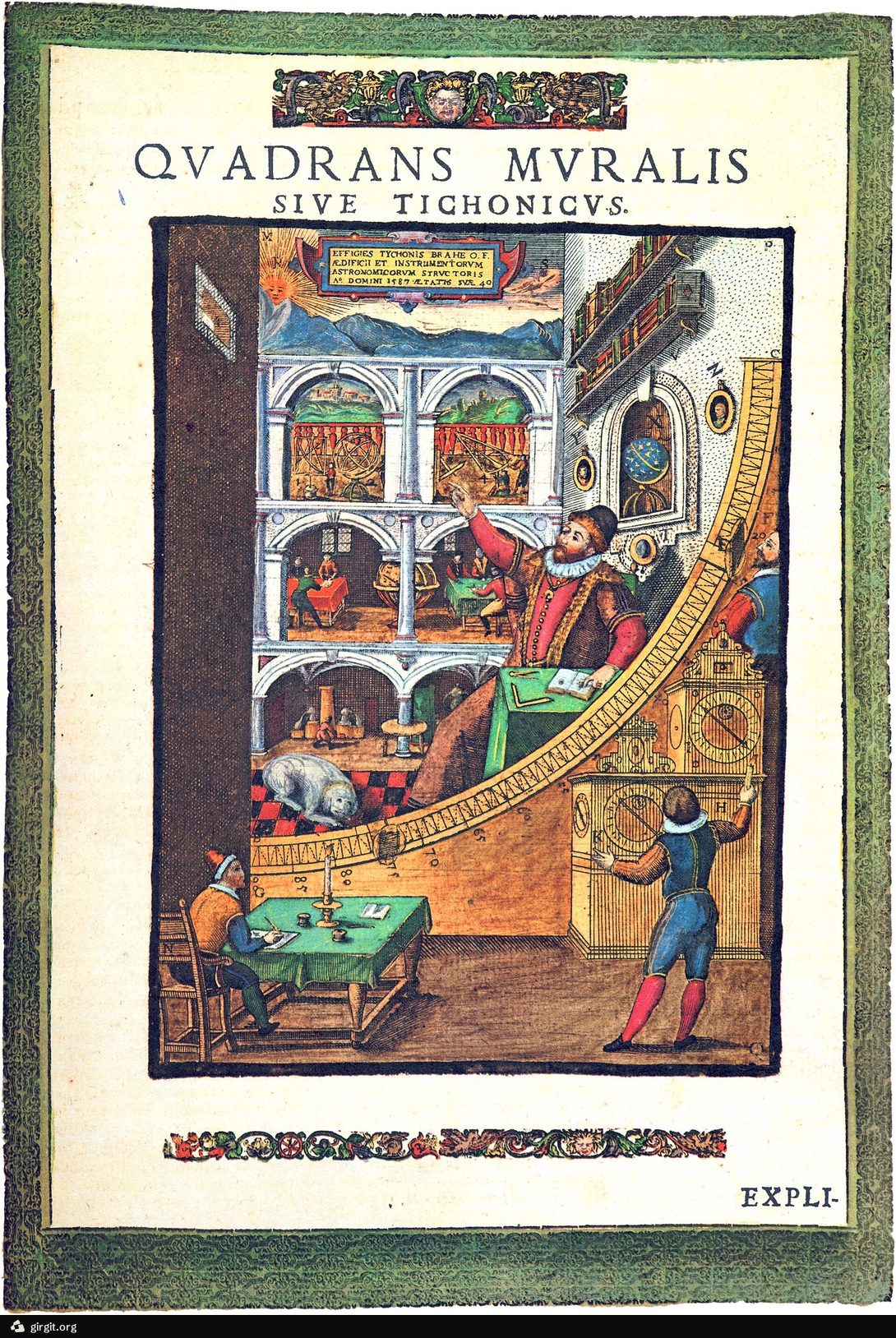 observer at the sightbrass arc, in degreesreading the clockwriting it down
Now do what Tycho's assistants did. Pick two numbers. Each becomes a cosine; the product appears as the point halfway between two other cosines.
Solve it
Solve it · by hand, the old way
Multiply \( 0.5 \times 0.866 \) using only the cosine values you know.
Answer
Solve it · predict the throb
Two tanpura strings ring at 240 Hz and 243 Hz. How many times a second does the sound swell? Many students say 1.5. Why is that wrong?
Hint
Answer
Solve it · a JEE classic
Show that \( \sin 20^\circ \sin 40^\circ \sin 60^\circ \sin 80^\circ = \tfrac{3}{16} \).
Hint
Answer
Connect it
Connect it
- Beats, Physics Ch 14. The swelling sound of two close notes is this page's formula heard: beats, with beat frequency \( |f_1 - f_2| \).
- Sum formulas, this chapter. All eight formulas are two lines of the sum and difference formulas added or subtracted.
- Double angles, this chapter. Put \( x = y \) in product to sum and you get \( 2\sin^2 x = 1 - \cos 2x \) and \( 2\cos^2 x = 1 + \cos 2x \): the half-angle forms.
- Integrals, Class 12. \( \int \sin 3x\cos x\,dx \) has no direct rule, but \( \tfrac{1}{2}\int(\sin 4x + \sin 2x)\,dx \) does: integrals using trig identities.
- Logarithms. Napier's logarithms (1614) did the same job as prosthaphaeresis, a product turned into a sum, and replaced it within a generation.
Still confused?
Why are there halves in sum to product but none in product to sum?
Product to sum starts from angles x and y and makes x + y and x − y. Sum to product goes the other way: given the sum and difference (call them x and y), the original angles are their average and half-difference, \( \tfrac{x + y}{2} \) and \( \tfrac{x - y}{2} \). The halves come from undoing the adding.
How could astronomers multiply numbers bigger than 1 with cosines?
They moved the decimal point. 309 × 788 becomes 0.309 × 0.788, which is \( \cos\alpha\cos\beta \) for two angles from the table; at the end the decimal point moves back by six places. The widget does the same.
Sources
- Tycho Brahe and mathematical techniques, Whipple Museum of the History of Science, University of Cambridge (Wittich's visit 1580; Ursus 1588; Werner; the 1591 manual; cos A cos B).
- Paul Wittich, MacTutor History of Mathematics, University of St Andrews.
- Prosthaphaeresis, Wikipedia (the four identities; Napier's logarithms 1614; worked example of a multiplication).
- Beat (acoustics), Wikipedia (beat frequency = difference; tuning by beats).
- Tycho's mural quadrant, from Astronomiae instauratae mechanica (1598), Wikimedia Commons.

Picture and video credits