- 1. How do we measure an angle?
- 2. What is a radian?
- 3. Changing degrees into radians and back
- 4. Sine and cosine for any angle
- 5. Tan, cot, sec and cosec
- 6. Which functions are positive where?
- 7. Domain and range of the six functions
- 8. What the graphs look like, and why they repeat
- 9. Sine and cosine of a sum or difference
- 10. Angles like π − x, and tan of a sum
- 11. Double and triple angles
- 12. Turning sums into products and back
- Review
1 of 12·NCERT §3.1 · §3.2 · §3.2.1·4 min
How do we measure an angle?
The big ideaAn angle is an amount of turning: how far a ray has swung about its starting point, with a plus sign for anticlockwise and a minus sign for clockwise.
In simple words
Hold one end of a pencil still on the table and swing the other end. How far you swing it is the angle. If you swing it the way clock hands do not go, we call the angle plus. If you swing it the way clock hands go, we call it minus. You can keep swinging past one full turn, so an angle can be bigger than a full circle.
Where this chapter is going
The word trigonometry comes from two Greek words, trigon (triangle) and metron (measure): it began as the art of measuring triangles. Sailors used it to steer, surveyors to draw maps, engineers to build. Today it describes anything that repeats: earthquake waves (the science of seismology), alternating current in electric circuits, the state of an atom, the rise and fall of tides, the note of a sitar string.
Much of it grew in India. Aryabhata (476–550), Brahmagupta, Bhaskara I and Bhaskara II worked out results that later travelled to the Middle East and on to Europe. Even the word "sine" has an Indian root: Aryabhata's jya (half-chord) became jiba in Arabic, which was misread and translated into Latin as sinus.
In Class 10 you met sine, cosine and tangent as ratios of sides of a right-angled triangle, so only for acute angles (between 0° and 90°). A triangle cannot have a 200° angle or a −45° angle. In this chapter we stretch the same ideas to every angle, and they become trigonometric functions. First we need a better idea of what an angle is.
An angle is a turn
Start with a ray (a half-line) and rotate it about its end point.
- The starting position of the ray is the initial side.
- The final position after turning is the terminal side.
- The fixed point it turns about is the vertex.
- The measure of the angle is the amount of rotation that takes the initial side to the terminal side.
Try it: drag the ray round more than once and watch the spiral keep count.
Direction matters. Turning anticlockwise gives a positive angle; turning clockwise gives a negative angle. So two angles can end with the terminal side in exactly the same place and still be different angles: 60° and −300° both stop at the same line, but one is a short turn left and the other a long turn right.
Units for measuring a turn
The most natural unit is one complete revolution: the ray turns all the way round and comes back to the initial side. This is handy for big, fast turns. A ceiling fan at full speed makes about 5 revolutions every second.
Two smaller units are used far more often: the degree (this page) and the radian (next page).
Degree measure
If the ray turns through \( \tfrac{1}{360} \) of a full revolution, the angle is one degree, written \( 1^\circ \). So a full turn is \( 360^\circ \), a half turn \( 180^\circ \), a quarter turn \( 90^\circ \).
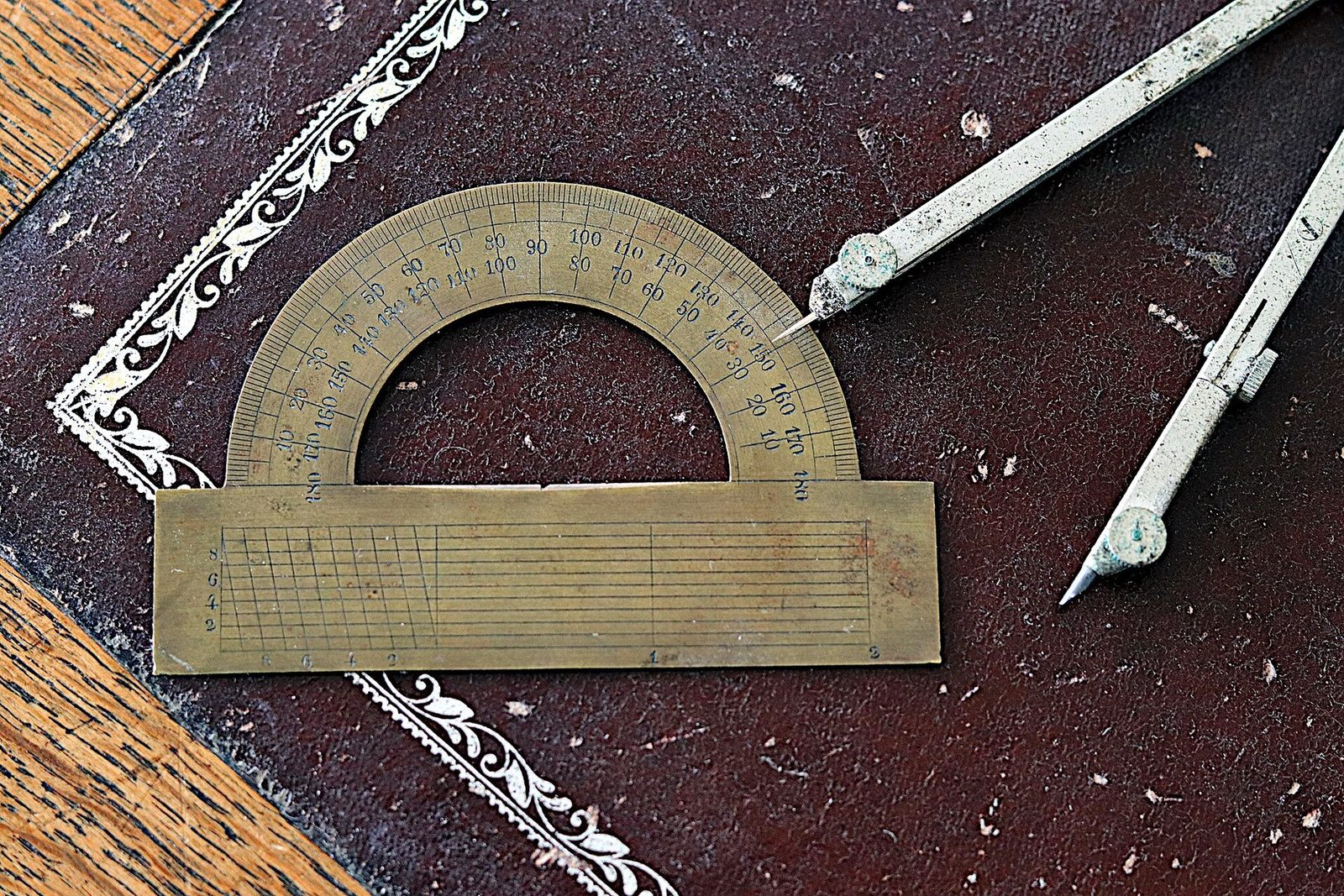 outer scale: 0° at left, clockwiseinner scale: 0° at right, anticlockwisecentre: the vertex goes here
For finer work a degree is cut into 60 minutes and a minute into 60 seconds, just as an hour is:
\[ 1^\circ = 60', \qquad 1' = 60'' \]Pictured in words, a few angles look like this (initial side along the positive \( x \)-axis):
- \( 270^\circ \): three quarter-turns anticlockwise; the terminal side points straight down.
- \( 420^\circ = 360^\circ + 60^\circ \): one full turn, then 60° more. It ends where \( 60^\circ \) ends.
- \( -30^\circ \): a small clockwise turn, ending just below the positive \( x \)-axis.
- \( -420^\circ \): one full clockwise turn, then 60° more clockwise. It ends where \( -60^\circ \) ends.
Worked example
- Write \( 52.35^\circ \) in degrees, minutes and seconds. The part \( 0.35^\circ = 0.35 \times 60' = 21' \). So \( 52.35^\circ = 52^\circ 21' \).
- Write \( 18^\circ 45' \) as a decimal of a degree. \( 45' = \tfrac{45}{60}^\circ = 0.75^\circ \), so \( 18^\circ 45' = 18.75^\circ \).
- Through what angle does the minute hand of a clock turn in 20 minutes? It makes a full turn in 60 minutes, so in 20 minutes it turns \( \tfrac{1}{3} \) of \( 360^\circ = 120^\circ \). Clock hands turn clockwise, so in the maths convention this angle is \( -120^\circ \).
Remember
- Angle = amount of rotation from the initial side to the terminal side, about the vertex.
- Anticlockwise is positive, clockwise is negative.
- \( 1 \text{ revolution} = 360^\circ \), \( 1^\circ = 60' \), \( 1' = 60'' \).
Try it. (a) Write \( 36^\circ 12' \) as a decimal of a degree. (b) Which positive angle less than 360° ends in the same place as \( 750^\circ \)? (c) A wheel makes 2.5 revolutions anticlockwise. What is the angle in degrees?
Answer
Just remember
These are human choices, not facts about circles. Any other choice would give the same geometry, so learn them with hooks.
- A full turn is \( 360^\circ \)
- A Babylonian habit: they counted in sixties, and \( 360 = 6 \times 60 \). It stuck because 360 can be cut into equal whole slices in 24 ways (the deep dive below shows why that matters).
- \( 1^\circ = 60' \) and \( 1' = 60'' \)
- Exactly like a clock: an hour has 60 minutes, a minute has 60 seconds. Same sixties, same names, same Babylonian root. The marks even look alike: one tick for minutes, two for seconds.
- Anticlockwise is plus, clockwise is minus
- "Open the bottle, get a plus." Unscrewing a bottle cap (seen from above) is an anticlockwise turn. To rebuild it without the hook: the quadrants I, II, III, IV are numbered anticlockwise, and turning the \( x \)-axis onto the \( y \)-axis is \( +90^\circ \).
- Trigonometry
- "Triangle measuring"; now the study of angles and the functions built on them.
- Initial side
- Where the turning ray starts.
- Terminal side
- Where the turning ray stops.
- Vertex
- The fixed point the ray turns about.
- Positive and negative angle
- Anticlockwise turn and clockwise turn.
- Degree
- \( \tfrac{1}{360} \) of a full turn; split into 60 minutes, each of 60 seconds.
Words to know
The ray of an angle turns one and a quarter times round, clockwise. What is the angle?
- \( 450^\circ \)
- \( -450^\circ \)
- \( -90^\circ \)
How many seconds are there in one degree?
- 60
- 3600
- 360
Do the angles \( 45^\circ \) and \( 405^\circ \) have the same terminal side?
- Yes, but they are different angles
- No, because 405° is bigger
- No, 405° is not a real angle
Deep dive · optional
Why is a full turn 360 and not 100?
Where the degree, the minute and the second came from, and why a number chosen 4,000 years ago still beats a round 100. The exam doesn't ask this, but it makes the units stick.
The roots: a turn needs a unit, and 360 is a good one
- Why is a full turn 360 degrees?Because the astronomers of Babylon, who wrote numbers in base 60, measured the sky that way, and Greek astronomers such as Hipparchus took the habit from them. Nobody wrote down the reason, so we have to look at what the number is good for.
- What is 360 good for?Cutting. A half, a third, a quarter, a fifth, a sixth, an eighth, a ninth, a tenth, a twelfth of a turn are all whole numbers of degrees. In total 360 can be cut into equal whole slices in 24 different ways. A round 100 allows only 9, and cannot even make clean thirds.
- Why did clean cutting matter so much?Every sum was done by hand. A sixth of a turn as \( 60^\circ \) is easy to use; as \( 16.666\ldots \) of a hundred it is a nuisance in every line of work. A unit with many divisors keeps fractions away.
- And why did Babylon count in sixties?60 is the smallest number that 1, 2, 3, 4, 5 and 6 all divide. Base 60 makes many fractions short and exact, which is why their tables of fractions worked so well.
- So is 360 a fact about circles?No. An angle is a fraction of a full turn (page 1 of this chapter), and you may call the full turn any number you like. The geometry is the same. Only one choice comes from the circle itself, not from people: the radian, on the next page.
There are other guesses for "why 360", and it is honest to say they are guesses. One: the sun seems to slide about one degree a day against the stars, and some old calendars used a year of 360 days. Another: six equilateral triangles fit round a point, so a circle splits naturally into six equal parts, and the Babylonians cut each part into 60. These ideas can all be true at once, and the reason chosen depends on which historian you read. What is certain is that 360 survived because it is so easy to divide.
The minutes and seconds come from the same base-60 habit. Medieval Latin writers called the first sixtieth of a degree pars minuta prima, "the first small part", and the sixtieth of that pars minuta secunda, "the second small part". The short forms became our "minute" and "second", for angles and for time alike.
The story: a clay tablet and a failed revolution
See it: which totals cut cleanly?
Choose how many units a full turn has, then cut it into slices. The strip lights every number of slices that comes out whole. Then press "Every total" and see where 360 stands among all the numbers up to 400.
The bars show something nice: 360 is a record. No number below it can be cut cleanly in as many ways. (Mathematicians call such numbers highly composite; 12, 60, 120, 240 and 360 are all on the list.) The decimal 100 and 400 are far down.
Solve it
Solve it
Between 3 o'clock and 4 o'clock, at exactly what time are the hour hand and the minute hand on top of each other?
Hint
Answer
Solve it
The Earth turns once, \( 360^\circ \), in about 24 hours. Indian Standard Time is the clock time at the line of longitude \( 82^\circ 30' \) E, near Mirzapur. Without looking it up, explain why India's clocks are 5 hours 30 minutes ahead of the clock at \( 0^\circ \) (Greenwich).
Hint
Answer
A surveyor's instrument is set to grades: 400 grades make a full turn. How many grades is a right angle, and how many degrees is 1 grade?
- 90 grades; 1 grade = 1°
- 100 grades; 1 grade = 0.9°
- 100 grades; 1 grade = 1.1°
Connect it
Connect it
- Radians, next page. The one unit nobody chose: the turn measured with the circle's own radius. What is a radian?
- Maps and phones. A place such as Delhi sits at about \( 28.6^\circ \) N, \( 77.2^\circ \) E: latitude and longitude are angles at the Earth's centre, in degrees, minutes and seconds. Page 3 turns those angles into kilometres: degrees and radians.
- Surveying India. The Great Trigonometrical Survey measured every angle of its triangles in degrees, minutes and seconds: see the deep dive on tan.
- Physics: turning things. Fans, wheels and planets turn through angles too, and physics measures them in radians per second: angular velocity.
- Time and angle are twins. 60 minutes in an hour, 60 minutes in a degree; 24 hours make one turn of the Earth, \( 15^\circ \) an hour. Every clock face is a protractor.
Sources
- Degree (angle), Wikipedia: theories for 360, divisors, Greek adoption from Babylon.
- Sexagesimal, Wikipedia: origins in Sumer and Babylon, why 60, YBC 7289's value of √2.
- YBC 7289, Yale Peabody Museum photograph and description, Wikimedia Commons.
- Second, Wikipedia: the names pars minuta prima and pars minuta secunda.
- Gradian, Wikipedia: the grade of the French Revolution and its use in surveying.
- Highly composite number, Wikipedia: 360 among the record-holders for number of divisors.
- Indian Standard Time, Wikipedia: the 82°30′ E reference meridian and UTC + 5:30.

Picture and video credits
Show 1 picture and video credits
- brass-protractor.jpg: Compo, CC BY-SA 4.0
