- 1. How do we sort animals?
- 2. Symmetry, germ layers and the coelom
- 3. Segments, the notochord, and the map of all phyla
- 4. Sponges, cnidarians and comb jellies
- 5. Flatworms, roundworms and segmented worms
- 6. Arthropods and molluscs: the two biggest phyla
- 7. Echinoderms and hemichordates
- 8. What makes a chordate?
- 9. Jawless vertebrates and fishes
- 10. Amphibians and reptiles
- 11. Birds and mammals
- Review
3 of 11·NCERT §4.1.5 · §4.1.6 · §4.2·pp. 39–40·5 min
Segments, the notochord, and the map of all phyla
The big ideaTwo more features, a body built in repeated segments and a stiff rod along the back called the notochord, complete the toolkit; put all the features together and the animal kingdom falls into eleven phyla.
In simple words
Some animals are built like a train: the same kind of box joined again and again, each with some of the same parts inside. Some animals, while they are still tiny babies, grow a stiff rod down their back that holds the body straight. With these two questions and the ones before, we can draw a family map of all animals.
Segmentation
In some animals the body is divided into segments, both on the outside and on the inside, and at least some organs are repeated in segment after segment. This is metameric segmentation, and the pattern is called metamerism. Each segment is a metamere.
The best example is the earthworm: count the rings on one in your garden after the rain. Each ring is a segment with its own set of excretory organs, nerve knots and muscles.
Segmented phyla (Table 4.2 in the textbook): Annelida, Arthropoda and Chordata. Molluscs and echinoderms are not segmented.
Segments look different in each of the three phyla. In an earthworm they are rings; in a centipede each one carries a pair of legs; in a fish they are hidden inside, as the zig-zag blocks of muscle you see in a fish steak.
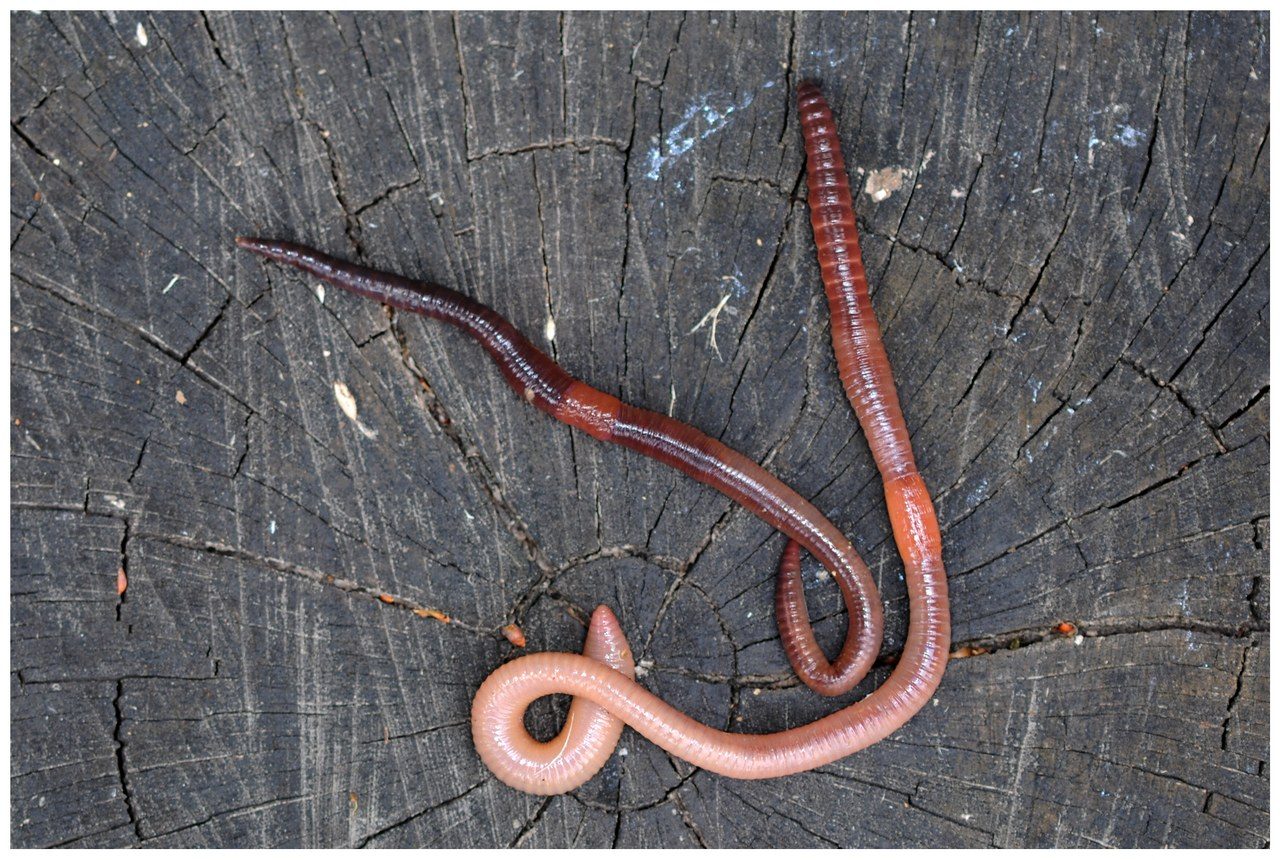 segments
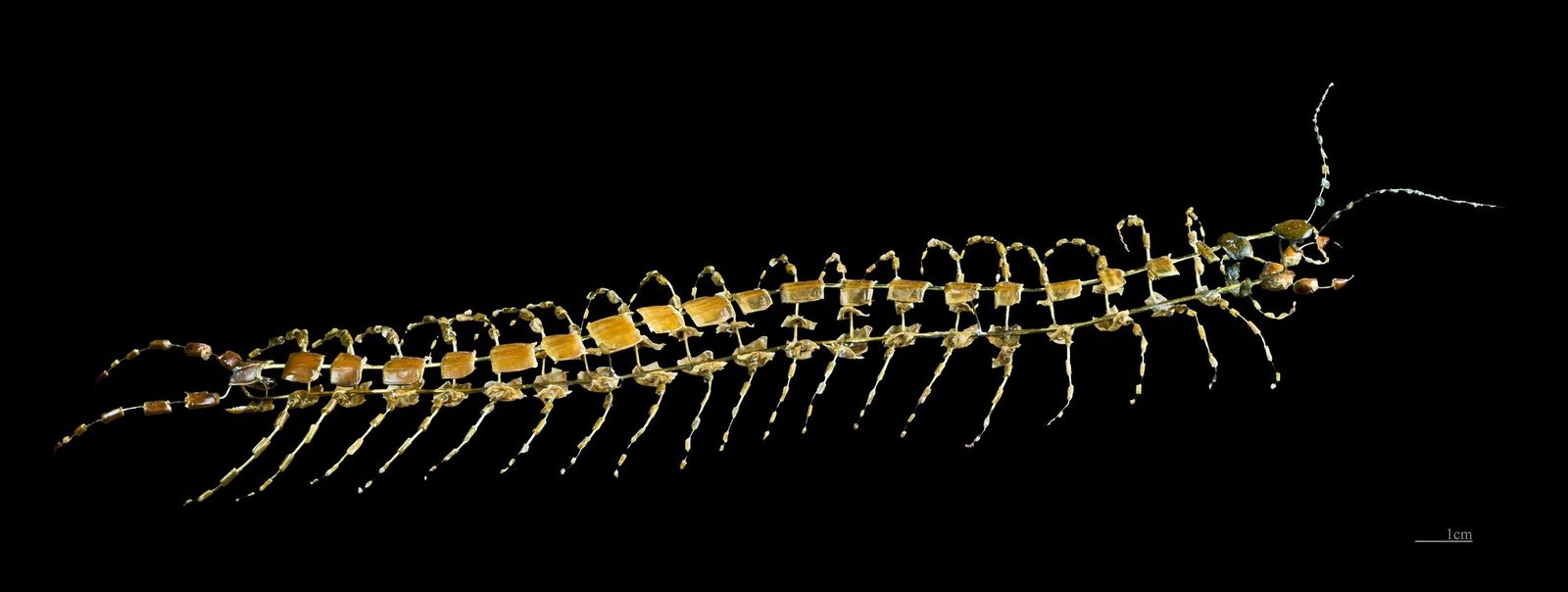 one segment, one pair of legsantennae
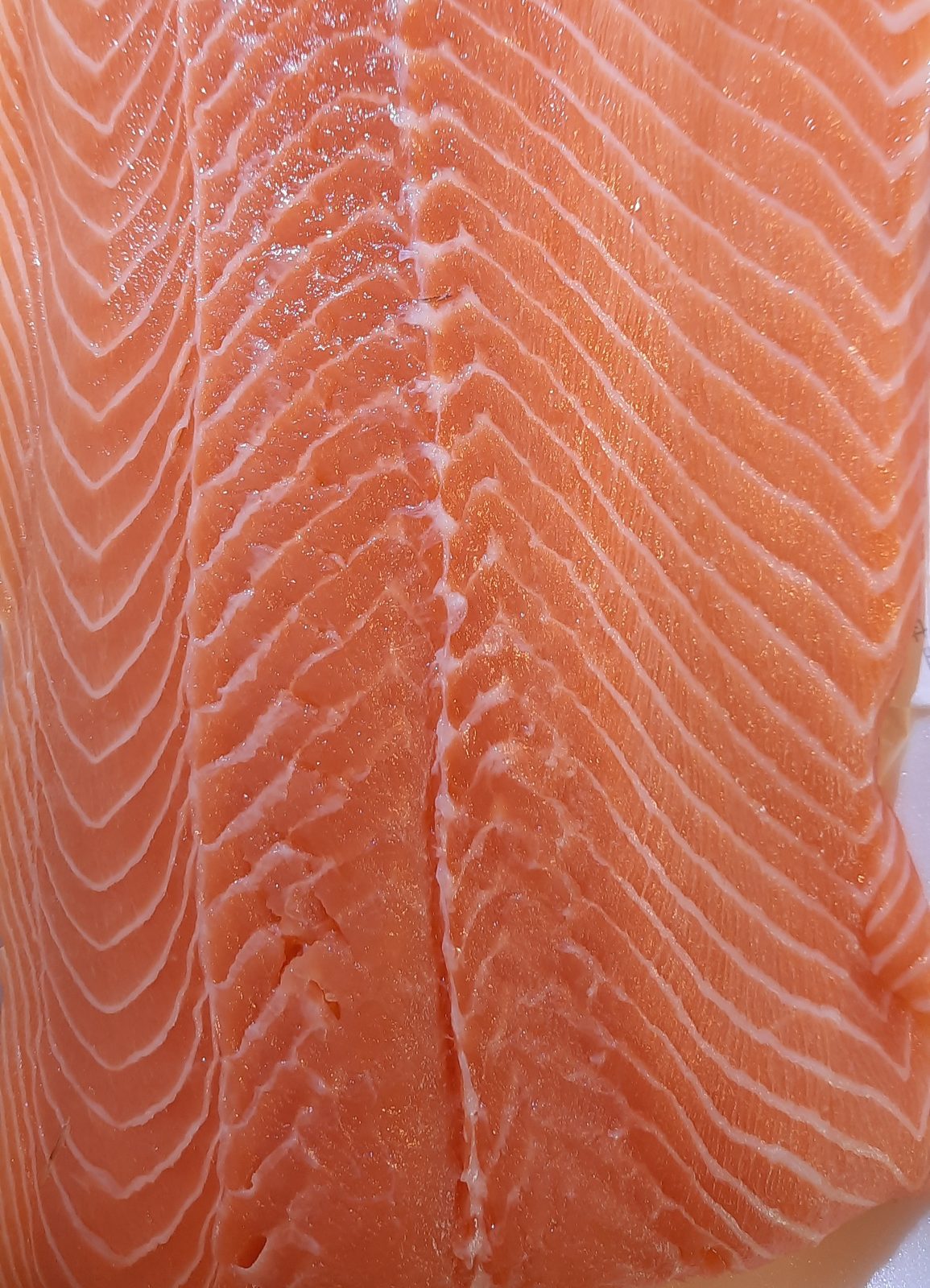 one muscle block
Notochord
The notochord is a rod-like support that forms along the dorsal side (the back) of the embryo. It grows from the mesoderm, so it is mesodermal in origin.
- Animals that form a notochord are chordates.
- Animals that never form one are non-chordates: every phylum from Porifera to Echinodermata (plus Hemichordata, as you'll see).
In you, the notochord was there for a few weeks in the womb, and was then replaced by the backbone.
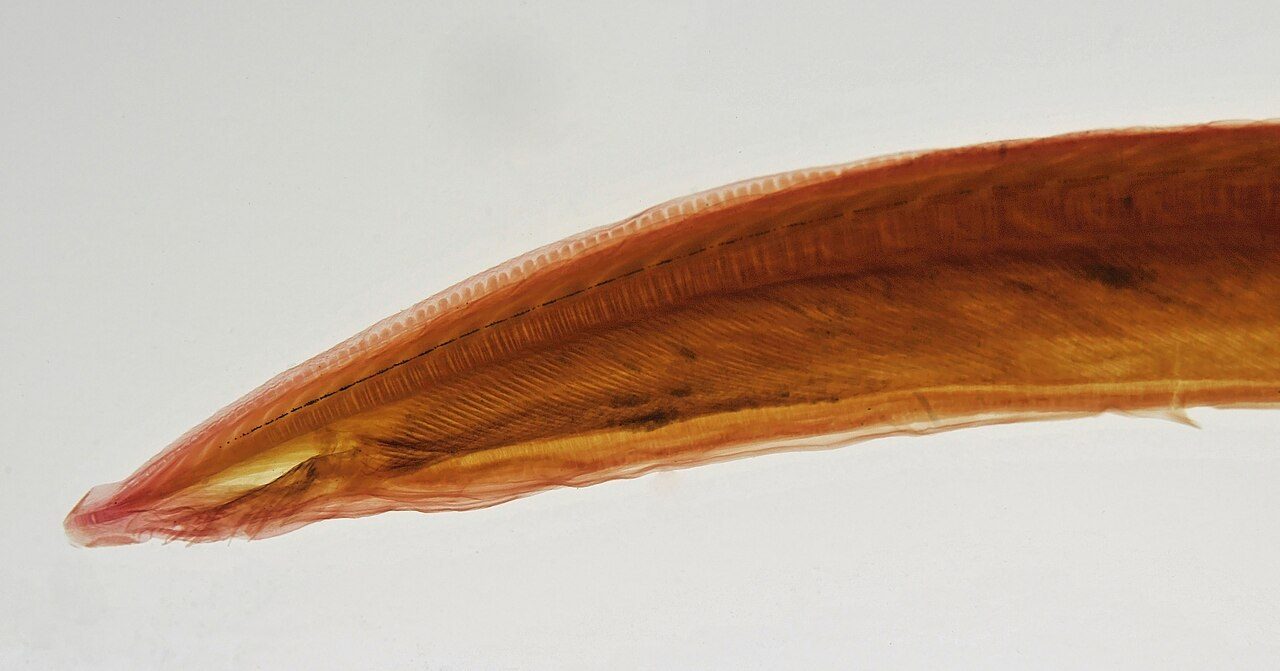 front endV-shaped muscle blocks
The map of the animal kingdom
Ask the questions in order and every phylum finds its place:
- Level of organisation? Cellular: Porifera. Tissue, organ or organ system: go on.
- Symmetry? Radial (with no coelom): Coelenterata and Ctenophora. Bilateral: go on.
- Body cavity?
- None (acoelomate): Platyhelminthes.
- False coelom (pseudocoelomate): Aschelminthes.
- True coelom (coelomate): Annelida, Arthropoda, Mollusca, Echinodermata, Hemichordata, Chordata.
Echinoderms sit with the bilateral coelomates in this chart because their larvae are bilateral, even though the adults are radial.
Try it: play twenty questions with the phyla. Which question narrows them fastest?
All the phyla on one page
This is the table to come back to. The next five concepts fill in each row.
| Phylum | Level | Symmetry | Coelom | Segments | Gut | Circulation | Breathing organs | Stand-out feature |
|---|---|---|---|---|---|---|---|---|
| Porifera | Cellular | Various | Absent | Absent | Absent | Absent | Absent | Pores and canals in the body wall |
| Coelenterata | Tissue | Radial | Absent | Absent | Incomplete | Absent | Absent | Cnidoblasts |
| Ctenophora | Tissue | Radial | Absent | Absent | Incomplete | Absent | Absent | Comb plates for moving |
| Platyhelminthes | Organ and organ system | Bilateral | Absent | Absent | Incomplete | Absent | Absent | Flat body, suckers |
| Aschelminthes | Organ system | Bilateral | Pseudocoelom | Absent | Complete | Absent | Absent | Long, worm-shaped body |
| Annelida | Organ system | Bilateral | Coelom | Present | Complete | Present | Absent | Body in ring-like segments |
| Arthropoda | Organ system | Bilateral | Coelom | Present | Complete | Present | Present | Cuticle exoskeleton, jointed legs |
| Mollusca | Organ system | Bilateral | Coelom | Absent | Complete | Present | Present | Shell outside, usually |
| Echinodermata | Organ system | Radial | Coelom | Absent | Complete | Present | Present | Water vascular system |
| Hemichordata | Organ system | Bilateral | Coelom | Absent | Complete | Present | Present | Proboscis, collar, trunk |
| Chordata | Organ system | Bilateral | Coelom | Present | Complete | Present | Present | Notochord, dorsal hollow nerve cord, gill slits |
Remember
- Segmented (metameric): Annelida, Arthropoda, Chordata. Earthworm is the textbook example.
- Notochord: dorsal, rod-like, mesodermal. Present = chordate; never formed = non-chordate.
- Organ system level + bilateral + true coelom + segments = Annelida, Arthropoda, Chordata.
Just remember
Which phyla are segmented, and which side the notochord lies on, are facts to learn. The hooks:
- Segmented: Annelida, Arthropoda, Chordata
- The segmented train has an "A-A-C" coach: Annelids, Arthropods, Chordates. Molluscs and echinoderms missed the train.
- Notochord: dorsal, rod-shaped, from mesoderm
- "Noto" is Greek for back (the same root as notum, the back plate of an insect): the notochord is the back-chord, a rod made by the middle layer, mesoderm.
- Non-chordates: Porifera to Echinodermata, plus Hemichordata
- Everything on the map except the last phylum. The hemichordate "half-chordate" is the one that fools you: it sits outside.
- Metamerism
- A body built of repeated segments, outside and inside.
- Metamere
- One segment of such a body.
- Notochord
- A rod of mesoderm along the back of an embryo.
- Dorsal
- On the back side. Ventral is the belly side.
- Chordate
- An animal that forms a notochord.
- Phylum
- A big group of animals sharing the same basic body plan.
Words to know
An animal is triploblastic, bilateral and has a true coelom, but its body is not segmented. Which phylum could it be?
- Annelida
- Arthropoda
- Mollusca
- Aschelminthes
The notochord develops from which germ layer?
- Ectoderm
- Mesoderm
- Endoderm
Which phylum has a complete gut but no circulatory system?
- Platyhelminthes
- Aschelminthes
- Annelida
- Coelenterata
Deep dive · optional
Why build a body in segments, around a rod?
What segments are for, what a notochord does, and how a Russian zoologist found the rod inside a sea squirt's tadpole. Beyond the exam, but it turns two rows of the table into ideas.
The roots
- Why is an earthworm built of segments?So that one part of its body can be thin while the next part is fat. Thin parts slide forward through the soil; fat parts press against the soil and grip it with their bristles. A wave of thin and fat running along the body moves the worm.
- Why does that need segments?Because the worm's skeleton is fluid: the coelom. Walls called septa divide the coelom into one sealed bag per segment. A bag of fluid can change shape but not volume, so when the circular muscles squeeze a segment thin, it must get longer; when the long muscles shorten it, it must get fatter. Without the walls, squeezing one part would just push fluid somewhere else.
- Why does "same volume" give such big changes?Volume goes as length × width². Squeeze a segment to half its width and it must become four times as long. A small squeeze gives a big stretch: try it below.
- Why repeat the same unit at all?Because one set of instructions used again and again is an easy way to build a long body. In arthropods the repeated segments were later grouped and specialised (head, thorax, abdomen); in chordates they show as the repeated blocks of muscle and the vertebrae. The genes that lay out segments in a fly embryo were found in the 1970s and 1980s, and the work won the 1995 Nobel Prize.
And the notochord? It is a rod of tightly packed cells that are swollen with fluid, wrapped in a tough sheath: stiff along its length, but able to bend. Muscle blocks on the left and right pull against it. Because the rod cannot be squashed shorter, a pull on one side bends the body instead of shortening it, and alternate pulls left and right send waves down the body: swimming. That is why a lancelet, with a notochord for life, swims like a little fish, and why the tadpole larva of a sea squirt has a notochord in its tail while it swims, and loses it when it settles down as an adult. In vertebrates the backbone takes over the job: stronger, and built in pieces so it can still bend.
The story
See it
The adult sea squirt and, in a 1905 encyclopedia plate, its tadpole larva with the notochord marked in the tail.
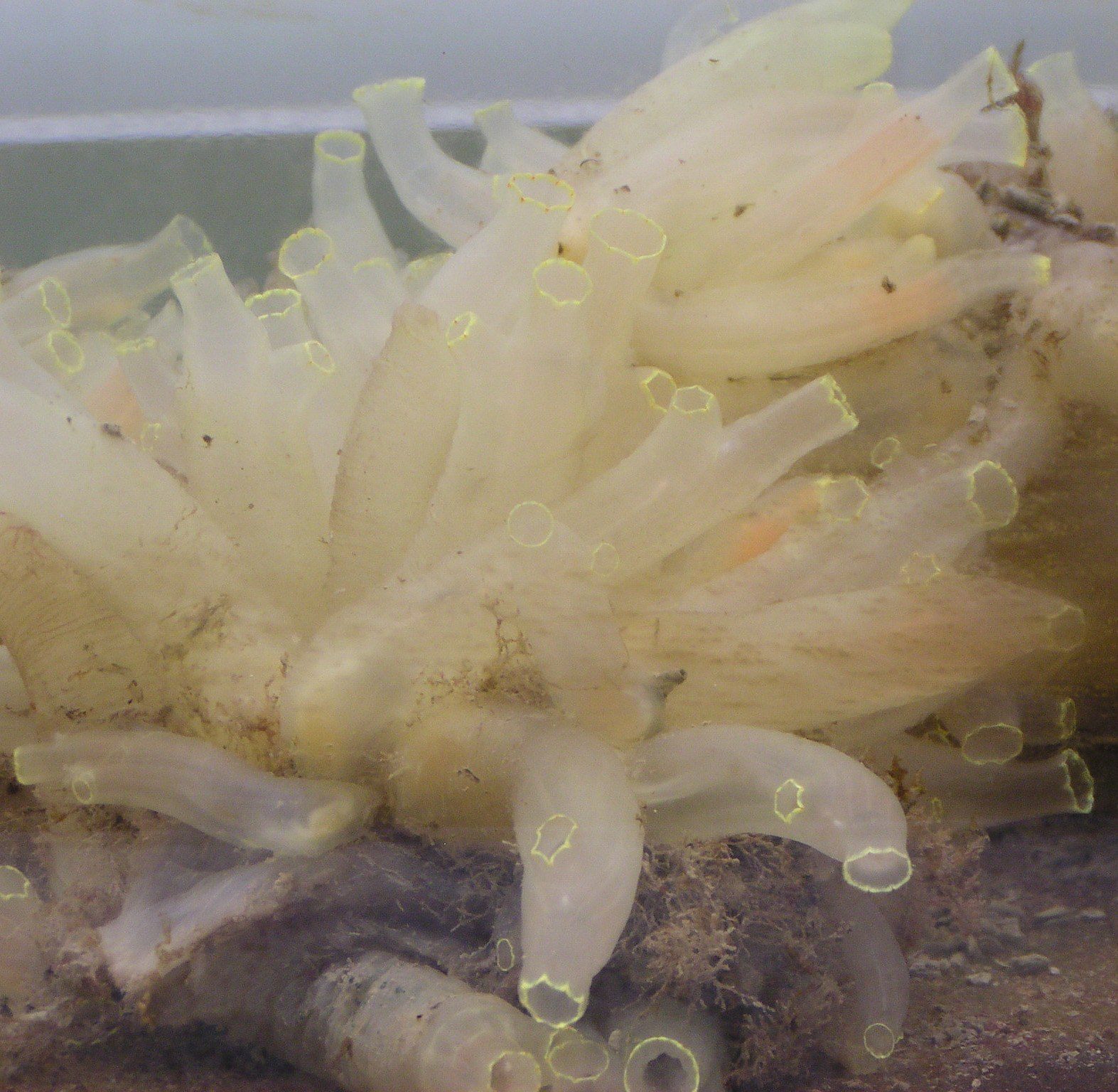 siphons
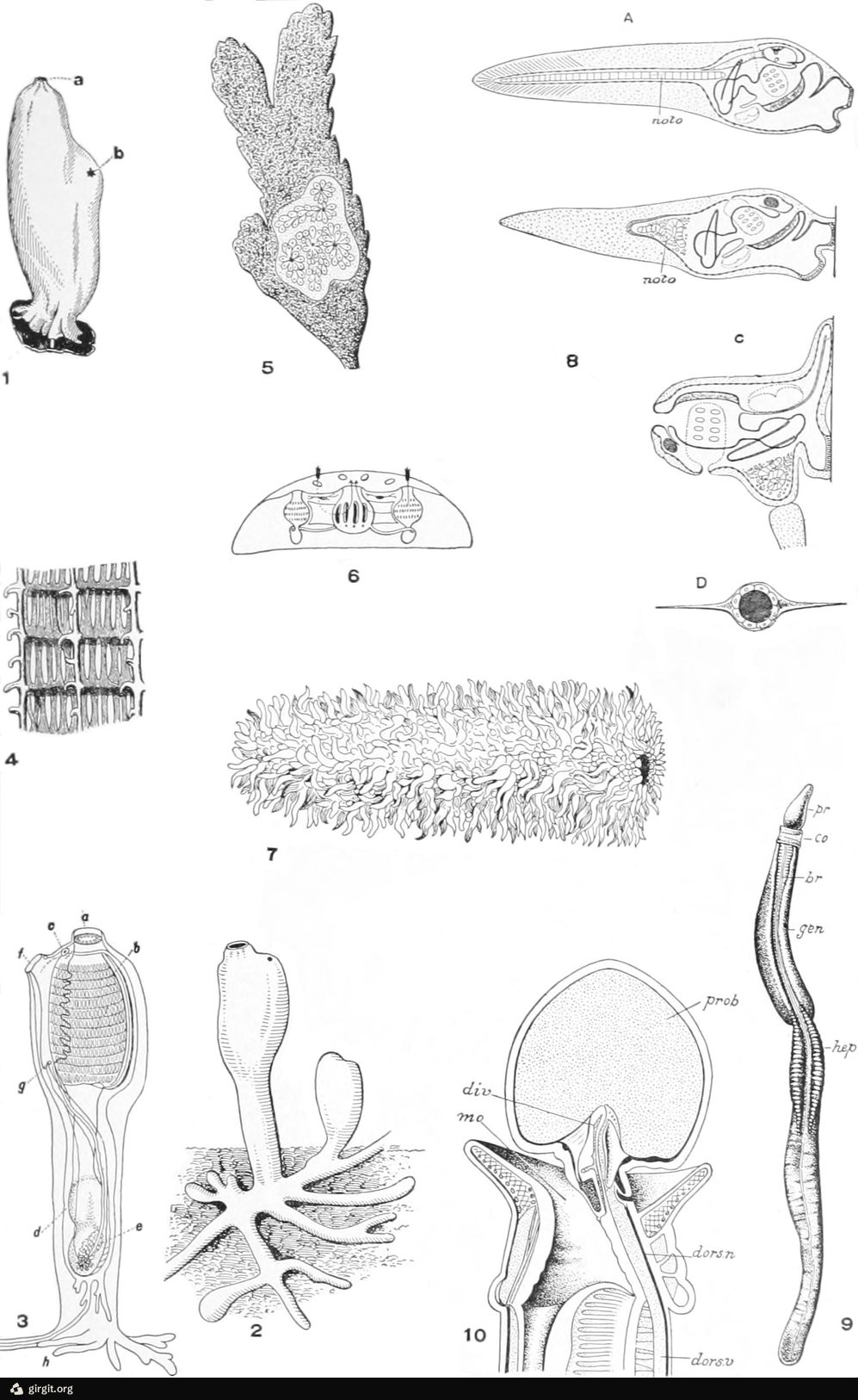 larva: notochord in the tailadult sea squirtacorn worm
Solve it
Solve it
An earthworm segment is 10 mm long and 4 mm wide. Its circular muscles squeeze it to 3 mm wide. How long does it become? And how wide would it be if its longitudinal muscles shortened it to 7 mm instead?
Hint
Answer
Solve it
An animal is found whose adult has a pharynx with gill slits, sits fixed to a rock and has no notochord. Its larva has never been seen. Is it a chordate? What would settle the question?
Answer
Why can't an earthworm crawl if the walls (septa) between its segments are removed?
- Its muscles would be destroyed
- Fluid would flow between segments, so no part could stay fat and grip
- It would lose its nephridia
Connect it
Connect it
- Earthworm and cockroach, Ch 7. Segments in detail: the earthworm and the cockroach, whose segments are grouped into head, thorax and abdomen.
- Your backbone, Ch 17. What replaced the notochord: the axial skeleton.
- Chordates, concept 8. The three badges, and the sea squirt and lancelet in detail.
- Evolution, Class 12. Shared embryos as evidence for evolution.
Still confused?
A cockroach's segments don't all look alike. Is it still metamerically segmented?
Yes. The segments are there, in the embryo and in the abdomen, but many have fused into groups that do different jobs (head, thorax, abdomen). Specialised segments are still segments.
Is the notochord the same as the spinal cord?
No. The notochord is a supporting rod made from mesoderm. The spinal cord is the dorsal hollow nerve cord, made from ectoderm, lying just above it. In vertebrates the vertebrae grow around both: the backbone replaces the notochord and protects the spinal cord.
Picture and video credits
Show 5 picture and video credits
- earthworms-drawing.jpg: James S.W., Porco D., Decaëns T., Richard B., Rougerie R., Erséus C., CC BY 4.0
- centipede-segments.jpg: Didier Descouens, CC BY-SA 4.0
- salmon-myomeres.jpg: Nwbeeson, CC BY-SA 4.0
- lancelet-branchiostoma.jpg: Parent Géry, CC BY-SA 3.0
- sea-squirt-ciona.jpg: perezoso, CC BY-SA 3.0


