- 1. How do we sort animals?
- 2. Symmetry, germ layers and the coelom
- 3. Segments, the notochord, and the map of all phyla
- 4. Sponges, cnidarians and comb jellies
- 5. Flatworms, roundworms and segmented worms
- 6. Arthropods and molluscs: the two biggest phyla
- 7. Echinoderms and hemichordates
- 8. What makes a chordate?
- 9. Jawless vertebrates and fishes
- 10. Amphibians and reptiles
- 11. Birds and mammals
- Review
2 of 11·NCERT §4.1.2 · §4.1.3 · §4.1.4·pp. 38–39·5 min
Symmetry, germ layers and the coelom
The big ideaThree questions sort most animals: how can the body be cut into matching halves, how many cell layers the embryo has, and whether there is a lined cavity between the gut and the body wall.
In simple words
Cut a round cake through the middle any way you like and the two pieces match. Cut a person and only one cut, nose to belly button, gives two matching sides. Animals are like this too. Next, a baby animal starts as two or three sheets of cells, like a sandwich with or without the filling. Last, some animals have an empty space between their skin and their food tube, and some have none.
Symmetry
Symmetry asks: can a cut through the centre split the body into two equal halves?
| Type | What it means | Examples |
|---|---|---|
| Asymmetrical | No plane through the centre gives two equal halves. | Most sponges |
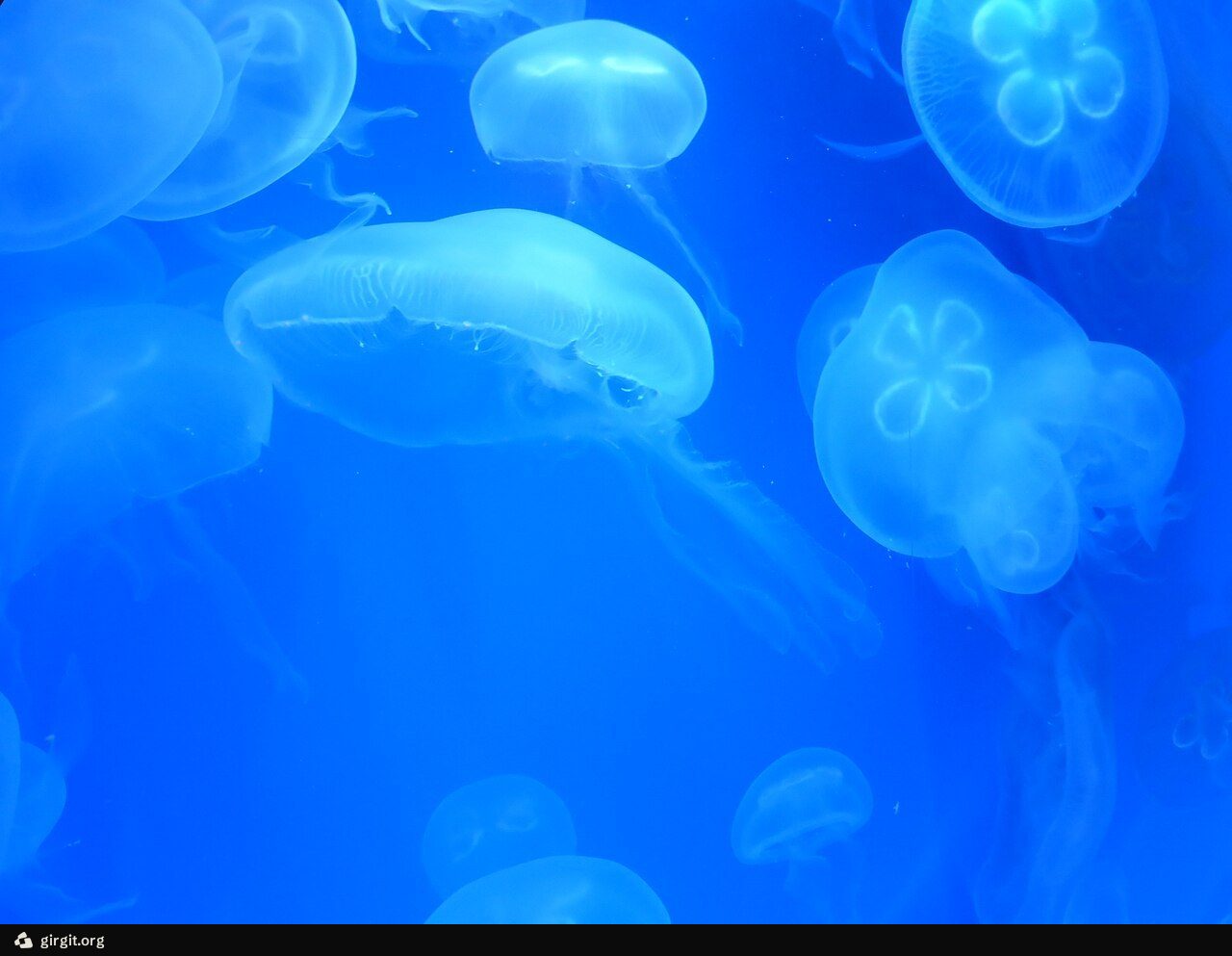
| Radial symmetry | Any plane through the central axis gives two identical halves. | Coelenterates, ctenophores, adult echinoderms |
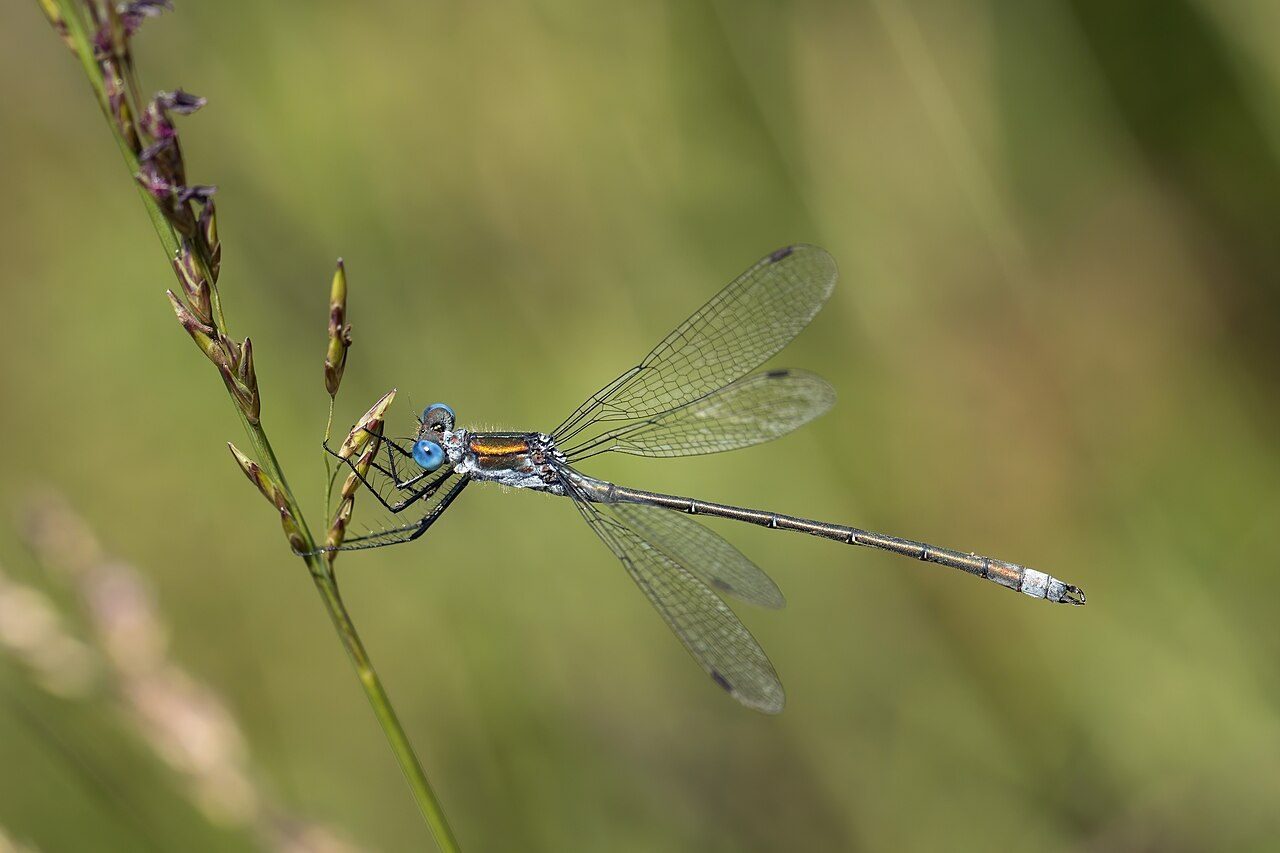
| Bilateral symmetry | Only one plane gives identical left and right halves. | Annelids, arthropods, chordates and most others |
Radial animals usually sit still or drift, meeting the world from all sides. Bilateral animals have a front end that goes first, which suits moving about.
 four-part body
Try it: turn the cut and watch the mirror image of the body slide over it.
Don't mix these up
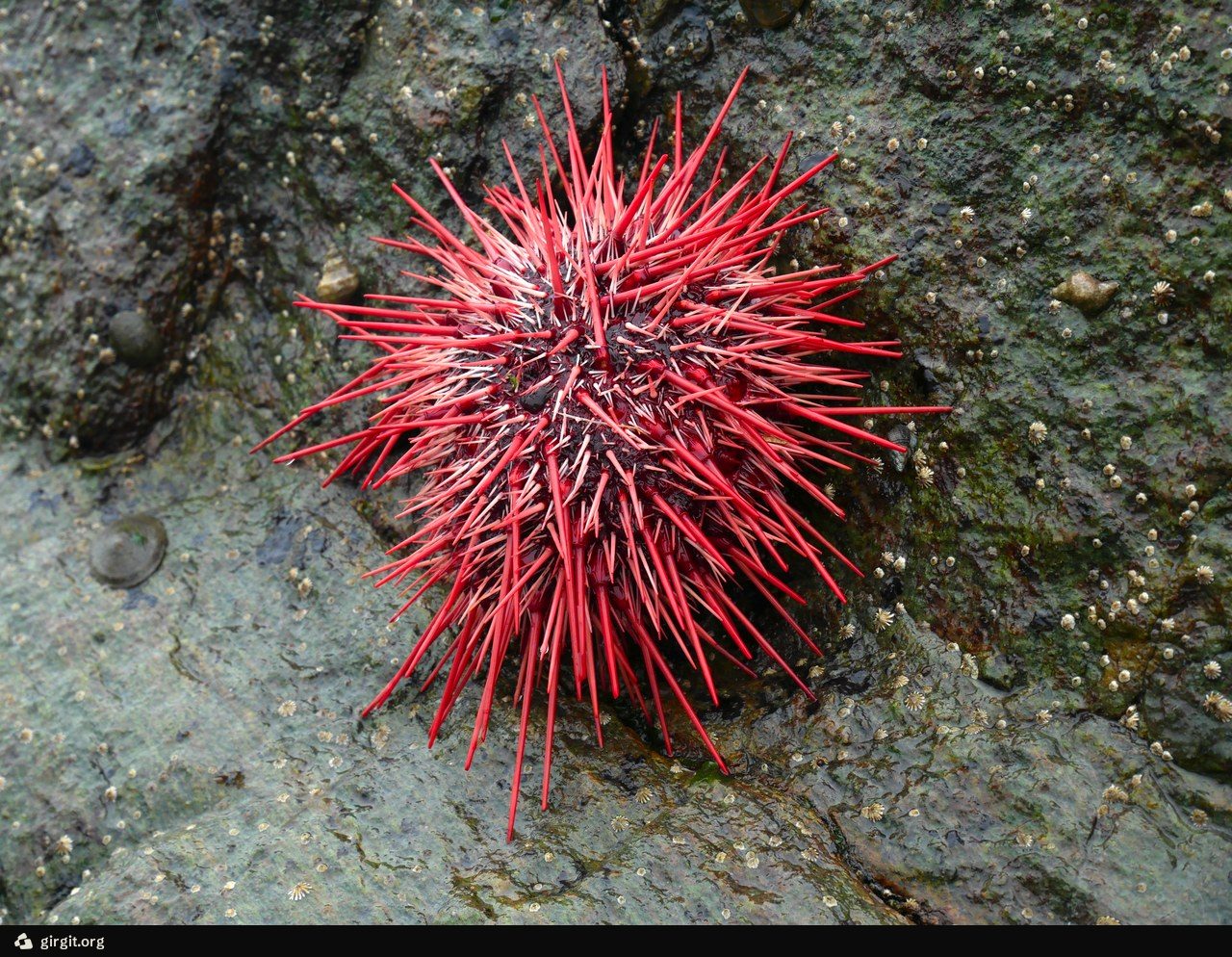
- Echinoderms (starfish) are the classic trap: the adult is radial, but the larva is bilateral. They are counted as radial in tables, and the textbook's chart puts them among bilateral coelomates with a star noting this.
- Hemichordates are bilateral, not radial.
Diploblastic and triploblastic
An early embryo is made of sheets of cells, the germ layers (also called germinal or embryonic layers). Every tissue of the adult grows from one of them.
- Diploblastic animals have two germ layers: an outer ectoderm and an inner endoderm. Between them sits a jelly-like layer with no proper cells organised in it, the mesoglea (it is undifferentiated: not turned into any tissue). Example: coelenterates (and ctenophores).
- Triploblastic animals have a third germ layer, the mesoderm, between ectoderm and endoderm. All animals from Platyhelminthes to Chordates are triploblastic.
Mesoderm matters because it builds muscles and lines the body cavity. Without it, there can be no true coelom.
Three real cross-sections, cut through the middle of the body, show the three answers. Find the gut in each, then look at what lies between the gut and the skin.
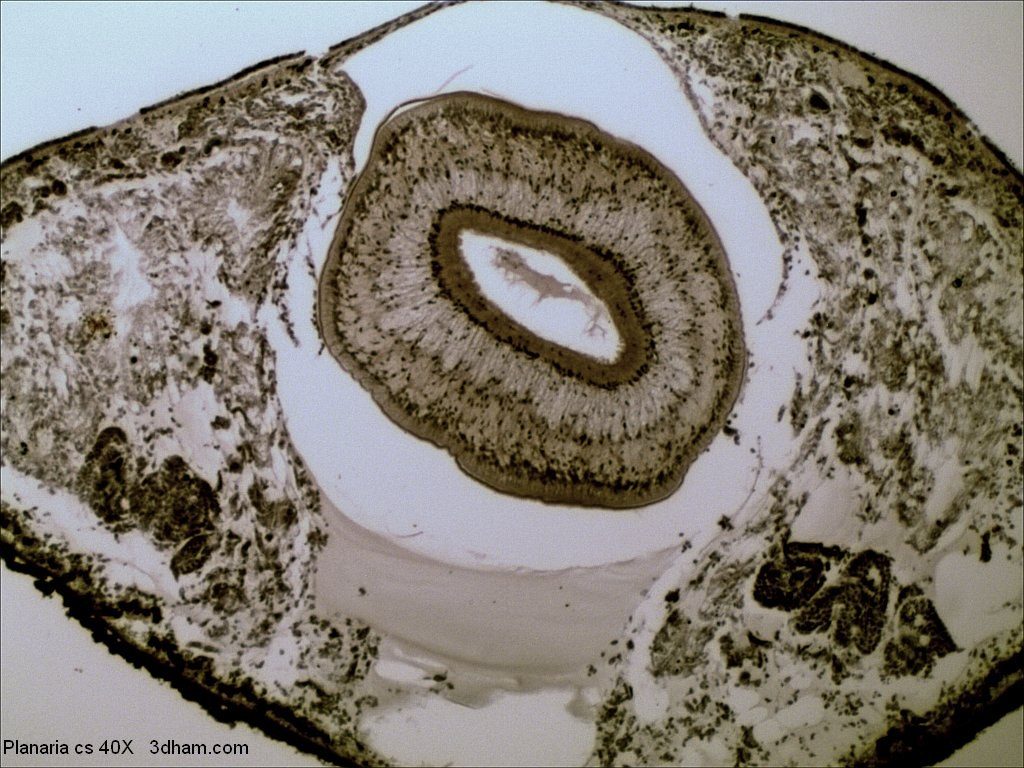 pharynxpharynx pouch (part of the gut)packed tissue, no cavity
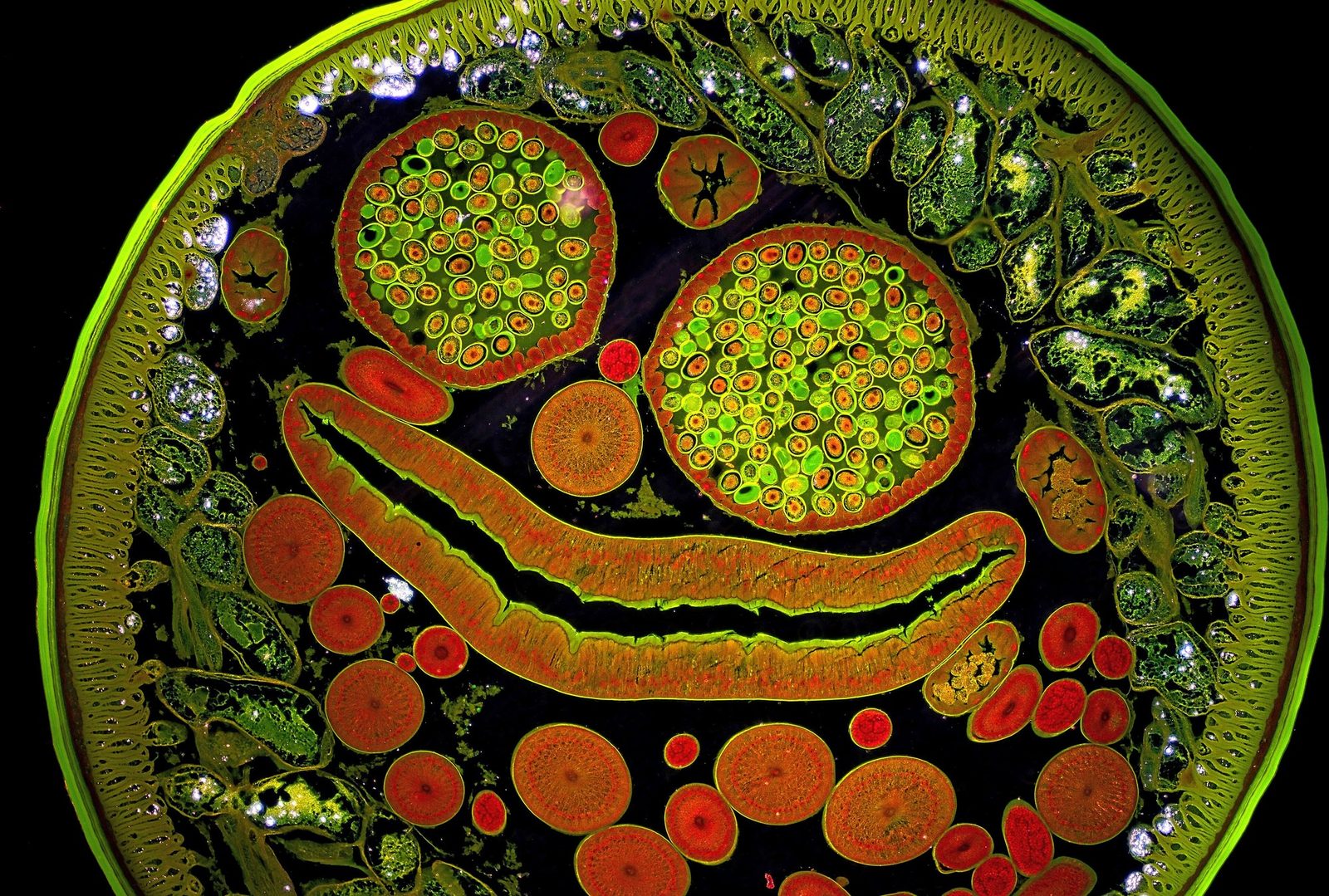 pseudocoelom (open space)gutegg tubesbody wall
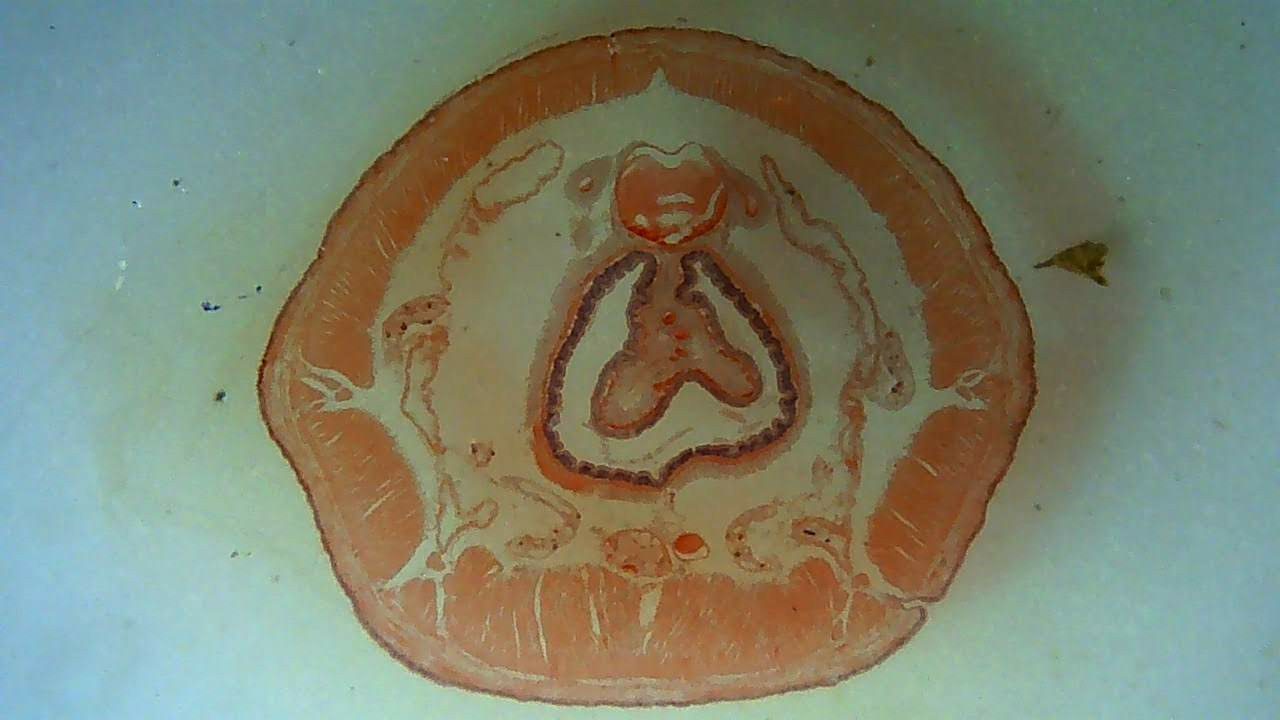 coelomgutbody wall muscles
The coelom
Is there a cavity between the body wall and the gut wall? And if so, what lines it? This is one of the most important questions in animal classification.
| Type | The body cavity | Examples |
|---|---|---|
| Coelomate | A true cavity, the coelom, fully lined by mesoderm on both sides (body wall side and gut side). | Annelids, molluscs, arthropods, echinoderms, hemichordates, chordates |
| Pseudocoelomate | A cavity is present, but not lined by mesoderm. The mesoderm lies as scattered pouches between ectoderm and endoderm. The cavity is a pseudocoelom ("false coelom"). | Aschelminthes (roundworms) |
| Acoelomate | No body cavity. The space is filled in. | Platyhelminthes (flatworms) |
Try it: build each body plan yourself.
A fluid-filled coelom gives the gut room to move and grow, cushions the organs, and lets muscles of the body wall work separately from the gut.
Sponges, cnidarians and ctenophores have no coelom either; the textbook's chart lists them as acoelomate too, but the word is used mainly for flatworms, the first triploblastic animals without one.
Don't mix these up
- Pseudocoelom: roundworms (Aschelminthes). No coelom: flatworms (Platyhelminthes). Flat worms are filled in; round worms have room, but it is a false room.
- Mesoderm on the body wall side only, none on the gut side? Not a true coelom: that pattern fits a pseudocoelom.
- The spongocoel of a sponge is not a coelom at all: it is the central water cavity.
Sort the phyla by body cavity.
Not in the current textbook, but NEET has used it as an option: a true coelom that forms by the splitting of the mesoderm is a schizocoelom (as in annelids, arthropods and molluscs). It is still a true coelom, lined by mesoderm on both sides.
Just remember
The reasons for symmetry and layers are in the deep dive below. What you simply have to learn is who goes where:
- Radial: cnidarians, ctenophores, adult echinoderms
- Things that look the same from every side of a plate: the jellyfish, the comb jelly, the starfish. Everything else that moves head-first is bilateral.
- Diploblastic: cnidarians and ctenophores only
- The two "jellies" have two layers and jelly (mesoglea) in between: "two jellies, two layers".
- Acoelomate: flatworms. Pseudocoelomate: roundworms. Coelomate: annelids onwards
- Flat is Filled. Round has a Room, but a false one. Annelids and all after have the real thing.
- Radial symmetry
- Any cut through the centre gives two matching halves.
- Bilateral symmetry
- Only one cut gives matching left and right halves.
- Diploblastic
- Two germ layers, ectoderm and endoderm, with mesoglea between.
- Triploblastic
- Three germ layers: ectoderm, mesoderm, endoderm.
- Coelom
- A body cavity fully lined by mesoderm.
- Pseudocoelom
- A body cavity without a mesoderm lining.
- Acoelomate
- With no body cavity.
Words to know
Which statement about a starfish is correct?
- Both the adult and the larva are radially symmetrical
- The adult is radial but the larva is bilateral
- The adult is bilateral but the larva is radial
- It is asymmetrical
The mesoglea of a Hydra is
- its third germ layer
- an undifferentiated layer between ectoderm and endoderm
- its coelom
Which pairing is correct?
- Porifera: pseudocoelomate
- Platyhelminthes: pseudocoelomate
- Aschelminthes: pseudocoelomate
- Annelida: acoelomate
Deep dive · optional
Why come in layers, halves and cavities?
Symmetry, germ layers and the coelom look like three unrelated facts to learn. They are one story: how a ball of cells folds itself into a body that can move. None of this is in the exam, but it makes the three tables obvious.
The roots
Symmetry follows lifestyle.
- Why are jellyfish and sea anemones radial?Because they meet the world from every side. A drifting jellyfish or an anemone stuck to a rock can be touched by food or danger from any direction, so a body that is the same all round, with tentacles all round, works best.
- Why are animals that crawl or swim bilateral?Because moving in one direction makes one end special. The end that goes first meets food and danger first, so that is where mouth, eyes and the main nerve centres gather: a head. Then top and bottom differ too (one faces the ground), and only left and right are left to match.
- Why do left and right still match?Because a moving animal must steer straight. Fins, legs or muscles that pull equally on both sides keep it on course; a lopsided swimmer goes round in circles.
- Then why is an adult starfish radial?Because its larva is a bilateral swimmer, but the adult settled down to a slow life on the sea floor, eating whatever it crawls over from any side. It went back to a radial plan on top of a bilateral ancestry. That is why its larva gives it away.
Layers and the coelom follow from how embryos fold. Every animal embryo starts as a ball of cells. In gastrulation one side folds in, like poking a finger into a soft ball: the outer layer is the ectoderm, the folded-in layer the endoderm, and the pocket it lines is the first gut. Cnidarians stop there, with jelly between the two layers. In triploblastic animals cells move into the gap and form a third layer, the mesoderm. Mesoderm makes muscle, and muscle needs something to push against. A fluid-filled space lined by mesoderm, the coelom, is exactly that: a water-filled bag that works as a skeleton (the earthworm's hydrostatic skeleton) and lets the gut move separately from the body wall. Flatworms fill the gap with packed cells instead, which is why they are flat and slow; roundworms keep a fluid space, but it is the old gap left over, not lined by mesoderm.
The genes behind the plan are the same across animals. A family of genes called Hox genes gives each part of the head-to-tail axis its identity, in the same order along the chromosome as along the body. Bilateral animals from flies to people share them, which is one more sign that all bilateral animals come from one bilateral ancestor.
The story
See it
Symmetry you can check at the beach: an adult urchin is round like a wheel, but the starfish larva below, a speck smaller than a grain of sand, has a left and a right.
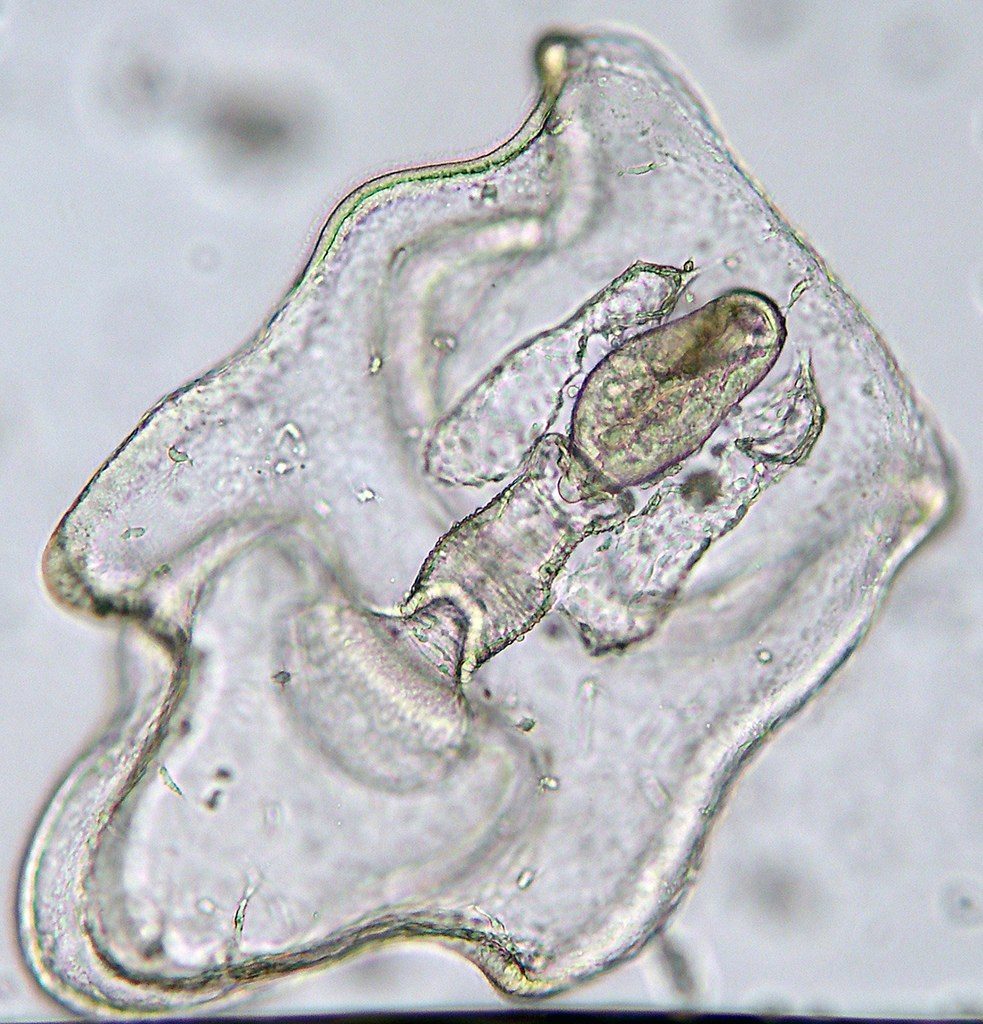 stomach
Solve it
Solve it
A sea creature is found that is radially symmetrical as an adult and has three germ layers and a true coelom. Its larva has not been seen. Which phylum is your best guess, and what do you predict about the larva?
Answer
Solve it
An earthworm with a punctured body wall leaks coelomic fluid. Predict what happens to its crawling, and explain from the roots above.
Answer
Which statement about the pseudocoelom is correct?
- It is not a body cavity at all
- It is a fluid-filled space not lined by mesoderm on the gut side
- It is found in flatworms
Connect it
Connect it
- Echinoderm larvae, concept 7. The bilateral larva of the starfish, and the first-opening-becomes-anus rule it shares with you.
- The earthworm, Ch 7. Its coelom and muscles in detail: the earthworm.
- Tissues from layers, Ch 7. Epithelium, muscle, nerve and connective tissue come from these three layers: how a body shares work.
- Your own gastrulation, Class 12. The human embryo forms the same three layers: cleavage and implantation.
Still confused?
Is mesoglea a germ layer?
No. It is a jelly between the two real layers, with few cells and no organs. That is why cnidarians are called diploblastic, not triploblastic.
Humans are not perfectly symmetrical: the heart is on the left. Are we bilateral?
Yes. Symmetry describes the body plan, the outside and the layout of the embryo. Some inner organs shift sides later (heart, liver, the coils of the gut), but the plan, with one left-right mirror plane, is bilateral.
Sources
- Embryo Project Encyclopedia (Arizona State University): Germ layers
- Hopwood (2022), The keywords "gastrulation" and Wolpert's line, British Journal for the History of Science
- Nobel Prize in Physiology or Medicine 1995: genetic control of early embryonic development
- Life: The Science of Biology, protostomes and deuterostomes
Picture and video credits
Show 5 picture and video credits
- damselfly-bilateral.jpg: Charles J. Sharp, CC BY-SA 4.0
- planarian-cross-section.jpg: John Alan Elson, CC BY-SA 4.0
- ascaris-cross-section.jpg: Massimo brizzi, CC BY-SA 4.0
- earthworm-cross-section.jpg: The Other 95%, CC BY-SA 4.0
- bipinnaria-larva.jpg: Bruno Vellutini from São Paulo/São Sebastião, Brasil, CC BY-SA 2.0


