- 1. How do we sort animals?
- 2. Symmetry, germ layers and the coelom
- 3. Segments, the notochord, and the map of all phyla
- 4. Sponges, cnidarians and comb jellies
- 5. Flatworms, roundworms and segmented worms
- 6. Arthropods and molluscs: the two biggest phyla
- 7. Echinoderms and hemichordates
- 8. What makes a chordate?
- 9. Jawless vertebrates and fishes
- 10. Amphibians and reptiles
- 11. Birds and mammals
- Review
8 of 11·NCERT §4.2.11·pp. 45–47·5 min
What makes a chordate?
The big ideaChordates are the animals that, at some stage, have a notochord, a hollow nerve cord along the back and gill slits in the throat; vertebrates are the chordates whose notochord is replaced by a backbone.
In simple words
You, a fish, a frog and a parrot all belong to one big family. At the start of life, every member grows a stiff rod down its back, a nerve tube just above it, and slits in its throat. In most of the family, a backbone of small bones later takes the place of the rod. A few sea animals in the family keep the rod and never grow a backbone.
The chordate features
Members of phylum Chordata are defined by three things:
- a notochord;
- a dorsal hollow nerve cord (a tube-like nerve cord on the back side);
- paired pharyngeal gill slits (openings in the throat).
They are also bilateral, triploblastic, coelomate, with an organ system level of organisation, a post-anal tail (a part of the body that goes on past the anus) and a closed circulatory system.
Chordates versus non-chordates
| Feature | Chordates | Non-chordates |
|---|---|---|
| Notochord | Present | Absent |
| Central nervous system | Dorsal, hollow and single | Ventral, solid and double |
| Pharynx | Perforated by gill slits | No gill slits |
| Heart | Ventral | Dorsal (if there is one) |
| Post-anal tail | Present | Absent |
A handy way to remember: the two groups are mirror images. Whatever is on the back in one is on the belly in the other. Think of an earthworm's double ventral nerve cord from concept 5, and compare it with your spinal cord running down your back.
Try it: turn an earthworm over and compare it with a fish.
Three subphyla
| Subphylum | Notochord | Examples |
|---|---|---|
| Urochordata (Tunicata) | Only in the larval tail | Ascidia, Salpa, Doliolum |
| Cephalochordata | From head to tail, kept throughout life | Branchiostoma (Amphioxus or lancelet) |
| Vertebrata | Only in the embryo; replaced by a vertebral column | Fish, frogs, reptiles, birds, mammals |
Urochordates and cephalochordates together are called protochordates. They are exclusively marine. The names help: uro = tail (notochord only in the tail), cephalo = head (notochord reaches right into the head).
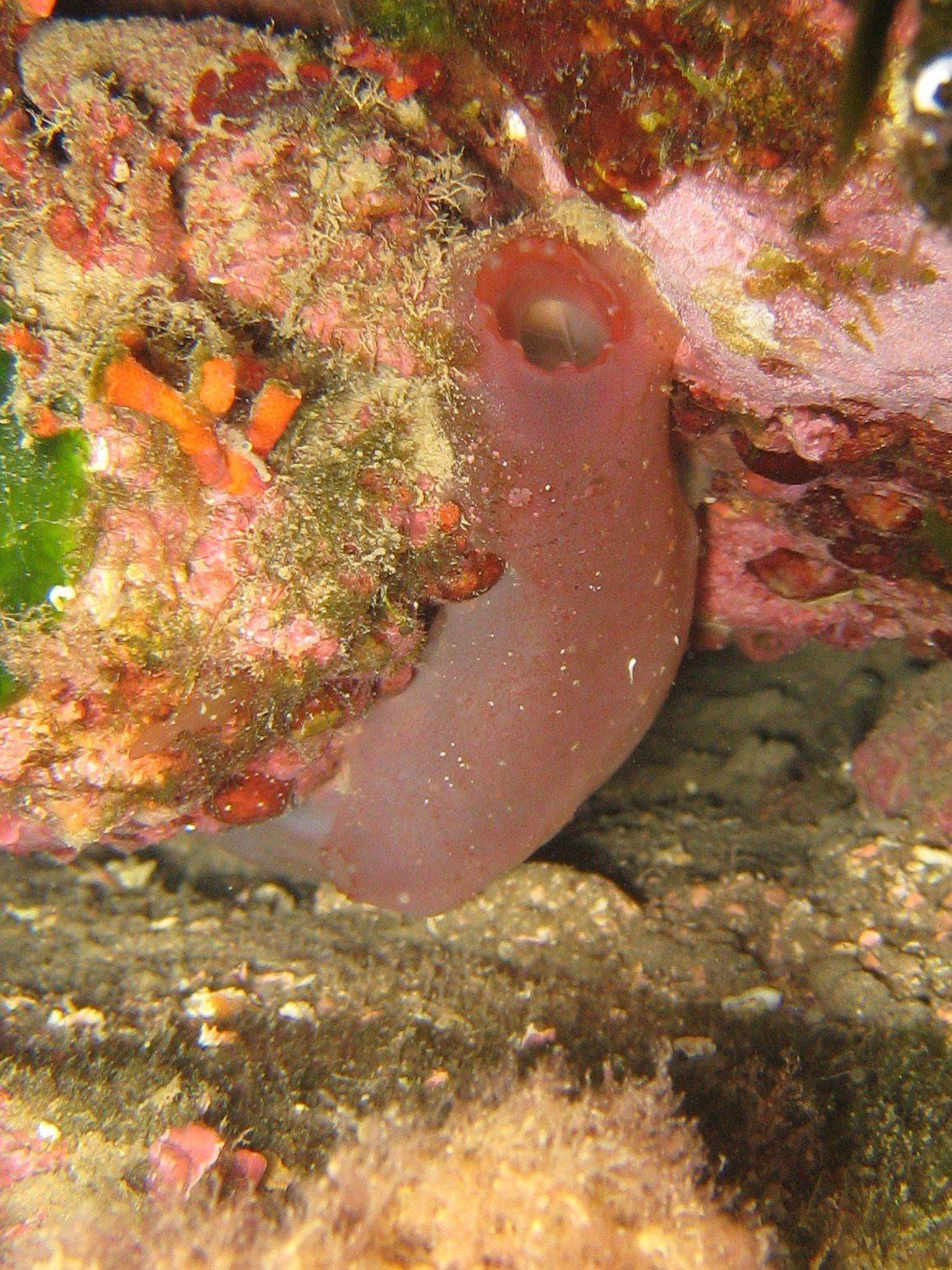 siphon
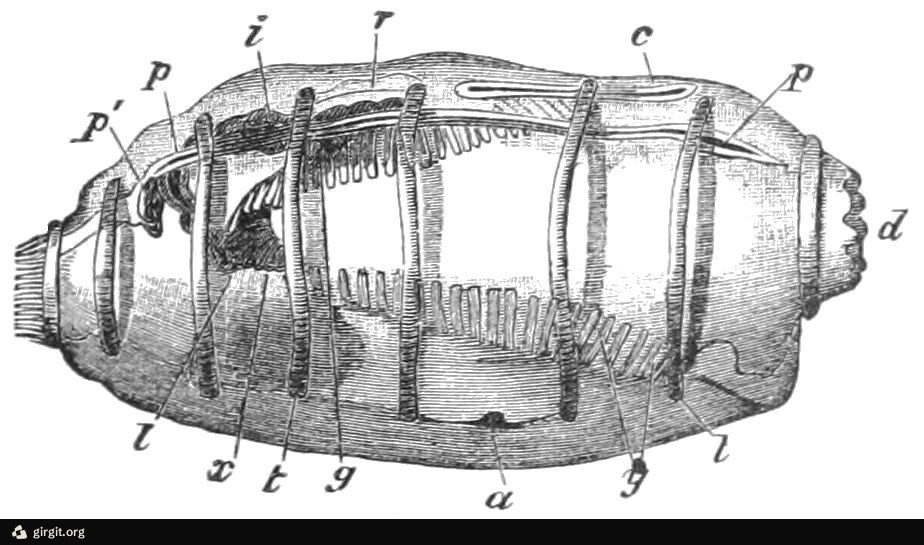
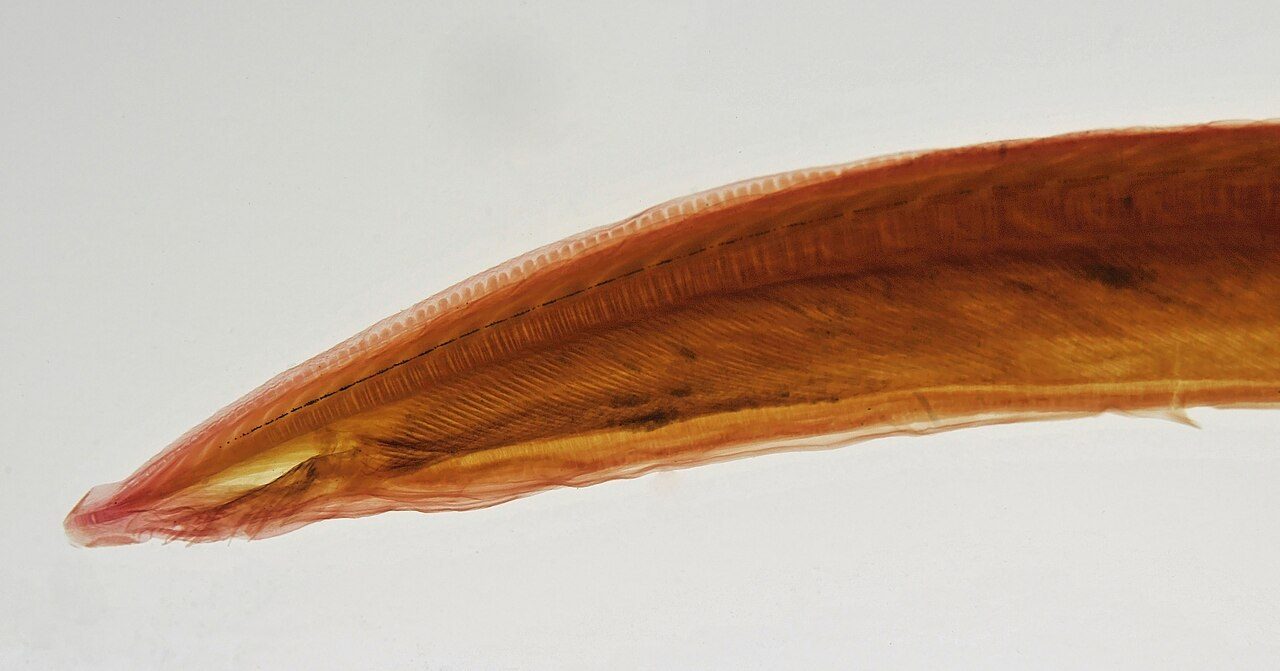 front endV-shaped muscle blocks
Vertebrates
In vertebrates, the embryo's notochord is replaced in the adult by a vertebral column (backbone) of cartilage or bone. So:
All vertebrates are chordates, but not all chordates are vertebrates.
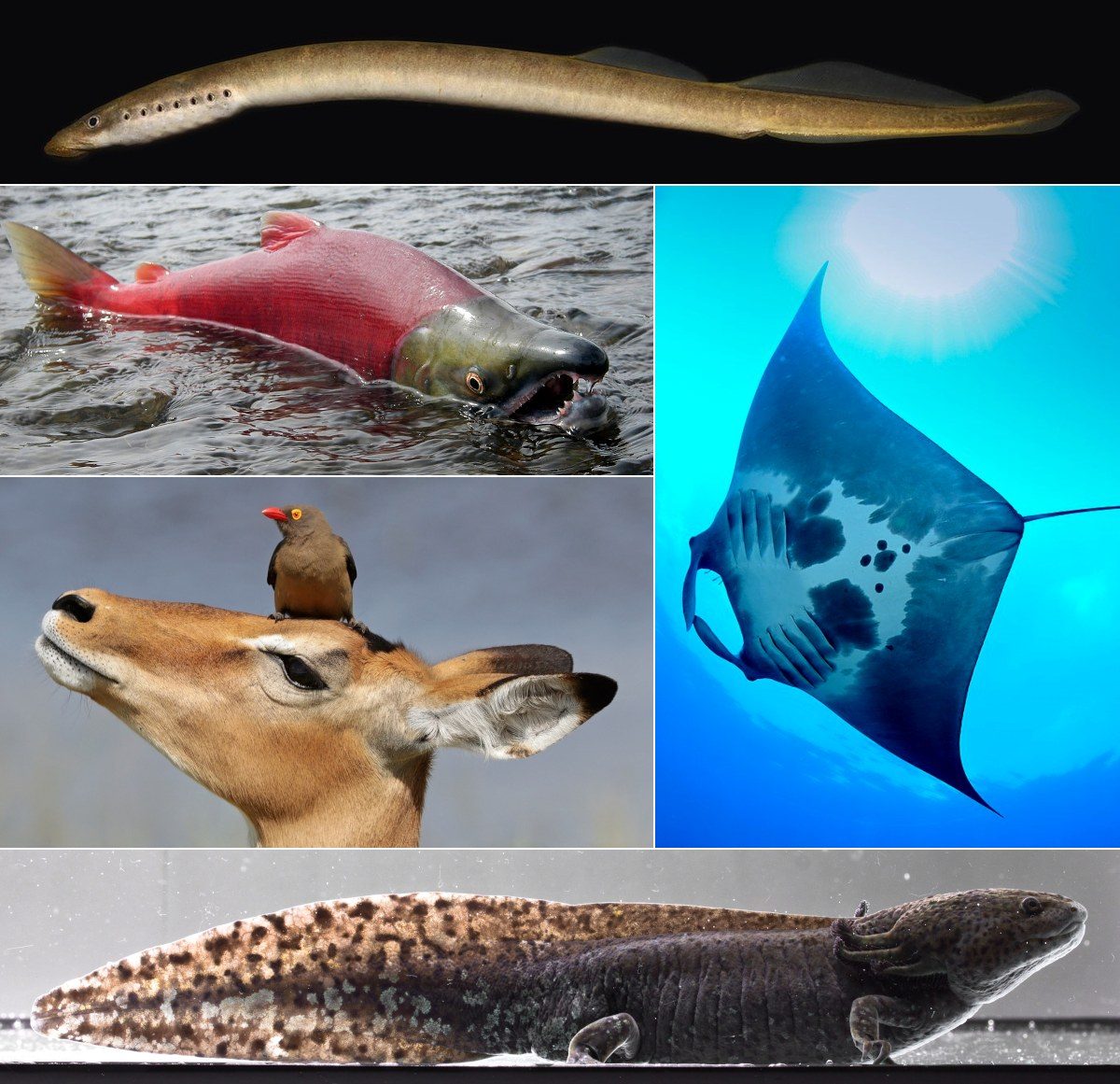 lamprey: jawlessbony fishray: cartilagebirdmammalamphibian
Besides the chordate features, vertebrates have:
- a muscular heart on the ventral side, with 2, 3 or 4 chambers depending on the class;
- kidneys, which remove waste and balance water and salts;
- paired appendages: fins or limbs.
How vertebrates are divided
- Division Agnatha: no jaws.
- Class Cyclostomata (lampreys, hagfish)
- Division Gnathostomata: with jaws.
- Super class Pisces (bear fins): Class Chondrichthyes, Class Osteichthyes.
- Super class Tetrapoda (bear limbs): Class Amphibia, Reptilia, Aves, Mammalia.
Gnathos means jaw, so "a-gnatha" is jawless and "gnatho-stomata" is jaw-mouthed. "Tetrapoda" means four-footed, even though snakes and some amphibians have lost their legs.
Don't mix these up
- Chordate nerve cord: dorsal, hollow, single. Non-chordate: ventral, solid, double.
- Chordate heart is ventral; non-chordate heart is dorsal. Easy to swap under pressure.
- Chordates are coelomate, not pseudocoelomate, and have a closed circulation.
- Lifelong notochord: Cephalochordata. Larval tail only: Urochordata.
Just remember
The subphyla, their examples and the vertebrate divisions are a list. Hooks from the names:
- Urochordata: Ascidia, Salpa, Doliolum
- Uro = tail: notochord only in the larval tail. Ascidia comes from the Greek for a wineskin bag, which is what an adult sea squirt looks like. Dolium is Latin for a big jar: Doliolum is the little barrel.
- Cephalochordata: Branchiostoma (Amphioxus)
- Cephalo = head: notochord right into the head, for life. Branchio-stoma = gill + mouth. Amphi-oxus = sharp at both ends, like a lancet.
- Agnatha (no jaws): Cyclostomata. Gnathostomata (jaws): Pisces (fins) and Tetrapoda (limbs)
- A-gnatha, no jaw; gnatho-stomata, jaw-mouths. Tetra-poda, four feet.
- Dorsal hollow nerve cord
- A tube of nerve tissue along the back.
- Pharyngeal gill slits
- Paired openings in the wall of the throat.
- Post-anal tail
- The part of the body that continues past the anus.
- Protochordates
- Urochordates and cephalochordates: chordates without a backbone.
- Vertebral column
- The backbone, of cartilage or bone, that replaces the notochord.
- Agnatha, Gnathostomata
- Jawless and jawed vertebrates.
- Tetrapoda
- Vertebrates with limbs: amphibians, reptiles, birds, mammals.
Words to know
Which feature belongs to a non-chordate?
- A dorsal hollow nerve cord
- A dorsal heart
- A pharynx with gill slits
- A post-anal tail
In which animal does the notochord run from head to tail and last all its life?
- Ascidia
- Branchiostoma
- Rana
- Balanoglossus
Why is it true that not all chordates are vertebrates?
- Some chordates never have a notochord
- Protochordates have a notochord but never a vertebral column
- Hemichordates are chordates without a backbone
Deep dive · optional
Why a rod, a tube, slits and a tail?
What the four chordate features were for in the first chordates, what became of them in you, and a fossil worm that turned out to be a distant relative. Not in the exam, but it makes the definition make sense.
The roots
- Why slits in the throat?For eating, first. A lancelet or a sea squirt draws water in through its mouth and lets it out through the slits in its pharynx; food particles stick to mucus on the way and are swallowed. The slits are a sieve. In fishes the same slits carry the gills, so they became breathing organs; in you they became parts of the ear and throat (see the jaws widget in concept 9).
- Why a stiff rod along the back?For swimming. Blocks of muscle on the left and right pull against the notochord, which cannot shorten, so the body bends side to side instead (concept 3).
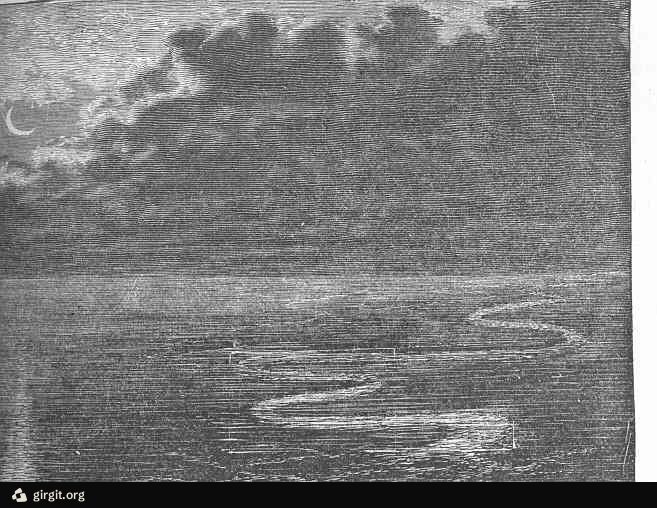
- Why a tail past the anus?Because the swimming muscle and the rod run on past the end of the gut. A tail that is all muscle and no gut is a better paddle. The tadpole larva of a sea squirt is exactly this: a swimming tail with a body on the front.
- Why is the nerve cord hollow?Because of how it forms: a strip of ectoderm along the back of the embryo rolls up into a tube, the neural tube. The hollow is the inside of the tube. In you it is still there, as the fluid-filled spaces of the brain and the thin canal down the middle of the spinal cord.
- Why replace the rod with a backbone?Because bigger, more active animals needed stronger support, anchors for bigger muscles, and armour for the nerve cord. A column of vertebrae, built in pieces, gives all three and can still bend.
So the four features are the kit of a small swimming filter-feeder. The lancelet keeps the whole kit for life; the sea squirt keeps only the sieve; a vertebrate rebuilds the kit into something bigger. The widget follows all three through a lifetime.
The story
See it
The three subphyla side by side: a sea squirt and a salp chain (urochordates), the lancelet (cephalochordate), and the vertebrates, all on this page. The Pikaia fossil and a modern reconstruction are above.
Solve it
Solve it
A tiny sea animal has a pharynx with slits, a notochord in its tail and a hollow nerve cord, and swims. Two weeks later it has settled on a rock, lost its tail and is pumping water through its slits. Name the subphylum, and say which features it kept.
Answer
Solve it
Spot the error: "All chordates have a backbone, and all animals with gill slits are chordates."
Answer
In an adult human, which chordate feature is still present in its original form?
- The notochord
- The dorsal hollow nerve cord
- Open gill slits
Connect it
Connect it
- Your spinal cord, Ch 18. The dorsal hollow nerve cord, grown up: the human neural system.
- Your backbone, Ch 17. What replaced the notochord: the axial skeleton.
- Jaws from slits, concept 9. What the pharyngeal arches became: jawless vertebrates and fishes.
- Evolution, Class 12. Embryos as evidence: evidences for evolution.
Still confused?
Did human embryos really have gill slits?
Not working gills. Around the fourth week the human embryo has pharyngeal arches with pouches inside and grooves outside, the same plan as the gill region of a fish embryo, but they never open through. They go on to form the jaw, the ear bones, the tonsils, the thymus and parts of the throat. Textbooks call them "gill slits" because of the shared plan.
Why is the heart ventral in chordates but dorsal in non-chordates?
It is a pattern, not a rule you can derive: in chordates the main pump lies below the gut, in annelids and arthropods the main pumping vessel or heart lies above it. Learn it with the "mirror image" picture: whatever is on the back in one group is on the belly in the other.
Picture and video credits
Show 4 picture and video credits
- ascidia-sea-squirt.jpg: Matthieu Sontag, CC BY-SA 3.0
- lancelet-branchiostoma.jpg: Parent Géry, CC BY-SA 3.0
- vertebrates-collage.jpg: Charles J. Sharp and others (Wikimedia Commons collage), CC BY-SA 4.0
- pikaia-reconstruction.jpg: Giovanni Mussini, M. Paul Smith, Jakob Vinther, Imran A. Rahman, Duncan J.E. Murdock, David A.T. Harper, Frances S. Dunn, CC BY 4.0


