- 1. How do we sort animals?
- 2. Symmetry, germ layers and the coelom
- 3. Segments, the notochord, and the map of all phyla
- 4. Sponges, cnidarians and comb jellies
- 5. Flatworms, roundworms and segmented worms
- 6. Arthropods and molluscs: the two biggest phyla
- 7. Echinoderms and hemichordates
- 8. What makes a chordate?
- 9. Jawless vertebrates and fishes
- 10. Amphibians and reptiles
- 11. Birds and mammals
- Review
7 of 11·NCERT §4.2.9 · §4.2.10·p. 45·5 min
Echinoderms and hemichordates
The big ideaEchinoderms are spiny-skinned sea animals that move with a system of water-filled tubes; hemichordates are small sea worms that share gill slits with us but have no true notochord.
In simple words
A starfish has no head and no brain in the middle, but it can walk. Under each arm are hundreds of tiny tube feet pumped full of sea water, like a row of little water balloons that stretch and grip. The acorn worm is a soft sea worm that digs in sand. It has slits in its throat like a fish, which makes it a far-off cousin of animals with backbones.
Phylum Echinodermata
"Echinoderm" means spiny-skinned. These animals have an endoskeleton (an inner skeleton) of calcareous ossicles: small chalky plates, often with spines poking out through the skin.
- All marine. Organ system level, triploblastic, coelomate.
- Adults are radial, but the larvae are bilateral.
- Complete gut, with the mouth on the lower (ventral) side and the anus on the upper (dorsal) side.
- Most distinctive feature: the water vascular system. It has three jobs: moving the animal (locomotion), catching food and carrying it to the mouth, and breathing (respiration).
- No excretory system.
- Sexes separate. Reproduction sexual. Fertilisation usually external. Development indirect, with a free-swimming larva.
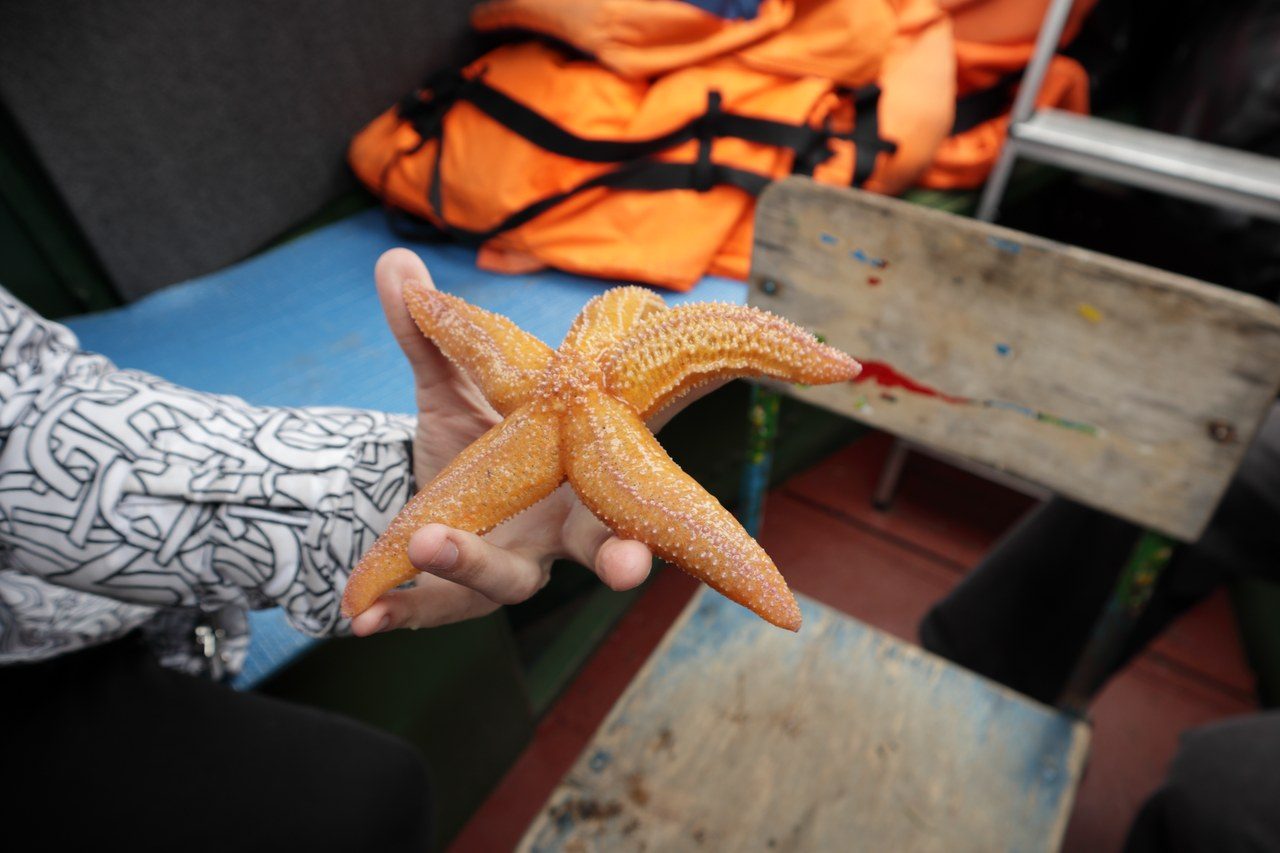 one of five arms
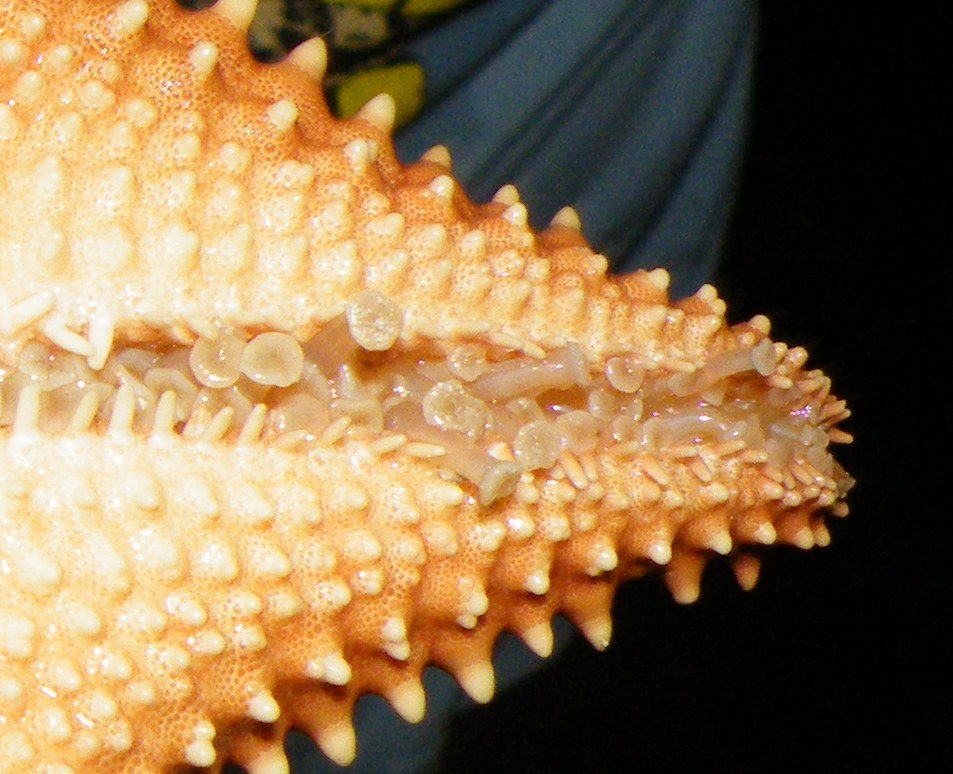 tube feet with suckersspines
Try it: squeeze the bulb above a tube foot and see how far the foot goes.
Examples:
| Genus | Common name |
|---|---|
| Asterias | Starfish |
| Echinus | Sea urchin |
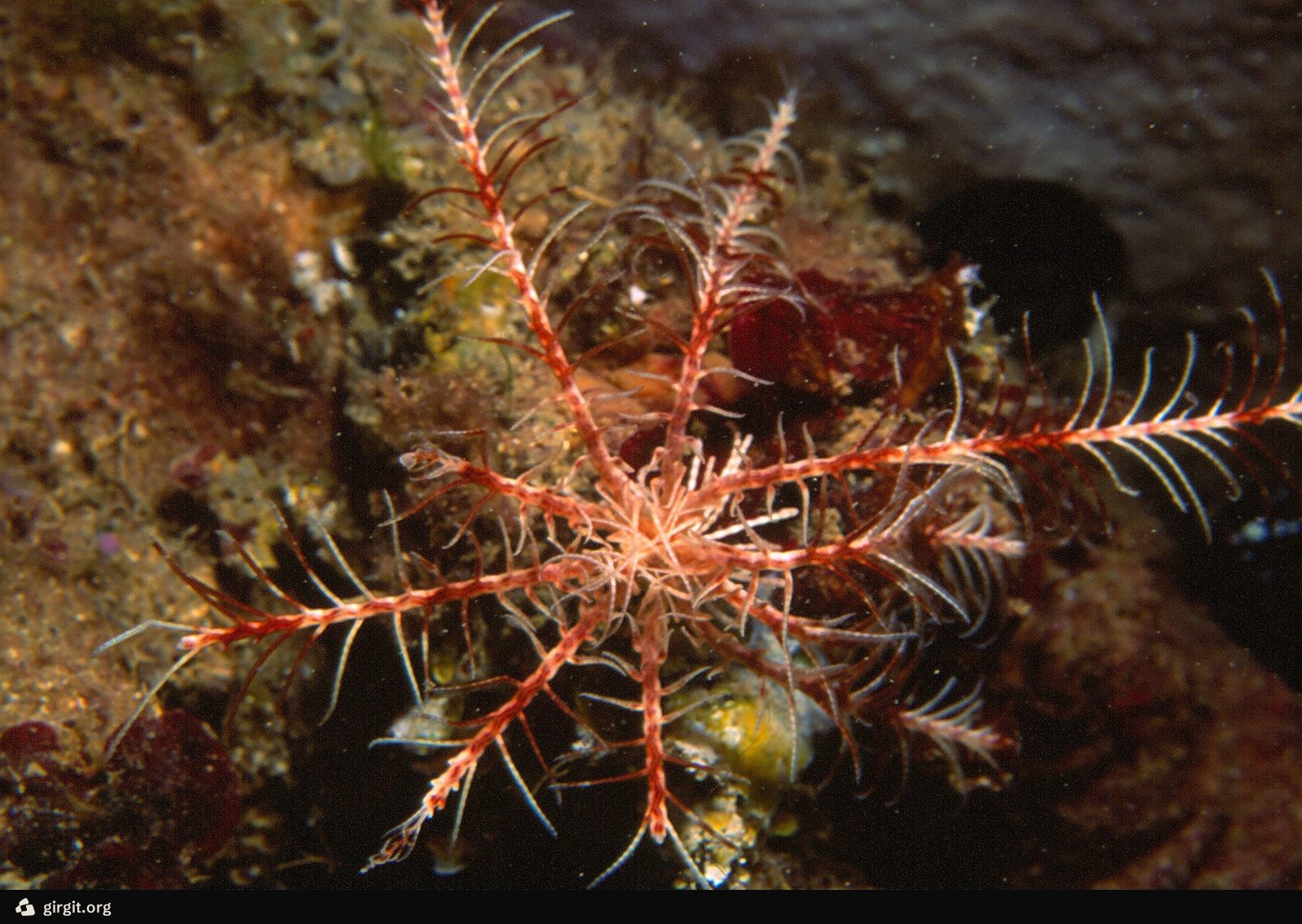
| Antedon | Sea lily |
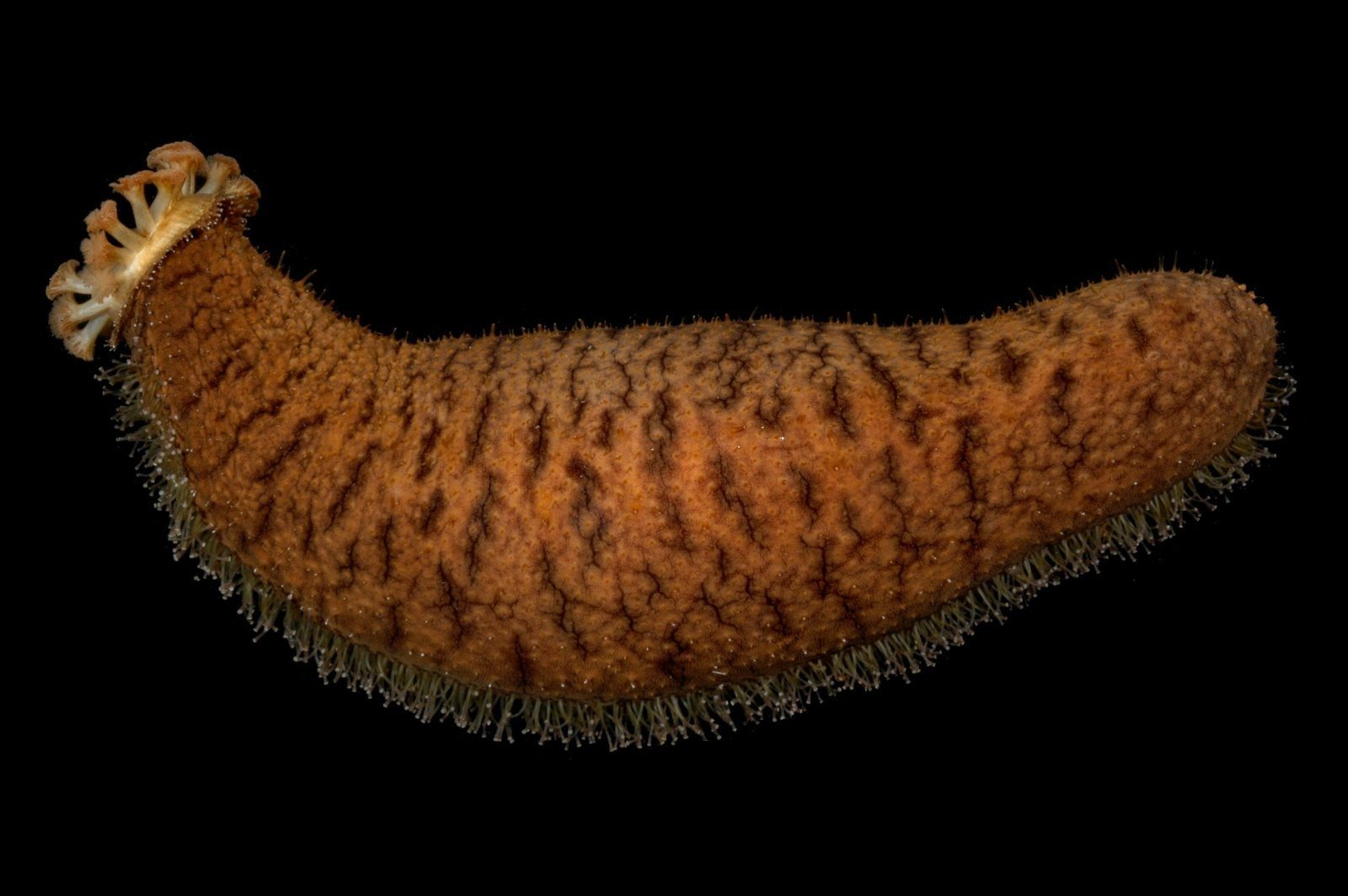
| Cucumaria | Sea cucumber |
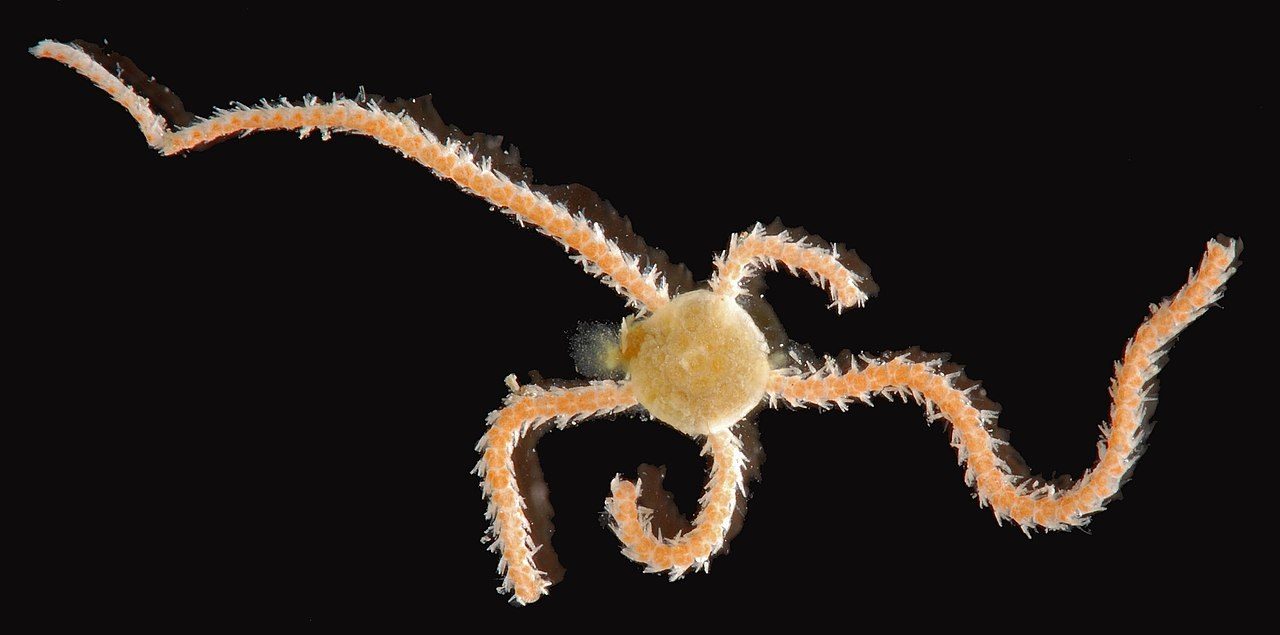
| Ophiura | Brittle star |
Starfish, sea lily and sea cucumber are no more fish, lilies or cucumbers than a seahorse is a horse.
Phylum Hemichordata
Hemichordata was once treated as a sub-phylum of Chordata. It is now a separate phylum, placed with the non-chordates.
Why the confusion? In the collar region they have a small, rudimentary (poorly developed) structure called the stomochord, which looks similar to a notochord but is not one. ("Hemi" means half: half a chordate.)
- Few in number: a handful of sea-dwelling animals shaped like worms.
- Organ system level, bilateral, triploblastic, coelomate.
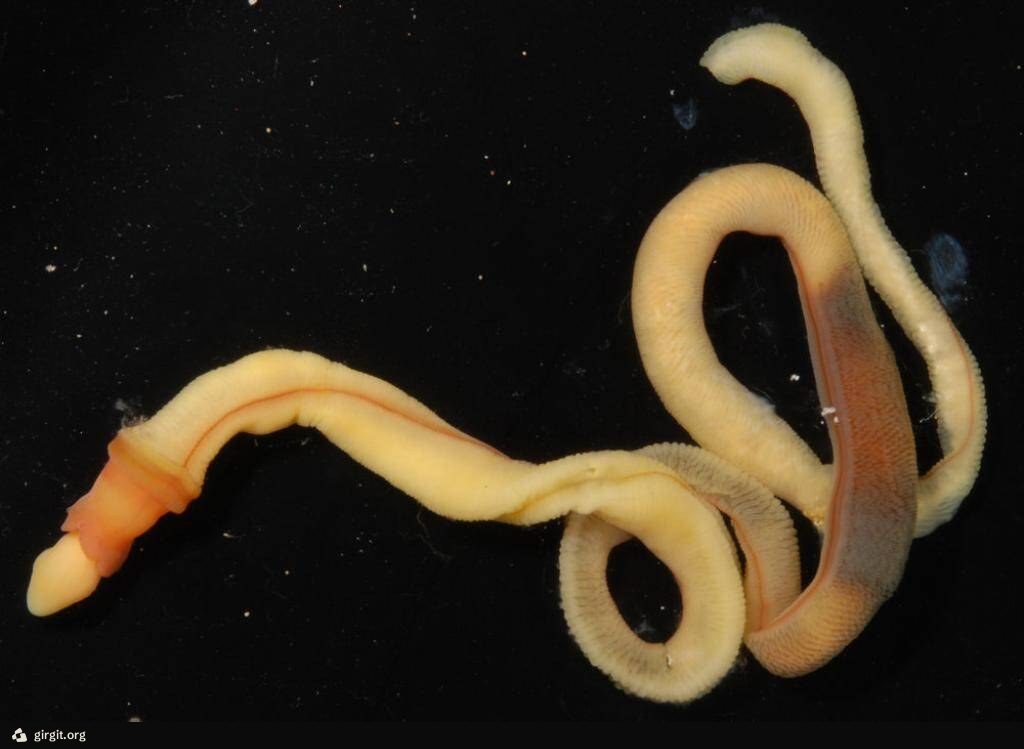
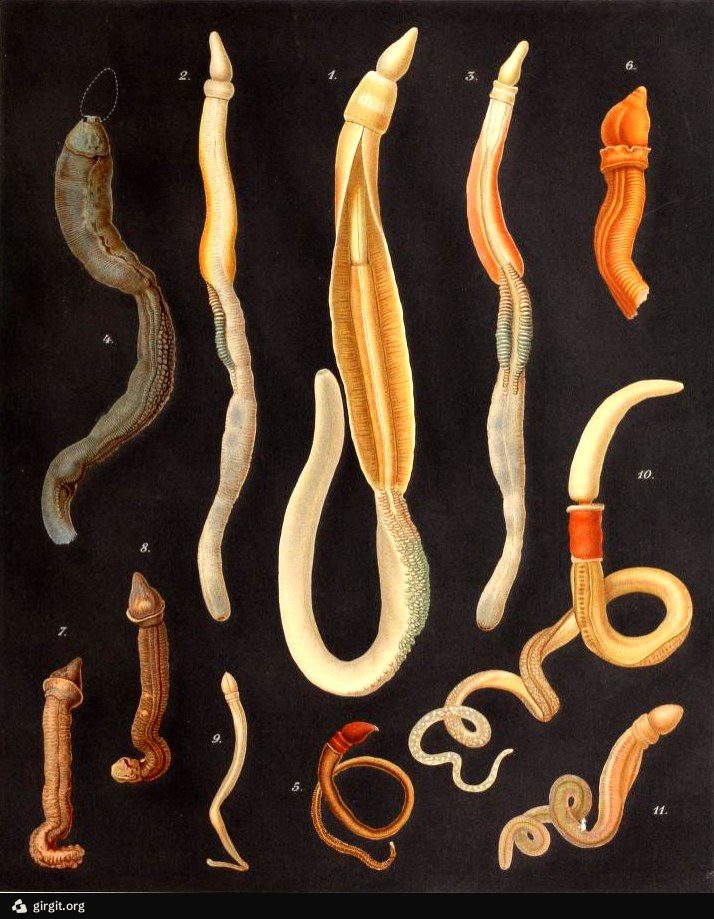
- Body cylindrical, in three parts: from front to back, a proboscis, a collar, and a long trunk.
- Open circulatory system.
- Breathing through gills: like chordates, the pharynx has gill slits.
- Excretory organ: the proboscis gland.
- Sexes separate. Fertilisation external. Development indirect.
Examples: Balanoglossus (the acorn worm) and Saccoglossus.
 probosciscollartrunk
 probosciscollartrunk
Side by side
| Echinodermata | Hemichordata | |
|---|---|---|
| Habitat | All marine | Marine |
| Symmetry | Adult radial, larva bilateral | Bilateral |
| Body | Spiny, endoskeleton of ossicles | Worm-like: proboscis, collar, trunk |
| Hallmark | Water vascular system | Stomochord, gill slits |
| Excretion | No excretory system | Proboscis gland |
| Fertilisation | Usually external | External |
| Remember | Asterias, Echinus, Antedon, Cucumaria, Ophiura | Balanoglossus, Saccoglossus |
Don't mix these up
- The water vascular system does locomotion, food capture and transport, and respiration. Not excretion, not digestion.
- Echinoderms have an endoskeleton (inside); arthropods have an exoskeleton (outside).
- Stomochord is not a notochord. Hemichordates are non-chordates. What they really share with chordates is a pharynx with gill slits.
- Radial symmetry is never found in hemichordates, adult or larva.
Just remember
Five echinoderm genera, two hemichordates, and one list of jobs. Hooks:
- Asterias (starfish), Echinus (sea urchin), Antedon (sea lily), Cucumaria (sea cucumber), Ophiura (brittle star)
- Aster is Greek for star (as in asteroid). Echinos means hedgehog: the spiny urchin, and the root of echino-derm. Cucumaria is the cucumber. Ophi- means snake: the brittle star's snaky arms. That leaves Antedon, the feathery sea lily.
- Water vascular system: locomotion, food capture and transport, respiration
- "Walk, eat, breathe". Never excretion: echinoderms have no excretory system at all.
- Hemichordates: Balanoglossus, Saccoglossus. Excretion by the proboscis gland
- Both end in -glossus, tongue: the proboscis looks like a tongue (and balanos, an acorn, gives the acorn worm its name).
- Ossicles
- Small chalky plates making an echinoderm's skeleton.
- Water vascular system
- Water-filled canals and tube feet of echinoderms.
- Stomochord
- A rudimentary notochord-like rod in a hemichordate's collar.
- Proboscis
- The front, snout-like part of a hemichordate.
- Proboscis gland
- The excretory organ of hemichordates.
- Endoskeleton
- A skeleton inside the body.
Words to know
Which job does the water vascular system of a starfish NOT do?
- Locomotion
- Capture of food
- Respiration
- Excretion
Why is Balanoglossus no longer placed in Chordata?
- It has no gill slits
- Its stomochord is not a true notochord
- It is radially symmetrical
- It has no coelom
In an echinoderm, the mouth is on the
- lower (ventral) side
- upper (dorsal) side
- same opening as the anus
Deep dive · optional
How does a starfish eat a clam, and why is it your cousin?
How water-powered feet open a shell, why a starfish is only almost radial, and how the acorn worm and the starfish ended up on our side of the animal family tree. Beyond the exam, but it ties this page to you.
The roots
- How does a starfish open a clam?It wraps its arms round the two shells, grips each with hundreds of tube feet and pulls. In experiments in 1956, starfish pulled with more than 3 kg of force. The old story is that it pulls for hours until the clam's muscle tires; the same experiments found that wrong: strong, repeated pulls open a gap fairly quickly.
- How wide a gap does it need?Only about 0.1 mm, thinner than a sheet of paper. The starfish then pushes its own stomach out through its mouth and slides it through the gap, and digests the clam inside its own shell.
- How do the tube feet hold on?Not by suction alone. Each foot has two kinds of glue cells that release a sticky protein layer, and a third kind that releases a substance that lets go. Stick, release, stick: the foot can walk on glass, upside down.
- Where does the pulling force come from?From hydraulics. The water vascular system is a closed set of water-filled canals. Squeezing an ampulla pushes water into its tube foot (try it above), and muscles in the foot pull it back. Every foot is a tiny hydraulic machine, and a starfish has hundreds.
Why "cousin"? In echinoderms, hemichordates and chordates, the first opening of the embryo becomes the anus and the mouth forms later (the gastrula widget in concept 2 shows this). Animals that develop this way are called deuterostomes, "second mouth". Most other bilateral animals, from worms to insects and molluscs, do it the other way. So, in the way their embryos are built, starfish and acorn worms are closer to us than an earthworm or an octopus is. The acorn worm adds gill slits like ours. That is why William Bateson, studying Balanoglossus in the 1880s, argued it was related to chordates and coined the name Hemichordata, "half-chordates". Later work showed its stomochord is not a true notochord: the gene that marks a notochord is not switched on in it. So today it is a separate, non-chordate phylum, but a close one.
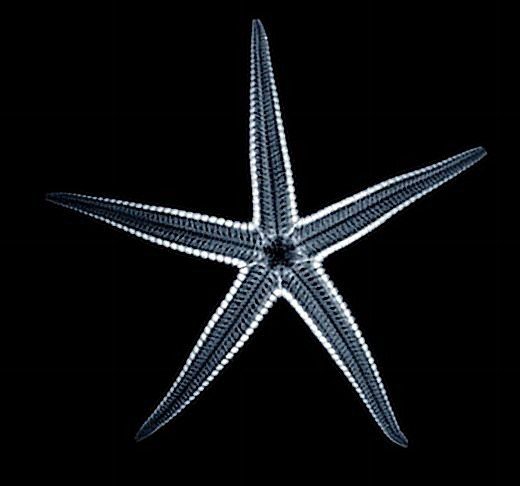
And the starfish's radial plan is only almost perfect. On its upper side, between two of the arms, sits one small sieve plate, the madreporite, where sea water enters the water vascular system. There is only one, so only one mirror line runs through it. Turn the starfish in the widget below and see.
The story
See it
The starfish's inner skeleton in an X-ray: thousands of small chalky ossicles, linked so the arms can bend. And the madreporite, the one sieve plate that breaks its perfect symmetry.
 ossicles
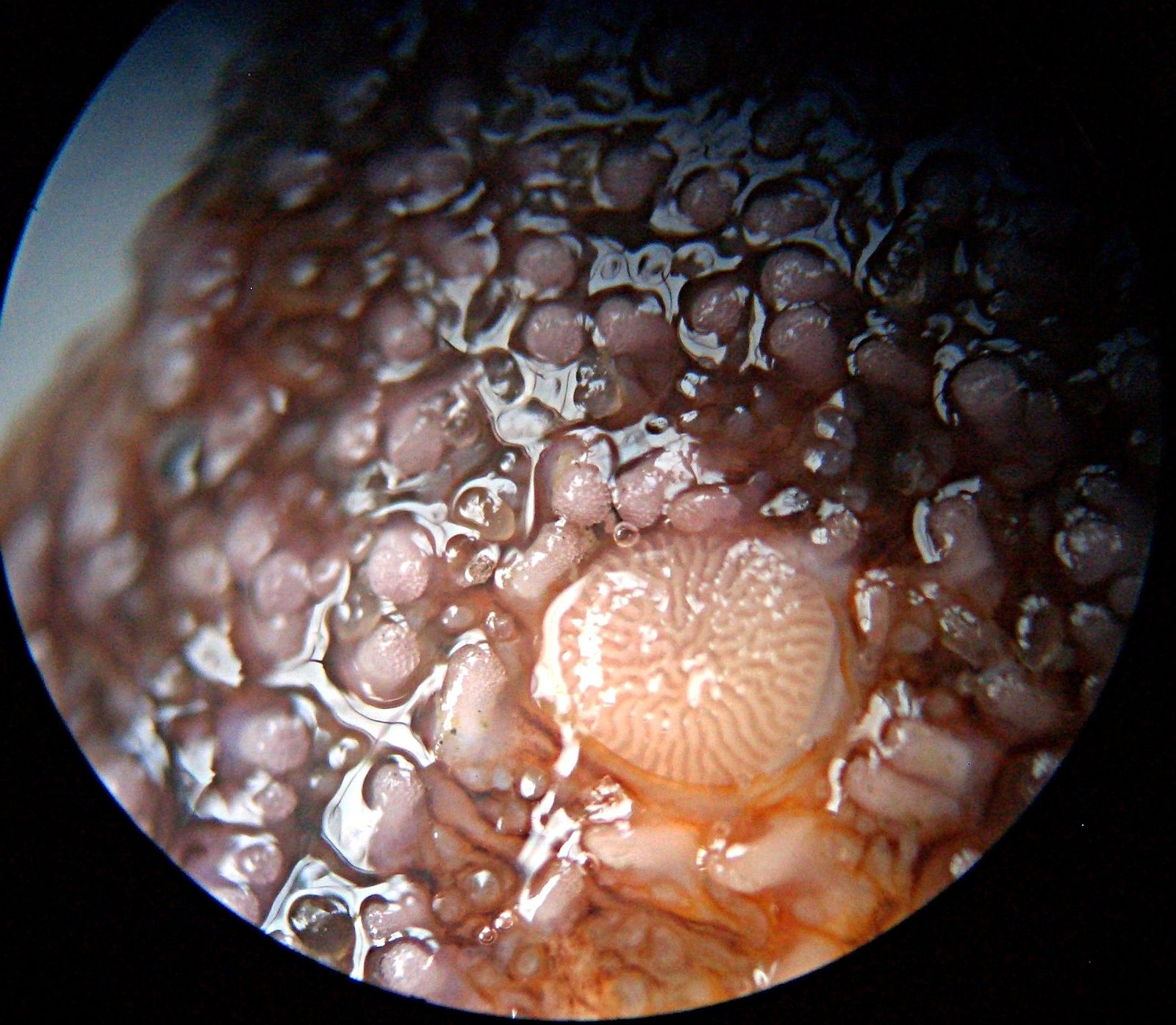 madreporite (sieve plate)
Solve it
Solve it
A starfish needs a gap of 0.1 mm to push its stomach into a clam. A clam's two shells meet along an edge 5 cm long. If the starfish opens a gap of 0.1 mm along the whole edge, how much water-filled space has it made, roughly, if the gap is 2 cm deep into the shell? Compare with the volume of a single drop of water (about 0.05 mL).
Answer
Solve it
A student says: "Hemichordates have gill slits, so they are chordates." Spot the error, using what defines a chordate.
Answer
In a starfish, sea water enters the water vascular system through the
- mouth
- madreporite
- tube feet
Connect it
Connect it
- Hydraulics, Physics Class 11. Pascal's law and the hydraulic lift, the same physics as the tube foot: hydraulic machines.
- Layers and openings, concept 2. Blastopore to anus, the deuterostome way: symmetry, layers and coelom.
- Chordates, concept 8. What hemichordates lack: the chordate features.
- Food webs, Class 12. Starfish, urchins and kelp as a chain where removing one link changes everything: food chains.
Still confused?
If the adult starfish is radial, why do textbooks call echinoderms "bilateral coelomates" in the chart?
Because their larvae are bilateral and their ancestors were bilateral. The radial adult is a later change. Tables list the adult (radial); the family tree goes by ancestry (bilateral).
Do echinoderms really have no excretory organs? Where does the waste go?
They have no special organs for it. Ammonia, their main waste, is very soluble and diffuses out across thin surfaces such as the tube feet and the skin gills into the sea water.
Sources
- Lavoie (1956), How sea stars open bivalves, Biological Bulletin 111: 114
- Tube foot adhesion and de-adhesion in sea stars (review)
- Stomochord
- Life: The Science of Biology, deuterostomes
- Cornell Chronicle (2020): sunflower sea star listed as critically endangered
- De'ath et al. (2012), The 27-year decline of coral cover on the Great Barrier Reef, PNAS
- eAtlas: crown-of-thorns starfish outbreaks
Picture and video credits
Show 7 picture and video credits
- starfish-asterias.jpg: Kristian Larsen, CC BY-SA 4.0
- starfish-tube-feet.jpg: Mokele, CC BY 3.0
- sea-urchin-tube-feet.mp4: Jon Houseman, CC BY-SA 4.0
- brittle-star.jpg: Smithsonian Environmental Research Center, CC BY 2.0
- sea-cucumber.jpg: François Michonneau, CC BY 3.0
- starfish-xray.jpg: Nevit Dilmen (talk), CC BY-SA 3.0
- madreporite.jpg: Eberhard Grünzinger, CC BY-SA 3.0


