Classification of Elements and Periodicity in PropertiesFull experience
- 1. Why sort the elements?
- 2. Mendeleev's periodic table
- 3. The modern periodic table
- 4. How do you name element 120?
- 5. Why the table has the shape it has
- 6. The s, p, d and f blocks
- 7. Metals, non-metals and metalloids
- 8. How big is an atom?
- 9. How hard is it to pull an electron off?
- 10. Which atoms want extra electrons?
- 11. Valence, and the odd ones at the top
- 12. Where are the most reactive elements?
- Review
6 of 12·NCERT §3.6 · §3.6.1 · §3.6.2 · §3.6.3 · §3.6.4·pp. 82–85·6 min
The s, p, d and f blocks
The big ideaThe periodic table splits into four blocks, s, p, d and f, named after the kind of orbital that receives the last electron, and each block has its own typical behaviour.
In simple words
Imagine a big building with four wings. Which wing a family lives in depends on which kind of room their newest member moved into. Families in the same wing live in a similar way. The chart works like that: four wings, and the last tiny bit added to each building block decides its wing.
A map of the four blocks
The aufbau principle ("building up": electrons fill the lowest-energy orbitals first) gives the periodic table its theory. Elements in one group have the same number and arrangement of outer electrons, so they act alike. Sorting by the orbital being filled gives four blocks. In words, picture the long-form table:
| Block | Where it sits | Groups | Last electron enters | Outer configuration |
|---|---|---|---|---|
| s-block | Two tall columns at the far left | 1, 2 | ns | ns1 or ns2 |
| p-block | Six columns at the right | 13 to 18 | np | ns2np1 to ns2np6 |
| d-block | Ten columns in the middle, from period 4 down | 3 to 12 | (n−1)d | (n−1)d1–10ns0–2 |
| f-block | Two rows of 14 in the panel below the table | (placed with group 3) | (n−2)f | (n−2)f1–14(n−1)d0–1ns2 |
Notice the widths: 2, 6, 10 and 14 columns, exactly the number of electrons an s, p, d or f subshell can hold.
Try it: read each configuration and pick its block. Three of them are traps.
One real element from each block. The label on each gives the end of its configuration: look at which subshell took the last electron.
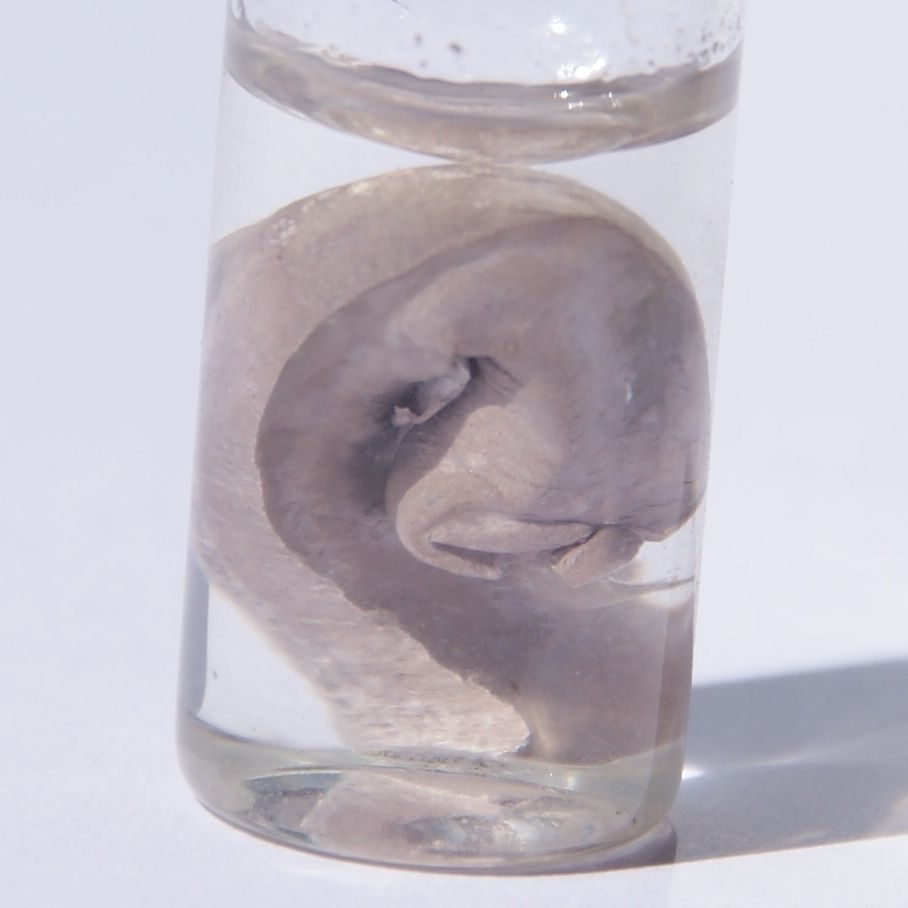 Na [Ne]3s¹
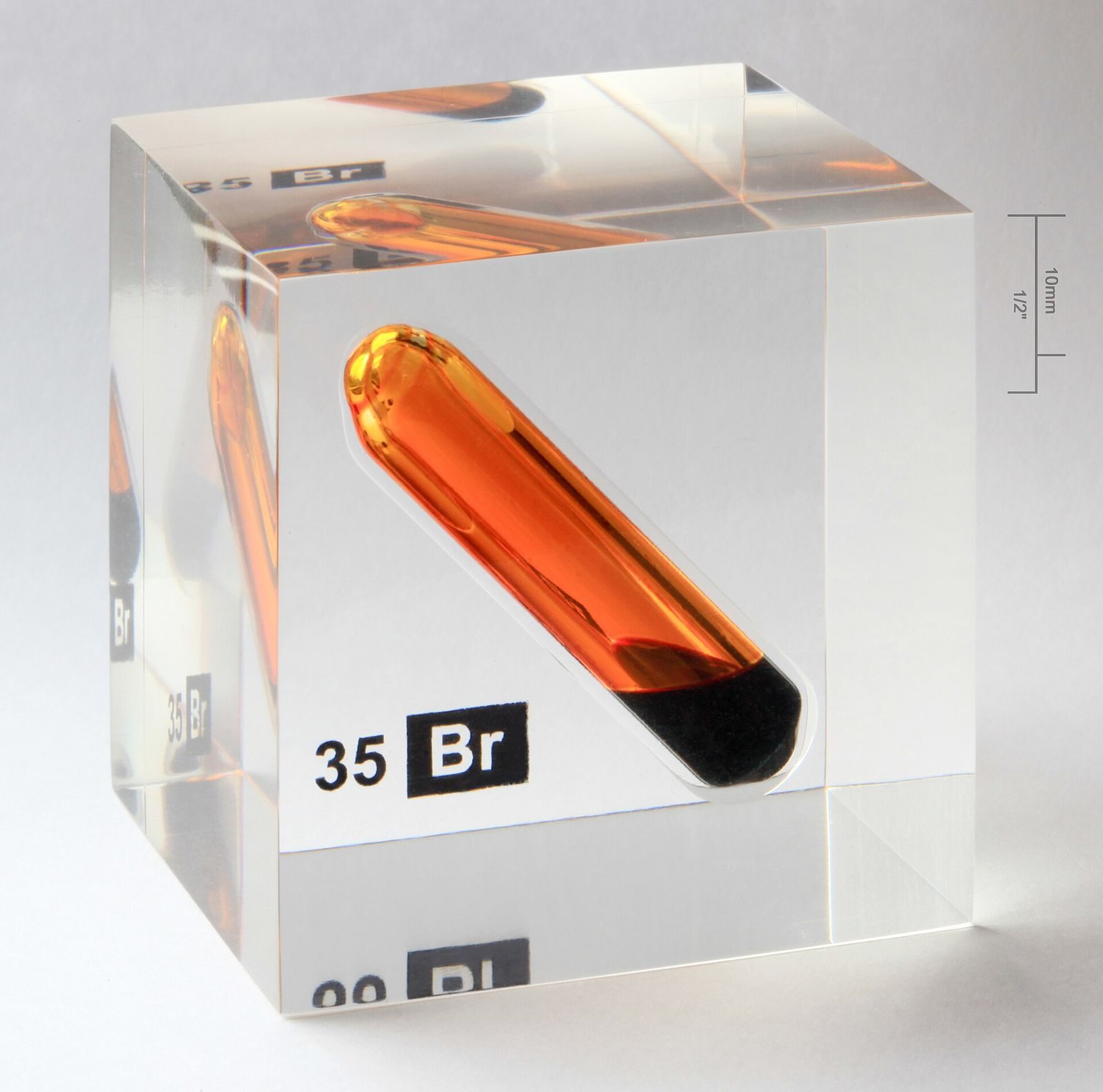 Br …4s²4p⁵
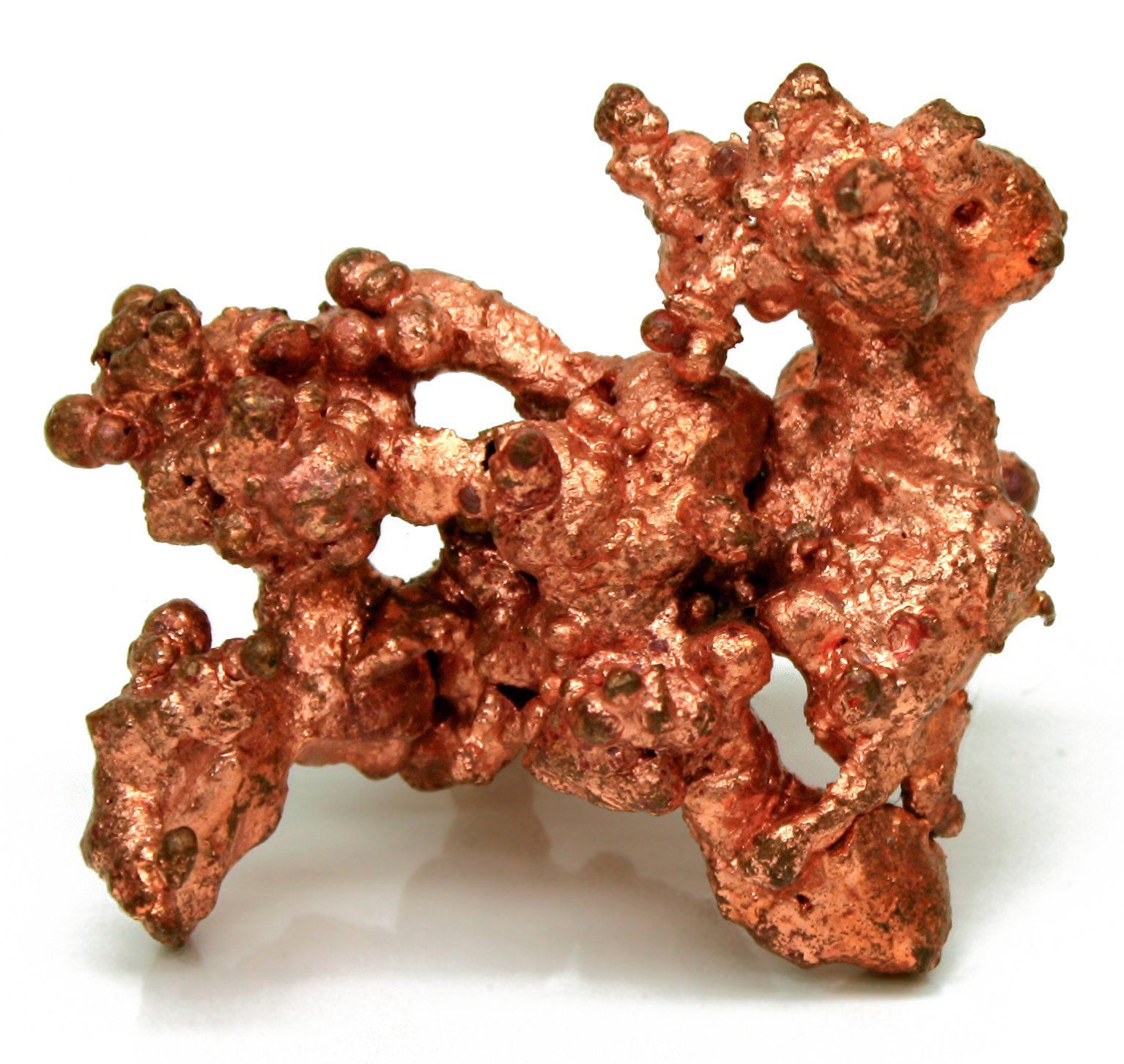 Cu [Ar]3d¹⁰4s¹
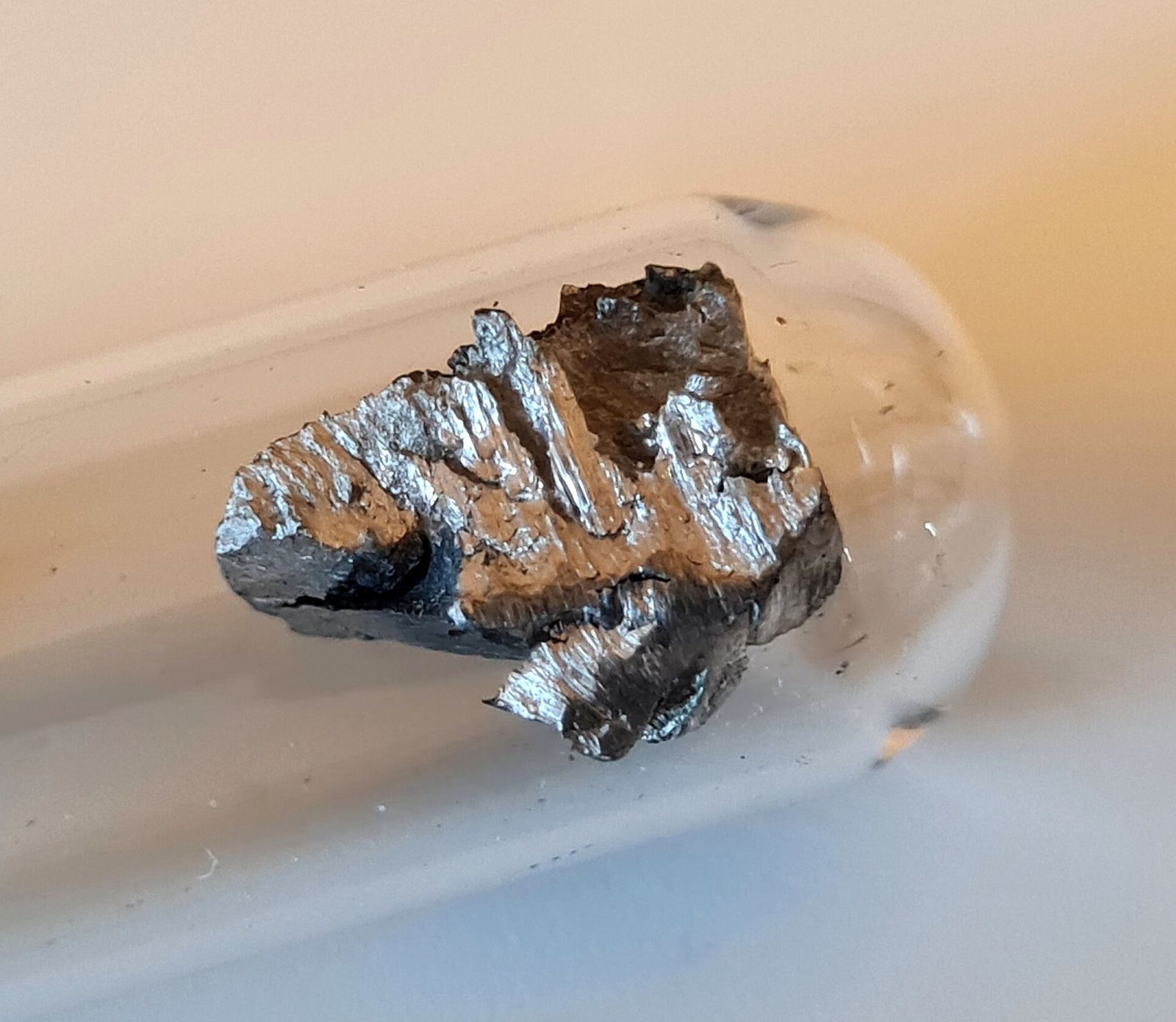 Nd [Xe]4f⁴6s²
Two exceptions: hydrogen and helium
- Helium (1s2) is strictly an s-block element, but it is placed with the noble gases in group 18 (p-block). Its outer shell is completely full, so it behaves like the other noble gases.
- Hydrogen (1s1) has one s electron like the alkali metals, so it could go in group 1. But it can also gain one electron to reach helium's arrangement, like the halogens of group 17. Because it fits both, it is usually shown on its own at the top of the table.
The s-block
Group 1, the alkali metals (ns1), and group 2, the alkaline earth metals (ns2).
- All are reactive metals with low ionization enthalpies (it is easy to remove their outer electrons).
- They readily lose their outer electrons to form 1+ ions (alkali metals) or 2+ ions (alkaline earth metals): \(\ce{Na -> Na+ + e-}\), \(\ce{Mg -> Mg^2+ + 2e-}\).
- Metallic character and reactivity increase down the group.
- Too reactive to be found free in nature.
- Their compounds are mostly ionic, except those of lithium and beryllium, which are more covalent.
The p-block
Groups 13 to 18. Together, the s-block and p-block are the representative elements or main group elements.
- Each period ends in a noble gas with a closed shell, ns2np6. Adding or removing electrons from it is very hard, so noble gases are very unreactive.
- Just before them are two important non-metal groups: the halogens (group 17) and the chalcogens (group 16). Both have highly negative electron gain enthalpies: they readily take one (halogens) or two (chalcogens) electrons to reach a noble gas configuration.
- Non-metallic character increases left to right across a period; metallic character increases down a group.
The d-block: transition elements
Groups 3 to 12, the middle of the table. Here electrons go into an inner d subshell, one shell below the outermost. General outer configuration: (n−1)d1–10ns0–2. Palladium is an odd one: 4d105s0.
- All are metals.
- They mostly form coloured ions, show variable valence (several oxidation states), are often paramagnetic (attracted by a magnet, because of unpaired electrons), and many are used as catalysts.
- Zn, Cd and Hg, with a full (n−1)d10ns2, show few of these typical properties.
- They form a bridge between the very reactive s-block metals and the less reactive elements of groups 13 and 14, hence the name transition elements.
The f-block: inner transition elements
The two rows below the main table: the lanthanoids, Ce (Z = 58) to Lu (Z = 71), and the actinoids, Th (Z = 90) to Lr (Z = 103). The last electron enters an f orbital two shells in: (n−2)f1–14(n−1)d0–1ns2. They are the inner transition elements.
- All are metals, and within each series the properties are very similar.
- Early actinoids have more complicated chemistry than the lanthanoids, because they show many oxidation states.
- All actinoids are radioactive. Many have been made only in nanogram amounts or less, so their chemistry is not fully known.
- Elements after uranium (Z = 92) are the transuranium elements.
Textbook check · §3.6.4Which element goes in group 3: lanthanum or lutetium?
- The textbook says
- Lanthanum (57) and actinium (89) sit in group 3; the f-block rows are Ce to Lu and Th to Lr.
- What we know now
- Chemists have argued about this for a century. An IUPAC report in 1988 put scandium, yttrium, lutetium and lawrencium in group 3, which makes the f-block La to Yb and Ac to No. A 2021 IUPAC project called the choice a matter of convention but still suggested the lutetium form, because it is the only one that keeps the atomic numbers in order, keeps the d-block in one piece and gives the blocks the widths quantum mechanics demands: 2, 6, 10 and 14. Most chemists and physicists who have studied the question now agree. The widget in the deep dive below lets you cut the table both ways.Source: E. Scerri, "Provisional report on discussions on group 3 of the periodic table", Chemistry International, 2021; Group 3 element (Wikipedia)
- In the exam
- Follow NCERT: lanthanoids Ce (58) to Lu (71), actinoids Th (90) to Lr (103), with La and Ac in group 3.
Worked example: placing element 115
- The last noble gas before it is radon (Z = 86). 115 − 86 = 29 more electrons.
- Period 7 fills 7s (2), then 5f (14), then 6d (10): that is 26. The remaining 3 go into 7p.
- Configuration: [Rn]5f146d107s27p3.
- ns2np3 is the nitrogen family, group 15, p-block. (It is moscovium, Mc.)
Try it. Where would element 119, when made, go? Give its configuration.
Answer
Textbook check · Problem 3.3Element 117 has been made, and Uuo is now Og
- The textbook says
- Element 117 "has not yet been discovered", and element 120 would be [Uuo]8s2.
- What we know now
- Element 117 was announced by a Russian–American team at Dubna in April 2010 and named tennessine (Ts) in November 2016, the same year element 118 got its name, oganesson (Og). So the core in brackets is now written [Og], and element 120 is [Og]8s2: period 8, group 2, s-block. The address does not change, only the name of the core.Source: IUPAC, names of elements 113, 115, 117 and 118 (2016); Tennessine (Wikipedia)
- In the exam
- Write [Og]8s2, group 2, period 8. The reasoning is exactly the book's.
Try it: tap through the problems and watch each configuration find its period, block and group on the table.
Don't mix these up
- Main group (representative) = s-block + p-block only. d- and f-block are not main group.
- A configuration ending in (n−1)d10ns1, like [Ar]3d104s1 (copper), is d-block, not group 1.
- Lanthanoids start at Ce (58), not La; actinoids at Th (90), not Ac.
Just remember
The block patterns follow from the filling order, but the group numbers and family names are conventions. Learn them once with the hooks.
- Outer configurations: s ns1–2; p ns2np1–6; d (n−1)d1–10ns0–2; f (n−2)f1–14(n−1)d0–1ns2
- Count the steps down: s and p live in shell n, d one floor below (n − 1), f two floors below (n − 2). "The later the letter, the deeper the floor."
- Group number from the outer electrons
- s-block: group = number of outer electrons (Na 3s1: group 1). d-block: group = (n−1)d electrons + ns electrons (Fe 3d64s2: group 8). p-block: group = 10 + ns and np electrons (Cl 3s23p5: 10 + 7 = group 17). The "10" is the ten d columns standing in between.
- Lanthanoids Ce (58) to Lu (71); actinoids Th (90) to Lr (103)
- Each row is 14 long and starts one after the element it is named for: La 57, so 58 to 71; Ac 89, so 90 to 103.
- Family names: alkali metals (1), alkaline earth metals (2), chalcogens (16), halogens (17), noble gases (18)
- Word roots: alkali from Arabic al-qalī, plant ashes, where potash came from; "earths" was the old word for oxides that do not melt or dissolve, like lime and magnesia; chalcogen from Greek chalkos, copper or ore, "ore-makers"; halogen from hals, salt, "salt-makers", since sodium plus chlorine is common salt.
- Block
- A region of the table where the same kind of orbital (s, p, d or f) is being filled.
- Representative elements
- The s- and p-block elements, also called main group elements.
- Halogens, chalcogens
- Group 17 and group 16 non-metals.
- Transition elements
- d-block metals, groups 3 to 12.
- Inner transition elements
- f-block metals: lanthanoids and actinoids.
- Paramagnetic
- Pulled towards a magnet, because of unpaired electrons.
- Transuranium elements
- Elements beyond uranium (Z above 92).
Words to know
Which configuration belongs to a d-block element?
- [Ne]3s1
- [Ar]3d104s24p5
- [Ar]3d34s2
Why is helium placed in group 18 although its last electron is in an s orbital?
- Its valence shell is completely filled, so it behaves like a noble gas
- It has eight outer electrons
- Its last electron is actually in a p orbital
Which property is NOT typical of transition elements?
- Forming coloured ions
- Showing variable oxidation states
- Being non-metals that readily gain electrons
- Acting as catalysts
Deep dive · optional
Why is the table cut into blocks 2, 6, 10 and 14 wide?
Where the block widths come from, why the f-block elements are so alike that nature mixes them in one sand, and the three quarrels the blocks still cause: hydrogen, helium and group 3. Not needed for the exam; it makes the shape of the table something you can explain.
The roots: one column per electron
- Why is the p-block exactly 6 columns wide?Because each step to the right adds one electron, and a p subshell has room for 6. After six steps it is full and the next electron has to go somewhere else.
- Why room for 6, and 10 for d, 14 for f?A subshell with quantum number l has 2l + 1 orbitals, one for each way its shape can point in space: 1 for s, 3 for p, 5 for d, 7 for f (see Quantum numbers). Each orbital holds two electrons with opposite spins, the Pauli rule. So 2, 6, 10, 14.
- Why do elements in one column behave alike?Chemistry happens at the outside of an atom. Down a column the outer arrangement repeats (ns1, ns2np5, and so on), so the behaviour repeats. Across a block only one subshell is changing, one electron at a time.
- Then why are neighbours in the f-block far more alike than neighbours in the s- or p-block?Because the electron being added goes two shells in. The 4f orbitals lie inside the filled 5s and 5p shells, tucked into the core, and they take almost no part in bonding. From the outside, cerium, neodymium and gadolinium all look much the same: three electrons easy to give away (mostly 6s2 and one more), so nearly all of them form 3+ ions of almost the same size.
- And what does that do in nature?Elements that behave alike travel together. When rocks crystallise, the lanthanoids slip into the same mineral grains, so one ore holds a dozen of them at once, and separating them is one of the slowest jobs in chemistry.
- The bedrock2l + 1 orbitals, two electrons each, filled in order of energy, and only the outermost electrons meet the neighbours.
So "block" is not just a colouring scheme. The width of each block is a count of electrons, and the way properties change across it tells you how deep the changing electron sits. In the s- and p-blocks the change happens right at the surface, so each step is a big change in behaviour. In the d-block it is one floor down, so neighbours differ less. In the f-block it is two floors down, so neighbours are near twins.
The story
See it
Here is the whole table as one machine. Slide the shape from 32 columns, where every period is one unbroken row, to the usual 18, and watch which 14 columns get lifted out. Switch the cut between NCERT's and IUPAC's choice and see which element ends up under yttrium. Slide further to Janet's left-step table. Tap any box for its address.
The f-block, where it is mined. The beach sands at Chavara, Kollam, are among India's richest in heavy minerals, and monazite grains like these are where cerium, lanthanum and neodymium come from:
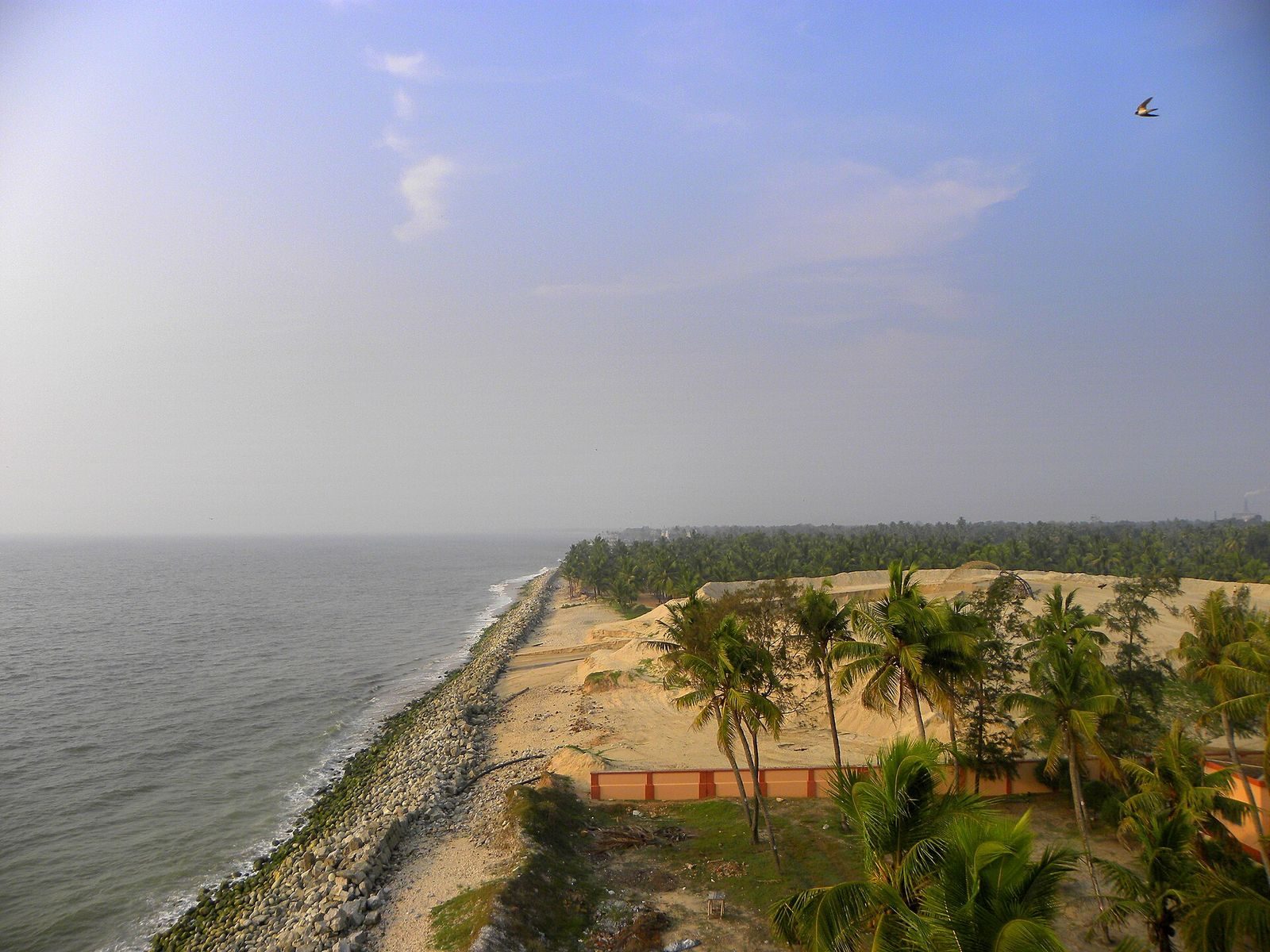 Arabian Seabeach sand belt
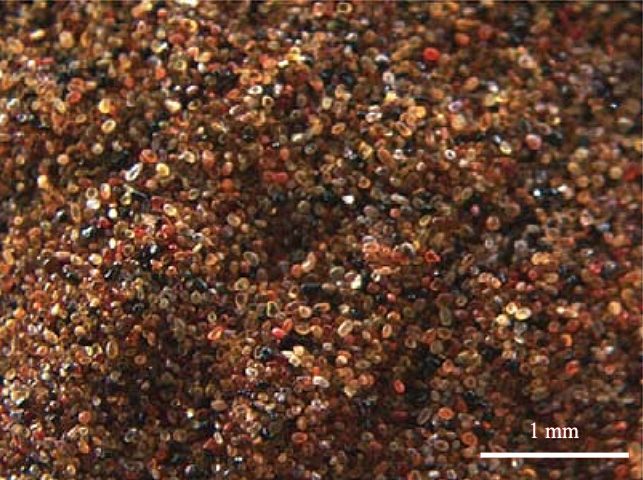 monazite grains
Solve it
Solve it: weigh the evidence
Use these NCERT values to decide whether hydrogen is more like lithium or more like fluorine. Ionization enthalpy (kJ mol−1): H 1312, Li 520, F 1681. Electron gain enthalpy (kJ mol−1): H −73, Li −60, F −328.
Answer
Solve it
Find the block, period and group (if it has one) of Z = 64, 80 and 114 without looking at a table.
Hint
Answer
Solve it: spot the error
"Zinc is 3d104s2. Its d subshell is full, so zinc is not a d-block element."
Answer
Solve it: think harder
Iron, cobalt and nickel are easy to separate from each other, but neodymium, praseodymium and samarium can only be pulled apart by repeating one extraction step over and over, in long chains of mixer tanks. Explain the difference from where the changing electron sits.
Answer
Connect it
Connect it
- Why 2l + 1 and two per orbital. Quantum numbers and Electronic configuration (Pauli, Hund, the filling order) in Chapter 2.
- Why the blocks come in this order. The n + l filling order, and a world where it is different: Why the table has the shape it has.
- Moving the actinoids. How Glenn Seaborg gave the 5f row its own place in 1944: The modern periodic table.
- Class 12. The lanthanoids' near-identical 3+ ions and the lanthanoid contraction are on The lanthanoids; their radioactive cousins on The actinoids.
- In your pocket. The strongest permanent magnets, neodymium–iron–boron, sit in headphones, hard disks and the motors of electric vehicles. A Toyota Prius's motors need about a kilogram of neodymium.
Still confused?
Are the "rare earths" actually rare?
No. Cerium is the 25th most common element in the earth's crust, more common than copper. They are called rare because they are spread thinly and always mixed together, and are hard to separate into pure elements.
If helium is in the s-block, why is it coloured like the p-block in some tables?
Tables colour it by where it is printed (group 18) or by its block (s). Both are used. By electrons it is s-block; by behaviour it is a noble gas. NCERT says exactly this: s-block element placed in group 18.
Why does the f-block have no group numbers?
The 18 group numbers belong to the 18-column table, where the f-block has been lifted out. In the 32-column table its 14 columns would sit between groups 2 and 3, but IUPAC has never given them numbers, so they are named by series: lanthanoids and actinoids.
Sources
- Periodic table, period 1 (Wikipedia): where to put hydrogen and helium; Scerri on floating hydrogen; IUPAC 1988 and helium; solid helium's packing
- Group 3 element (Wikipedia): Bassett 1892, Werner 1905, Bury; the 1988 IUPAC report; the 2021 view and E. Scerri, provisional report on group 3, Chemistry International (2021)
- Lanthanide (Wikipedia): 4f orbitals isolated inside the core, little part in bonding; separation by solvent extraction
- Monazite (Wikipedia): composition, Ce/La/Nd shares, Indian and Brazilian monazite before the Second World War
- IREL (India) Limited (Wikipedia): founded 18 August 1950; Rare Earths Division at Aluva/Eloor, 1952
- India's three-stage nuclear power programme (Wikipedia): Bhabha, thorium share, 9 to 10% ThO2 in Indian monazite
- Rare-earth element (Wikipedia): cerium more abundant than copper and Neodymium magnet (Wikipedia): uses; about 1 kg of neodymium in a Prius
- Transition metal (Wikipedia): the IUPAC Gold Book definition and group 12
Picture and video credits
Show 6 picture and video credits
- sodium-metal-under-oil.jpg: Hi-Res Images of Chemical Elements, CC BY 3.0
- bromine-ampoule-in-acrylic-cube.jpg: Alchemist-hp (pse-mendelejew.de), CC BY-SA 3.0 de
- native-copper-nugget.jpg: Jonathan Zander (Digon3), derivative by Materialscientist, CC BY-SA 3.0
- neodymium-metal-in-ampoule.jpg: Tobias Meints, CC BY-SA 4.0
- chavara-coast-kollam-mineral-sands.jpg: Arunvrparavur, CC BY-SA 4.0
- monazite-sand-micrograph.jpg: D. Kemp, A. C. Cilliers slightly modified by Gretarsson (replaced red, poorly visible scale bar by a white one), CC BY-SA 4.0


