Act 09NCERT §4.2.11.1–4.2.11.3 · pp. 47–486 min
Jawless vertebrates and fishes
The lancelet becomes a lamprey: an eel-shaped body with a round sucking disc for a mouth, no jaws, one nostril on top and seven gill openings in a row.
A vertebrate with a round mouth and no jaw at all.
Drag to turn it. No scales, no paired fins.
From the textbookpp. 47–48
NCERT Biology, Class 11 · Reprint 2026-27
9.0The big idea
No jaws. Then cartilage. Then bone.
First the jawless vertebrates, the cyclostomes. Then the fishes, sorted by their skeleton: cartilage (sharks, rays) or bone (rohu, katla and most fish you know).
Full text
The big ideaThe first vertebrates in the list have no jaws (cyclostomes); then come the fishes, sorted by what their skeleton is made of: cartilage (sharks and rays) or bone (rohu, katla and most fish you know).
In simple words
Some long, slimy, eel-like animals have a round sucking mouth and no jaws at all; they hang on to fish. Then there are real fish. Sharks and rays have a skeleton of soft, bendy gristle, like the tip of your nose, and they must keep swimming or they sink. Most other fish have a skeleton of hard bone, a flap over their gills, and a bag of air inside that lets them float without trying.
9.1Class Cyclostomata · "round mouth"
A mouth with no jaw
- The only living AgnathaJawless vertebrates.
- A sucking, circular mouth without jawsAn elongated body.
- No scales, no paired finsCranium and vertebral column of cartilage; closed circulation.
Full text
Class Cyclostomata: jawless vertebrates
"Cyclostome" means round mouth. These are the only living members of Agnatha.
- All living members are ectoparasites (parasites on the outside of the host) on some fishes.
- Elongated body with 6 to 15 pairs of gill slits for breathing.
- A sucking, circular mouth without jaws.
- No scales and no paired fins.
- Cranium (skull) and vertebral column are cartilaginous.
- Closed circulation.
- Life story: they live in the sea but migrate to fresh water to spawn (lay eggs). Within a few days of spawning, the adults die. The larvae undergo metamorphosis and return to the ocean.
Examples: Petromyzon (lamprey) and Myxine (hagfish).
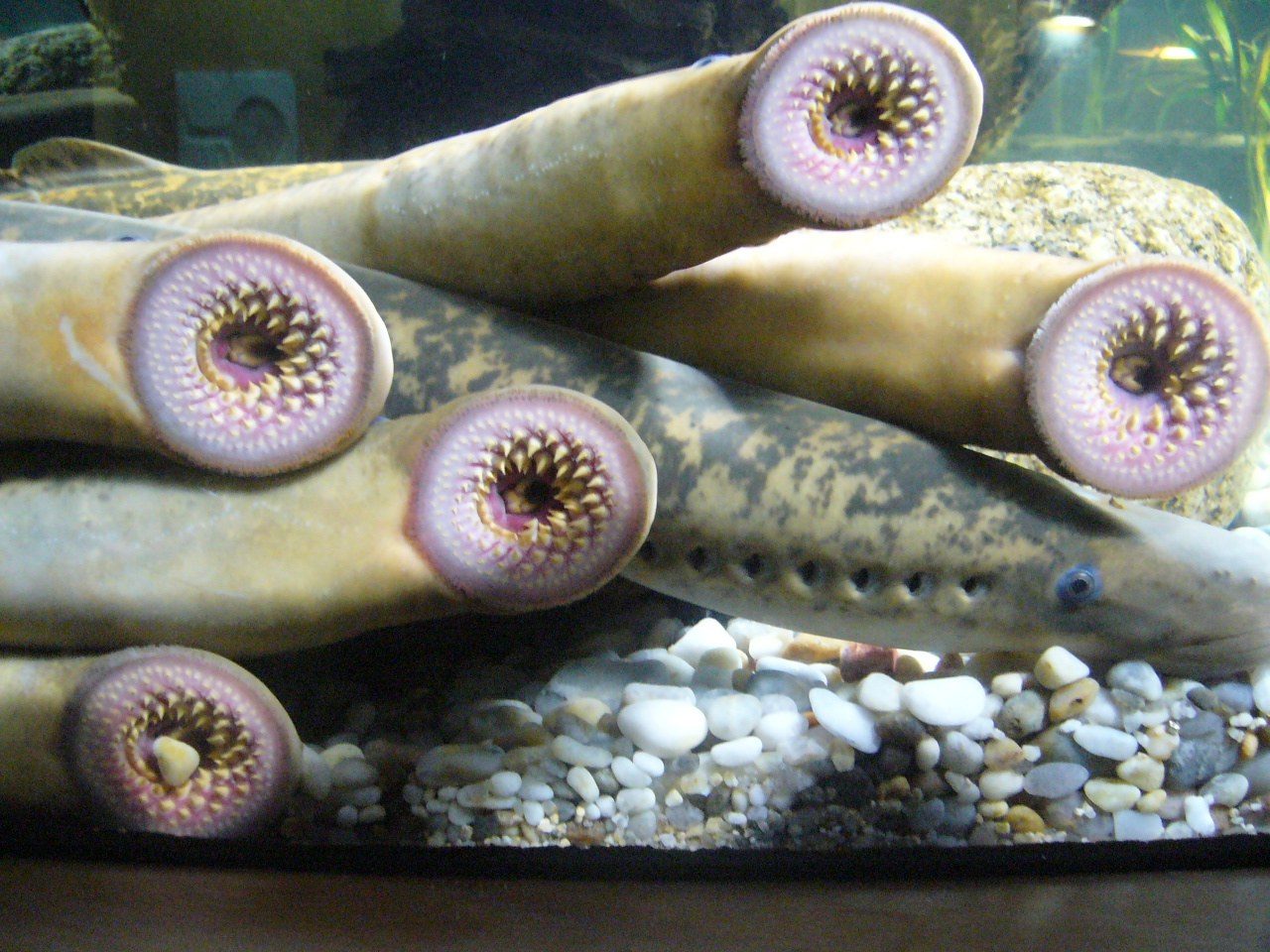
Look at the mouth first: a round sucking disc ringed with horny teeth, and no jaw to open or shut. The lamprey clamps on, rasps a hole with its tongue and drinks blood and body fluid.
9.2Gijón aquarium · scroll is the playhead
Watch it hold on
The disc seals like a suction cup. There is nothing to close it: no jaw.
They grip the host's skin.
The tongue files a hole; the lamprey feeds on blood and flesh.
9.3Breathing with the mouth shut
Portholes down the side
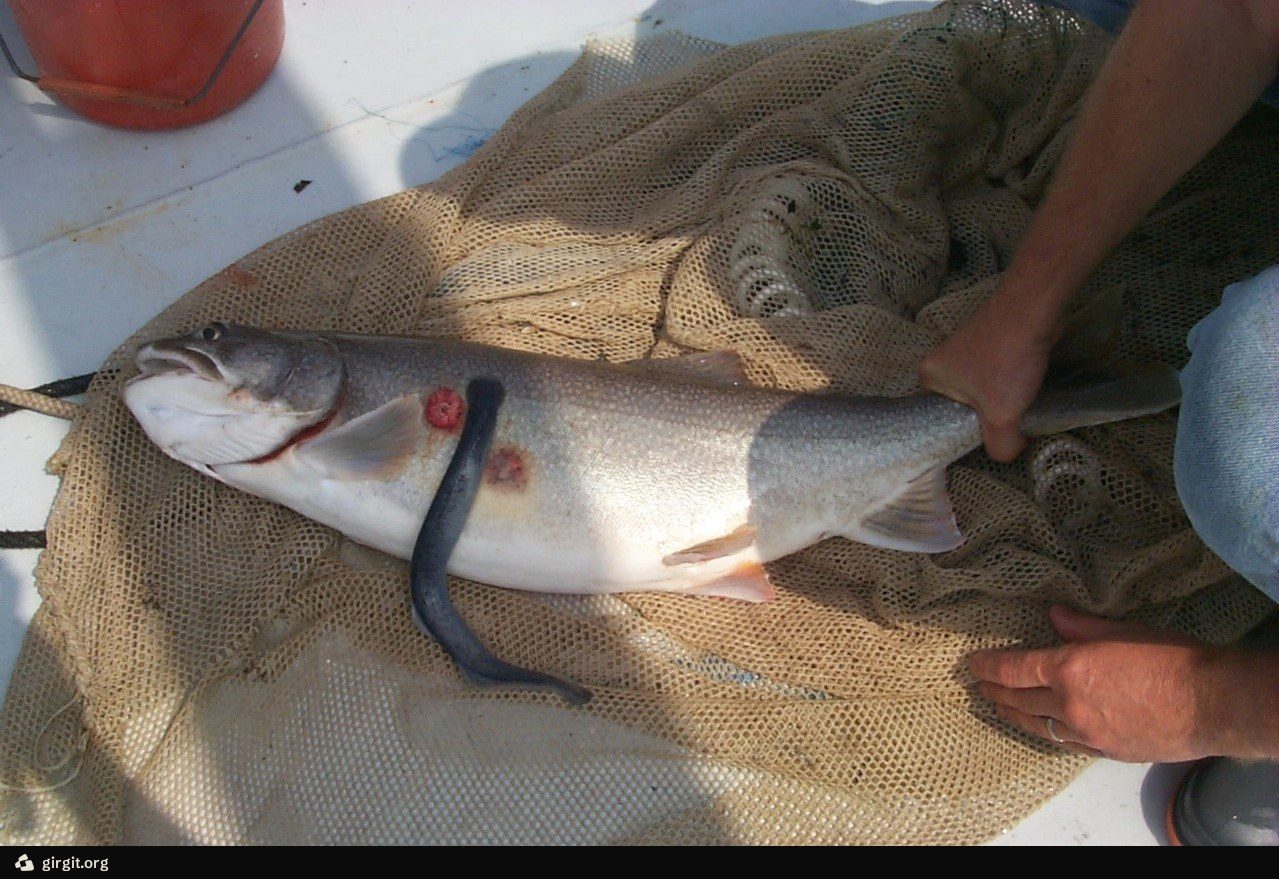
6 to 15 pairs of gill slits in cyclostomes; a sea lamprey shows seven a side. Clamped to a fish, it cannot gulp water, so the pores pump it in and out.
9.4On the outside of the host
A parasite that rides
All living cyclostomes are ectoparasites on some fishes, says the textbook. In the Great Lakes, one sea lamprey kills up to about 18 kg of fish in the 12 to 18 months it feeds.
9.5The life story
Up the river to die
Born in a river, grown in the sea, back to the river once, to lay eggs and die. The larvae undergo metamorphosis, then return to the ocean.
9.6Textbook check
That is the lamprey's life
The textbook says
All cyclostomes are ectoparasites and migrate to fresh water to spawn
Now we know
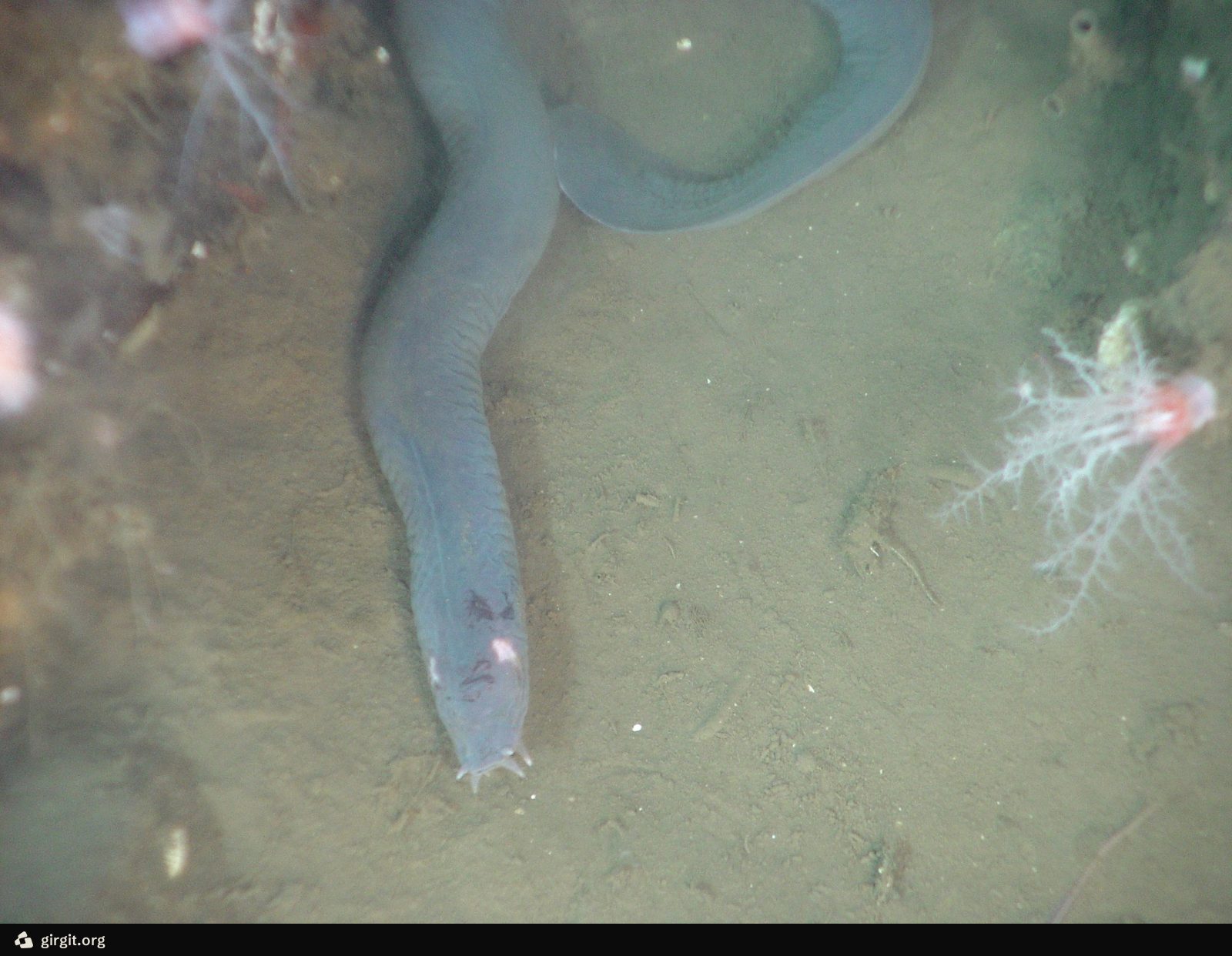
That fits lampreys. Hagfish are sea-floor scavengers and hunters, never in rivers
In the exam, write the textbook's line. Examples to learn: Petromyzon (lamprey) and Myxine (hagfish).
9.7The hagfish's weapon
1litre
of slime in under a second
A shark that bites one gags on a mouthful of slime. The hagfish then ties itself in a knot and slides it down its body to wipe clean.
CheckLamprey or hagfish?
What is wrong here?
A student writes: "Hagfish are ectoparasites on fish and swim up rivers to spawn." What is wrong?
- Hagfish have jaws
- That is the lamprey's life, not the hagfish's
- Hagfish are not vertebrates
9.8Class Chondrichthyes · "cartilage fish"
Gristle, teeth and shocks
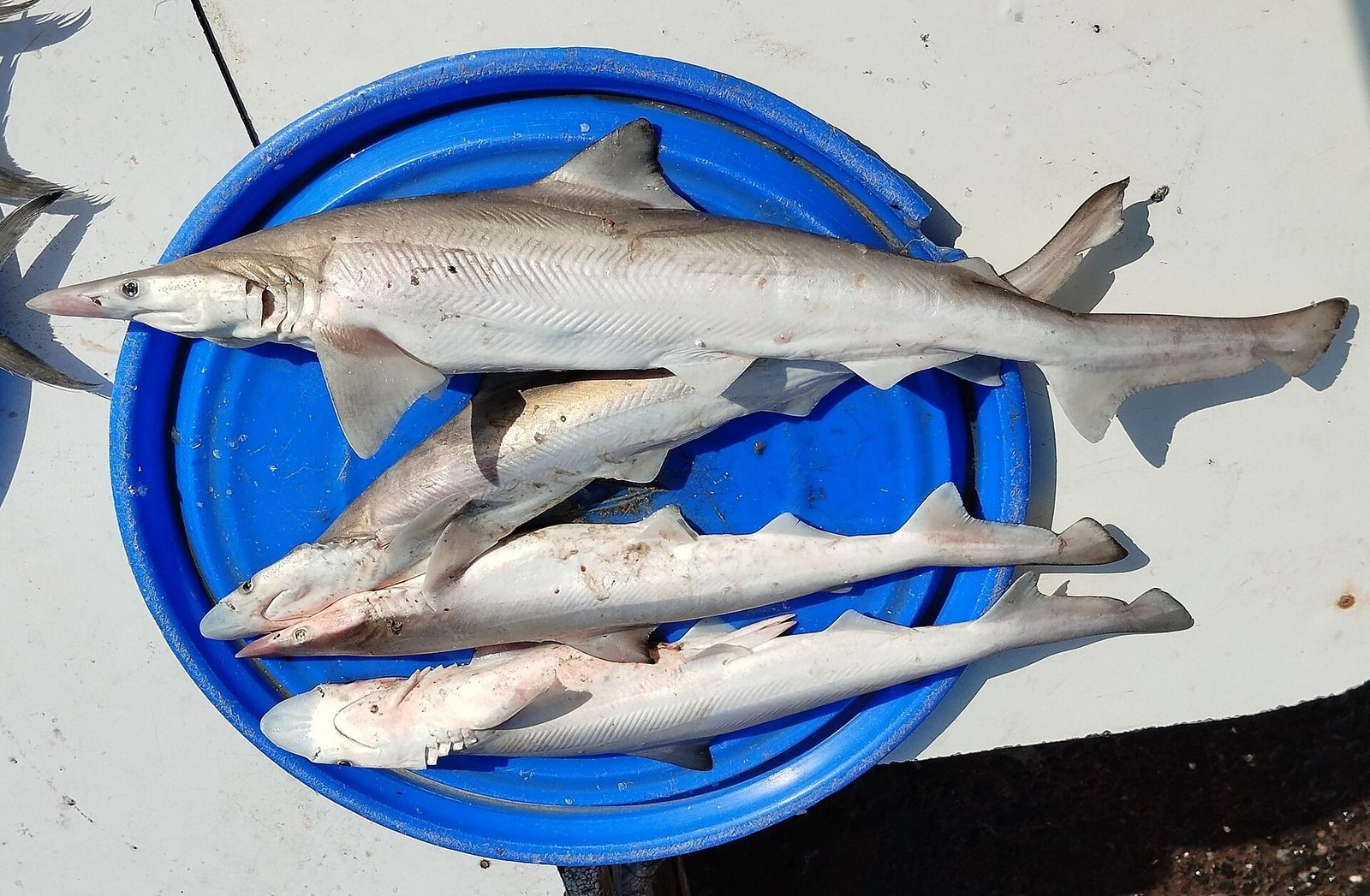
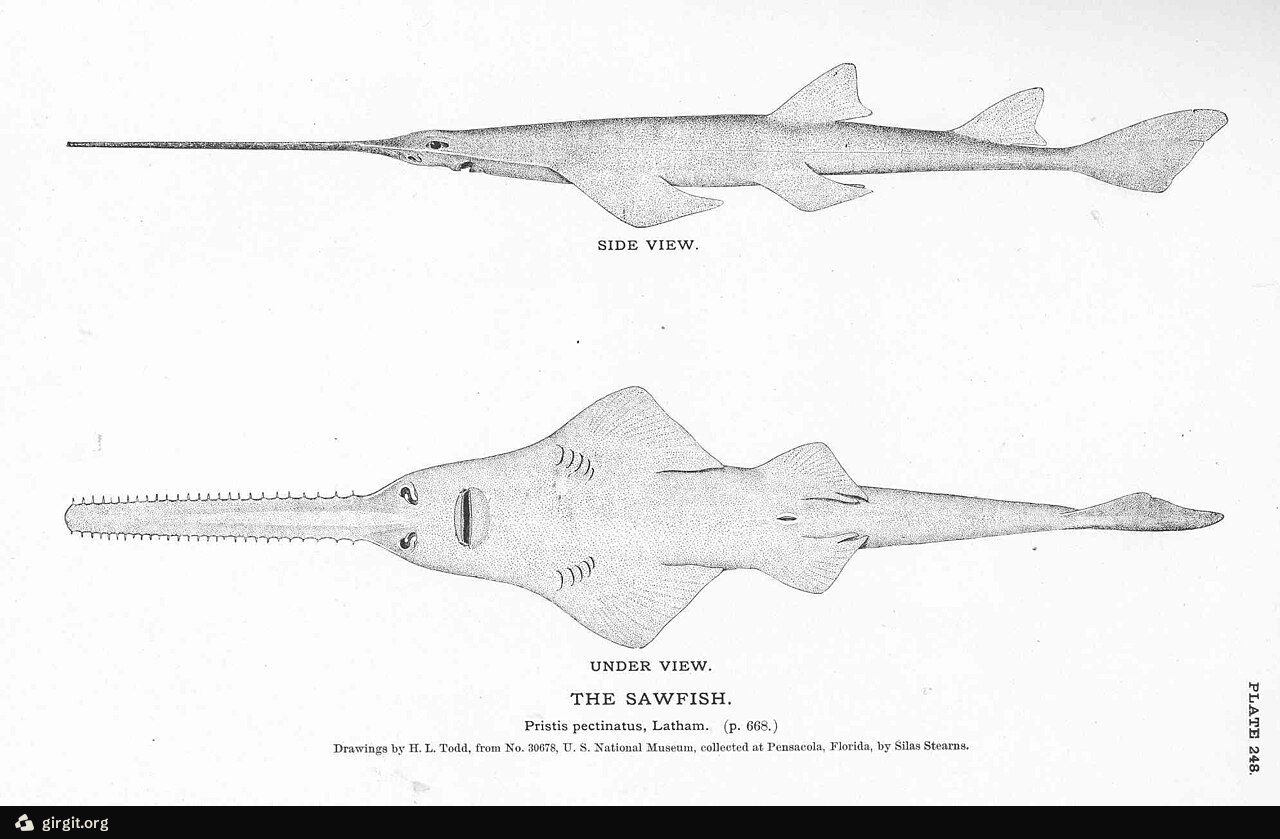
Gill slits separate, with no operculum (gill cover).
Mouth on the ventral side. Very powerful jaws: predaceous.
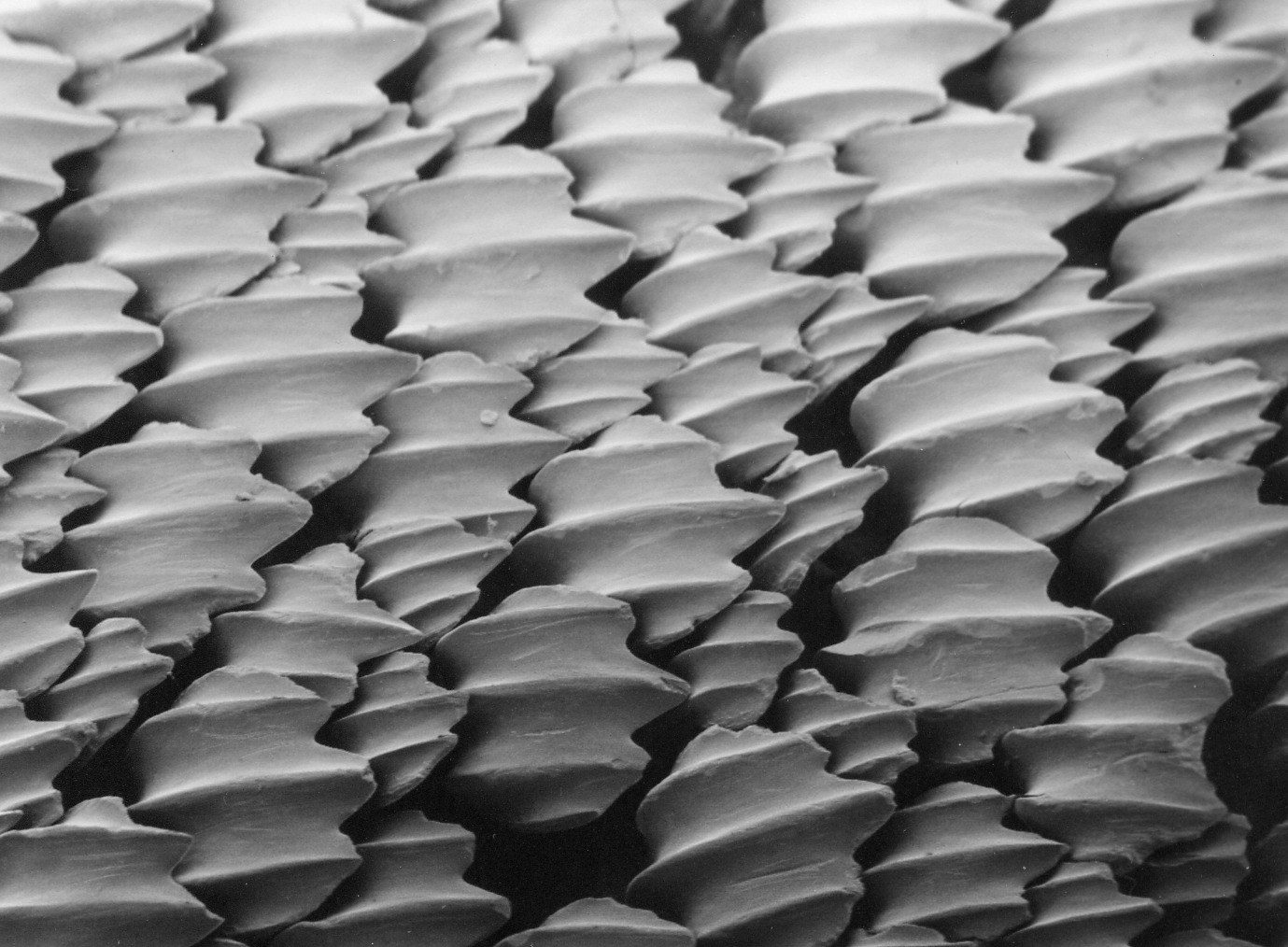
Smooth head to tail, sandpaper tail to head. The teeth are modified placoid scales, pointing backwards.
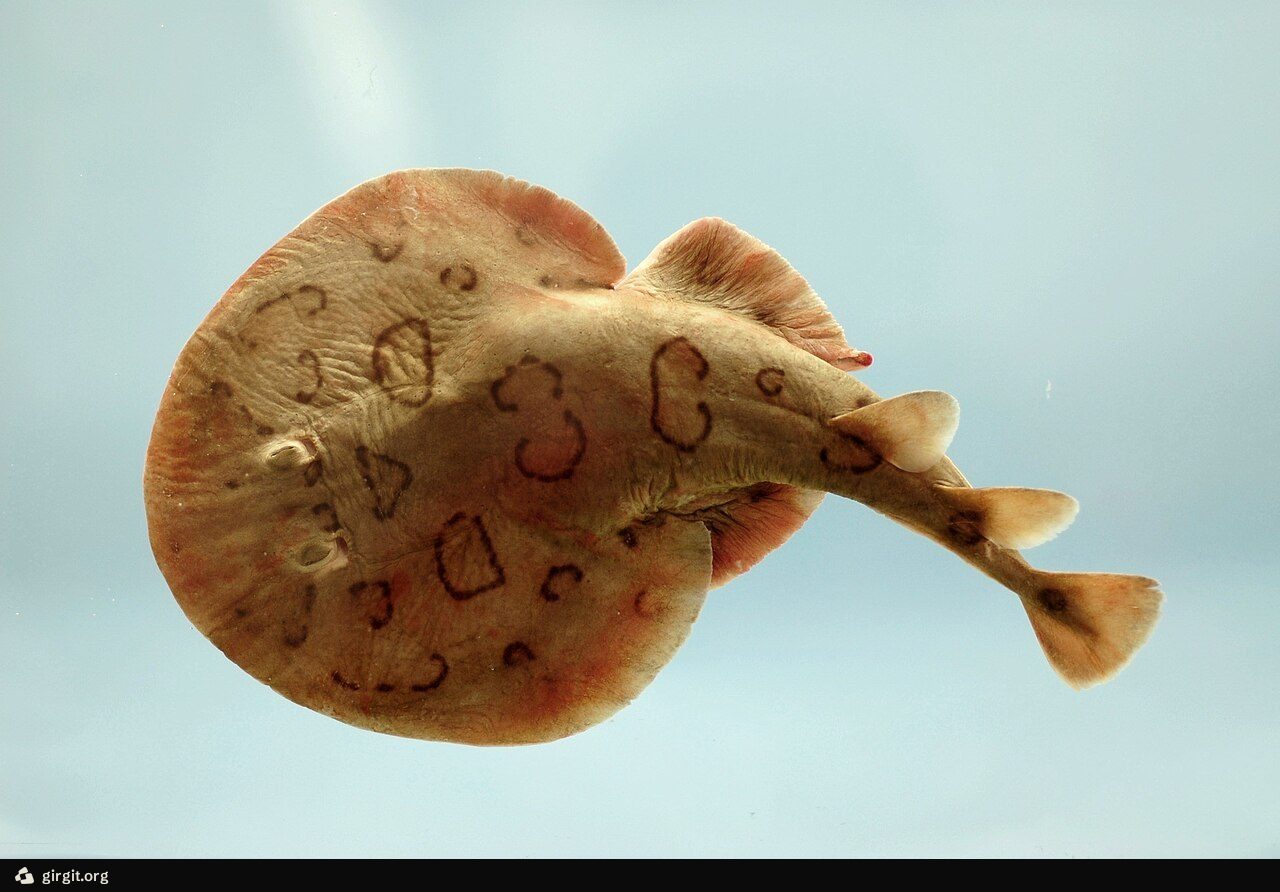
Some have electric organs.
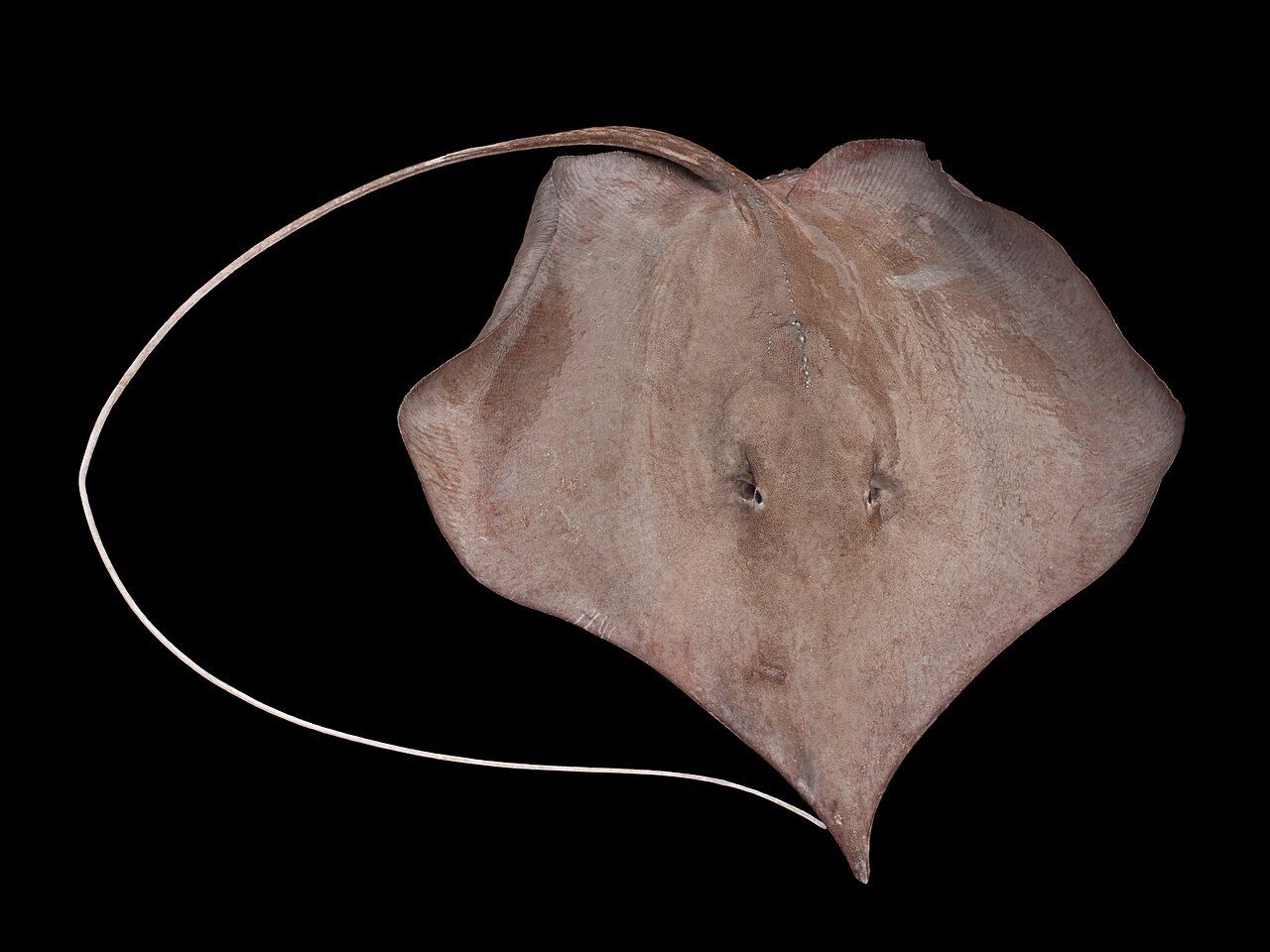
Some have a poison sting.
9.9Air bladders in a shark
0
so it must swim constantly, or sink
- Heart two-chamberedOne auricle, one ventricle.
- Cold-blooded: poikilothermousNo steady body temperature.
- Sexes separate; males have claspersOn the pelvic fins. Fertilisation internal; many viviparous.
- Learn: Scoliodon (dogfish), Pristis (sawfish), Carcharodon (great white shark), Trygon (stingray).
Try itGive it a float
Sink, hover or rise?
Add an air bladder and watch the fish stop sinking.
CheckSwimming while resting
What is it missing?
A fish keeps swimming even while resting, or it sinks. What is it missing?
- Jaws
- An air bladder
- An operculum
- Paired fins
9.10Textbook check · NEET extra
The rod, and the tail
The textbook says · now we know
The notochord persists throughout life
In adult sharks cartilage vertebrae largely replace it; only remnants stay between them. Write the textbook's line in the exam.
Not in the textbook · NEET has asked
A heterocercal tail
The upper lobe is longer, because the backbone runs up into it. Most bony fishes: two equal lobes.
The teeth of a shark are
- modified placoid scales
- modified cycloid scales
- outgrowths of a bony jaw
Full text
Class Chondrichthyes: cartilaginous fishes
Chondros means cartilage, ichthys means fish.
- Marine, with a streamlined body and a cartilaginous endoskeleton.
- Mouth on the ventral side (underneath).
- The textbook says the notochord persists throughout life.
- Gill slits are separate and have no operculum (gill cover).
- Tough skin full of tiny placoid scales. The teeth are modified placoid scales, pointing backwards. Jaws are very powerful; they are predaceous (hunters).
- No air bladder, so they must swim constantly to avoid sinking.
- Heart two-chambered: one auricle, one ventricle.
- Some have electric organs (Torpedo, the electric ray); some have a poison sting (Trygon, the stingray).
- Cold-blooded or poikilothermous: they cannot keep their body temperature steady.
- Sexes separate. In males the pelvic fins carry claspers for passing sperm. Fertilisation internal; many are viviparous (giving birth to live young).
Examples: Scoliodon (dogfish), Pristis (sawfish), Carcharodon (great white shark), Trygon (stingray).
Run a finger along a shark from head to tail and it feels smooth; run it back and it feels like sandpaper. Those are the placoid scales, each one a tiny tooth pointing backwards.
Not in the current textbook, but NEET has asked it: sharks have a heterocercal tail fin, in which the upper lobe is longer than the lower one because the backbone runs up into it. Most bony fishes have a tail with two equal lobes.
A bony fish made of points, turning slowly as it swims: a backbone of vertebrae, a bony skull and jaws, a gill cover over the gills, a gas-filled swim bladder above the gut, and fins.
9.11Class Osteichthyes · "bone fish"
Bone, a lid and a float
- Marine and freshwaterA bony endoskeleton, streamlined body.
- Mouth mostly terminalAt the front tip.
- Four pairs of gills under an operculumOne gill cover on each side.
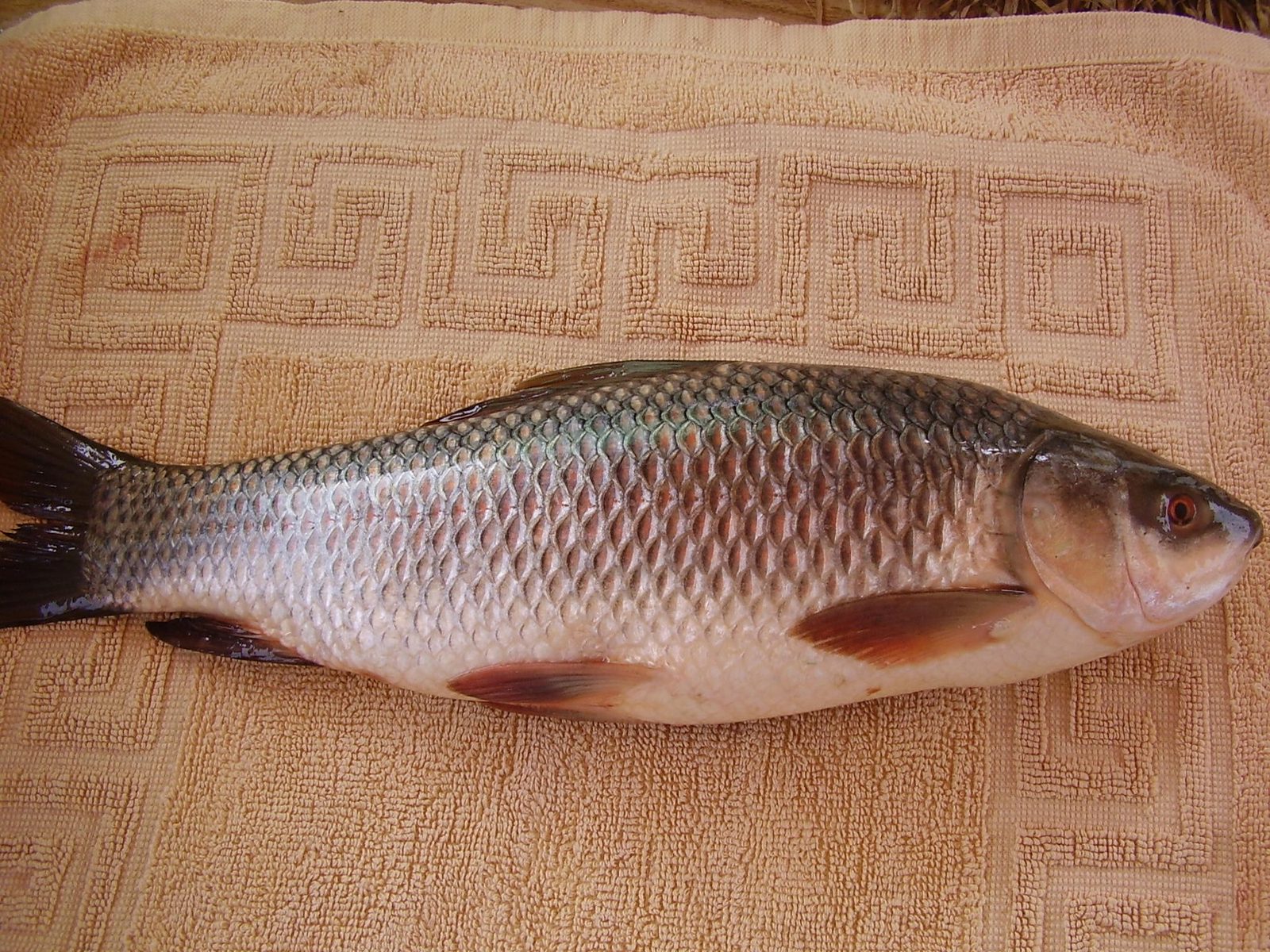
9.12Labeo, the rohu
Scales you can count
- Cycloid or ctenoid scalesCovering the skin.
- Heart two-chambered; cold-bloodedLike the sharks.
- Sexes separateFertilisation usually external; mostly oviparous; development direct.
Full text
Class Osteichthyes: bony fishes
Osteon means bone.
- Marine and freshwater, with a bony endoskeleton and streamlined body.
- Mouth mostly terminal (at the front tip).
- Four pairs of gills, covered on each side by an operculum.
- Skin covered in cycloid or ctenoid scales.
- An air bladder regulates buoyancy (how well it floats), so it can hover without swimming.
- Heart two-chambered (one auricle, one ventricle). Cold-blooded.
- Sexes separate. Fertilisation usually external. Mostly oviparous; development direct.
| Where | Genus | Common name |
|---|---|---|
| Marine | Exocoetus | Flying fish |
| Hippocampus | Sea horse | |
| Freshwater | Labeo | Rohu |
| Catla | Katla | |
| Clarias | Magur | |
| Aquarium | Betta | Fighting fish |
| Pterophyllum | Angel fish |
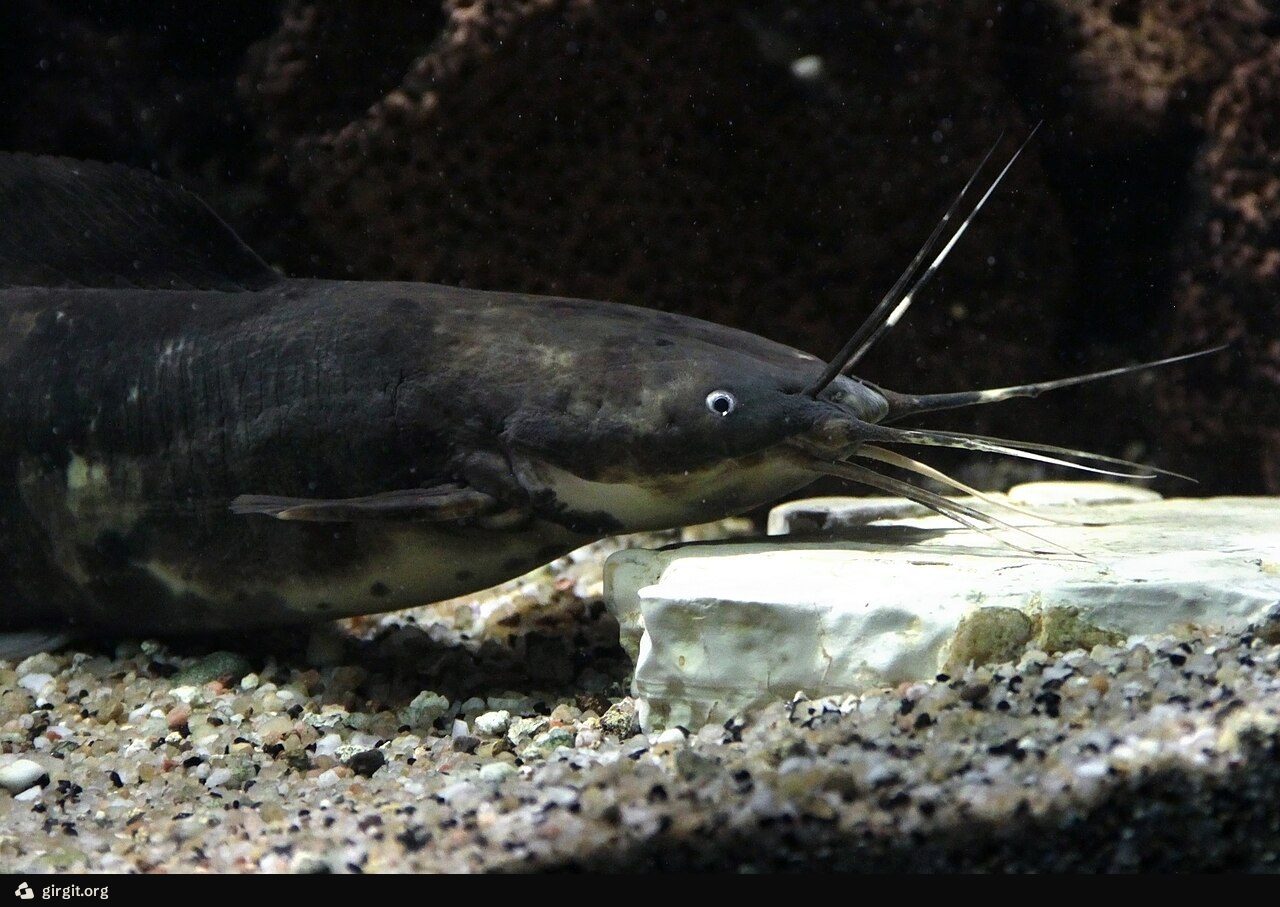
Rohu, katla and magur are the fish of a Bengali or Assamese fish curry: all bony fish.
9.13The air bladder sets buoyancy
A submarine, or a plane
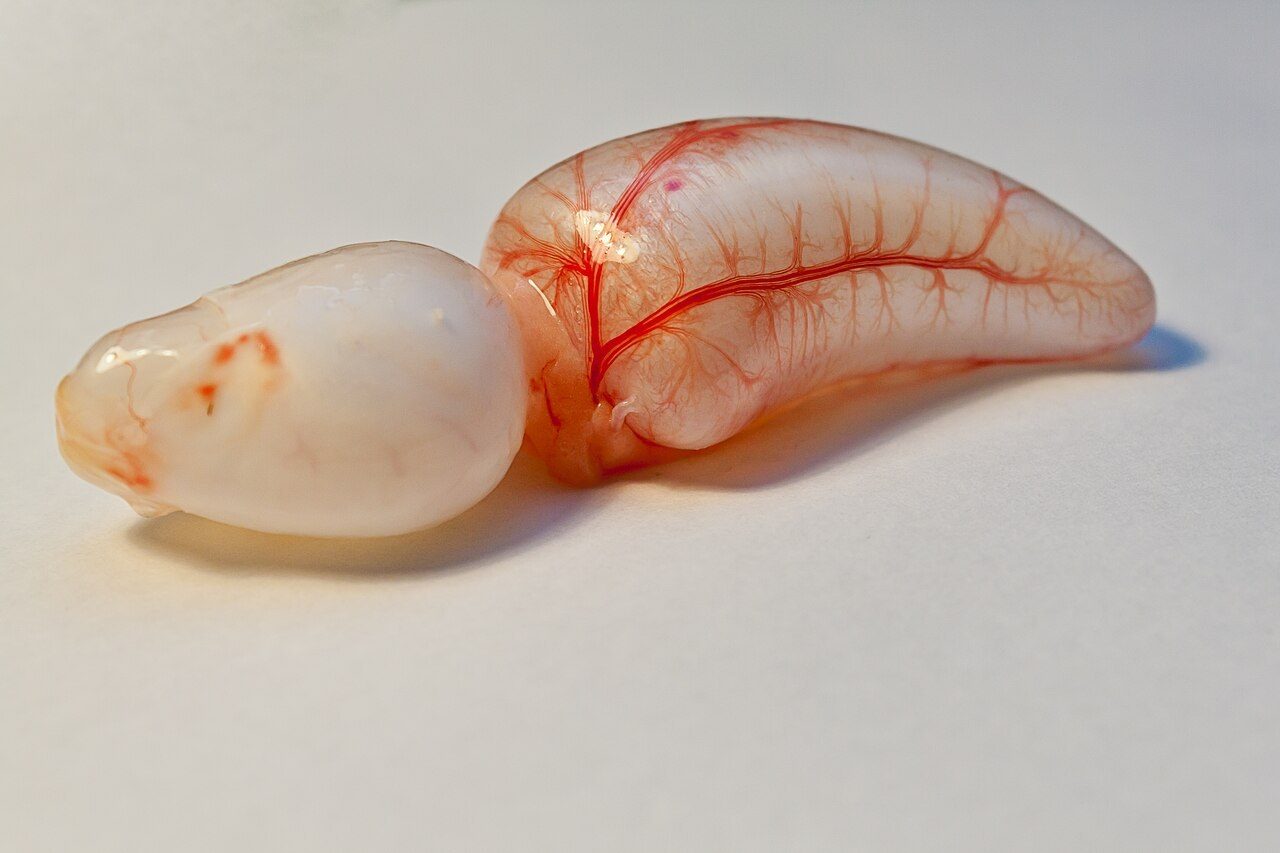
Bony fish · a ballast tank
Add gas to rise, let it out to sink
It hovers without moving a fin.
Shark · a plane
Stop moving forward and it goes down
No tank at all: its fins give lift, like wings.
9.14Bony fish to learn
The fish curry, and the aquarium
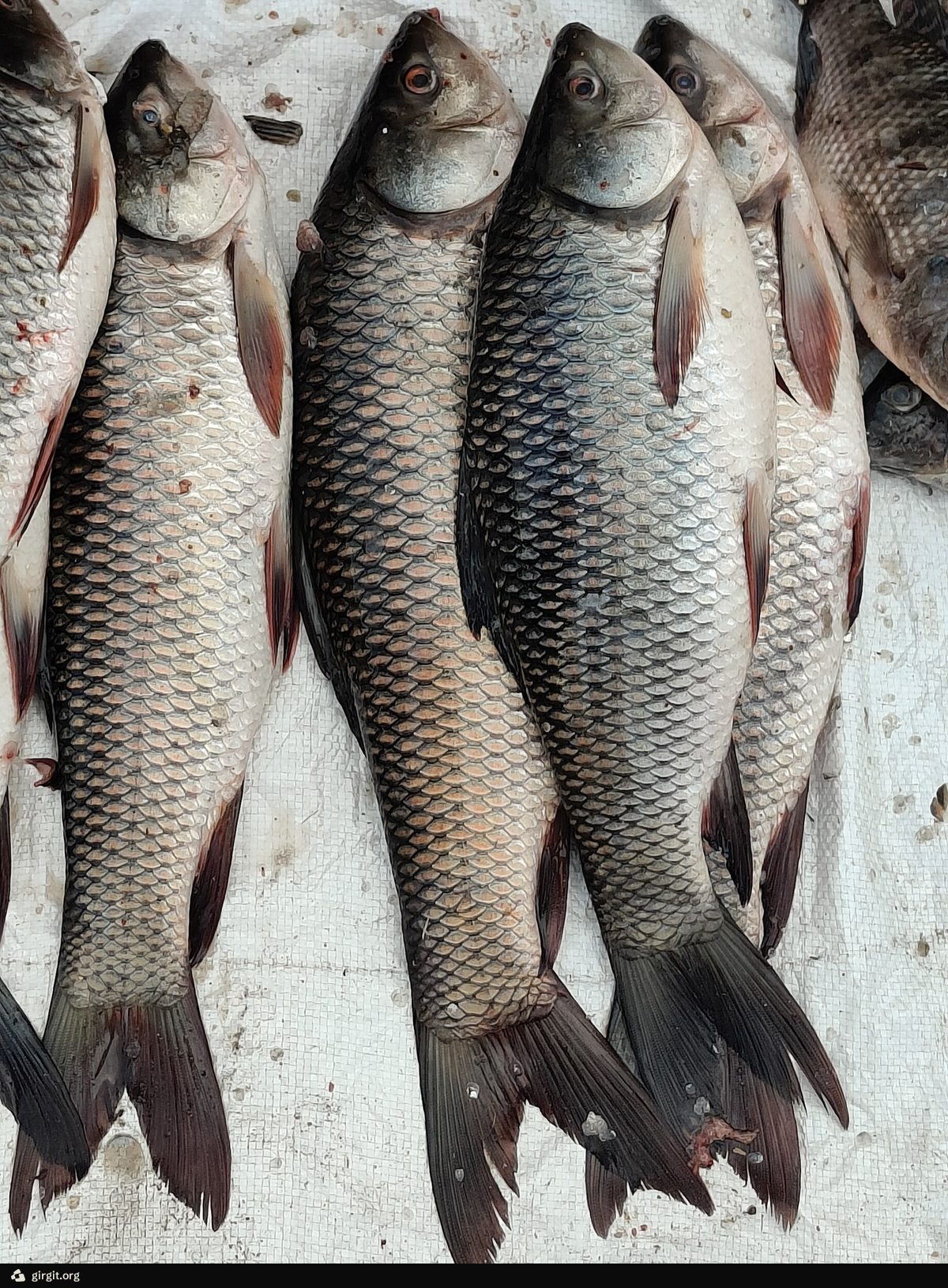
Katla. With Labeo (rohu) and Clarias, the fish of a Bengali or Assamese curry.
Magur, a catfish.
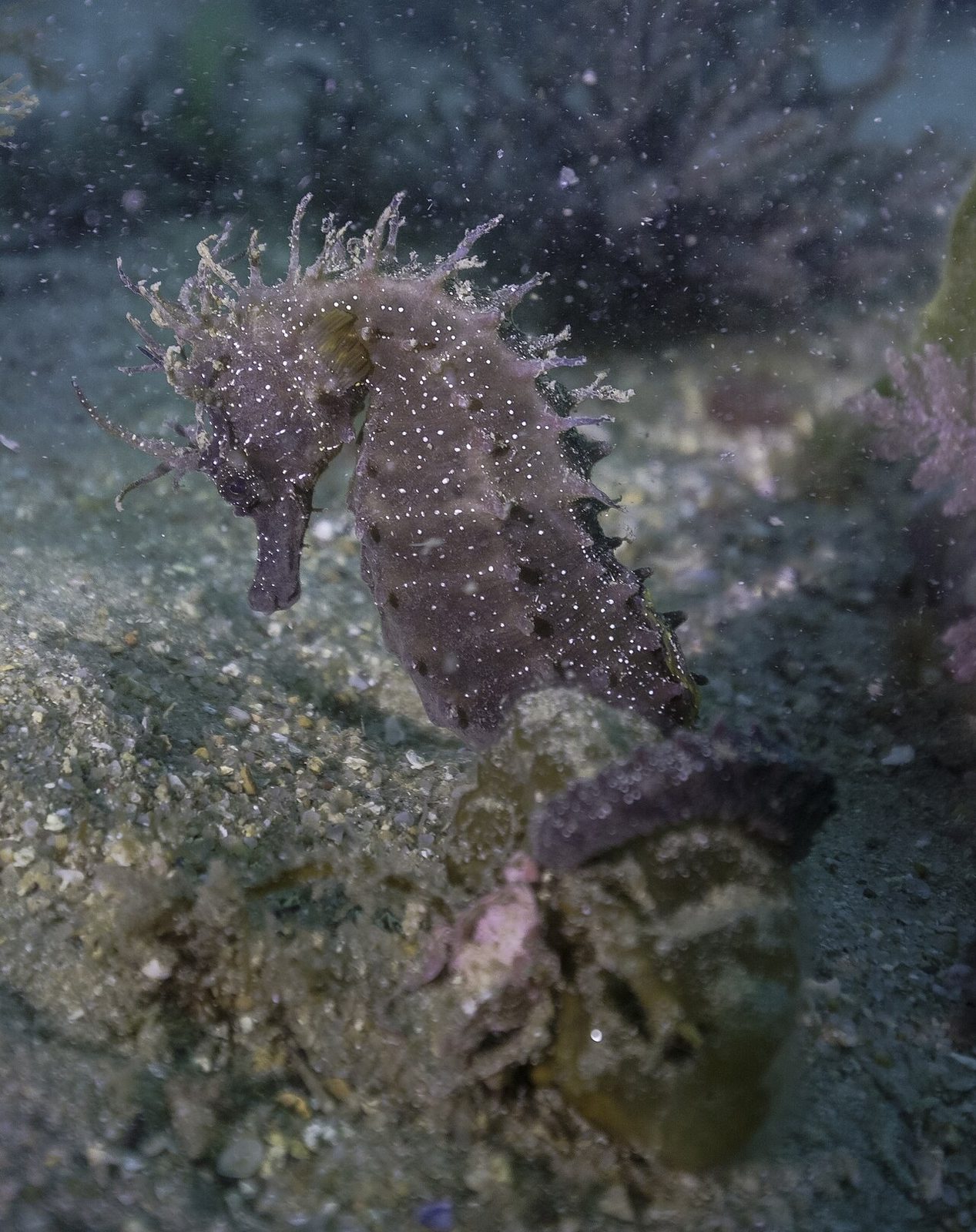
Sea horse, swimming upright. And flying fish.
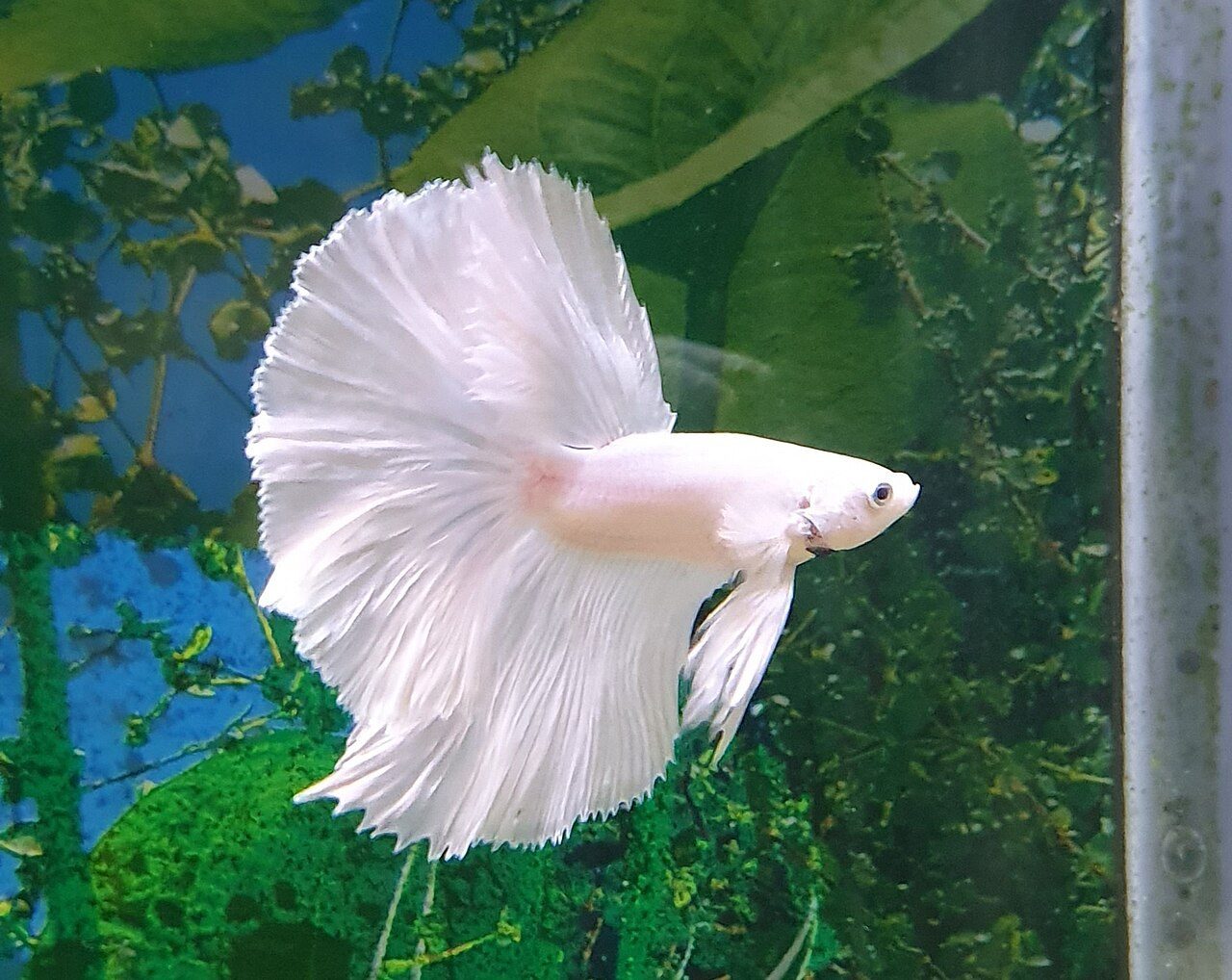
Fighting fish, bred for its fins. And angel fish.
CheckBone or cartilage?
Which is a bony fish?
Which of these is a bony fish?
- Pristis
- Scoliodon
- Clarias
- Myxine
9.15Side by side
Three classes, one glance
Cyclostomata
No jaws
- Skeleton
- Cartilage
- Mouth
- Circular, sucking
- Gills
- 6 to 15 pairs of slits
- Scales · paired fins
- None · none
- Air bladder
- Not stated
- Breeding
- Spawn in fresh water
Chondrichthyes
Very powerful jaws
- Skeleton
- Cartilage
- Mouth
- Ventral
- Gills
- Separate slits, no operculum
- Scales · paired fins
- Placoid · present
- Air bladder
- Absent: must keep swimming
- Breeding
- Internal; many viviparous
Osteichthyes
Jaws present
- Skeleton
- Bone
- Mouth
- Mostly terminal
- Gills
- 4 pairs, with operculum
- Scales · paired fins
- Cycloid or ctenoid · present
- Air bladder
- Present
- Breeding
- Usually external; mostly oviparous
Full text
Side by side
| Cyclostomata | Chondrichthyes | Osteichthyes | |
|---|---|---|---|
| Jaws | None | Very powerful | Present |
| Skeleton | Cartilage | Cartilage | Bone |
| Mouth | Circular, sucking | Ventral | Mostly terminal |
| Gills | 6 to 15 pairs of slits | Separate slits, no operculum | 4 pairs, with operculum |
| Scales | None | Placoid | Cycloid or ctenoid |
| Paired fins | None | Present | Present |
| Air bladder | Not stated | Absent: must keep swimming | Present |
| Fertilisation | Spawn in fresh water | Internal; many viviparous | Usually external; mostly oviparous |
| Remember | Petromyzon, Myxine | Scoliodon, Pristis, Trygon, Torpedo | Labeo, Catla, Hippocampus, Betta |
Don't mix these up
- "All Pisces have an operculum" is false: only bony fish do.
- 6 to 15 pairs of gill slits = cyclostomes. Poison sting = Trygon. Electric organ = Torpedo.
- Air bladder = Osteichthyes. Its absence is why sharks swim non-stop.
- Dogfish (Scoliodon) and sawfish (Pristis) are cartilaginous; flying fish (Exocoetus) and sea horse (Hippocampus) are bony.
9.16Don't mix these up
Only bony fish have a lid
Trap
All Pisces have an operculum
Fact
Only bony fish do
Dogfish and sawfish are cartilaginous; flying fish and sea horse are bony. Poison sting: Trygon. Electric organ: Torpedo.
Don't mix these up
- "All Pisces have an operculum" is false: only bony fish do.
- 6 to 15 pairs of gill slits = cyclostomes. Poison sting = Trygon. Electric organ = Torpedo.
- Air bladder = Osteichthyes. Its absence is why sharks swim non-stop.
- Dogfish (Scoliodon) and sawfish (Pristis) are cartilaginous; flying fish (Exocoetus) and sea horse (Hippocampus) are bony.
Try itSort them
Jawless, cartilage or bone
Drop each genus in its class.
KeepJust remember
Names that carry clues
Greek and Latin hooks: tap a card.
WordsTo know
Seven words
- Ectoparasite
- A parasite that clings to the outside of its host.
- Operculum
- The bony flap covering the gills of bony fish.
- Placoid scales
- Tiny tooth-like scales in shark skin.
- Air bladder
- A gas-filled sac that controls floating in bony fish.
- Poikilothermous
- Cold-blooded: body temperature follows the surroundings.
- Claspers
- Parts of a male shark's pelvic fins used in mating.
- Viviparous
- Giving birth to live young.
NEETAsked in the exam
The real thing
RootsJaws were made from gills
A gill bar that learnt to bite
- Lampreys never lost jawsTheir line is older.
- The first gill arch grewA jointed bar that already squeezed the throat.
- Every step had to workEvolution reshapes what is there.
- Embryos replay itArch 1 makes the jaw, in a shark and in you.
See itArch to jaw
Grow a jaw from a gill
Scrub the arches forward; drag the jaw.
RootsYou hear with old gill bars
3 ear bones
Arch 1 became your malleus and incus, arch 2 the stapes. In sharks the spiracle behind each eye is the old slit squeezed shut, and the hyomandibula still props the jaw. The fossils of each step are still missing.
RootsLungs came first
A float made from a lung
Bony fish
The first ones gulped air with lungs
In most descendants the lung became the gas-filled swim bladder.
Sharks
A huge oily liver
Up to about a quarter of the body in some deep-sea sharks. Still not enough to hover, so they swim.
StoryThe Great Lakes
Through the canal
- 1921Lake Erie, North AmericaNiagara Falls had blocked them; the Welland Canal let them round. Native to Lake Ontario? Still argued.
- 1938Lake SuperiorAfter Michigan and Huron (1936, 1937).
- 1955Great Lakes Fishery CommissionThe USA and Canada. Over 6,000 compounds tested.
- 1958TFM in the streamsLamprey numbers down about 90% in most areas.
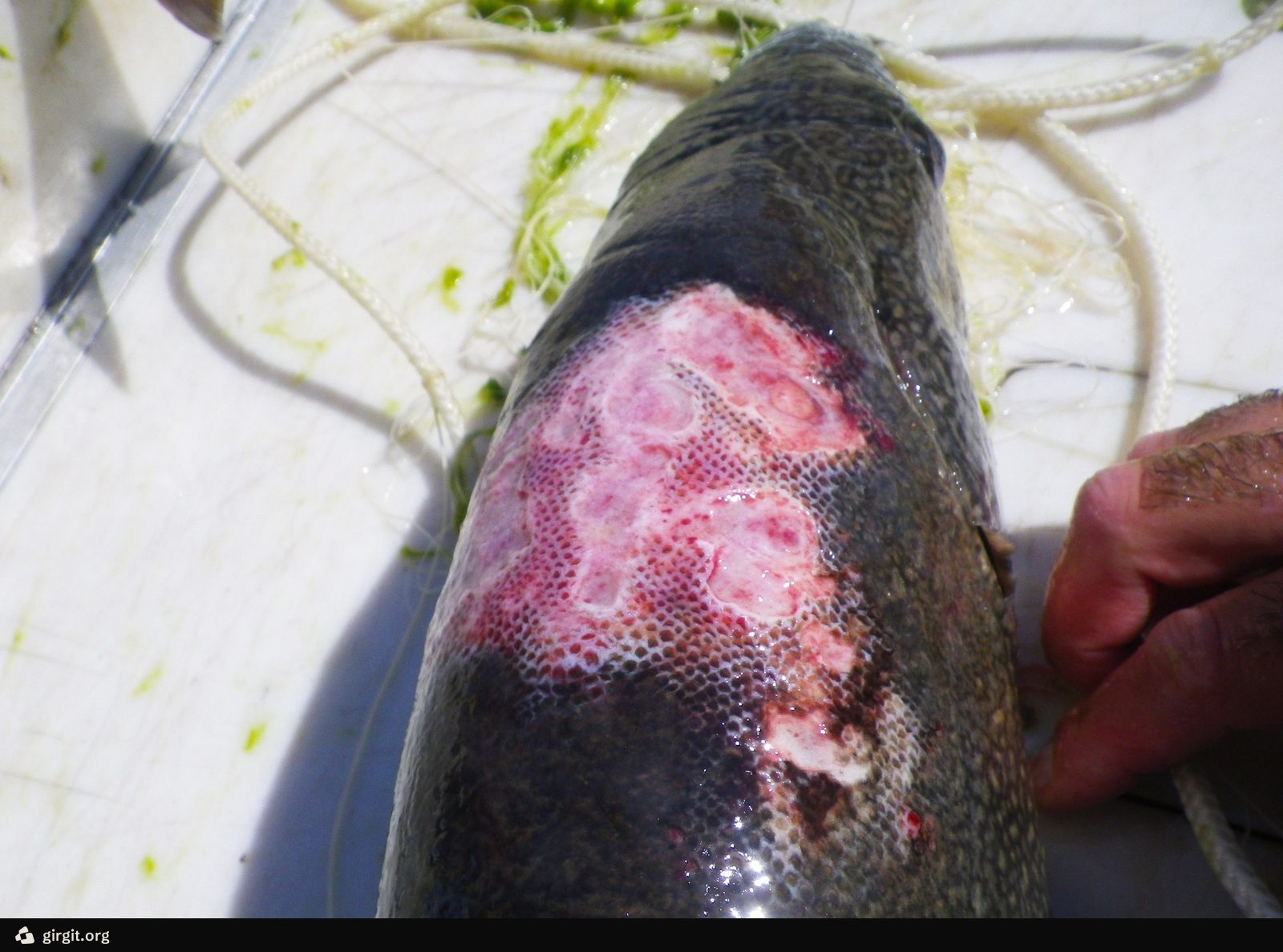 lamprey wounds
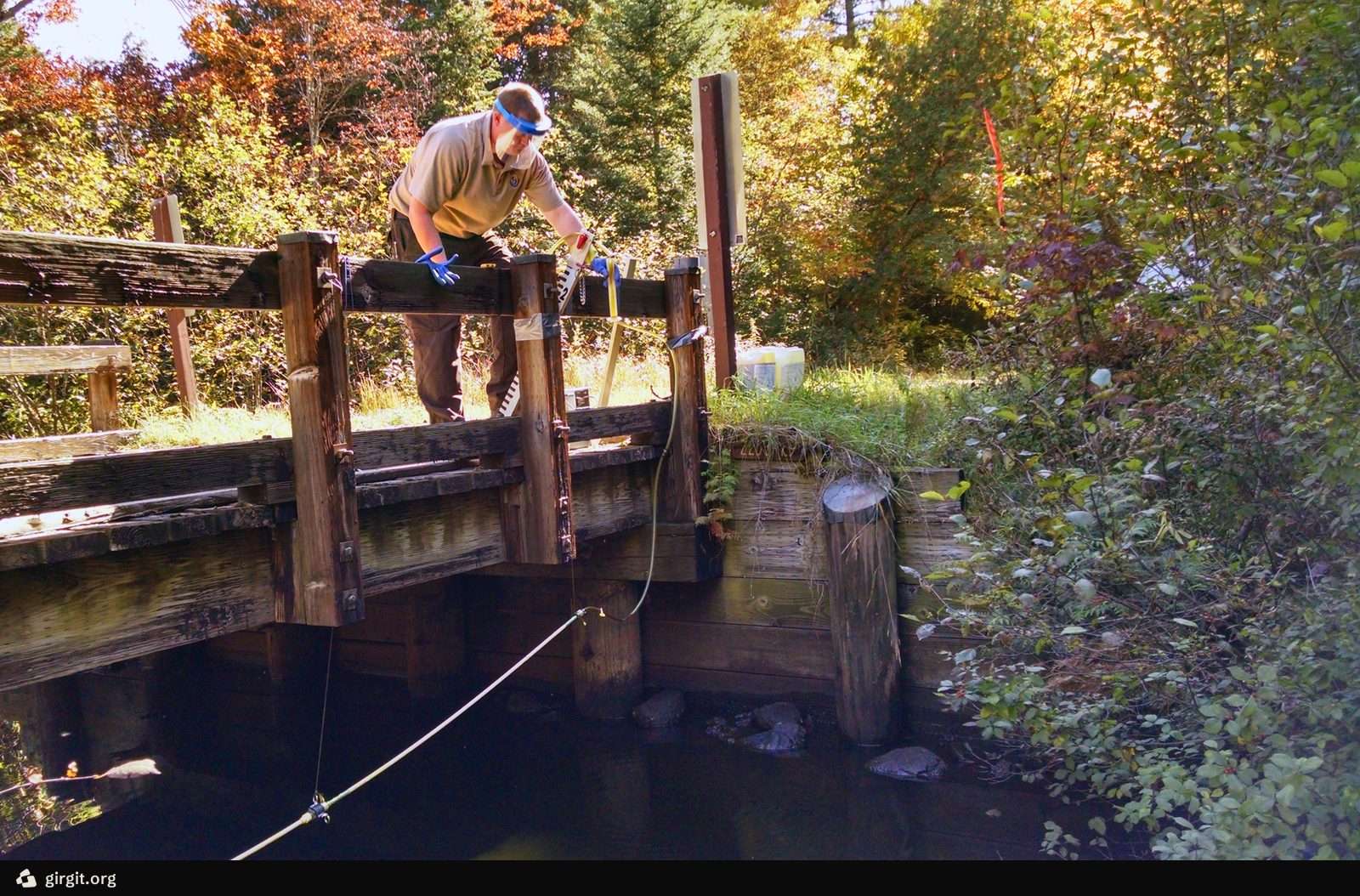
StoryLake trout, early 1960s
2%
of the old 15 million pounds a year
It saved the Great Lakes fishery.
The Commission's Marc Gaden, on TFM, poured in since 1958. Each lamprey feeds for 12 to 18 months. Stop treating and they come back.
Story13 July 2017, Highway 101, Oregon
The slime that shut a road
- 13 containers, about 3,400 kgLive hagfish bound for Korea tipped near Depoe Bay.
- A car and the road coatedCleared with a bulldozer and hoses.
- Fibres finer than a hairUncoil in sea water: slime is almost all water.
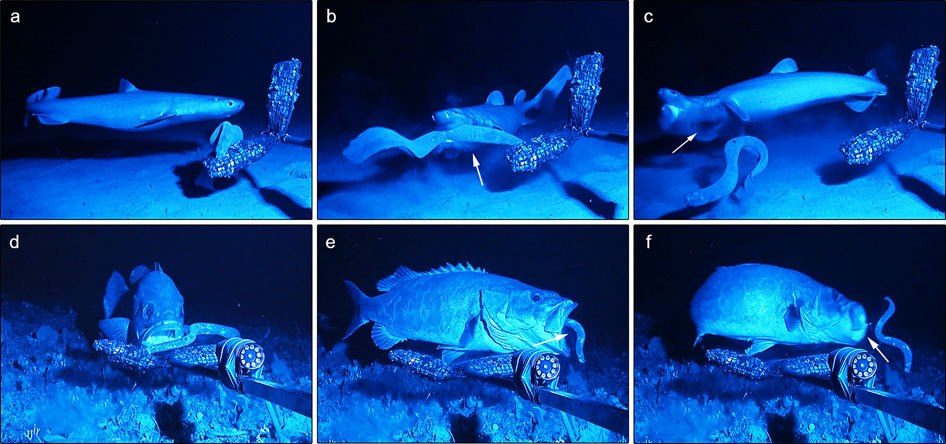
See itDeep-sea cameras off New Zealand, 2011
Bite, gag, let go
Sharks and big fish bit hagfish; in under half a second their mouths and gills filled with slime.
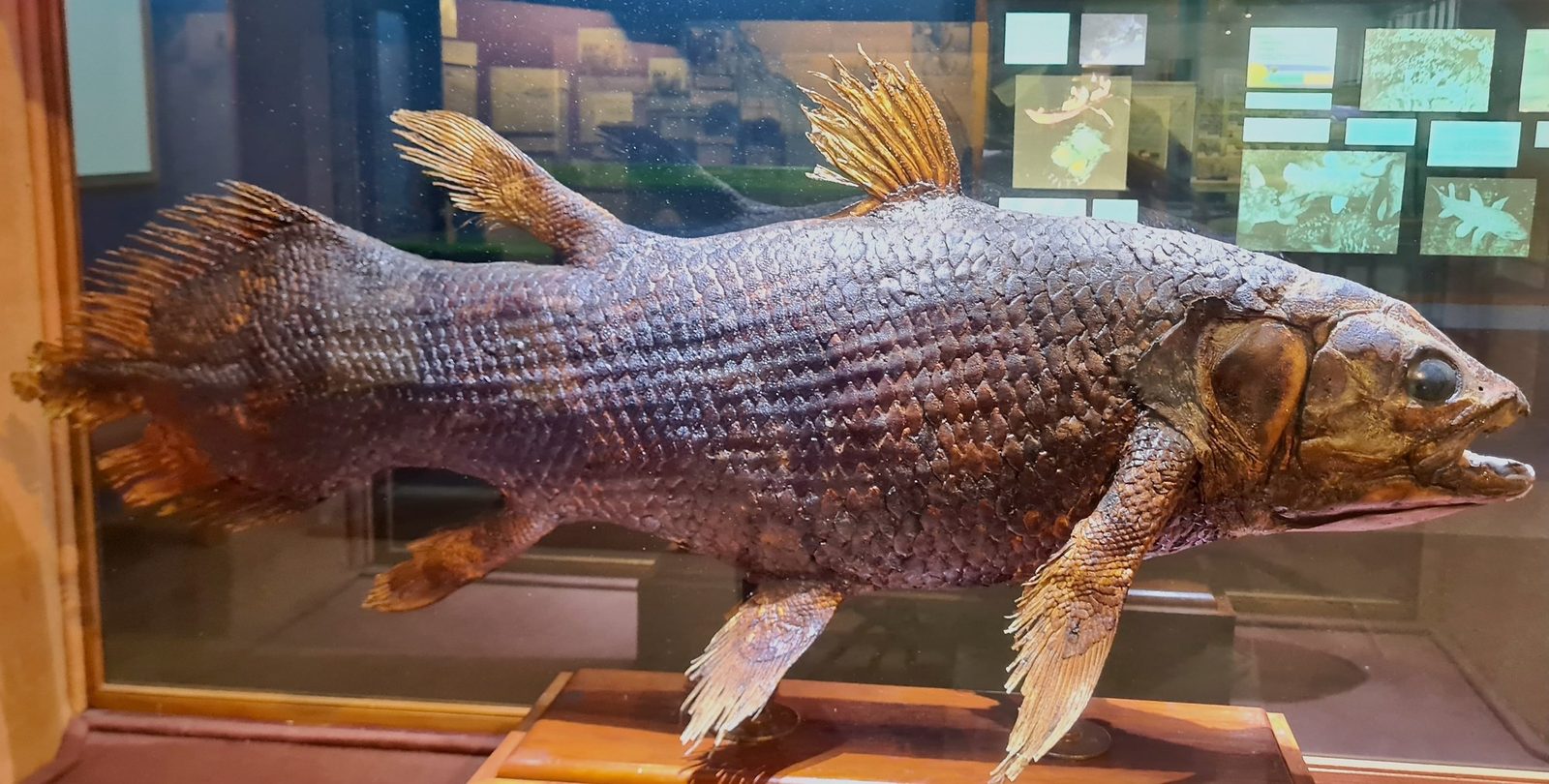 fleshy lobed finthree-lobed tail
Story22 December 1938, East London, South Africa
MOST IMPORTANT PRESERVE SKELETON AND GILLS = FISH DESCRIBED.
Telegram from J. L. B. Smith to Marjorie Courtenay-Latimer, after a blue fin on Captain Hendrik Goosen's trawler Nerine. A fish known only from fossils.
StoryScale by scale, bone by bone
Back from the dead
- 1939February: a true CoelacanthNamed Latimeria chalumnae, for the curator and the Chalumna river.
- 1952The ComorosA second one turns up.
- 1990sIndonesiaA second species. A lobe-finned bony fish: the branch that gave rise to four-legged animals.
Solve itOil against gas · lampreys against a lake
Your turn
Solve it
Use the bladder widget's numbers. Shark muscle and cartilage average about 1,075 kg/m³; sea water is 1,025 kg/m³; shark liver oil (mostly squalene) is about 860 kg/m³. What fraction of a shark's volume would have to be this oil for it to hover without swimming? Compare it with the air bladder of a bony fish.
Hint
Answer
Solve it
Before the lampreys, the upper Great Lakes gave about 15 million pounds (about 6.8 million kg) of lake trout a year. One lamprey kills up to about 18 kg of fish while it feeds. Roughly how many feeding lampreys would it take to eat a whole year's catch? Does that sound possible?
Answer
ConnectAnd still confused?
Where this goes next
Connect it
- Gill slits, concept 8. The pharyngeal gill slits that make you a chordate are the same slits whose arches became jaws and ear bones.
- Your ear, Class 11 Ch 18. The malleus, incus and stapes of the ear are former gill arches 1 and 2.
- Floating, Physics Class 11 Ch 9. The bladder and the shark liver are Archimedes' principle at work; see pressure and depth.
- Lungs to legs, concept 10. The coelacanth is a lobe-finned fish; its cousins' fins became the limbs of the first amphibians.
- Fish on your plate. India is the world's third-largest fish producer (about 175 lakh tonnes in 2022-23, three-quarters from inland waters). The backbone of Indian fish farming is the major carps rohu, katla and mrigal, which would not breed in ponds until Hiralal Chaudhuri and K. H. Alikunhi in Odisha induced spawning with a pituitary injection on 10 July 1957. India now marks 10 July as National Fish Farmers' Day.
- The biggest fish is a shark. The whale shark, a cartilaginous fish that filters plankton, became in 2001 the first fish protected under Schedule I of India's Wild Life (Protection) Act. In Gujarat, a campaign led by the Forest Department compared the whale sharks' yearly visit to a daughter coming home to her parents, and fishers have since freed hundreds of whale sharks caught in their nets. See conservation.
If sharks have cartilage, are they more "primitive" than bony fish?
Not really. Sharks and bony fish are two branches that split long ago, and both have had the same amount of time to evolve. Fossils suggest early relatives of both had bone in their skin and skulls; the shark line later lost most of it and kept a light, flexible cartilage skeleton, which suits a fish with no float. Cartilage is a different design, not an unfinished one.
Does a shark really die if it stops swimming?
Some do, some don't. A shark sinks if it stops, because it has no air bladder. Breathing is a separate question: great whites and makos must swim to push water over their gills (ram ventilation), but nurse sharks pump water with their cheek muscles and can rest on the sea floor. The exam fact, "no air bladder, so they swim constantly to avoid sinking", is about floating.
The textbook says all cyclostomes are parasites that spawn in fresh water. Is that true for hagfish?
No. That description fits lampreys. Hagfish are sea-floor scavengers and hunters that never enter rivers. In the exam, write NCERT's statement; just know it is really about Petromyzon.
Sources
- Great Lakes Fishery Commission: Sea lamprey and Lampricides
- GLFC: Sea lamprey life cycle
- US Fish and Wildlife Service: All about invasive sea lamprey
- National Geographic (2024): the sea lamprey fight
- OPB (2017): Hagfish truck spill on Highway 101
- Zintzen et al. (2011), Hagfish predatory behaviour and slime defence, Scientific Reports
- Hagfish slime gland cells and thread skeins (eLife)
- Ota et al. (2011), vertebra-like elements in hagfish, Nature Communications
- Review: the origin of jaws from the pharyngeal arches
- StatPearls: Embryology, pharyngeal arches
- Natural History Museum: Coelacanths and Smith (1939), Nature 143: 455
- Florida Museum: Shark biology and Britannica: Do sharks die if they stop swimming?
- University of Copenhagen (2021): lungs came before swim bladders
- Lok Sabha answer: India's fish production 2022-23; Vikaspedia: National Fish Farmers' Day
- Gujarat Forest Department: Whale shark conservation