Classification of Elements and Periodicity in PropertiesFull experience
- 1. Why sort the elements?
- 2. Mendeleev's periodic table
- 3. The modern periodic table
- 4. How do you name element 120?
- 5. Why the table has the shape it has
- 6. The s, p, d and f blocks
- 7. Metals, non-metals and metalloids
- 8. How big is an atom?
- 9. How hard is it to pull an electron off?
- 10. Which atoms want extra electrons?
- 11. Valence, and the odd ones at the top
- 12. Where are the most reactive elements?
- Review
2 of 12·NCERT §3.2·pp. 75–78·4 min
Mendeleev's periodic table
The big ideaMendeleev arranged elements by atomic weight so that similar ones fell in the same column, and he trusted the pattern so much that he left gaps for elements nobody had found yet.
In simple words
A man made a big chart of all the building blocks known in his time, from light to heavy, putting look-alikes under each other. Where the chart had a hole, he did not squeeze something in. He said: "Something belongs here, nobody has found it yet, and this is what it will be like." Years later people found those missing ones, and they were just as he said.
The periodic law, 1869
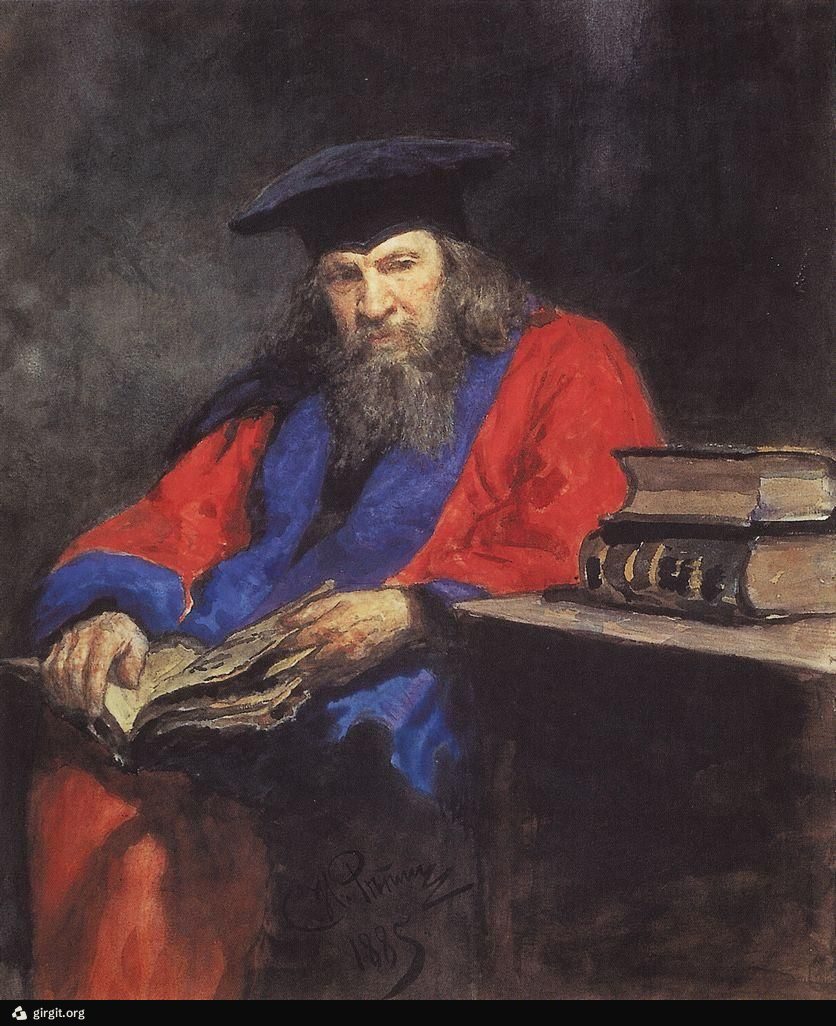
Two chemists, working independently, reached the same idea in 1869: the Russian Dmitri Mendeleev (1834–1907) and the German Lothar Meyer (1830–1895). When elements are lined up by increasing atomic weight, similar physical and chemical properties turn up at regular intervals.
Lothar Meyer drew graphs of atomic volume, and of melting and boiling points, against atomic weight. The graph went up and down in a repeating pattern. Unlike Newlands, he noticed that the length of the repeat changes: it is not always eight. By 1868 he had a table very close to the modern one, but it was published only after Mendeleev's.
Here is a curve of the kind Meyer drew, from a magazine of 1901. Atomic volume is the space one mole of atoms of the solid takes up (molar mass ÷ density). Look where the peaks fall: on the alkali metals, sodium, potassium, rubidium and caesium, every time.
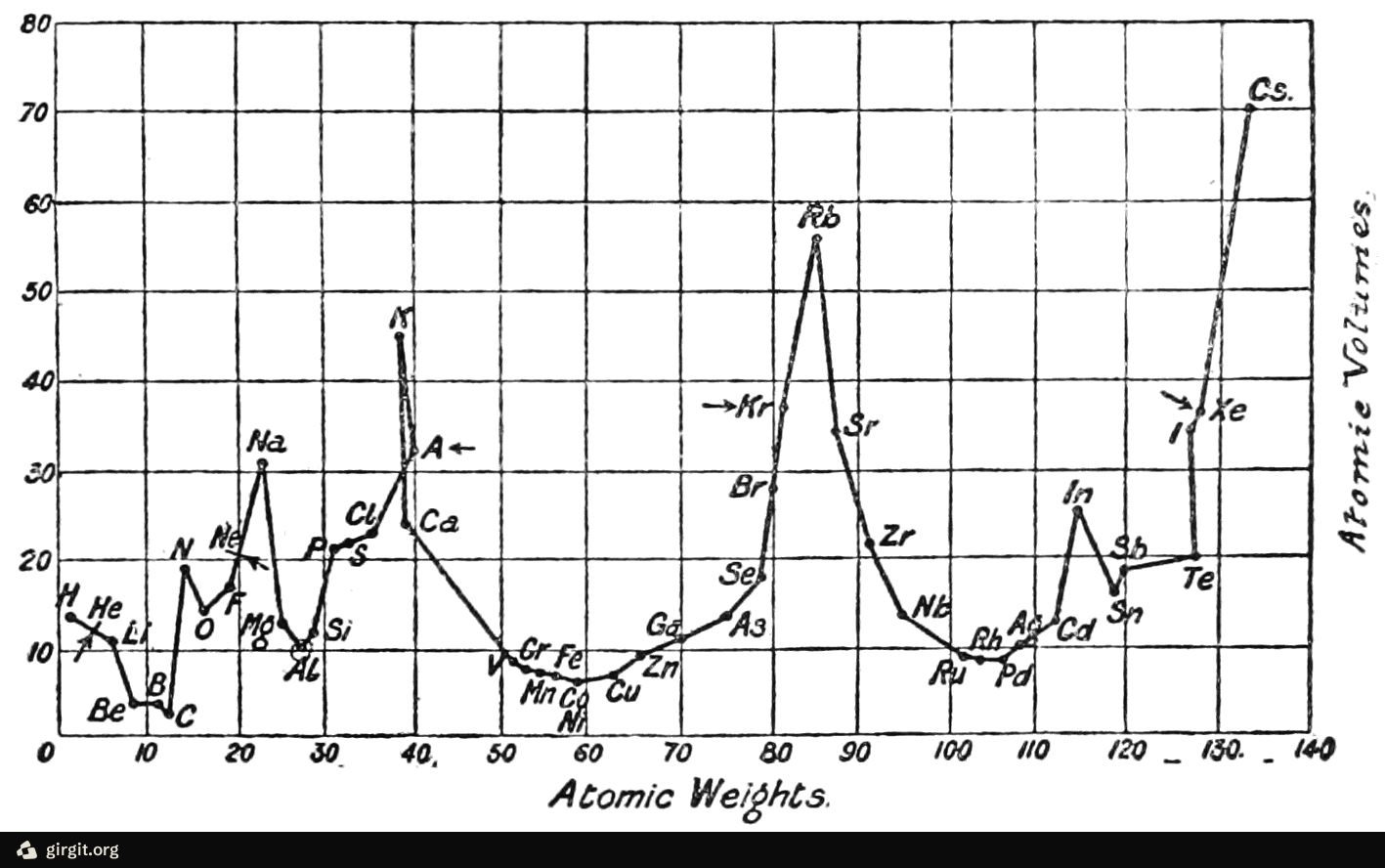 alkali metals on the peaksFe, Co, Ni in the valleynoble gas, added later
Dobereiner began the search, but Mendeleev was the first to publish the Periodic Law:
Mendeleev's periodic law
- The properties of the elements are a periodic function of their atomic weights.
"Periodic function" means the properties repeat as you go along, the way the phases of the moon repeat every month.
How Mendeleev built his table
He laid the elements out in rows and columns, lightest first, so that elements with similar properties sat in the same column, called a group. His system was more detailed than Meyer's: he used a wider range of physical and chemical properties, and leaned especially on the formulas and properties of compounds (for example, which elements form oxides of the type RO or R2O3).
He made two bold choices:
- Similar properties first, weight order second. Iodine (127) is lighter than tellurium (128), so strict weight order would put iodine first. But iodine behaves like fluorine, chlorine and bromine, so Mendeleev put iodine in Group VII with them and tellurium in Group VI. He guessed the weights might have been measured wrongly.
- Gaps for missing elements. Where no known element fitted, he left a blank space and said an undiscovered element belonged there.
This is the table he printed in 1869, in Russian. Here the families run across, not down: B, Al and "? = 68" share a row. Find his question marks: each is an element he was sure existed but nobody had found.
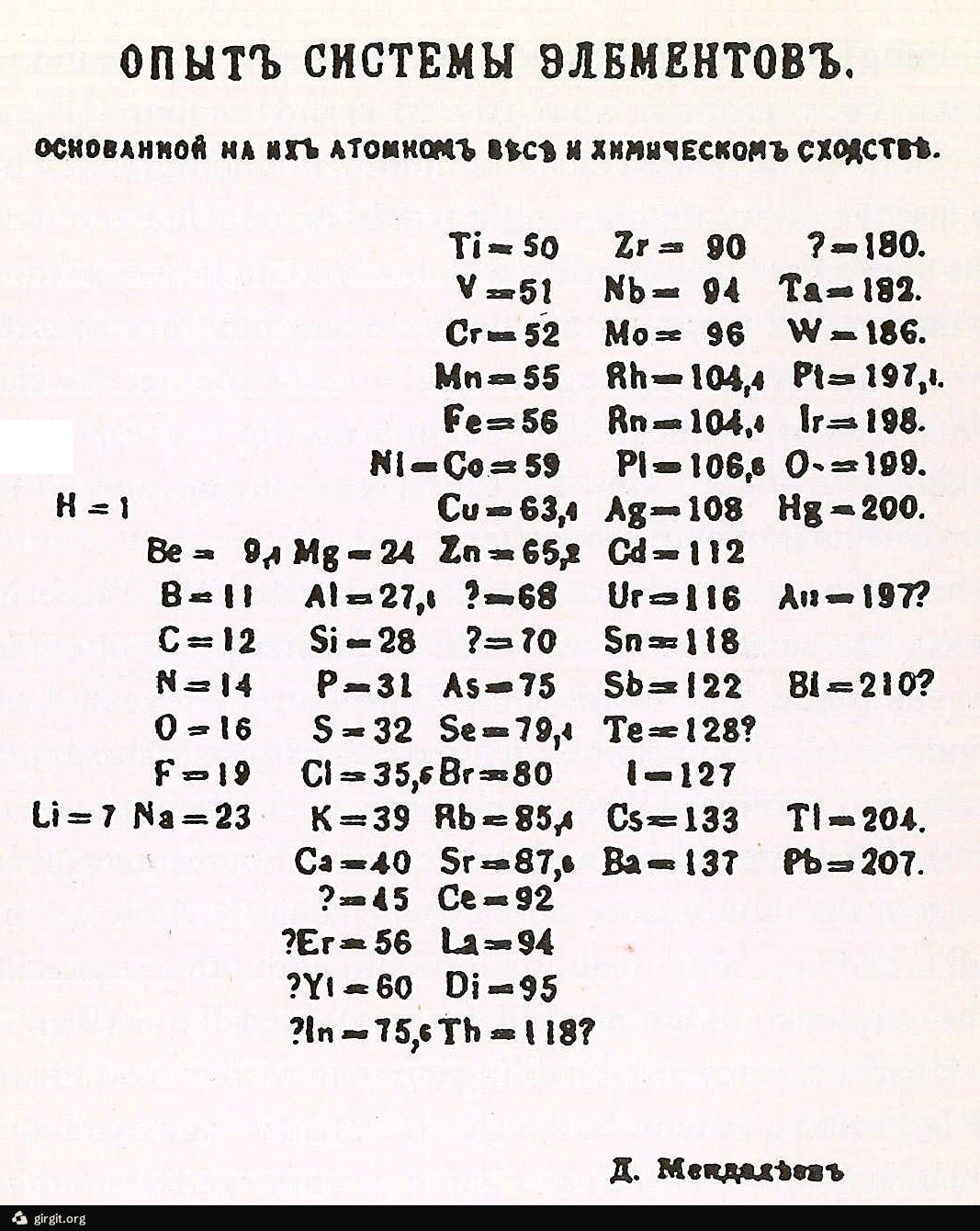 gallium, 1875germanium, 1886scandium, 1879Te before I
Try it: guess first, then switch between strict weight order and Mendeleev's order.
Try it: before you read his numbers, guess what he predicted for the gap below silicon.
Eka-aluminium and eka-silicon
Gallium and germanium were unknown when Mendeleev published his table. He left a gap below aluminium and a gap below silicon, and named the missing elements eka-aluminium and eka-silicon ("eka" is Sanskrit for "one": one place below). He even predicted their properties. When gallium (1875) and germanium (1886) were found, the match was remarkable:
| Property | Eka-aluminium (predicted) | Gallium (found) | Eka-silicon (predicted) | Germanium (found) |
|---|---|---|---|---|
| Atomic weight | 68 | 70 | 72 | 72.6 |
| Density / (g/cm3) | 5.9 | 5.94 | 5.5 | 5.36 |
| Melting point / K | Low | 302.93 | High | 1231 |
| Formula of oxide | \(\ce{E2O3}\) | \(\ce{Ga2O3}\) | \(\ce{EO2}\) | \(\ce{GeO2}\) |
| Formula of chloride | \(\ce{ECl3}\) | \(\ce{GaCl3}\) | \(\ce{ECl4}\) | \(\ce{GeCl4}\) |
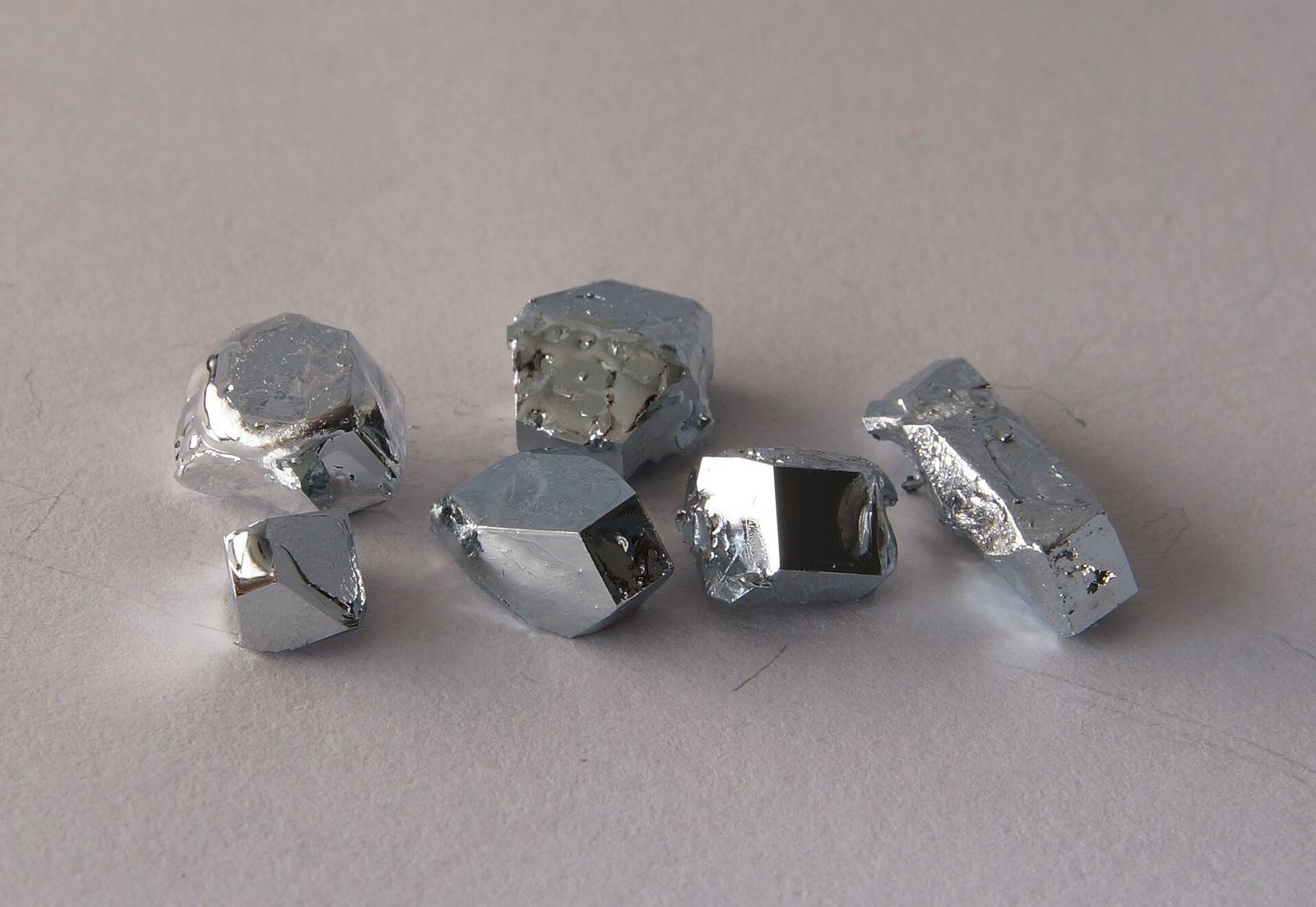 Ga · melts at 29.8 °C
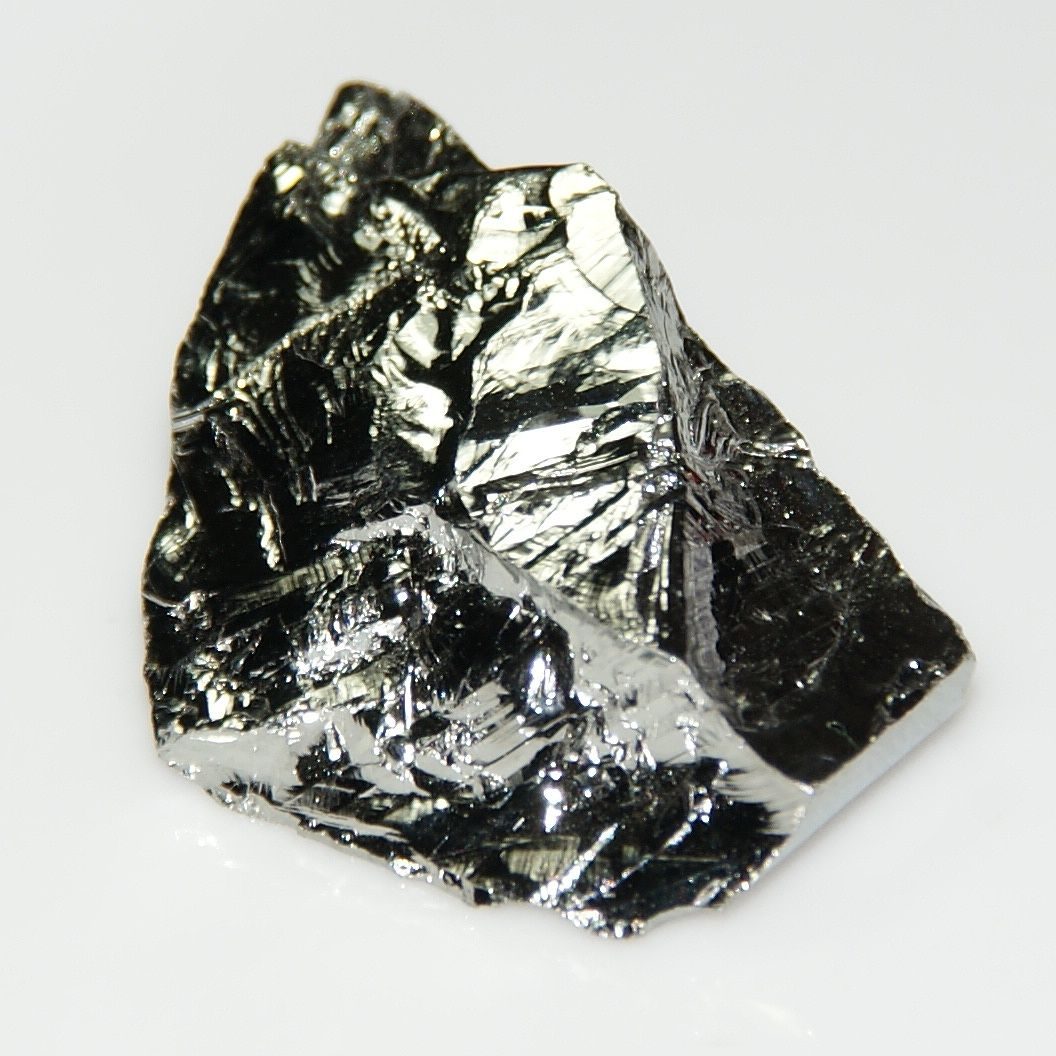 Ge · grey, brittle
Gallium's "low" melting point is very low indeed: 29.8 °C, below body temperature. Here a crystal of solid gallium is lifted out of a pool of liquid gallium:
These bold, numerical predictions came true, and that is what made Mendeleev and his periodic table famous. NCERT shows the version of his table published in 1905.
Try it. Mendeleev's eka-silicon formed \(\ce{EO2}\). Its neighbour above, silicon, forms \(\ce{SiO2}\). What chloride would you predict for germanium, given that silicon forms \(\ce{SiCl4}\)?
Answer
Don't mix these up
- Mendeleev's table was based on atomic weight; the modern one on atomic number.
- Eka-aluminium = gallium; eka-silicon = germanium. Not the other way round: aluminium is in the gallium column.
- Lothar Meyer used physical properties (atomic volume, melting and boiling points); Mendeleev used a broader set, especially compound formulas.
Just remember
The prefixes, names and dates are labels people chose. Nothing deeper to understand here; use the hooks.
- eka = one place below, dvi = two places below, tri = three (Sanskrit)
- The same numbers you count in Hindi: ek, do, teen. Eka-silicon is "silicon plus one row".
- Eka-boron = scandium (1879) · eka-aluminium = gallium (1875) · eka-silicon = germanium (1886)
- Each finder named it after home: Gallium for Gaul (France, Lecoq de Boisbaudran), Germanium for Germany (Winkler), Scandium for Scandinavia (Nilson). Then just keep the partner: gALlium hides "al" for aluminium; germanium sits under silicon, the two chip-making elements.
- Mendeleev and Lothar Meyer, both 1869; Davy Medal to both in 1882
- Meyer = Measured volumes (physical properties, a curve). Mendeleev = Made predictions (compounds, formulas, gaps).
- Mendeleev's law: properties are a periodic function of atomic weight
- Mendeleev = Mass. The modern law swaps in atomic number (next page).
- Periodic Law (Mendeleev)
- Properties of elements repeat in a pattern with atomic weight.
- Group
- A vertical column of similar elements.
- Eka-
- "One place below"; Mendeleev's prefix for an undiscovered element.
- Eka-aluminium
- Gallium, predicted before it was found.
- Eka-silicon
- Germanium, predicted before it was found.
Words to know
Mendeleev put iodine (atomic weight 127) after tellurium (128). Why?
- He ordered elements by atomic number
- He put similar properties ahead of strict weight order
- He did not know their atomic weights
What made Mendeleev's table more convincing than earlier attempts?
- It was the first table ever drawn
- It was ordered perfectly by atomic weight
- It predicted undiscovered elements and their properties correctly
Deep dive · optional
How could Mendeleev describe a metal nobody had seen?
Why a hole in a table can tell you an element's weight and density, why the trick worked for gallium and germanium but failed elsewhere, and what really happened in 1869, 1875 and 1886. Not needed for the exam; it turns "he predicted gallium" from a fact into a method you can use.
The roots: a gap is surrounded by clues
- How could Mendeleev give a number for an element he had never seen?Every gap in his table had neighbours on four sides: above and below in its family, left and right in its row. Their properties were known. The missing element's properties had to lie between them, so a simple average gave a good first guess.
- Why should the missing value lie between the neighbours?Because properties change in small, regular steps across the table. Going down a family, each element is the one above with one more shell of electrons. Going along a row, each element has one more proton and one more electron than the last. Small, regular changes in the atom give small, regular changes in weight, density and the formulas of compounds.
- Why did he dare to say some measured weights were wrong?For the same reason. If the pattern is that regular, a value that breaks it is more likely a bad measurement than a broken pattern. He cut beryllium's accepted weight from about 14 to 9.4 and doubled uranium's from 120 to 240, and he was right both times. He also insisted tellurium must be lighter than iodine. That one he got wrong: the order was right, but for a reason he could not know.
- Why did averaging fail for some of his other gaps?An average can fill a hole inside a pattern you already see. It cannot invent a pattern you have not seen. Nobody expected the fourteen lanthanoids, a whole extra stretch of row, or the noble gases, a whole extra family. Mendeleev also predicted elements that never existed, such as one lighter than hydrogen.
- The bedrockEach element differs from its neighbours by one electron in the same outer shell, or by one whole shell. That is why the table works as a map, and why a blank space on the map can be filled in before anyone goes there.
There is a catch you have already met on the first page: neighbours above and below are not always evenly spaced. Above technetium (element 43) is manganese, 18 places earlier; below it is rhenium, 32 places later, because the lanthanoids sit in between. So the average of the column is pulled far too heavy. The row is safer there. Mendeleev also reasoned from the compounds of the neighbours, and that is what made his predictions so specific: the formula of the oxide, the formula and boiling point of the chloride, whether the oxide dissolves in acid.
The story
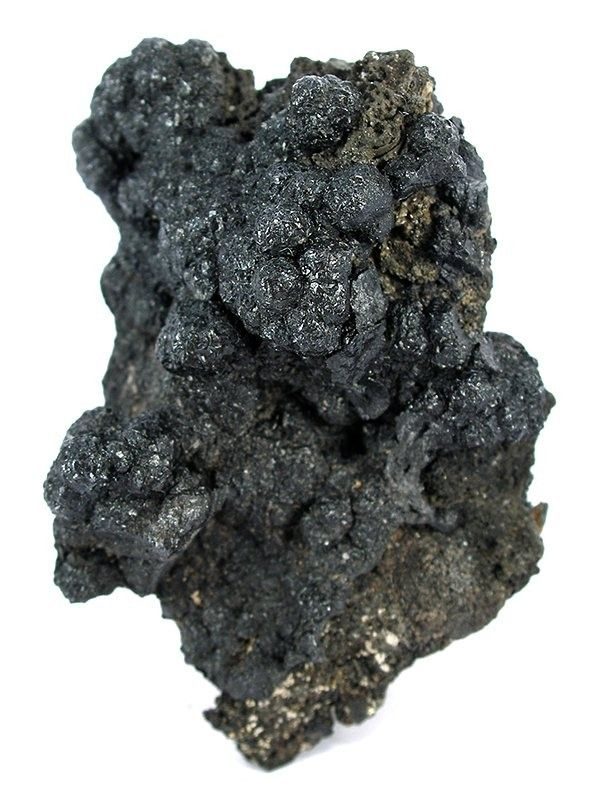 argyrodite, Ag₈GeS₆
See it
Now you be Mendeleev. Choose a gap, choose a property, and decide how much to trust the column against the row. Then compare with the element that was later found. Press Every gap to see how the error changes as you shift your trust, for all four gaps at once.
Scandium, the eka-boron Lars Nilson found in Swedish minerals in 1879, is a soft silvery metal, rare enough that a few grams of its oxide were a prize:
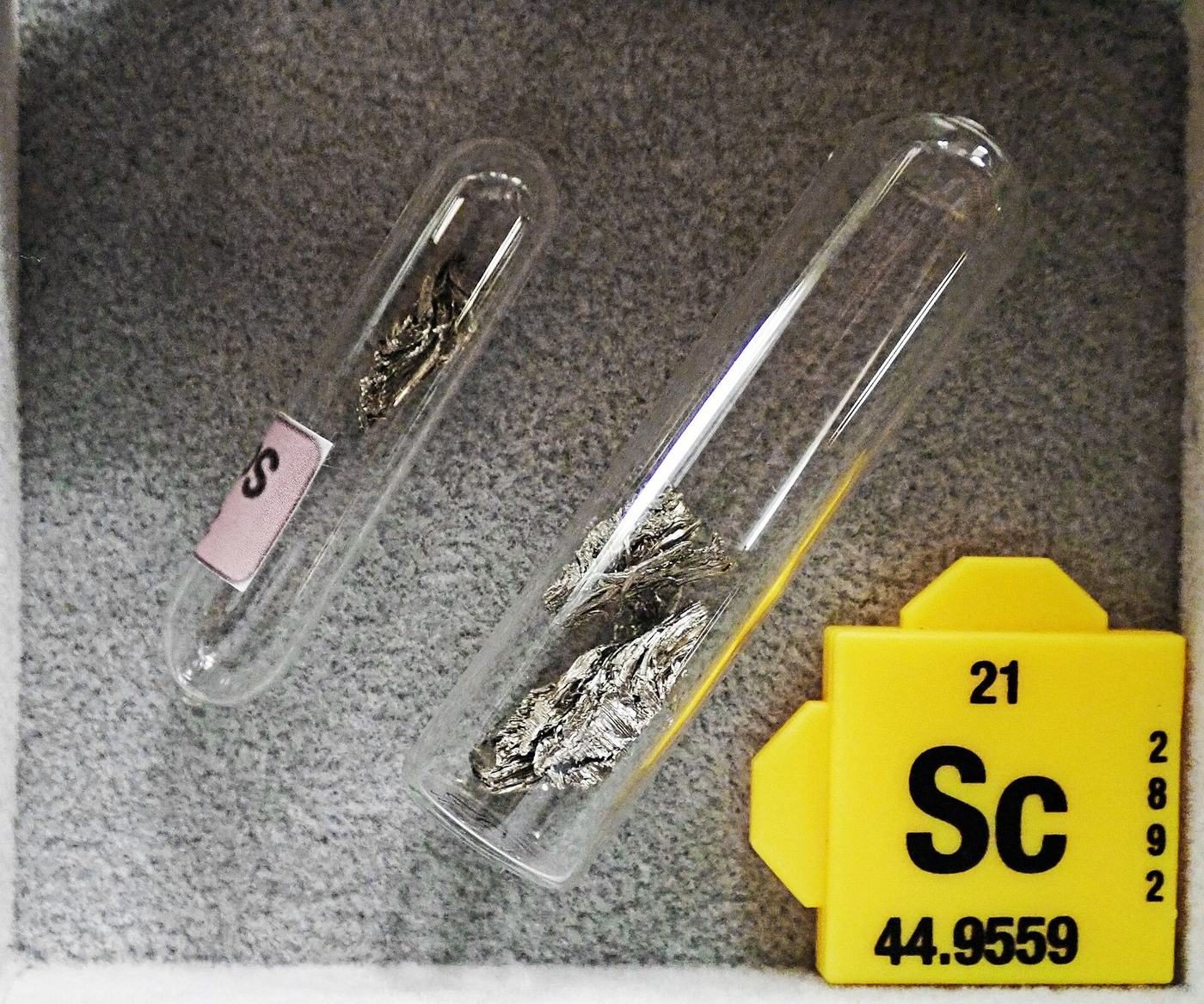 Sc flakes
Solve it
Solve it: predict, then check
Silicon tetrachloride, SiCl4, boils at 57.7 °C. Tin tetrachloride, SnCl4, boils at 114.2 °C. Germanium sits between silicon and tin. Predict the formula and the boiling point of germanium's chloride.
Hint
Answer
Solve it: think harder
Mendeleev put tellurium (atomic weight 127.6) before iodine (126.9) and said tellurium's weight must have been measured wrongly. Later, careful measurements kept giving 127.6. So who was right about the order, and why is tellurium heavier anyway? Tellurium is element 52, iodine element 53. Natural iodine is a single isotope, iodine-127. About two-thirds of natural tellurium is tellurium-128 and tellurium-130.
Answer
Solve it: spot the error
A student uses Mendeleev's law strictly: "Argon weighs 39.9 and potassium 39.1, so potassium must come first, and argon must sit in the alkali-metal family." What goes wrong?
Answer
Connect it
Connect it
- Triads, previous page. Averaging neighbours is Dobereiner's trick, done in two directions, and it fails for the same reason: unequal jumps. See Why sort the elements?
- The spectroscope, Chapter 2. Gallium was found by two new spectral lines, just as caesium and helium were. See Atomic spectra.
- Moseley, next page. Atomic number fixed tellurium and iodine, argon and potassium, cobalt and nickel. See The modern periodic table and Atomic number, isotopes and isobars.
- The lanthanoids, Class 12. The row Mendeleev could never place: The lanthanoids.
- Germanium today. Eka-silicon turned out to be a semiconductor like silicon itself. The first transistors, announced in 1948, were made of germanium; see Metals, non-metals and metalloids for why the elements on that border behave this way.
- Element 101. Mendelevium, made in 1955, is named after him.
Still confused?
Did Mendeleev predict the noble gases?
No. Argon was found in 1894, and helium, neon, krypton and xenon soon after. They needed a whole new family that his table had no room for, and he did not accept them at once: at first he suggested argon might be a form of nitrogen with three atoms to a molecule. By 1902 he had placed them in a new group, "group 0". The table bent to fit them, which is a sign of a good idea: it could grow without being torn up.
If he left gaps, why do we say Newlands' table "failed" but Mendeleev's did not?
Leaving gaps let the table make claims that could be checked: "an element will be found here, with this weight and this oxide". When gallium, scandium and germanium turned up and fitted, the table had passed a test it could have failed. Newlands' table had no gaps, so it made no such claims.
Is Mendeleev's table the one in our textbooks?
No. His had about eight groups, ordered by weight, with families sometimes split into two sub-columns. Today's long form has 18 groups, ordered by atomic number, and the lanthanoids and actinoids sit below. The idea, families repeating, is his.
Sources
- Dmitri Mendeleev (Wikipedia): Principles of Chemistry, the dream as told by Inostrantsev, March 1869, uranium's weight, Davy Medal 1882, mendelevium
- Physics World (2019): the table dated 17 February 1869 (Julian), 1 March (Gregorian)
- Simon Schaffer, "Dozing at his desk", London Review of Books (2005), on Gordin's A Well-Ordered Thing: the dream and card stories have little if any evidence
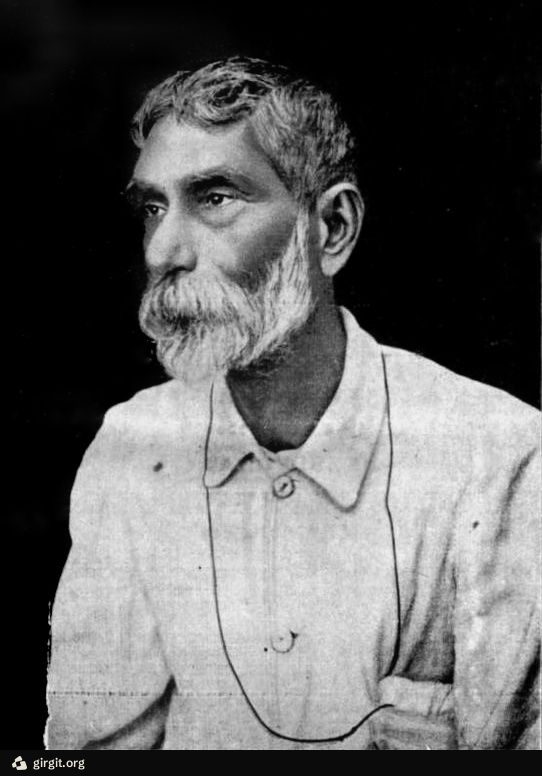
- History of the periodic table (Wikipedia): Meyer's 1864 and 1870 tables and atomic-volume curve, beryllium's weight, the list of predictions, Winkler and Richter, argon as triatomic nitrogen, P.C. Ray and T.H. Holland (citing Mazumdar 2010)
- Mendeleev's predicted elements (Wikipedia): eka, dvi, tri; predicted and found values for gallium and germanium; noble gases in group 0 by 1902
- Gallium (Wikipedia): density 4.7 then 5.9, Gallia and the rooster, melting point 29.76 °C and Paul-Émile Lecoq de Boisbaudran (Wikipedia): 52 kg of sphalerite, two new lines
- Germanium (Wikipedia): argyrodite, 6 February 1886, the name and Clemens Winkler (Wikipedia): the 93 to 94 per cent analysis
- Prafulla Chandra Ray (Wikipedia): Presidency College, Calcutta
- Mendelevium (Wikipedia): first made in 1955 and Germanium (Wikipedia): the germanium transistor of 1948
- Scandium (Wikipedia): Nilson 1879, euxenite and gadolinite
- Boiling points: SiCl4, GeCl4, SnCl4 (Wikipedia)
- Isotopes: CIAAW, tellurium and CIAAW, iodine; densities, melting points and atomic weights in the widget from the Wikipedia element pages and the RSC periodic table
Picture and video credits
Show 5 picture and video credits
- gallium-crystals.jpg: Maxim Bilovitskiy, CC BY-SA 4.0
- germanium-polycrystalline.jpg: Jurii, CC BY 3.0
- gallium-crystal-lifted-from-liquid.mp4: Gallium0031, CC BY 3.0
- argyrodite-himmelsfuerst-mine.jpg: Robert M. Lavinsky, CC BY-SA 3.0
- scandium-in-a-vial.jpg: James St. John, CC BY 2.0


