Classification of Elements and Periodicity in PropertiesFull experience
- 1. Why sort the elements?
- 2. Mendeleev's periodic table
- 3. The modern periodic table
- 4. How do you name element 120?
- 5. Why the table has the shape it has
- 6. The s, p, d and f blocks
- 7. Metals, non-metals and metalloids
- 8. How big is an atom?
- 9. How hard is it to pull an electron off?
- 10. Which atoms want extra electrons?
- 11. Valence, and the odd ones at the top
- 12. Where are the most reactive elements?
- Review
7 of 12·NCERT §3.6.5·p. 85·3 min
Metals, non-metals and metalloids
The big ideaMetals fill the left and centre of the table, non-metals sit at the top right, and a diagonal zig-zag of metalloids with mixed properties runs between them.
In simple words
Most building blocks are shiny, bendy and carry heat well, like a steel tumbler. A few, crowded into one corner of the chart, are dull, break easily and do not carry heat, like a lump of coal or the air. Along the border between the two sit some in-between ones that act a bit like both.
Metals
More than 78% of all known elements are metals, and they occupy the left side (and the whole middle) of the table. Typical metals:
- are solids at room temperature. Mercury is a liquid; gallium (303 K) and caesium (302 K) melt only just above room temperature, so a piece of gallium melts in your palm;
- have high melting and boiling points;
- are good conductors of heat and electricity;
- are malleable (can be hammered into thin sheets, like the silver varq on sweets) and ductile (can be drawn into wires, like copper wiring).
Two metals you may not think of as metals: sodium is soft enough to cut with a kitchen knife, and the cut face shines like a mirror for a few seconds before air dulls it. Silver can be beaten so thin that the varq on a sweet is less than a thousandth of a millimetre thick.
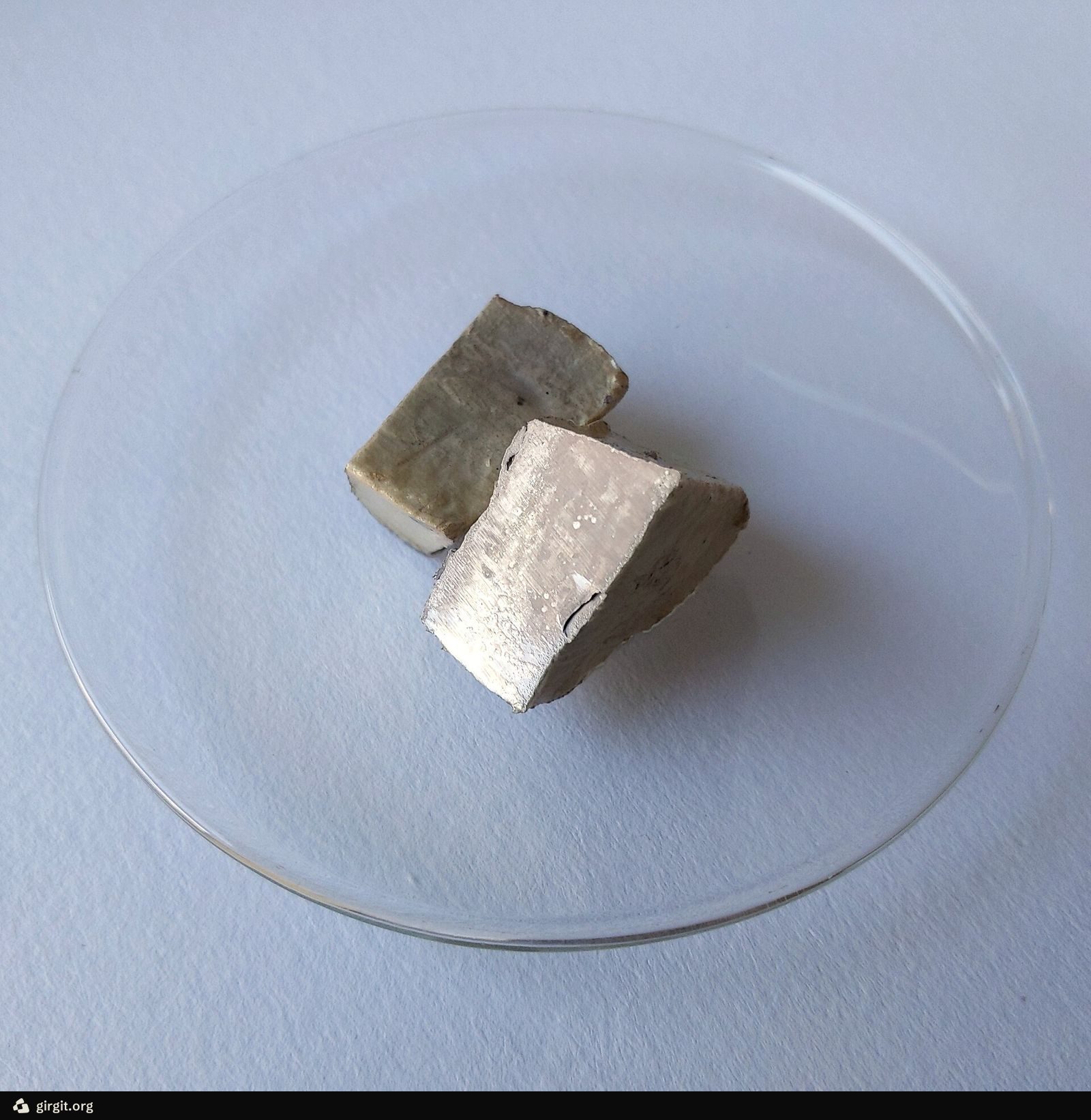 Na: fresh cut, shinyold surface: dull, tarnished
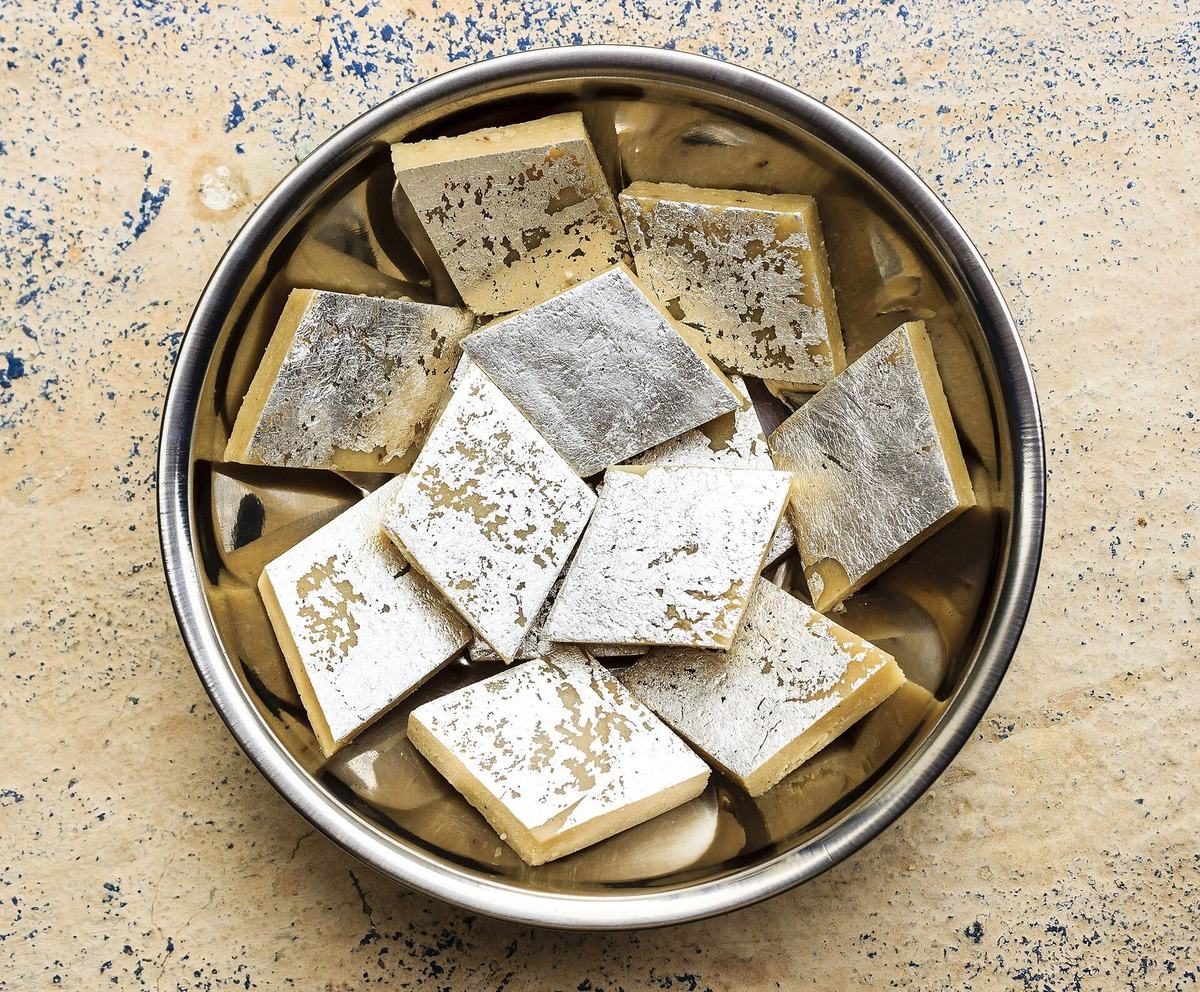 silver vark: under 1 µm thick
Mercury and gallium show the metal shine even as liquids:
Non-metals
Non-metals are found at the top right of the table, and there are fewer than twenty of them. Typical non-metals:
- are solids or gases at room temperature (bromine is the one liquid);
- have low melting and boiling points, except boron and carbon (diamond), which are very high;
- are poor conductors of heat and electricity;
- as solids, are mostly brittle: neither malleable nor ductile. Hit a lump of sulphur and it crumbles.
Carbon shows both faces of a non-metal. Diamond is the hardest natural substance and does not conduct at all. Graphite, the same element, conducts along its layers (that is why it is used as an electrode), but it is still a brittle, flaky non-metal.
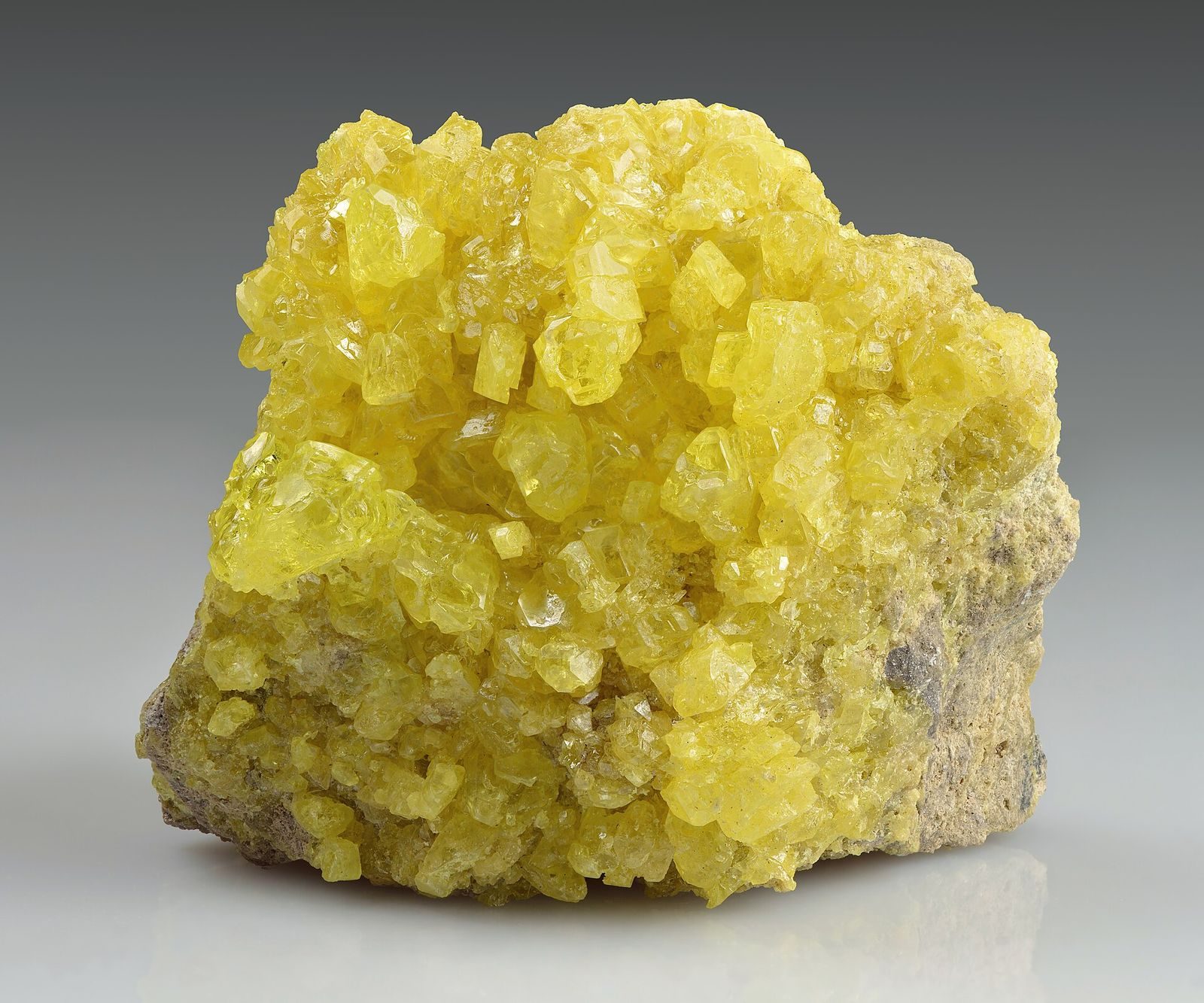 S: yellow, brittle, no shine
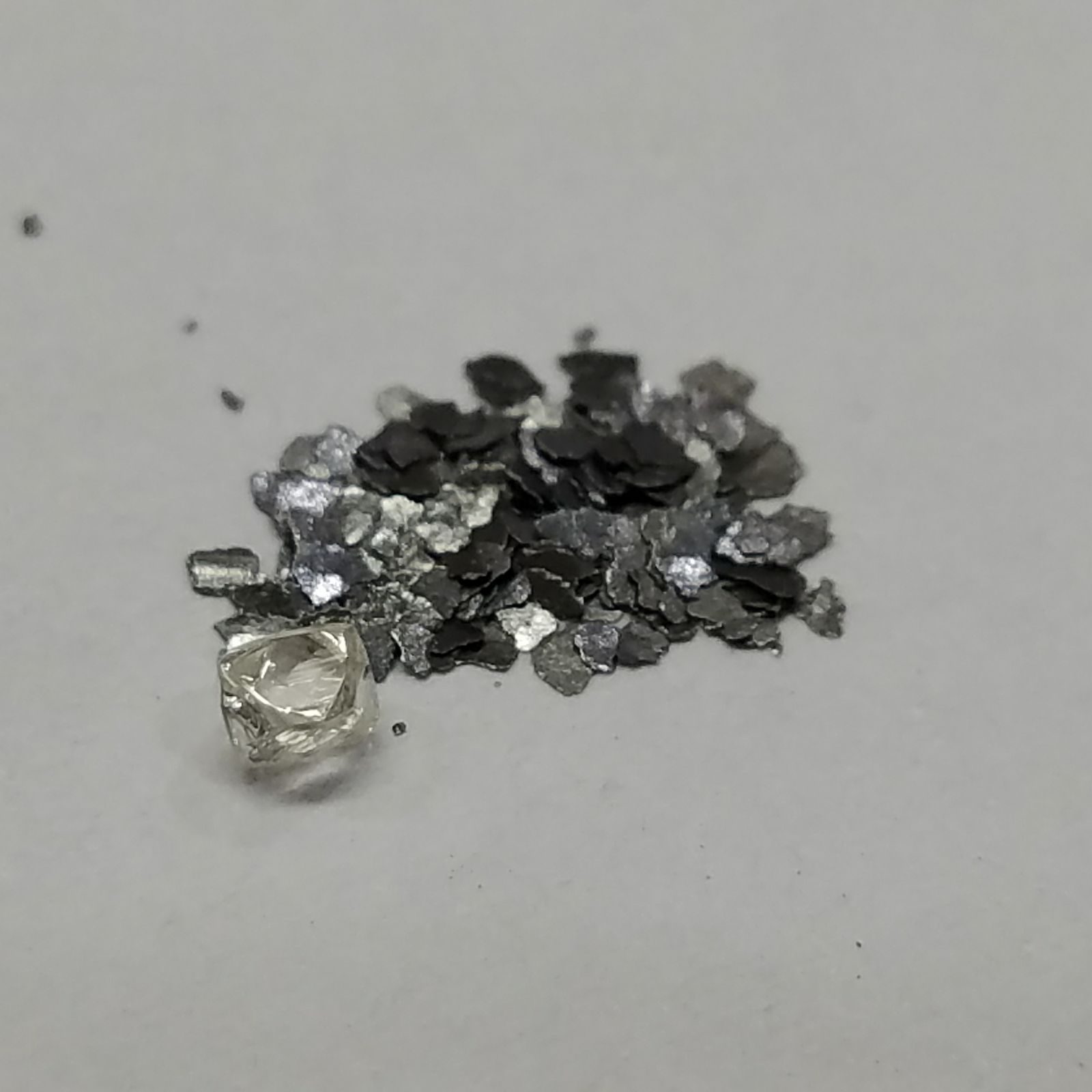 diamond: an insulatorgraphite: conducts
Try it: guess first, then sort the p-block one element at a time and watch the border appear.
The trend, and the border
- Across a period (left to right): metallic → non-metallic. Sodium is a soft metal; chlorine, at the other end of the same row, is a poisonous gas.
- Down a group: more metallic. In group 14, carbon is a non-metal, silicon and germanium are metalloids, tin and lead are metals.
The change is not sudden. A thick zig-zag line runs diagonally across the p-block, starting between boron and aluminium and stepping down to between polonium and astatine. The elements along it, such as silicon, germanium, arsenic, antimony and tellurium, show properties of both metals and non-metals. These are the metalloids or semi-metals. Silicon, for example, shines like a metal but is brittle, and conducts electricity only a little, which is exactly why it is used in computer chips.
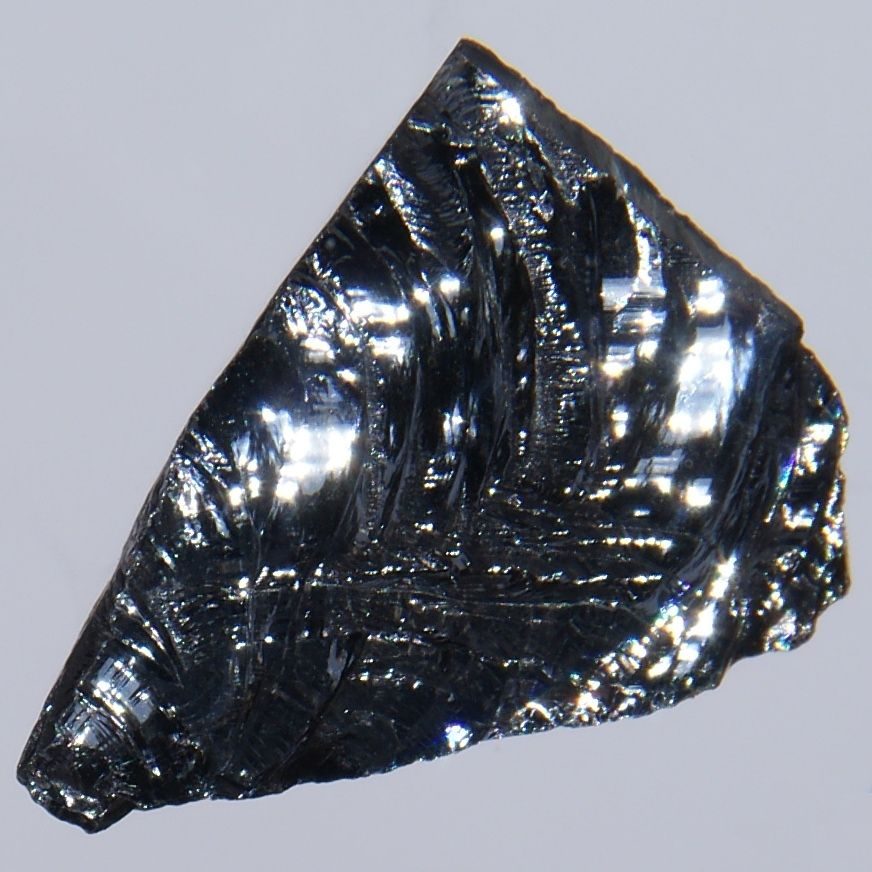 Si: shines like a metalbreaks like glass
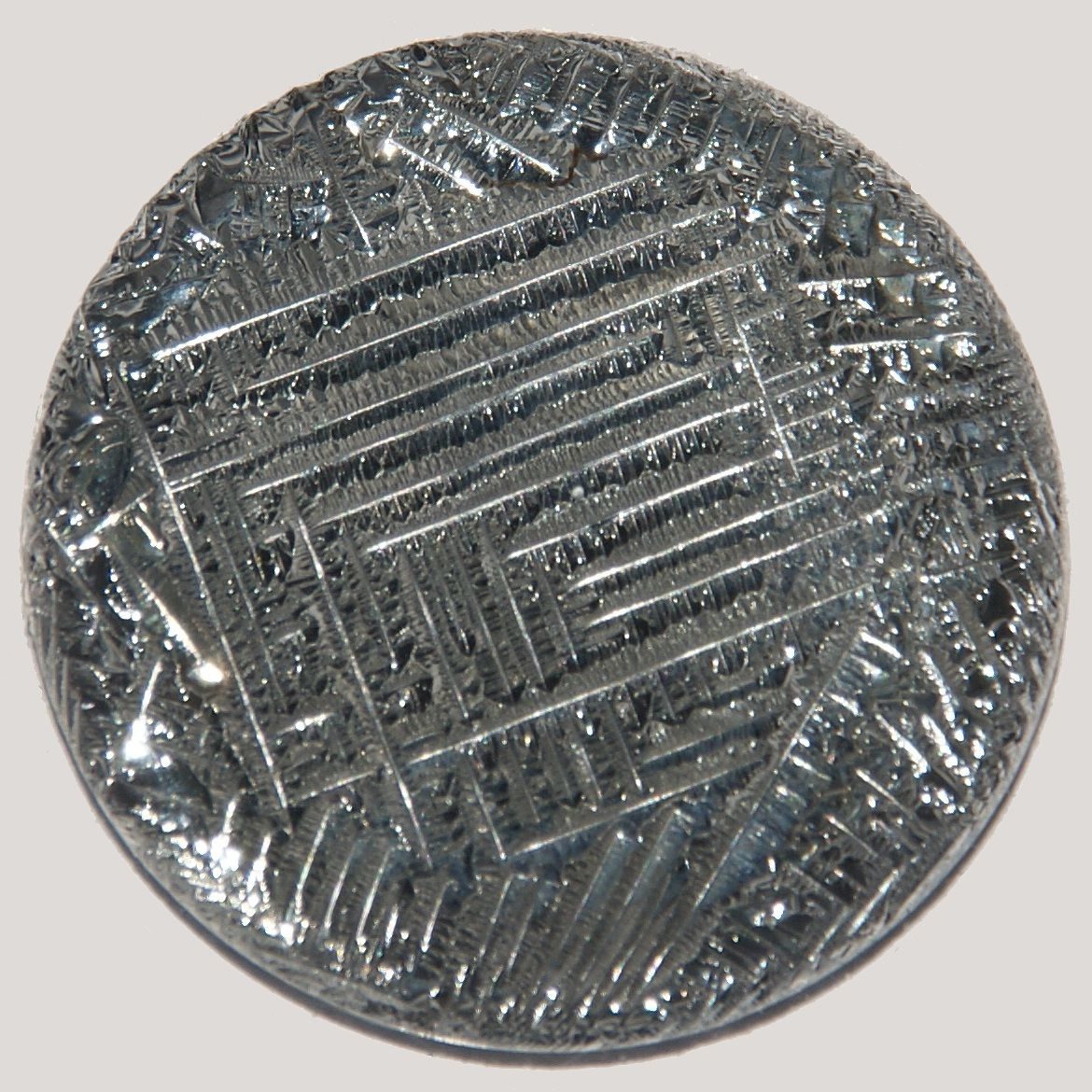 Te: shiny but brittle
Try it: test period 3 from sodium to chlorine with a bulb and a battery.
Worked example: ordering metallic character
Arrange in increasing metallic character: Cs, Al, S, K, Mg.
- Period 3 has S, Al and Mg. Across a period metallic character falls, so S < Al < Mg.
- K is in group 1, period 4: more metallic than Mg (further left and further down).
- Cs is in group 1, period 6: more metallic than K (further down).
- Answer: S < Al < Mg < K < Cs.
Try it. Arrange in increasing metallic character: Ca, B, Be, C, Ba.
Answer
Don't mix these up
- Gallium and caesium are both low-melting metals (about 303 K and 302 K). Neither has a high melting point.
- Boron and carbon are non-metals with high melting points: the exceptions among non-metals.
- Metallic character goes up going down a group and going left in a period.
Just remember
Which elements count as metalloids is a convention (books differ), not a law of nature, and the liquids are simply facts to know. Use the hooks.
- Metalloids (NCERT): Si, Ge, As, Sb, Te
- "Sir, Get Assam's Sab Tea" (sab = all). They also walk down a staircase: two in group 14 (Si, Ge), two in group 15 (As, Sb), one in group 16 (Te). Many other books add boron and sometimes polonium; in an NCERT exam, use these five.
- Liquid at room temperature: mercury (a metal) and bromine (a non-metal)
- "Hug, Bro": one liquid from each side of the line, Hg and Br.
- Melt just above room temperature: gallium (303 K) and caesium (302 K)
- Both melt near 30 °C, so on a Delhi summer afternoon both would be puddles. Gallium is the one that melts in your palm (caesium you never touch: it bursts into flame in moist air).
- Non-metals with very high melting points: boron and carbon (diamond)
- The first two letters of the alphabet, B and C, are the two hard exceptions.
- Metal
- Shiny, conducts heat and electricity, malleable and ductile; on the left of the table.
- Non-metal
- Dull, poor conductor, brittle when solid; at the top right.
- Metalloid (semi-metal)
- An element on the zig-zag border with properties of both, e.g. Si, Ge, As, Sb, Te.
- Malleable
- Can be beaten into thin sheets.
- Ductile
- Can be drawn into wires.
- Brittle
- Breaks or crumbles when hit.
Words to know
Element X is brittle, shiny, and a weak conductor of electricity. Where in the table is it most likely to be?
- In group 1
- On the zig-zag line between metals and non-metals
- In group 18
Which is the most metallic: Si, P, Na, Mg?
- Si
- P
- Na
- Mg
Deep dive · optional
What decides which side of the staircase an element lands on?
Why metals shine and conduct, why the border between metals and non-metals is a staircase, and why a metalloid like silicon conducts better when it is hot, which a metal never does. The exam does not ask this; it is here so the zig-zag line stops being a line you memorise.
The roots: whose electron is it?
- Why does a metal shine and carry current?Because its outer electrons do not belong to any one atom. They roam through the whole piece like a crowd in a station. Push them with a battery and they flow: a current. Light falling on them makes them jiggle in step with it, and jiggling electrons send the light straight back: the shine.
- Why are the outer electrons free in sodium but locked up in sulphur?Two pulls compete. An atom pulls on its own outer electron (how hard is its ionisation enthalpy). Its neighbours in the solid pull on that electron too. A sodium atom holds its single outer electron loosely (496 kJ mol−1 frees it) and sits among 8 close neighbours, so the electron is as much at home beside the next atom as beside its own: it wanders. A sulphur atom holds its electrons tightly and shares them with only two partners in fixed covalent bonds, so they stay put.
- Why does that make the border a staircase?Across a period, nuclear charge grows while the shell stays the same, so the hold on outer electrons gets stronger and elements turn non-metallic towards the right. Down a group, each step adds a shell: the outer electrons sit further out, behind more inner electrons that shield them, so the hold gets weaker and elements turn metallic. Each step down, you must go a step further right to reach the same grip. Draw that line and you get a diagonal staircase.
- Then what is a metalloid, exactly?In a solid, the energies an electron may have merge into wide bands: a full band (the electrons in bonds) and an empty band above it, where electrons could move freely. Between them may lie a gap with no allowed energies. Diamond's gap is 5.5 eV, far too wide to jump: an insulator. Silicon's is 1.14 eV and germanium's 0.67 eV: a few electrons get kicked across by heat, so they conduct a little. In tin and lead the two bands overlap: no gap, a metal. A metalloid is an element whose gap is small but not zero.
- The bedrockOpposite charges attract, more weakly with distance and less when inner electrons stand in between (Chapter 2). And electrons can only have allowed energies. The staircase is these two facts, read across the table.
The physicist Karl Herzfeld put the tug of war into one number in 1927: compare how strongly an atom holds its outer electron with how strongly the neighbours in the solid pull on it. When the neighbours' pull wins, the electron goes free and the element is a metal. In 1983 Peter Edwards and Michell Sienko showed that this one ratio sorts the periodic table remarkably well, with the familiar metalloids sitting right where it is close to 1. It is a rough classical idea, not the whole truth, but it explains why the border runs where it does.
One consequence is a real surprise. Heat a metal and its free electrons are already free; the hotter atoms only jiggle more and get in their way, so resistance rises. Heat a metalloid and you kick more electrons across its gap, so resistance falls, fast. Measured at room temperature, silicon's resistivity drops by about 7.5% for every degree you warm it, while copper's rises by about 0.4%.
The story
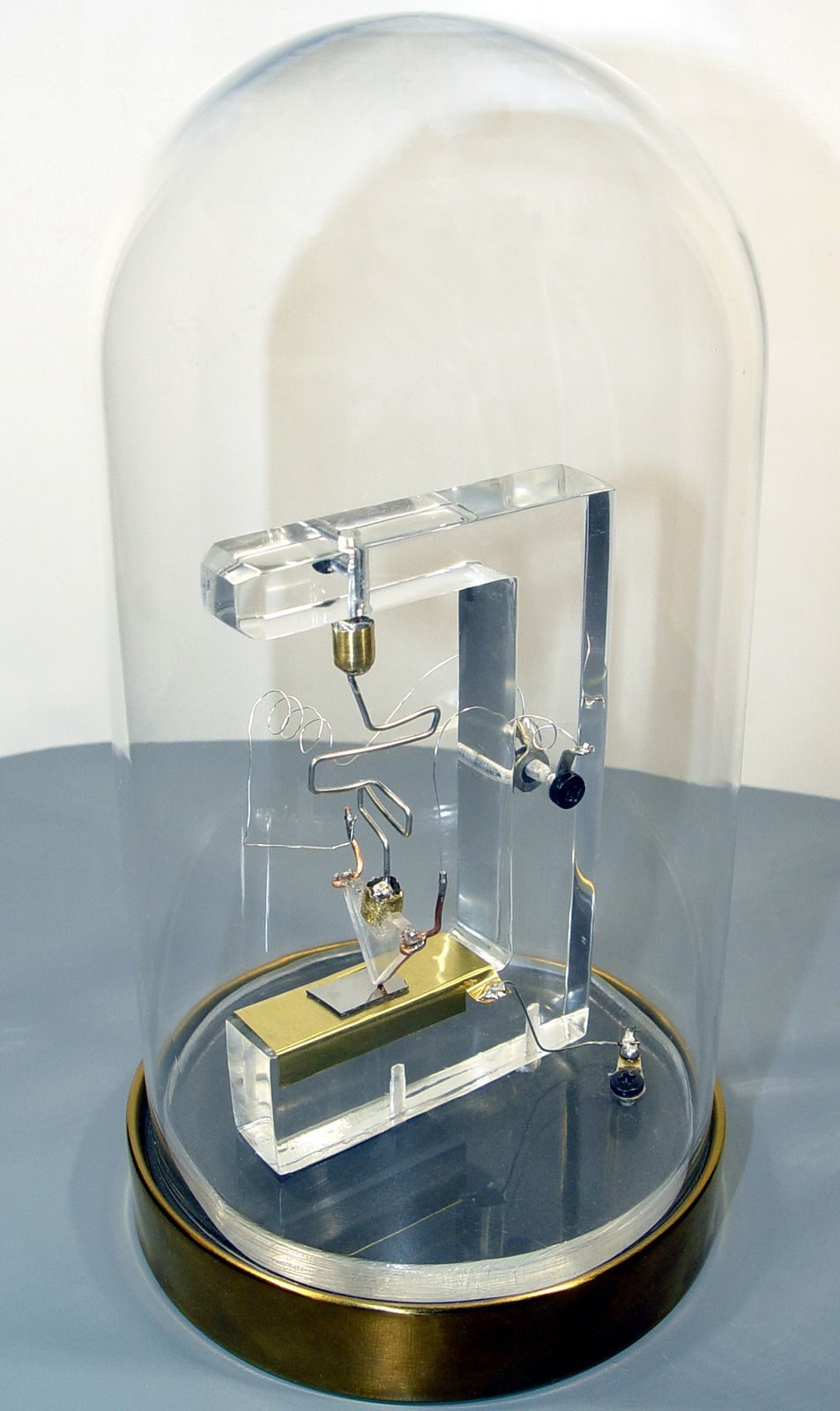 germanium crystalgold contacts
 grey tin: crumbling
See it
Pick an element of group 14 and warm it. Watch the gap, the electrons heat lifts across it, and where the element sits on a ladder of resistivity that spans twenty powers of ten. Then press Every temperature to see all six at once.
The free electrons are also why a metal shines. Cut sodium and the fresh face is a mirror; within seconds oxygen and moisture turn the surface into a dull crust of oxide and hydroxide, which has no free electrons, and the shine is gone.
A metalloid made pure enough becomes the most precisely made object most people own. A whole wafer of silicon is one single crystal, cut into hundreds of chips:
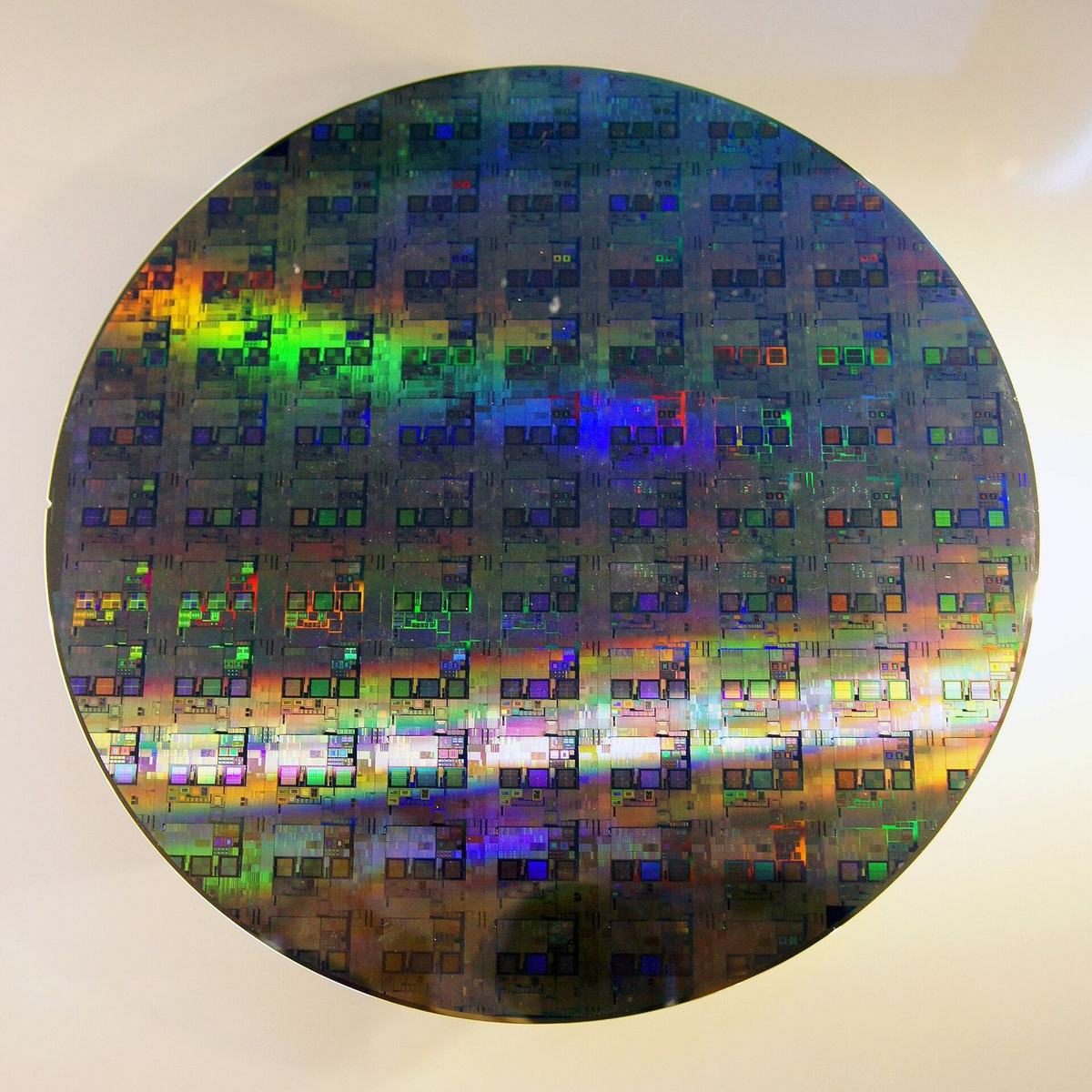 pure silicon, 30 cm acrosseach square is one chip
Solve it
Solve it: predict a measured number
In the simple band picture, a semiconductor's resistivity goes as \( \rho \propto T^{-3/2}\, e^{E_g/2kT} \), where \( E_g \) is the gap and \( k = 8.617 \times 10^{-5} \) eV K−1. Use it to predict by what percentage silicon's resistivity changes per kelvin at 293 K (Eg = 1.14 eV). The measured value is −7.5% per K.
Hint
Answer
Solve it: estimate
Chip-grade silicon is "nine nines" pure: 99.9999999%. Silicon has about \( 5 \times 10^{28} \) atoms per m3, and at room temperature only about \( 1.5 \times 10^{16} \) of its own electrons per m3 are free. If every leftover impurity atom were phosphorus, giving one free electron each, would the impurities or silicon's own electrons carry most of the current?
Answer
Solve it: what would happen if…
Early radios used germanium transistors. Using the formula from the first problem, estimate how many times better pure germanium and pure silicon conduct at 100 °C than at 20 °C. Why did germanium radios misbehave on a hot car dashboard?
Answer
Connect it
Connect it
- Electrons and shielding, Chapter 2. The loose hold on outer electrons down a group is the shielding of filled inner shells; the bands are allowed energies, spread out by many atoms.
- Ionisation enthalpy and electronegativity, this chapter. Metals are the low-ionisation-enthalpy elements. The metalloids sit in a narrow band of electronegativity, roughly 1.8 to 2.2 on the Pauling scale.
- Mendeleev's eka-silicon. Germanium, the metal of the first transistor, is the element Mendeleev predicted in 1871 from the gap under silicon.
- Physics, Class 12. Bands, gaps, holes and doping are worked out fully in Energy bands and Intrinsic semiconductors.
- On Indian rooftops. The dark blue-black solar panels now common on Indian roofs are thin slices of silicon. A photon of sunlight with more than 1.1 eV of energy lifts an electron across silicon's gap, and that freed electron is the current.
- The d-block, Class 12. Why zinc, cadmium and mercury melt so much lower than their neighbours (their filled d electrons stay out of the metallic bonding) is in physical properties of the d-block.
Still confused?
Graphite conducts electricity. Why isn't it a metal?
Being a metal is more than conducting. In graphite each carbon bonds firmly to three others in flat sheets, and the fourth outer electron of every atom is shared across the whole sheet, so current flows easily along the layers (resistivity a few millionths of an ohm metre, roughly 150 to 300 times copper's) but poorly across them. Graphite is still brittle and flaky, cannot be hammered or drawn into wire, and carbon forms acidic oxides and covalent bonds like a non-metal. It is a non-metal with one metal-like habit.
Why is mercury a liquid when gold and cadmium, its neighbours, melt at 1064 °C and 321 °C?
Mercury's atom is so heavy (80 protons) that its innermost electrons move at a large fraction of the speed of light, and Einstein's relativity then pulls its outer 6s electrons in closer and holds them tight. They hardly join in bonding, so mercury atoms cling to each other only weakly. Computer simulations published in 2013 found that relativity lowers mercury's melting point by about 105 K: without it, mercury would be a solid on a warm day. The same effect gives gold its yellow colour.
Is boron a metalloid or a non-metal?
Both answers appear in books, because the line is not sharp. Boron is hard, black, shiny and a poor conductor that conducts better when hot, which are metalloid habits, and many textbooks list it as one. NCERT keeps it with the non-metals and names Si, Ge, As, Sb and Te as the metalloids. In the exam, follow NCERT.
Sources
- Band gap (Wikipedia): diamond 5.5 eV, silicon 1.14 eV, germanium 0.67 eV
- Electrical resistivity and conductivity (Wikipedia): resistivity and temperature coefficients at 20 °C for copper, tin, lead, germanium, silicon, diamond, graphite
- Metalloid (Wikipedia): the Goldhammer–Herzfeld criterion, Herzfeld 1927 and Edwards & Sienko 1983 (J. Chem. Educ. 60, 691); metalloid electronegativities about 1.8 to 2.2
- History of the transistor (Wikipedia): germanium point-contact transistor, 23 December 1947; Nobel 1956; first silicon transistors, Tanenbaum (26 January 1954) and Teal
- Silicon (Wikipedia): abundance in the crust, "nine-9" semiconductor purity
- Tin pest (Wikipedia): 13.2 °C, grey tin, 27% swelling, organ pipes from 1467, Erdmann 1851, the Napoleon legend and the Scott expedition cans
- F. Calvo et al., "Evidence for low-temperature melting of mercury owing to relativity", Angew. Chem. Int. Ed. 52, 7583 (2013): 105 K and Relativistic quantum chemistry (Wikipedia): mercury and gold
- Vark (Wikipedia): silver leaf 0.2 to 0.8 µm thick
- Caesium (Wikipedia): melting point 28.5 °C, pyrophoric and Gallium (Wikipedia): melting point 29.76 °C
- Intrinsic carrier density of silicon and atoms per cubic metre: NCERT Physics Part II, Class 12, Chapter 14, as used on our Intrinsic semiconductors page
Picture and video credits
Show 10 picture and video credits
- kaju-katli-with-silver-vark.jpg: Jagisnowjughead, CC BY-SA 4.0
- mercury-in-an-ampoule.mp4: 2x910, CC BY-SA 4.0
- gallium-drops-merging.mp4: Tavo Romann, CC BY-SA 4.0
- sulfur-crystals-bolivia.jpg: Ivar Leidus, CC BY-SA 4.0
- diamond-and-graphite.jpg: 2x910, CC BY-SA 4.0
- silicon-lump-shiny.jpg: Hi-Res Images of Chemical Elements (images-of-elements.com), CC BY 3.0
- tellurium-disc.jpg: Hi-Res Images of Chemical Elements (images-of-elements.com), CC BY 3.0
- first-transistor-replica.jpg: Mister rf, CC BY-SA 4.0
- sodium-cut-with-a-knife.mp4: NCSSMDistanceEd, CC BY 3.0
- silicon-wafer-12-inch.jpg: Peellden, CC BY-SA 3.0


