Classification of Elements and Periodicity in PropertiesFull experience
- 1. Why sort the elements?
- 2. Mendeleev's periodic table
- 3. The modern periodic table
- 4. How do you name element 120?
- 5. Why the table has the shape it has
- 6. The s, p, d and f blocks
- 7. Metals, non-metals and metalloids
- 8. How big is an atom?
- 9. How hard is it to pull an electron off?
- 10. Which atoms want extra electrons?
- 11. Valence, and the odd ones at the top
- 12. Where are the most reactive elements?
- Review
5 of 12·NCERT §3.5·pp. 81–82·5 min
Why the table has the shape it has
The big ideaEach period of the table is one new shell being filled, and the number of elements in a period is twice the number of orbitals being filled, which is why the rows hold 2, 8, 8, 18, 18 and 32.
In simple words
Think of a cinema hall where each row has a fixed number of seats, and two people can share each seat. People fill the hall one at a time, in a set order. Each new row of the chart starts when a new row of seats starts filling. The number of things in a row of the chart is just the number of people who fit before the next row begins.
A quick recap from Chapter 2
An electron is described by four quantum numbers. The principal quantum number \( n \) gives the main energy level, the shell. Inside each shell are subshells (orbitals) labelled s, p, d and f, holding up to 2, 6, 10 and 14 electrons. The way electrons are shared out among orbitals is the electronic configuration. An element's place in the table tells you which orbital received its last electron.
Filling the periods
The period number is the value of \( n \) for the outermost (valence) shell. Each new period begins when electrons start entering the next shell.
| Period | Orbitals filled, in order | Orbitals | Elements | Runs from |
|---|---|---|---|---|
| 1 (n = 1) | 1s | 1 | 2 | H (1s1) to He (1s2) |
| 2 (n = 2) | 2s, 2p | 4 | 8 | Li to Ne (2s22p6) |
| 3 (n = 3) | 3s, 3p | 4 | 8 | Na to Ar |
| 4 (n = 4) | 4s, 3d, 4p | 9 | 18 | K to Kr |
| 5 (n = 5) | 5s, 4d, 5p | 9 | 18 | Rb to Xe |
| 6 (n = 6) | 6s, 4f, 5d, 6p | 16 | 32 | Cs to Rn |
| 7 (n = 7) | 7s, 5f, 6d, 7p | 16 | 32 | Fr to Og (Z = 118) |
Try it: guess first, then slide through the first 54 elements and watch where each new electron sits.
The story, row by row:
- Period 1: only 1s. Hydrogen (1s1) and helium (1s2) complete the first shell, the K shell.
- Period 2: lithium puts its third electron in 2s; beryllium is 1s22s2. From boron the 2p orbitals fill, and the L shell is complete at neon (2s22p6). Eight elements.
- Period 3: sodium to argon fill 3s and 3p. Again eight. (The 3d orbitals are not filled here: they are higher in energy than 4s.)
- Period 4: potassium and calcium fill 4s. Then, before 4p, the 3d orbitals become the cheaper option, giving the 3d transition series from scandium (Z = 21, 3d14s2) to zinc (Z = 30, 3d104s2). Then 4p fills, ending at krypton. 2 + 10 + 6 = 18 elements.
- Period 5: just like period 4, from rubidium. The 4d series starts at yttrium (Z = 39), and the period ends at xenon when 5p is full.
- Period 6: 6s, then 4f, then 5d, then 6p. The 4f orbitals fill from cerium (Z = 58) to lutetium (Z = 71): the lanthanoid series, the 4f inner transition series. 2 + 14 + 10 + 6 = 32 elements.
- Period 7: like period 6, filling 7s, 5f, 6d and 7p, and most of its members are radioactive and made in laboratories. After actinium (Z = 89) the 5f orbitals fill: the actinoid series. It ends at element 118, a member of the noble gas family.
The 4f and 5f series are printed separately at the bottom. This keeps the table a sensible width and, more importantly, keeps each column a family of look-alikes.
Each period ends when its last p subshell is full (period 1 ends when 1s is full), and the element that does it is always a noble gas. Add up the period lengths and you get their atomic numbers: 2, 10, 18, 36, 54, 86 and 118.
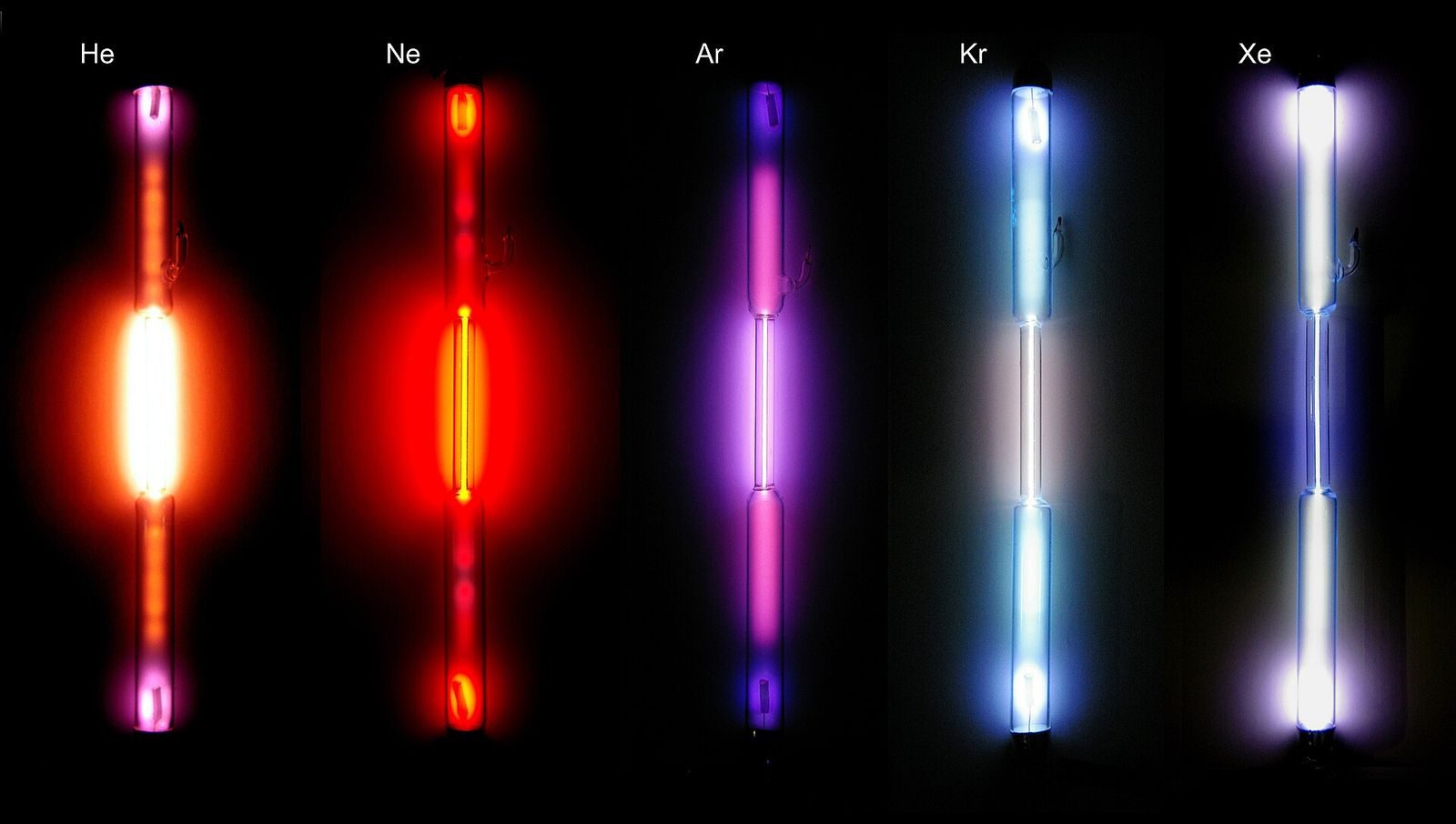 Z = 2Z = 10Z = 18Z = 36Z = 54
Try it: drag through all 118 elements and watch the table build itself, one subshell at a time.
Worked example: why does period 4 have 18 elements?
- Period 4 starts filling 4s. Before 4p comes 3d, because 3d is lower in energy than 4p.
- Orbitals available, in order of energy: 4s < 3d < 4p. That is 1 + 5 + 3 = 9 orbitals.
- Each orbital holds 2 electrons, so 9 × 2 = 18 electrons can be added.
- One electron per new element, so 18 elements, potassium to krypton.
Try it. Using the same reasoning, why does period 6 have 32 elements?
Answer
Down a group: the same outer pattern
Elements in the same group have the same number of electrons in their outer orbitals, arranged the same way, and so they behave alike. Take Group 1, the alkali metals: every one ends in ns1. A short way to write a configuration is to put the previous noble gas in square brackets.
| Z | Element | Configuration | Short form |
|---|---|---|---|
| 3 | Li | 1s22s1 | [He]2s1 |
| 11 | Na | 1s22s22p63s1 | [Ne]3s1 |
| 19 | K | 1s22s22p63s23p64s1 | [Ar]4s1 |
| 37 | Rb | … 4s24p65s1 | [Kr]5s1 |
| 55 | Cs | … 5s25p66s1 | [Xe]6s1 |
| 87 | Fr | … | [Rn]7s1 |
The atomic masses of these six vary a lot and not in a neat way, but the outer configuration is identical. That is the proof that properties depend on atomic number (through the electrons), not on atomic mass.
Remember
- Period number = outermost shell n.
- Elements in a period = 2 × orbitals being filled: 2, 8, 8, 18, 18, 32, 32.
- 3d series: Sc (21) to Zn (30). 4d series starts at Y (39). Lanthanoids: Ce (58) to Lu (71). Actinoids start after Ac (89).
- Same group = same outer configuration = similar properties.
Just remember
The lengths of the periods have a reason (the deep dive below rebuilds them). These bits do not: they are names and starting points. Use the hooks.
- Shell letters: K (n = 1), L (n = 2), M (n = 3), N (n = 4)
- Plain alphabet order from K. Why K and not A? In 1911 the X-ray scientist Charles Barkla started at K to leave room for letters before it, in case more shells turned up deeper inside. None ever did, so the alphabet of shells starts at K.
- Noble gases close the periods: Z = 2, 10, 18, 36, 54, 86, 118
- Running totals of the period lengths: 2, then +8, +8, +18, +18, +32, +32. They are the cores you write in brackets: [He], [Ne], [Ar], [Kr], [Xe], [Rn], [Og].
- Where the inner series start: 3d at Sc (21), 4d at Y (39), lanthanoids Ce (58) to Lu (71), actinoids after Ac (89)
- Each d series starts one step after the group 2 metal: Ca 20, then Sc 21; Sr 38, then Y 39. The two f series start one step after the elements they are named after, La (57) and Ac (89).
- The names lanthanoid and actinoid
- From lanthanum, Greek lanthanein, "to lie hidden" (it was found hiding in a cerium salt), and actinium, Greek aktis, "ray" (it is so radioactive that it glows pale blue in the dark). Hidden ones on the first f row, glowing ones on the second.
- Electronic configuration
- How an atom's electrons are shared out among its orbitals.
- Valence shell
- The outermost shell, holding the electrons used in bonding.
- Transition series
- A run of 10 elements in which d orbitals are being filled.
- Inner transition series
- A run of 14 elements in which f orbitals are being filled.
- Lanthanoids
- The 4f series, Ce to Lu, in period 6.
- Actinoids
- The 5f series after actinium, in period 7.
Words to know
Why does period 3 have only 8 elements, even though the third shell can hold 18 electrons?
- The third shell has no d orbitals
- The 3d orbitals fill only after 4s, in period 4
- Every period must have exactly 8 elements
An element has the outer configuration 5s1. Which period and group is it in?
- Period 5, group 1
- Period 1, group 5
- Period 5, group 15
Deep dive · optional
Why 2, 8, 8, 18, 18, 32, 32?
Where the row lengths really come from, why they come in pairs, and how an old engineer who studied hornets drew the rule before the physicists named it. Not needed for the exam; it lets you rebuild the table's shape from scratch.
The roots: the order of the seats, not the size of the shells
- Why does period 3 stop at argon, when shell 3 has room for 18?Because a period ends when the next electron's cheapest empty home is a new s subshell. After 3p is full, the cheapest empty orbital is 4s, not 3d. So element 19, potassium, opens shell 4 and starts a new row. The size of a shell never decides where a row ends; the order of the subshells does.
- Why is 4s cheaper than 3d?Not because a 4s electron is closer to the nucleus on average: it is farther. But a 4s electron spends a small part of its time very close to the nucleus, inside the inner electrons. There it feels almost the full nuclear charge, and that pulls its energy down. A 3d electron almost never gets inside, so the 18 inner electrons screen it well. This diving in is called penetration.
- Why does an s electron get in and a d electron not?Close to the nucleus an orbital with angular quantum number l grows like \( r^{l} \). For s (l = 0) that is not zero at all, so an s electron can sit right at the nucleus. For p it starts at zero, for d slower still, for f slowest. More l means less penetration, so higher energy.
- Then why does hydrogen not care?Hydrogen has one electron and no inner electrons to get past. Its energy depends on n alone, \( E_n = -13.6/n^2 \) eV, so 3s, 3p and 3d have exactly the same energy. Penetration matters only when there is a crowd of inner electrons to dive through. If every atom ranked its subshells like hydrogen, shells would fill one by one and the rows would be 2, 8, 18, 32: the widget below builds that world.
- Why do the real lengths come in pairs?Energy rises roughly with n + l (bigger n: farther out; bigger l: less penetration), ties going to the smaller n. In that order, period n holds ns, then (n − 2)f, then (n − 1)d, then np, whichever of them exist. A d set first fits in at period 4 and an f set at period 6, and each stays for every later period. So the lengths are 2, 2 + 6, 2 + 6, 2 + 10 + 6 twice, then 2 + 14 + 10 + 6 twice: 2 × 1², 2 × 2² twice, 2 × 3² twice, 2 × 4² twice.
- The bedrockTwo electrons per orbital (Pauli), 2l + 1 orbitals in a subshell, and Coulomb's pull of the nucleus, weakened by the electrons in between. Everything else in the shape of the table follows.
So the periodic table is a picture of penetration. Shell sizes, 2n², are set by counting orbitals; the rows are set by the energy order, and in a many-electron atom that order is scrambled just enough that each new d or f set arrives one or two periods late. The n + l rule that summarises this is a good approximation, not a law: about 20 known elements, such as chromium and copper, end up with a slightly different arrangement (see Electronic configuration). Taken at face value, the same rule says periods 8 and 9 would each hold 2 × 5² = 50 elements, with a new g-block. For atoms that heavy, though, the inner electrons move so fast that relativity shifts their energies, and the simple order is expected to break down.
The story
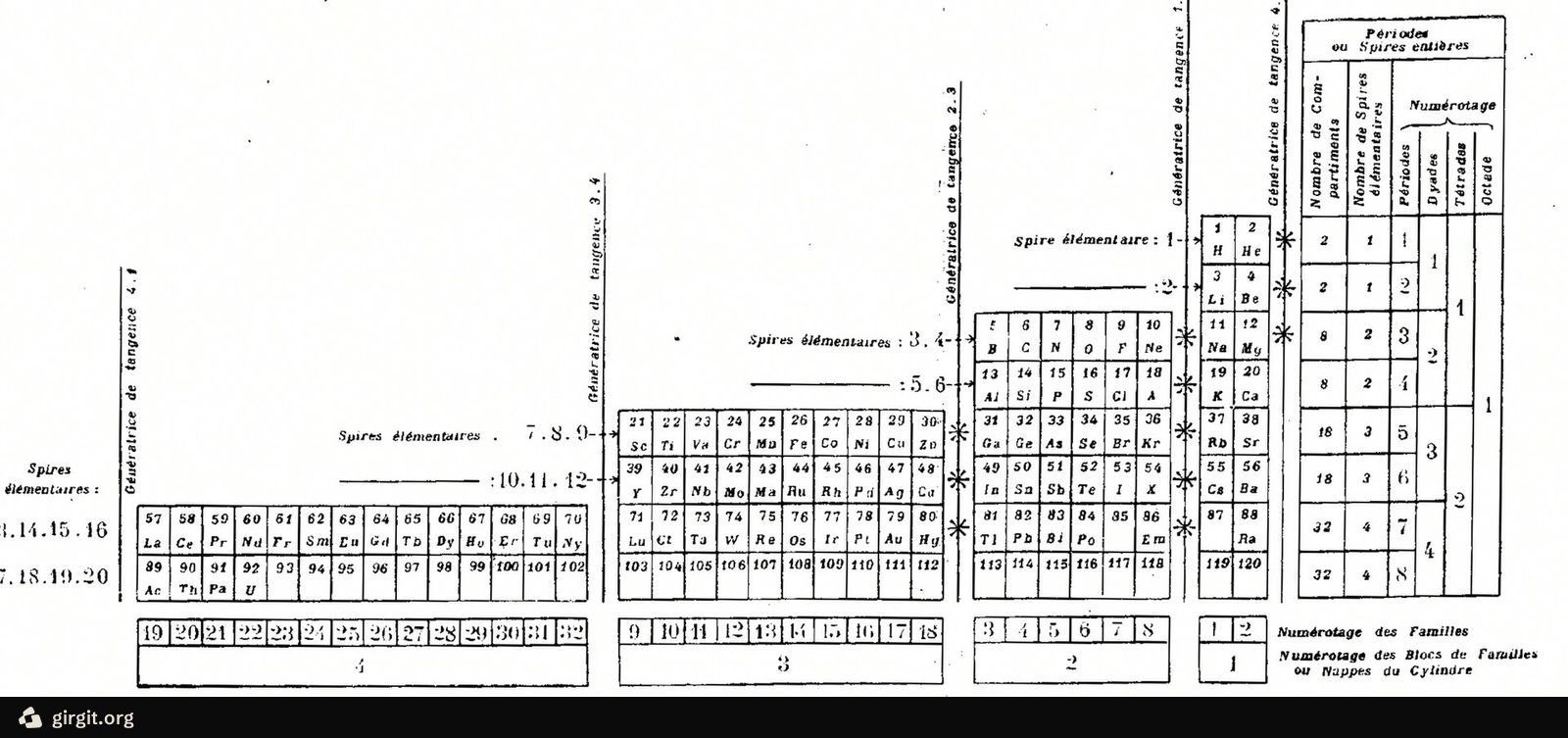 fdpsHe above Be
See it
Build the hydrogen world. Set the penetration number k to 0 and every atom ranks its subshells by n alone; set it to 1 and you get the real n + l order. Each strip is one row of the table. Drag the element number too: in the hydrogen world, where does potassium go? Then press Every k to see each row's length jump at the exact moments one subshell slips past another.
Solve it
Solve it
Use the n + l rule (smaller n first on a tie) to decide which fills first in each pair: (a) 5s or 4d, (b) 6s or 4f, (c) 4f or 5d, (d) 5f or 6d. Then name the period in which each of 4f and 5f fills.
Answer
Solve it: what would happen if…
In the hydrogen world, where energy depends on n only, what would element 19 look like, and would argon still be a noble gas?
Hint
Answer
Solve it: think harder
Predict the length of period 8 from the n + l rule. Which subshells would it fill, and how many elements is that?
Answer
Solve it: spot the error
A student writes: "Iron is [Ar]4s²3d⁶. 3d filled last, so Fe²⁺ loses two 3d electrons and is [Ar]4s²3d⁴." What is wrong?
Answer
Connect it
Connect it
- Penetration, Chapter 2. The 4s-versus-3d curves, and how much of each lies inside 100 pm, are on Shapes and energies of orbitals.
- Why 2l + 1 and 2n². The orbital counts behind every number on this page come from Quantum numbers.
- The exceptions, and element 72. Chromium, copper and the hafnium hunt that tested Bohr's table are on Electronic configuration.
- Hydrogen's levels depend on n alone. \( -13.6/n^2 \) eV is Bohr's result: Bohr's model.
- Next page. The order of filling names the four blocks: The s, p, d and f blocks. The closed shells at 2, 10, 18, 36 and 54 show up again as the tall peaks of ionization enthalpy.
- Class 12. Why 4s empties first in transition-metal ions, and what it does to their colours and magnetism: Position and configuration of the d-block.
Still confused?
Is 4s always lower in energy than 3d?
No. In potassium and calcium, where 3d is empty, 4s is lower, which is why they put their outer electrons there. From scandium on, once 3d holds electrons, 3d lies below 4s. The filling order is a rule for which arrangement the neutral atom ends up in, not a fixed ranking of orbitals in every atom.
Why does period 1 have only 2 elements?
Shell 1 allows only l = 0 (l can go from 0 to n − 1). One subshell, 1s, one orbital, two electrons. Then 2s is next, so lithium starts period 2.
Is the n + l rule a law of nature?
No, it is a good summary of how penetration and orbital size trade off. It fails for about 20 known elements by one or two electrons (Cr, Cu, Nb, Mo, Pd, Ag, Au, La, Ce, Gd, Th, U and others), and is expected to fail more often in elements heavier than 120.
Sources
- Aufbau principle (Wikipedia): Bohr in the early 1920s; Janet 1928 and 1930; Karapetoff 1930; Madelung 1936; Klechkowski 1961; Demkov and Ostrovsky 1971; about 20 exceptions; element 121 expected exception
- Charles Janet (Wikipedia): engineer and naturalist, the 1894 hornets' nest, atoms at 78, the left-step table, nothing beyond 120
- Niels Bohr (Wikipedia): the Bohr Festival, Göttingen, 12 to 22 June 1922; the 1922 Nobel Prize
- Periodic table, history (Wikipedia): Thomsen's 1895 long form used in Bohr's Nobel lecture; Pauli and the period lengths
- Eric Scerri, "The trouble with the aufbau principle", Education in Chemistry (RSC), 2013: 3d below 4s from scandium
- Electron shell (Wikipedia): Barkla's letters, starting at K in 1911
- Lanthanum and Actinium (Wikipedia): the names, Mosander 1839, actinium's blue glow
- Janet's left-step table (Wikimedia Commons, public domain)

Picture and video credits
Show 1 picture and video credits
- noble-gas-discharge-tubes.jpg: Alchemist-hp www.pse-mendelejew.de, CC BY-SA 2.0 de
